
Leber Congenital Amaurosis Market
Key Highlights
- The total Leber Congenital Amaurosis treatment market size is expected to grow positively by 2036 in the leading markets.
- The United States accounted for the largest Leber Congenital Amaurosis treatment market size in 2025, compared to other major markets, including the EU4 countries (Germany, France, Italy, and Spain), the United Kingdom, and Japan.
- Key Leber Congenital Amaurosis companies, including Atsena Therapeutics, Opus Genetics, MeiraGTx, Odylia Therapeutics, and others, are actively working on innovative Leber Congenital Amaurosis drugs.
- Some of the key Leber Congenital Amaurosis therapies in clinical trials include ATSN-101, OPGx-LCA5, AAV-AIPL1, RPGRIP1 Gene Therapy (OT-004), and others. These novel Leber Congenital Amaurosis therapies are anticipated to enter the Leber Congenital Amaurosis market in the forecast period and are expected to change the market.
DelveInsight's "Leber Congenital Amaurosis Market Insights, Epidemiology, and Market Forecast-2036" report delivers an in-depth understanding of the Leber Congenital Amaurosis, historical and forecasted epidemiology as well as the Leber Congenital Amaurosis market trends in the United States, EU5 (Germany, Spain, Italy, France, and United Kingdom) and Japan.
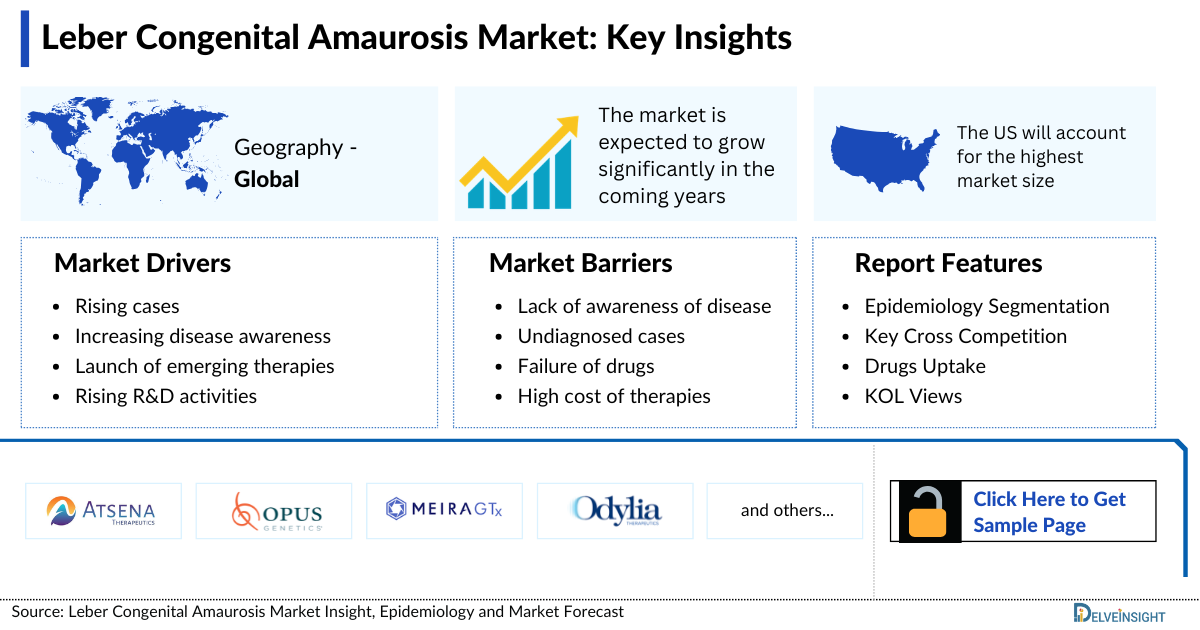
The Leber Congenital Amaurosis market report provides current treatment practices, emerging drugs, Leber Congenital Amaurosis market share of the individual therapies, current and forecasted Leber Congenital Amaurosis market Size from 2022 to 2036 segmented by seven major markets. The Report also covers current Leber Congenital Amaurosis treatment practice/algorithm, market drivers, market barriers and unmet medical needs to curate the best of the opportunities and assesses the underlying potential of the Leber Congenital Amaurosis market.
Geography Covered
- The United States
- EU4 (Germany, France, Italy, and Spain), and the United Kingdom
- Japan
Study Period: 2022-2036
Key Factors Driving the Leber Congenital Amaurosis Market
- Rising Awareness of Rare Inherited Retinal Diseases: Increased awareness among healthcare professionals, patient advocacy groups, and caregivers has led to improved diagnosis and greater demand for specialized treatment. Educational initiatives also encourage participation in clinical research.
- Advancements in Gene Therapy: The development of gene replacement and gene-editing therapies has significantly transformed the LCA treatment landscape. The success of approved gene therapies has encouraged continued investment in next-generation treatments targeting additional genetic mutations.
- Increasing Genetic Diagnosis and Early Screening: Wider adoption of genetic testing and next-generation sequencing (NGS) enables earlier and more accurate diagnosis of LCA. Early identification of disease-causing mutations improves patient selection for targeted therapies and clinical trials.
- Expansion of Clinical Trial Pipeline: Multiple investigational therapies targeting different LCA-associated genes are progressing through clinical development. Positive trial outcomes may broaden the treatment landscape beyond currently approved therapies, supporting long-term market expansion.
Leber Congenital Amaurosis Disease Understanding and Treatment Algorithm
Leber Congenital Amaurosis Overview
Leber Congenital Amaurosis (LCA) is a rare, inherited retinal disorder that causes severe vision loss or blindness from birth or within the first few months of life. It results from mutations in genes that are essential for the normal development and function of the retina, particularly the photoreceptor cells responsible for detecting light. Children with LCA typically present with profound visual impairment, poor pupillary responses, involuntary eye movements (nystagmus), and behaviors such as eye rubbing, known as the oculodigital sign. More than 25 genes, including RPE65, CEP290, GUCY2D, and CRB1, have been linked to the disease, highlighting its genetic heterogeneity. Advances in genetic testing have significantly improved the diagnosis of LCA, while the emergence of gene therapies has transformed the treatment landscape for certain genetic subtypes, offering the potential to preserve or improve vision in eligible patients. Ongoing research is focused on expanding gene-specific therapies and developing novel approaches, such as gene editing and optogenetics, to address the broader spectrum of LCA-causing mutations.
Leber Congenital Amaurosis Diagnosis
Early diagnosis of Leber Congenital Amaurosis (LCA) is essential for timely intervention, genetic counseling, and identification of patients who may benefit from emerging gene-specific therapies. The diagnostic process begins with a detailed clinical evaluation, including assessment of visual behavior, nystagmus, poor pupillary light responses, and severely impaired vision presenting within the first year of life. Comprehensive ophthalmic examinations, such as fundus evaluation, optical coherence tomography (OCT), and fundus autofluorescence, help identify characteristic retinal abnormalities, although findings may vary depending on the underlying genetic mutation. Electroretinography (ERG) is considered a key diagnostic tool, typically demonstrating markedly reduced or absent retinal responses, reflecting severe retinal dysfunction. Advances in molecular diagnostics have made genetic testing a cornerstone of LCA diagnosis, enabling confirmation of disease-causing mutations in genes such as RPE65, CEP290, GUCY2D, and CRB1. Genetic confirmation not only establishes the diagnosis but also guides prognosis, facilitates family counseling, and determines eligibility for approved and investigational gene therapies, supporting the growing trend toward precision medicine in inherited retinal diseases.
Leber Congenital Amaurosis Treatment
Treatment strategies have evolved significantly with advances in genetic medicine, shifting from supportive care to targeted therapies aimed at addressing the underlying genetic defects. While conventional management, including visual aids, orientation and mobility training, and low-vision rehabilitation, remains essential for preserving quality of life, gene therapy has transformed the treatment landscape for eligible patients. The approval of gene replacement therapy for individuals with biallelic RPE65 mutations marked a major milestone, demonstrating that restoring functional gene expression can improve visual function. Beyond RPE65, numerous investigational approaches, including gene editing, RNA-based therapies, optogenetics, stem cell therapies, and mutation-specific gene replacement strategies, are progressing through preclinical and clinical development. These advances are expected to expand treatment options and further improve outcomes for patients with Leber congenital amaurosis in the coming years.
Leber Congenital Amaurosis Epidemiology
The Leber Congenital Amaurosis epidemiology section provides insights about the historical and current Leber Congenital Amaurosis patient pool and forecasted trends for individual seven major countries. It helps to recognize the causes of current and forecasted trends by exploring numerous studies and views of key opinion leaders. This part of the Leber Congenital Amaurosis market report also provides the diagnosed patient pool and their trends along with assumptions undertaken.
Key Findings
The disease epidemiology covered in the report provides historical as well as forecasted Leber Congenital Amaurosis epidemiology scenario in the 7MM covering the United States, EU5 countries (Germany, Spain, Italy, France, and the United Kingdom), and Japan from 2022 to 2036.
- LCA is estimated to occur in 2–3 per 100,000 live births, corresponding to an overall prevalence of approximately 1.2–2.4 cases per 100,000 population (roughly 1 in 30,000–80,000 individuals).
- Although considered an ultra-rare disease, LCA accounts for approximately 5% of all inherited retinal dystrophies and is responsible for up to 20% of childhood blindness in specialized schools for visually impaired children.
- More than 25 genes have been implicated in LCA, with pathogenic variants in genes such as CEP290, GUCY2D, CRB1, RPE65, AIPL1, RDH12, and RPGRIP1 accounting for a substantial proportion of cases.
Leber Congenital Amaurosis Drug Chapters
The drug chapter segment of the Leber Congenital Amaurosis report encloses the detailed analysis of Leber Congenital Amaurosis marketed drugs and late-stage (Phase-III and Phase-II) Leber Congenital Amaurosis pipeline drugs. It also helps to understand the Leber Congenital Amaurosis clinical trial details, expressive pharmacological action, agreements and collaborations, approval and patent details, advantages and disadvantages of each included drug and the latest news and press releases.
Leber Congenital Amaurosis Marketed Drugs
Luxturna (voretigene neparvovec): Novartis
Luxturna (voretigene neparvovec) is the first and only approved gene therapy for patients with RPE65 mutation-associated Leber Congenital Amaurosis (LCA) and inherited retinal dystrophy. The therapy delivers a functional copy of the RPE65 gene directly into retinal cells using an adeno-associated viral (AAV2) vector, restoring the visual cycle and improving functional vision in eligible patients. Unlike conventional supportive care, Luxturna addresses the underlying genetic cause of the disease through a one-time subretinal administration.
The therapy first received approval from the US FDA in December 2017, followed by European Commission approval in November 2018, making it available across all EU member states, including France, Germany, Italy, and Spain. Following Brexit, it has also been authorized in the United Kingdom, while Japan approved Luxturna in 2023 for inherited retinal dystrophy associated with biallelic RPE65 mutations.
Leber Congenital Amaurosis Emerging Drugs
ATSN-101: Atsena Therapeutics
ATSENA is developing ATSN-101, an investigational gene therapy for Leber congenital amaurosis type 1 (LCA1), in partnership with Nippon Shinyaku Co., Ltd., which holds commercialization rights to the therapy in the United States and Japan. ATSN-101 has completed a Phase 1/2 clinical trial (NCT03920007), demonstrating positive outcomes, and the company is now preparing to initiate a global pivotal trial later this year. The program is built on more than two decades of research and preclinical work conducted in the founders' laboratory at the University of Florida.
Key Leber Congenital Amaurosis Companies
- Atsena Therapeutics
- Opus Genetics
- MeiraGTx
- Odylia Therapeutics
Recent Developments in the Leber Congenital Amaurosis Market
- In July 2026, Atsena Therapeutics announced that the European Medicines Agency (EMA) has awarded orphan designation to its two clinical-stage gene therapy candidates targeting inherited retinal diseases: ATSN-101, being developed for Leber congenital amaurosis type 1 (LCA1), and ATSN-201, intended to treat X-linked retinoschisis (XLRS).
- In May 2026, Atsena Therapeutics showcased data from three studies at the Association for Research in Vision and Ophthalmology (ARVO) Annual Meeting in Denver, Colorado. The presentations featured 12-month results for ATSN-201 in patients with X-linked retinoschisis (XLRS), three-year data for ATSN-101 in Leber congenital amaurosis type 1 (LCA1), and a novel methodology for assessing functional vision in patients with inherited retinal diseases.
Leber Congenital Amaurosis Market Outlook
The Leber Congenital Amaurosis market outlook of the report helps to build a detailed comprehension of the historic, current, and forecasted Leber Congenital Amaurosis market trends by analyzing the impact of current Leber Congenital Amaurosis therapies on the market, unmet needs, drivers and barriers, and demand for better technology.
This segment gives a thorough detail of Leber Congenital Amaurosis market trend of each marketed drug and late-stage pipeline therapy by evaluating their impact based on the annual cost of therapy, inclusion and exclusion criteria's, mechanism of action, compliance rate, growing need of the market, increasing patient pool, covered patient segment, expected launch year, competition with other therapies, brand value, their impact on the market and view of the key opinion leaders. The calculated Leber Congenital Amaurosis market data are presented with relevant tables and graphs to give a clear view of the market at first sight.
According to DelveInsight, the Leber Congenital Amaurosis market in 7MM is expected to witness a major change in the study period 2022-2036.
Key Findings
This section includes a glimpse of the Leber Congenital Amaurosis market in 7MM.
The United States Market Outlook
This section provides the total Leber Congenital Amaurosis market size and market size by therapies in the United States.
EU-5 Countries: Market Outlook
The total Leber Congenital Amaurosis market size and market size by therapies in Germany, France, Italy, Spain, and the United Kingdom is provided in this section.
Japan Market Outlook
The total Leber Congenital Amaurosis market size and market size by therapies in Japan is also mentioned.
Leber Congenital Amaurosis Drugs Uptake
This section focuses on the rate of uptake of the potential Leber Congenital Amaurosis drugs recently launched in the Leber Congenital Amaurosis market or expected to get launched in the market during the study period 2022-2036. The analysis covers Leber Congenital Amaurosis market uptake by drugs; patient uptake by therapies; and sales of each drug.
Leber Congenital Amaurosis Drugs Uptake helps in understanding the drugs with the most rapid uptake, reasons behind the maximal use of new drugs, and allow the comparison of the drugs on the basis of Leber Congenital Amaurosis market share and size which again will be useful in investigating factors important in market uptake and in making financial and regulatory decisions.
Leber Congenital Amaurosis Pipeline Development Activities
The Leber Congenital Amaurosis report provides insights into different therapeutic candidates in Phase II, and Phase III stage. It also analyses Leber Congenital Amaurosis key players involved in developing targeted therapeutics.
Pipeline Development Activities
The Leber Congenital Amaurosis report covers the detailed information of collaborations, acquisition, and merger, licensing, patent details, and other information for Leber Congenital Amaurosis emerging therapies.
Reimbursement Scenario in Leber Congenital Amaurosis
Approaching reimbursement proactively can have a positive impact both during the late stages of product development and well after product launch. In a report, we take reimbursement into consideration to identify economically attractive indications and market opportunities. When working with finite resources, the ability to select the markets with the fewest reimbursement barriers can be a critical business and price strategy.
KOL- Views
To keep up with current Leber Congenital Amaurosis market trends, we take KOLs and SMEs ' opinion working in the Leber Congenital Amaurosis domain through primary research to fill the data gaps and validate our secondary research. Their opinion helps to understand and validate current and emerging therapies treatment patterns or Leber Congenital Amaurosis market trends. This will support the clients in potential upcoming novel treatment by identifying the overall scenario of the market and the unmet needs.
Competitive Intelligence Analysis
We perform Competitive and Market Intelligence analysis of the Leber Congenital Amaurosis Market by using various Competitive Intelligence tools that include - SWOT analysis, PESTLE analysis, Porter's five forces, BCG Matrix, Market entry strategies etc. The inclusion of the analysis entirely depends upon the data availability.
Scope of the Report
- The report covers the descriptive overview of Leber Congenital Amaurosis, explaining its causes, signs and symptoms, pathophysiology, diagnosis and currently available therapies
- Comprehensive insight has been provided into the Leber Congenital Amaurosis epidemiology and treatment in the 7MM
- Additionally, an all-inclusive account of both the current and emerging therapies for Leber Congenital Amaurosis is provided, along with the assessment of new therapies, which will have an impact on the current treatment landscape
- A detailed review of the Leber Congenital Amaurosis market; historical and forecasted is included in the report, covering drug outreach in the 7MM
- The report provides an edge while developing business strategies, by understanding trends shaping and driving the global Leber Congenital Amaurosis market
Report Highlights
- In the coming years, the Leber Congenital Amaurosis market is set to change due to the rising awareness of the disease, and incremental healthcare spending across the world; which would expand the size of the market to enable the drug manufacturers to penetrate more into the market
- The companies and academics are working to assess challenges and seek opportunities that could influence Leber Congenital Amaurosis R&D. The therapies under development are focused on novel approaches to treat/improve the disease condition
- Major players are involved in developing therapies for Leber Congenital Amaurosis. The launch of emerging therapies will significantly impact the Leber Congenital Amaurosis market
- A better understanding of disease pathogenesis will also contribute to the development of novel therapeutics for Leber Congenital Amaurosis
- Our in-depth analysis of the pipeline assets across different stages of development (Phase III and Phase II), different emerging trends and comparative analysis of pipeline products with detailed clinical profiles, key cross-competition, launch date along with product development activities will support the clients in the decision-making process regarding their therapeutic portfolio by identifying the overall scenario of the research and development activities
Leber Congenital Amaurosis Report Insights
- Leber Congenital Amaurosis Patient Population
- Therapeutic Approaches
- Leber Congenital Amaurosis Pipeline Analysis
- Leber Congenital Amaurosis Market Size and Trends
- Leber Congenital Amaurosis Market Opportunities
- Impact of upcoming Leber Congenital Amaurosis Therapies
Leber Congenital Amaurosis Report Key Strengths
- 11 Years Forecast
- 7MM Coverage
- Leber Congenital Amaurosis Epidemiology Segmentation
- Key Cross Competition
- Highly Analyzed Market
- Drugs Uptake
Leber Congenital Amaurosis Report Assessment
- Current Treatment Practices
- Unmet Needs
- Leber Congenital Amaurosis Pipeline Product Profiles
- Leber Congenital Amaurosis Market Attractiveness
- Market Drivers and Barriers
Key Questions
Market Insights:
- What was the Leber Congenital Amaurosis drug class share (%) distribution in 2022 and how it would look like in 2036?
- What would be the Leber Congenital Amaurosis total market size as well as market size by therapies across the 7MM during the forecast period (2022-2036)?
- What are the key findings pertaining to the market across 7MM and which country will have the largest Leber Congenital Amaurosis market size during the forecast period (2026-2036)?
- At what CAGR, the Leber Congenital Amaurosis market is expected to grow by 7MM during the forecast period (2026-2036)?
- What would be the Leber Congenital Amaurosis market outlook across the 7MM during the forecast period (2026-2036)?
- What would be the Leber Congenital Amaurosis market growth till 2036, and what will be the resultant market Size in the year 2036?
- How would the unmet needs affect the market dynamics and subsequent analysis of the associated trends?
Epidemiology Insights:
- What are the disease risk, burden, and regional/ethnic differences of the Leber Congenital Amaurosis?
- What are the key factors driving the epidemiology trend for seven major markets covering the United States, EU5 (Germany, Spain, France, Italy, UK), and Japan?
- What is the historical Leber Congenital Amaurosis patient pool in seven major markets covering the United States, EU5 (Germany, Spain, France, Italy, UK), and Japan?
- What would be the forecasted patient pool of Leber Congenital Amaurosis in seven major markets covering the United States, EU5 (Germany, Spain, France, Italy, UK), and Japan?
- Where will be the growth opportunities in the 7MM with respect to the patient population pertaining to Leber Congenital Amaurosis?
- Out of all 7MM countries, which country would have the highest prevalent population of Leber Congenital Amaurosis during the forecast period (2026-2036)?
- At what CAGR the patient population is expected to grow in 7MM during the forecast period (2026-2036)?
Current Treatment Scenario, Marketed Drugs and Emerging Therapies:
- What are the current options for the Leber Congenital Amaurosis treatment in addition to the approved therapies?
- What are the current treatment guidelines for the treatment of Leber Congenital Amaurosis in the USA, Europe, and Japan?
- What are the Leber Congenital Amaurosis marketed drugs and their respective MOA, regulatory milestones, product development activities, advantages, disadvantages, safety and efficacy, etc.?
- How many companies are developing therapies for the treatment of Leber Congenital Amaurosis?
- How many therapies are in-development by each company for Leber Congenital Amaurosis treatment?
- How many are emerging therapies in mid-stage, and late stage of development for Leber Congenital Amaurosis treatment?
- What are the key collaborations (Industry - Industry, Industry - Academia), Mergers and acquisitions, licensing activities related to the Leber Congenital Amaurosis therapies?
- What are the recent novel therapies, targets, mechanisms of action and technologies being developed to overcome the limitation of existing therapies?
- What are the clinical studies going on for Leber Congenital Amaurosis and their status?
- What are the current challenges faced in drug development?
- What are the key designations that have been granted for the emerging therapies for Leber Congenital Amaurosis?
- What are the global historical and forecasted market of Leber Congenital Amaurosis?
Reasons to buy
- The report will help in developing business strategies by understanding trends shaping and driving the Leber Congenital Amaurosis market
- To understand the future market competition in the Leber Congenital Amaurosis market and Insightful review of the key market drivers and barriers
- Organize sales and marketing efforts by identifying the best opportunities for Leber Congenital Amaurosis in the US, Europe (Germany, Spain, Italy, France, and the United Kingdom) and Japan
- Identification of strong upcoming players in the market will help in devising strategies that will help in getting ahead of competitors
- Organize sales and marketing efforts by identifying the best opportunities for Leber Congenital Amaurosis market
- To understand the future market competition in the Leber Congenital Amaurosis market