leishmaniasis pipeline insight
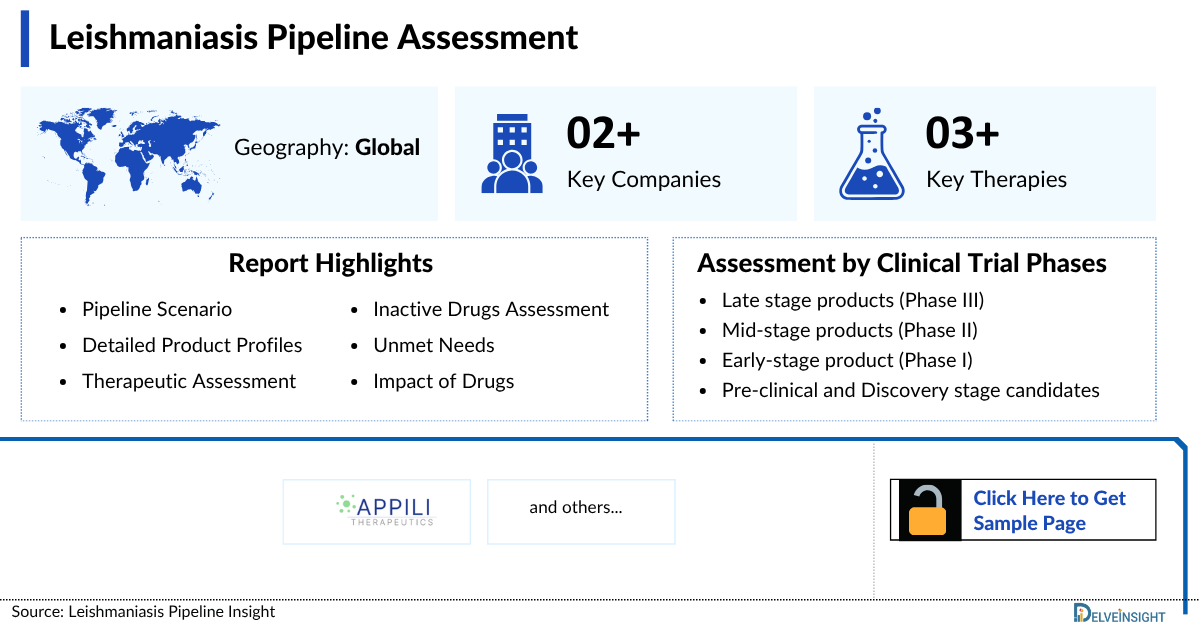
DelveInsight’s, “Leishmaniasis Pipeline Insight, 2026,” report provides comprehensive insights about 2+ companies and 3+ pipeline drugs in Leishmaniasis pipeline landscape. It covers the pipeline drug profiles, including clinical and nonclinical stage products. It also covers the therapeutics assessment by product type, stage, route of administration, and molecule type. It further highlights the inactive pipeline products in this space.
Geography Covered
- Global coverage
Leishmaniasis Understanding
Leishmaniasis: Overview
Leishmaniasis is a neglected tropical disease caused by protozoan parasites of the genus *Leishmania*, which are transmitted to humans through the bite of infected female sandflies. It presents in various clinical forms, most notably cutaneous and visceral leishmaniasis, depending on the species and host response. Historically widespread across tropical and subtropical regions of Europe, Africa, Asia, and the Americas, leishmaniasis has been recognized for thousands of years, with evidence found in Egyptian mummies and ancient medical texts such as the Ebers Papyrus. Early accounts described characteristic skin lesions, while visceral forms were only recognized much later. The identification of the causative protozoa in the late 19th and early 20th centuries marked a significant advancement in understanding the disease, leading to its classification into Old World and New World types based on geographic and species differences.
Leishmaniasis presents in two main clinical forms, each with distinct signs and symptoms. Visceral leishmaniasis (VL), the more severe form, is characterized by prolonged fever, significant weight loss, and marked enlargement of the spleen and liver. Patients often develop anemia, low white blood cell and platelet counts, along with general weakness, swollen lymph nodes, and elevated immunoglobulin levels. If left untreated, VL is typically fatal. Cutaneous leishmaniasis (CL), the most common form, manifests as ulcerative skin lesions on exposed body parts. These lesions can lead to permanent scarring, disfigurement, or disability, and may be accompanied by systemic symptoms such as fatigue, appetite loss, and abdominal discomfort.
Leishmaniasis is transmitted through the bite of infected female sandflies, primarily of the *Phlebotomus* genus in the Old World and *Lutzomyia* in the New World. During blood meals, sandflies ingest *Leishmania* parasites from infected hosts and later transmit the infectious promastigote form to new hosts, including humans, canines, rodents, and other mammals. Once inside the human body, the promastigotes are taken up by phagocytic cells and transform into amastigotes within phagolysosomes. In cutaneous leishmaniasis (CL), the parasites primarily infect skin macrophages, leading to localized lesions. In contrast, visceral leishmaniasis (VL) involves hematogenous spread of the amastigotes to deeper organs, including the liver, spleen, bone marrow, and intestinal lymph nodes, resulting in more systemic and life-threatening disease.
Prevention of leishmaniasis focuses on minimizing exposure to infected sandflies, particularly in endemic regions. Protective strategies include awareness of nocturnal sandfly activity, use of fine-mesh bed nets treated with permethrin, and controlling reservoir hosts such as dogs with vaccines or insecticidal collars. Treatment depends on the clinical form and geographic location. Limited cutaneous leishmaniasis (CL) may resolve spontaneously but often requires intralesional antimonial therapy or systemic agents like miltefosine or amphotericin B in more severe cases. Mucocutaneous leishmaniasis typically necessitates systemic treatment, with pentavalent antimonials, amphotericin B, and pentamidine showing the highest cure rates, while azoles have limited use. Visceral leishmaniasis (VL) is potentially fatal and always requires treatment, with therapy choices—such as sodium stibogluconate, liposomal amphotericin B, paromomycin, or miltefosine—based on regional resistance patterns and drug availability.
"Leishmaniasis- Pipeline Insight, 2026" report by DelveInsight outlays comprehensive insights of present scenario and growth prospects across the indication. A detailed picture of the Leishmaniasis pipeline landscape is provided which includes the disease overview and Leishmaniasis treatment guidelines. The assessment part of the report embraces, in depth Leishmaniasis commercial assessment and clinical assessment of the pipeline products under development. In the report, detailed description of the drug is given which includes mechanism of action of the drug, clinical studies, NDA approvals (if any), and product development activities comprising the technology, Leishmaniasis collaborations, licensing, mergers and acquisition, funding, designations and other product related details.
Report Highlights
The companies and academics are working to assess challenges and seek opportunities that could influence Leishmaniasis R&D. The therapies under development are focused on novel approaches to treat/improve Leishmaniasis.
Leishmaniasis Emerging Drugs Chapters
This segment of the Leishmaniasis report encloses its detailed analysis of various drugs in different stages of clinical development, including phase III, II, I, preclinical and Discovery. It also helps to understand clinical trial details, expressive pharmacological action, agreements and collaborations, and the latest news and press releases.
Leishmaniasis Emerging Drugs
- ATI-1801: Appili Therapeutics
LXE408 is a first-in-class parasite-selective inhibitor of the kinetoplastid proteasome with potent and uniform anti-parasitic activity against all kinetoplastid parasites, including Leishmania species causing visceral leishmaniasis (L. donovani and L. infantum), as well as parasites causing Chagas disease (T. cruzi) and human African trypanosomiasis (T. brucei). Safety data in healthy volunteers suggest that LXE408 is safe and tolerated at all doses tested (up to 600 mg single dose and 600 mg multiple dose). Currently, the drug is in the Phase II stage of development to treat Visceral Leishmaniasis.
Further product details are provided in the report……..
Leishmaniasis: Therapeutic Assessment
This segment of the report provides insights about the different Leishmaniasis drugs segregated based on following parameters that define the scope of the report, such as:
- Major Players in Leishmaniasis
There are approx. 2+ key companies which are developing the therapies for Leishmaniasis. The companies which have their Leishmaniasis drug candidates in the most advanced stage, i.e. phase II include, Novartis.
Phases
DelveInsight’s report covers around 3+ products under different phases of clinical development like
- Late stage products (Phase III)
- Mid-stage products (Phase II)
- Early-stage product (Phase I) along with the details of
- Pre-clinical and Discovery stage candidates
- Discontinued & Inactive candidates
Route of Administration
Leishmaniasis pipeline report provides the therapeutic assessment of the pipeline drugs by the Route of Administration. Products have been categorized under various ROAs such as
- Oral
- Intravenous
- Subcutaneous
- Parenteral
- Topical
Molecule Type
Products have been categorized under various Molecule types such as
- Monoclonal Antibody
- Peptides
- Polymer
- Small molecule
- Gene therapy
Product Type
Drugs have been categorized under various product types like Mono, Combination and Mono/Combination.
Leishmaniasis: Pipeline Development Activities
The report provides insights into different therapeutic candidates in phase II, I, preclinical and discovery stage. It also analyses Leishmaniasis therapeutic drugs key players involved in developing key drugs.
Pipeline Development Activities
The report covers the detailed information of collaborations, acquisition and merger, licensing along with a thorough therapeutic assessment of emerging Leishmaniasis drugs.
Leishmaniasis Report Insights
- Leishmaniasis Pipeline Analysis
- Therapeutic Assessment
- Unmet Needs
- Impact of Drugs
Leishmaniasis Report Assessment
- Pipeline Product Profiles
- Therapeutic Assessment
- Pipeline Assessment
- Inactive drugs assessment
- Unmet Needs
Key Questions
Current Treatment Scenario and Emerging Therapies:
- How many companies are developing Leishmaniasis drugs?
- How many Leishmaniasis drugs are developed by each company?
- How many emerging drugs are in mid-stage, and late-stage of development for the treatment of Leishmaniasis?
- What are the key collaborations (Industry–Industry, Industry–Academia), Mergers and acquisitions, licensing activities related to the Leishmaniasis therapeutics?
- What are the recent trends, drug types and novel technologies developed to overcome the limitation of existing therapies?
- What are the clinical studies going on for Leishmaniasis and their status?
- What are the key designations that have been granted to the emerging drugs?