
Libmeldy Sales Market Forecast
Key Factors Driving Libmeldy Growth
Market Share Gains and New Patient Starts
- Libmeldy is establishing a foothold as the first gene therapy for early-onset metachromatic leukodystrophy (MLD) in major markets, including the European Union and the US (as Lenmeldy) — marking a paradigm shift from only palliative care to a potential disease-modifying treatment.
- Commercial uptake is still emerging given the ultra-rare nature of MLD, with initial sales reflecting treatment of a very limited number of eligible patients globally.
- Adoption is driven by early newborn screening efforts and specialist referral pathways that identify eligible pre-symptomatic patients who may benefit most.
Expansion Across Key Indications
- Metachromatic Leukodystrophy (MLD): Libmeldy’s sole approved indication is for early-onset MLD (late-infantile and early-juvenile forms) — a rare, fatal lysosomal storage disorder with no prior curative option.
- The therapy is positioned as a one-time, disease-modifying treatment that restores functional ARSA enzyme activity, which can preserve motor and cognitive functions when administered early.
- Pipeline expansion beyond MLD is limited but gene-therapy platform learnings may inform future orphan disease programs in related neurogenetic conditions (ongoing research landscape).
Geographic Expansion
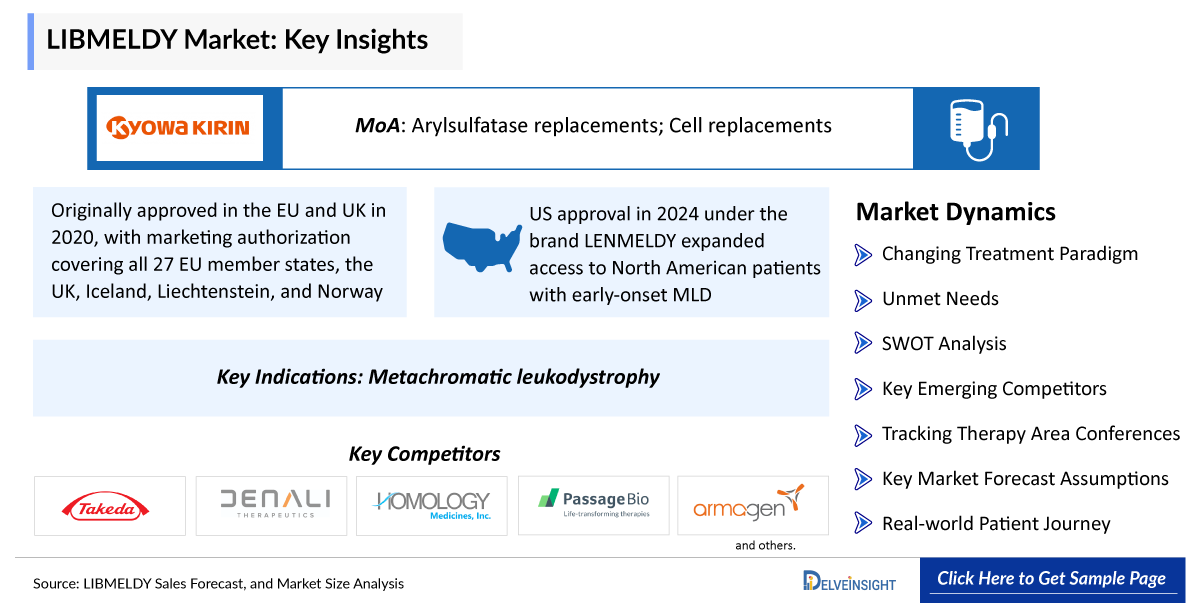
- Originally approved in the European Union (Libmeldy) and UK in 2020, with marketing authorization covering all 27 EU member states, the UK, Iceland, Liechtenstein, and Norway.
- US approval in 2024 under the brand Lenmeldy expanded access to North American patients with early-onset MLD.
- Additional regulatory approvals in countries such as Switzerland broaden geographic reach, while emerging Asia-Pacific markets are anticipated to follow as screening and healthcare infrastructure improve.
New Indication Approvals
- To date, approvals focus solely on early-onset MLD, where treatment is most effective before significant neurological decline.
- Regulatory agencies have not yet expanded Libmeldy to other lysosomal storage disorders, but ongoing research and gene-therapy innovation could form the basis for future indications.
Strong Volume Momentum
- Volume is inherently limited by disease rarity and strict eligibility criteria, but newborn screening expansion initiatives are increasing early diagnosis rates, which is expected to raise patient identification and treatment initiation.
- Real-world evidence from clinical follow-up (median over 6–12 years for early treated patients) supports durability of therapeutic effect and long-term benefit, reinforcing clinician confidence in early use.
Competitive Differentiation and Market Trends
- As a one-time autologous HSC gene therapy, Libmeldy differentiates from traditional supportive care or symptomatic management options by addressing the root genetic cause of MLD.
- The gene therapy profile — durable enzyme expression after a single administration — offers potential long-term clinical benefit rather than ongoing chronic therapy.
- High cost (e.g., >$4M list price in the US) reflects the value of its transformative potential but also creates payer challenges and necessitates value-based reimbursement discussions.
- Broader trends such as expanded newborn screening mandates and precision medicine adoption support earlier treatment initiation and payer engagement.
Libmeldy Recent Developments
- FDA Approval in the US (2024): The US Food and Drug Administration approved Lenmeldy (atidarsagene autotemcel) — the same gene therapy marketed as Libmeldy in Europe — for children with pre-symptomatic late-infantile and early-juvenile MLD, making it the first and only approved treatment of its kind in the US.
- Swissmedic Approval (Dec 2023): The Swiss Agency for Therapeutic Products authorized Libmeldy for early-onset MLD, expanding access beyond EU member states.
- Newborn Screening Impact: Analysts highlight potential growth opportunities as expanded newborn screening recommendations (e.g., additions to screening panels) are expected to increase identification of MLD patients and demand for Libmeldy.
- Commercial and Access Progress: Orchard Therapeutics, now part of Kyowa Kirin, has secured reimbursement agreements in key European markets and initiated newborn screening studies across multiple regions to drive future patient starts.
- Market Performance Context: Early commercial sales have been modest relative to pricing and targets, leading to strategic leadership adjustments in commercial operations to accelerate uptake.
“Libmeldy Sales Forecast, and Market Size Analysis – 2034” report provides comprehensive insights of Libmeldy for approved indication like Metachromatic leukodystrophy in the 7MM. A detailed picture of Libmeldy’s existing usage in anticipated entry and performance in approved indications in the 7MM, i.e., the United States, EU4 (Germany, France, Italy, and Spain) and the United Kingdom, and Japan for the study period 2020 –2034 is provided in this report along with a detailed description of the Libmeldy for approved indications. The Libmeldy market report provides insights about Libmeldy’s sales forecast, mechanism of action (MoA), dosage and administration, as well as research and development including regulatory milestones, along with other developmental activities. Further, it also consists of historical and current Libmeldy performance, future market assessments inclusive of the Libmeldy market forecast analysis for approved indications in the 7MM, SWOT, analysts’ views, comprehensive overview of market competitors, and brief about other emerging therapies in respective indications. It also provides analysis of Libmeldy sales forecasts, along with factors driving its market.
Libmeldy Drug Summary
Libmeldy (atidarsagene autotemcel) is an autologous gene therapy product designed for the treatment of metachromatic leukodystrophy (MLD), a rare genetic disorder caused by biallelic mutations in the arylsulfatase A (ARSA) gene that lead to deficient ARSA enzyme activity, resulting in sulfatide accumulation and progressive nervous system damage. It consists of the patient's own CD34+ hematopoietic stem cells harvested from bone marrow or blood, genetically modified ex vivo with a lentiviral vector to express functional ARSA, then reinfused as a single intravenous dose (minimum 3 × 10^6 cells/kg body weight, up to ~30 × 10^6 in trials) following myeloablative conditioning with busulfan to enable engraftment. The modified cells home to the bone marrow, differentiate into ARSA-producing myeloid cells that provide cross-correction to other cells via enzyme secretion, aiming to halt or slow disease progression in children with presymptomatic late infantile/early juvenile forms or early symptomatic early juvenile MLD who retain walking ability and pre-cognitive decline, with effects expected to be long-lasting upon successful engraftment. The report provides Libmeldy’s sales, growth barriers and drivers, post usage and approvals in multiple indications
Scope of the Libmeldy Market Report
The report provides insights into:
- A comprehensive product overview including the Libmeldy MoA, description, dosage and administration, research and development activities in approved indication like Metachromatic leukodystrophy.
- Elaborated details on Libmeldy regulatory milestones and other development activities have been provided in Libmeldy market report.
- The report also highlights Libmeldy‘s cost estimates and regional variations, reported and estimated sales performance, research and development activities in approved indications across the United States, Europe, and Japan.
- The Libmeldy market report also covers the patents information, generic entry and impact on cost cut.
- The Libmeldy market report contains current and forecasted Libmeldy sales for approved indications till 2034.
- Comprehensive coverage of the late-stage emerging therapies for respective indications.
- The Libmeldy market report also features the SWOT analysis with analyst views for Libmeldy in approved indications.
Methodology
The Libmeldy market report is built using data and information sourced primarily from internal databases, primary and secondary research and in-house analysis by DelveInsight’s team of industry experts. Information and data from the secondary sources have been obtained from various printable and nonprintable sources like search engines, news websites, global regulatory authorities websites, trade journals, white papers, magazines, books, trade associations, industry associations, industry portals and access to available databases.
Libmeldy Analytical Perspective by DelveInsight
In-depth Libmeldy Market Assessment
This Libmeldy sales market forecast report provides a detailed market assessment of Libmeldy for approved indication like Metachromatic leukodystrophy in the seven major markets, i.e., the United States, EU4 (Germany, France, Italy, and Spain) and the United Kingdom, and Japan. This segment of the report provides current and forecasted Libmeldy sales data uptil 2034.
Libmeldy Clinical Assessment
The Libmeldy market report provides the clinical trials information of Libmeldy for approved indications covering trial interventions, trial conditions, trial status, start and completion dates.
Libmeldy Competitive Landscape
The report provides Insights on competitors and marketed products within the domain, along with a summary of emerging products and their respective launch dates, posing significant competition in the market.
Libmeldy Market Potential & Revenue Forecast
- Projected market size for the Libmeldy and its key indications
- Estimated Libmeldy sales potential (Libmeldy peak sales forecasts)
- Libmeldy Pricing strategies and reimbursement landscape
Libmeldy Competitive Intelligence
- Number of competing drugs in development (pipeline analysis)
- Libmeldy Market positioning compared to existing treatments
- Libmeldy Strengths & weaknesses relative to competitors
Libmeldy Regulatory & Commercial Milestones
- Libmeldy Key regulatory approvals & expected launch timelines
- Commercial partnerships, licensing deals, and M&A activity
Libmeldy Clinical Differentiation
- Libmeldy Efficacy & safety advantages over existing drugs
- Libmeldy Unique selling point
Libmeldy Market Report Highlights
- In the coming years, the Libmeldy market scenario is set to change due to strong adoption, increased prescriptions and broader uptake in multiple immunological indications; which would expand the size of the market.
- The Libmeldy companies are developing therapies that focus on novel approaches to treat/improve the disease condition, assess challenges, and seek opportunities that could influence Libmeldy’s dominance.
- Other emerging products for Metachromatic leukodystrophy are expected to give tough market competition to Libmeldy and launch of late-stage emerging therapies in the near future will significantly impact the market.
- A detailed description of regulatory milestones, and developmental activities, provide the current development scenario of Libmeldy in approved indications.
- Analyse Libmeldy cost, pricing trends and market positioning to support strategic decision-making in the immunology landscape.
- Our in-depth analysis of the forecasted Libmeldy sales data uptil 2034 will support the clients in decision-making process regarding their therapeutic portfolio by identifying the overall scenario of Libmeldy in approved indications.
Key Questions Answered in the Libmeldy Market Report
- What is the class of therapy, route of administration and mechanism of action of Libmeldy? How strong is Libmeldy’s clinical and commercial performance?
- What is Libmeldy’s clinical trial status in each individual indications such as Metachromatic leukodystrophy and study completion date?
- What are the key collaborations, mergers and acquisitions, licensing and other activities related to the Libmeldy Manufacturers?
- What are the key designations that have been granted to Libmeldy for approved indications? How are they going to impact Libmeldy’s penetration in various geographies?
- What is the current and forecasted Libmeldy market scenario for approved indications? What are the key assumptions behind the forecast?
- What are the current and forecasted sales of Libmeldy in the seven major countries, including the United States, Europe (Germany, France, Italy, Spain) and the United Kingdom, and Japan?
- What are the other emerging products available and how are these giving competition to Libmeldy for approved indications?
- Which are the late-stage emerging therapies under development for the treatment of approved indications?
- How cost-effective is Libmeldy? What is the duration of therapy and what are the geographical variations in cost per patient?

