Lipid Nanoparticle Market Summary
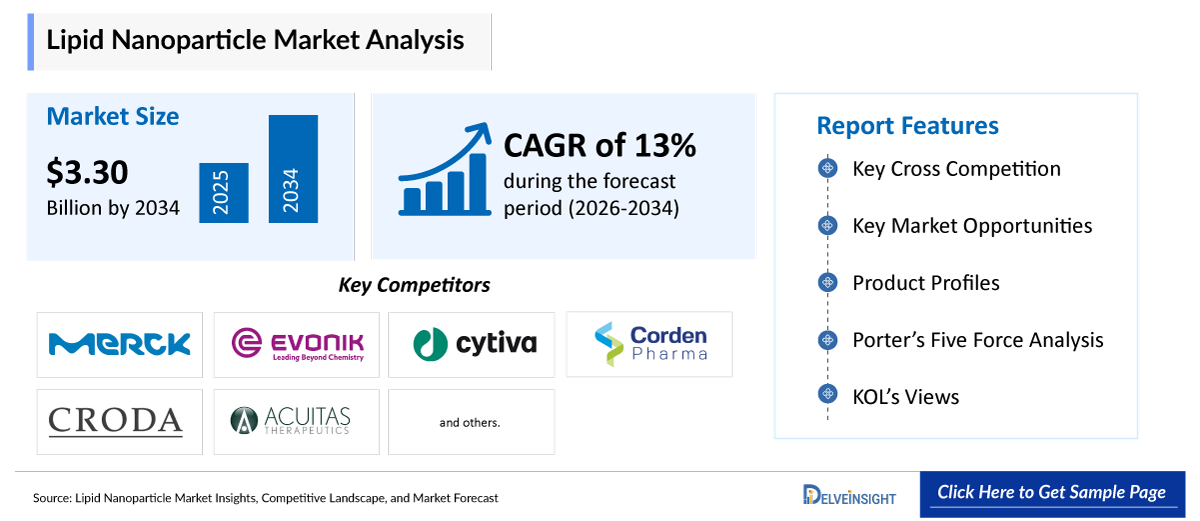
- The global lipid nanoparticle market was valued at USD 1.10 billion in 2025 and is projected to reach USD 3.30 billion by 2034.
- The market is expected to expand at a CAGR of 13.0% during the forecast period 2026-2034, supported by the validation of lipid nanoparticles as the leading delivery system for messenger RNA, the expansion of RNA and nucleic acid therapeutics beyond vaccines, the advance of ionizable lipids and formulation technology, and the growth of specialized manufacturing capacity.
- By composition, the ionizable lipids segment dominated the lipid nanoparticle market with a 38% share in 2025.
- By payload, the messenger RNA segment dominated the lipid nanoparticle market with a 48% share in 2025.
- By application, the infectious disease and vaccines segment dominated the lipid nanoparticle market with a 44% share in 2025.
- By end-user, the pharmaceutical and biotechnology companies segment dominated the lipid nanoparticle market with a 58% share in 2025.
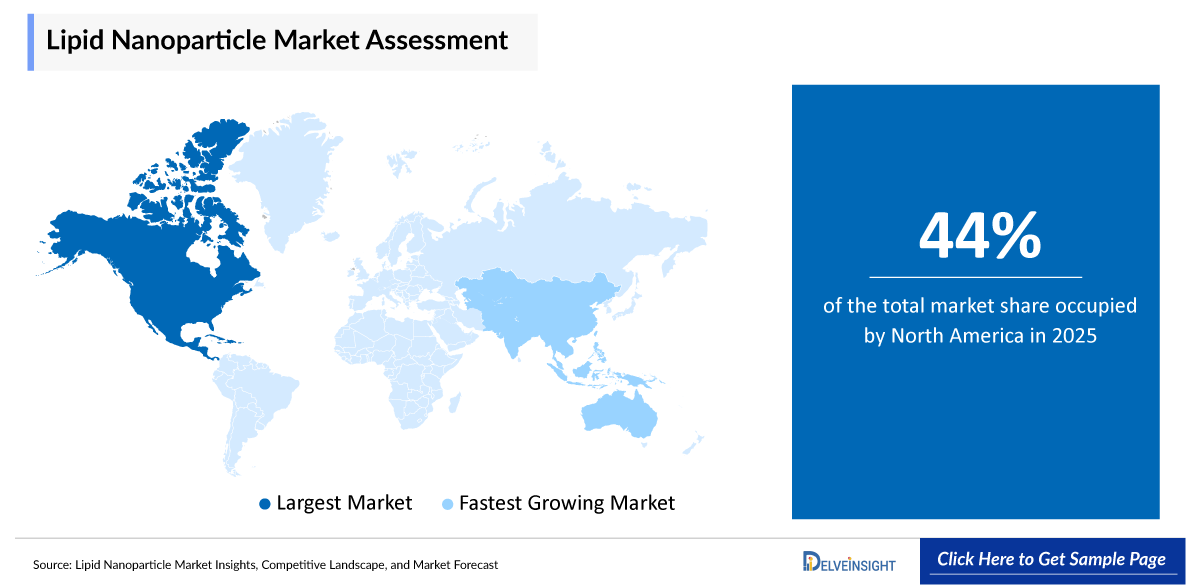
- North America accounted for the largest share of the lipid nanoparticle market at 44% in 2025, while Asia-Pacific is anticipated to register the fastest growth through 2034.
Lipid nanoparticles are lipid-based delivery systems that encapsulate and deliver nucleic acid and other therapeutic payloads into cells, protecting the payload from degradation and enabling its cellular uptake and intracellular release. The scope encompasses the lipid components that constitute the nanoparticle, namely the ionizable lipid that binds and releases the nucleic acid, the phospholipid or helper lipid, the cholesterol that provides structure, and the polyethylene glycol lipid that stabilizes the particle, together with the formulation technologies, reagents, and services that produce lipid nanoparticles. Lipid nanoparticles are the delivery system of the messenger RNA vaccines against COVID-19 and of the first approved small interfering RNA therapeutic, and leading participants include the developers of proprietary ionizable lipids such as Acuitas Therapeutics and Genevant Sciences, the suppliers of lipid components such as Avanti Polar Lipids, Evonik, and Merck, and the providers of formulation technology and manufacturing such as Cytiva through Precision NanoSystems and the specialized contract manufacturers. The contemporary market is defined by the validation of lipid nanoparticles for messenger RNA, the expansion of RNA and nucleic acid therapeutics, and the advance of ionizable lipids and manufacturing.
Lipid Nanoparticle Market Key Growth Drivers
- Validation of lipid nanoparticles as the leading delivery system for messenger RNA, demonstrated by the messenger RNA vaccines against COVID-19.
- Expansion of RNA and nucleic acid therapeutics beyond vaccines into oncology, rare and genetic diseases, and gene editing.
- Advance of ionizable lipids and formulation technology that improve encapsulation, potency, and targeting.
- Growth of small interfering RNA therapeutics, following the first approved lipid nanoparticle small interfering RNA product.
- Growth of specialized lipid nanoparticle manufacturing capacity and contract manufacturing.
- Deep and growing pipeline of lipid nanoparticle-enabled drugs across modalities and indications.
- Investment in domestic manufacturing capacity and supply chain security for lipids and lipid nanoparticles.
Key Companies in Lipid Nanoparticle Market
The leading participants in the lipid nanoparticle market include the following:
- Merck KGaA
- Evonik Industries AG
- Cytiva (Danaher Corporation)
- CordenPharma International
- Croda International Plc
- Acuitas Therapeutics Inc.
- Genevant Sciences Corporation
- Thermo Fisher Scientific Inc.
- Lonza Group AG
- NOF Corporation
For illustrative purposes, only the top 10 companies are listed in the Table of Contents. The report may include analysis and references to additional companies relevant to the market assessment.
Lipid Nanoparticle Market Size
The following table summarizes the headline market metrics for the global lipid nanoparticle market across the base year and the forecast horizon.
|
Report Metrics |
Details |
|
2025 Market Size |
USD 1.10 billion |
|
2034 Projected Market Size |
USD 3.30 billion |
|
Growth Rate (2026-2034) |
13.0% CAGR |
|
Largest Market |
North America (44% share in 2025) |
|
Fastest Growing Market |
Asia-Pacific |
|
Market Structure |
Moderately Consolidated |
All market values are expressed in USD and represent DelveInsight estimates synthesized from primary and secondary research.
Factors Contributing to the Growth of the Lipid Nanoparticle Market
Market Drivers
Validation of Lipid Nanoparticles as the Leading Delivery System for Messenger RNA
The foundational driver of the lipid nanoparticle market is the validation of lipid nanoparticles as the leading delivery system for messenger RNA, demonstrated at global scale by the messenger RNA vaccines against COVID-19. Messenger RNA is fragile and cannot enter cells on its own, and lipid nanoparticles protect the messenger RNA from degradation and ensure that it is taken up into cells where it is translated into the encoded protein, making the lipid nanoparticle the enabling delivery system of messenger RNA medicine. The messenger RNA vaccines against COVID-19, delivered in lipid nanoparticles, were administered in billions of doses and demonstrated the safety, efficacy, and scalability of lipid nanoparticle delivery, transforming lipid nanoparticles from a specialized delivery option into a core enabling platform for vaccines and nucleic acid therapeutics. The clinical and commercial validation of lipid nanoparticles for messenger RNA, at unprecedented scale, established the lipid nanoparticle as the delivery system of choice for messenger RNA and catalyzed the expansion of messenger RNA and nucleic acid medicine. The demonstrated performance and scalability of lipid nanoparticle delivery, and the transition of messenger RNA into a mainstream therapeutic modality, drive the demand for lipid nanoparticles. As messenger RNA medicine expands on the validated foundation of lipid nanoparticle delivery, demand for lipid nanoparticles grows. The validation of lipid nanoparticles as the leading delivery system for messenger RNA anchors the growth of the market across the forecast period.
Expansion of RNA and Nucleic Acid Therapeutics Beyond Vaccines
The expansion of RNA and nucleic acid therapeutics beyond vaccines into oncology, rare and genetic diseases, and gene editing is a defining driver that broadens and deepens the demand for lipid nanoparticles. The validation of messenger RNA and lipid nanoparticles in vaccines has catalyzed the expansion of RNA and nucleic acid medicine into a broad range of applications, and messenger RNA applications have broadened beyond vaccines into oncology, rare diseases, protein replacement, and gene editing, creating a surge of clinical programs that require lipid nanoparticle delivery. Lipid nanoparticles deliver messenger RNA, small interfering RNA, self-amplifying RNA, plasmid DNA, and gene editing systems for the treatment of infectious diseases, cancer, rare and genetic diseases, cardiovascular and metabolic diseases, and other conditions, and the breadth of payloads and indications enlarges the demand for lipid nanoparticles. The expansion of RNA and nucleic acid therapeutics into new modalities and indications, the growth of the clinical pipeline, and the versatility of lipid nanoparticles across payloads drive the demand for lipid nanoparticle delivery. As RNA and nucleic acid therapeutics expand beyond vaccines into a broad range of modalities and indications, the demand for the lipid nanoparticle delivery they require grows and diversifies. The expansion of RNA and nucleic acid therapeutics beyond vaccines sustains demand for lipid nanoparticles across the forecast period.
Advance of Ionizable Lipids and Formulation Technology
The advance of ionizable lipids and formulation technology, which improve encapsulation, potency, and targeting, is a powerful driver that concentrates value in the ionizable lipid and improves the performance of lipid nanoparticles. The ionizable lipid is the key component of the lipid nanoparticle, binding the nucleic acid during formulation and enabling its release inside the cell, and its design determines the encapsulation, potency, tolerability, and biodistribution of the lipid nanoparticle. Developers have designed and synthesized large libraries of novel ionizable lipids, with leading developers having synthesized hundreds of novel lipids and identified those that outperform earlier clinically validated lipids, and the advance of ionizable lipid design improves the potency, tolerability, and targeting of lipid nanoparticles. Formulation technology, including microfluidic mixing and continuous manufacturing, improves the reproducibility, encapsulation, and scalability of lipid nanoparticle formulation, and the advance of ionizable lipids and formulation enables the delivery of new payloads, the targeting of tissues beyond the liver, and the improvement of potency and tolerability. The improvement of ionizable lipids and formulation expands the applications and improves the performance of lipid nanoparticles, and it concentrates value and competition in the ionizable lipid and the formulation. As ionizable lipids and formulation technology advance and as they improve the performance and expand the applications of lipid nanoparticles, demand grows. The advance of ionizable lipids and formulation technology sustains the growth and modernization of the lipid nanoparticle market across the forecast period.
Growth of Small Interfering RNA Therapeutics
The growth of small interfering RNA therapeutics, following the first approved lipid nanoparticle small interfering RNA product, drives the demand for lipid nanoparticles and diversifies the market beyond messenger RNA vaccines. Small interfering RNA therapeutics silence disease-causing genes, and the first approved small interfering RNA therapeutic was delivered in a lipid nanoparticle, validating lipid nanoparticles for small interfering RNA and establishing the modality. The pipeline of small interfering RNA and RNA interference therapeutics has expanded, with programs targeting liver, cardiovascular, metabolic, neurological, and genetic diseases, and the growth of small interfering RNA therapeutics, supported by regulatory approvals and expanding pipelines, drives the demand for lipid nanoparticles and other delivery systems that enable them. While some small interfering RNA therapeutics use conjugate delivery, lipid nanoparticles remain an important delivery system for small interfering RNA and other nucleic acids, and the growth of the modality drives demand. The validation of lipid nanoparticles for small interfering RNA, the expansion of the small interfering RNA pipeline, and the growth of RNA interference therapy drive the demand for lipid nanoparticle delivery. As small interfering RNA therapeutics grow and as their pipeline expands, demand for lipid nanoparticle delivery grows. The growth of small interfering RNA therapeutics sustains demand for lipid nanoparticles across the forecast period.
Growth of Specialized Manufacturing Capacity and Contract Manufacturing
The growth of specialized lipid nanoparticle manufacturing capacity and contract manufacturing drives the supply and adoption of lipid nanoparticles and supports the development of lipid nanoparticle-enabled drugs. The manufacture of lipid nanoparticles requires specialized lipids, formulation technology, good manufacturing practice facilities, analytical testing, and expertise, and only specialized manufacturers are equipped to produce lipid nanoparticle components and formulations for clinical and commercial products. The growth of the RNA and lipid nanoparticle pipeline drives the demand for specialized manufacturing, and pharmaceutical and biotechnology companies partner with specialized contract manufacturers for lipid supply, formulation, and production, and the contract manufacturers expand their capacity, capabilities, and services. Contract manufacturers and lipid suppliers expand good manufacturing practice lipid production, formulation technology, and manufacturing capacity, and they provide the lipids, formulation, and production that the pipeline requires, from discovery through commercial supply. The growth of the pipeline, the specialized requirements of lipid nanoparticle manufacture, and the reliance on specialized suppliers and contract manufacturers drive the growth of manufacturing capacity and services. As the pipeline grows and as it requires specialized lipids, formulation, and manufacturing, demand for lipid nanoparticle components and services grows. The growth of specialized manufacturing capacity and contract manufacturing sustains demand for lipid nanoparticles across the forecast period.
Deep and Growing Pipeline of Lipid Nanoparticle-Enabled Drugs
The deep and growing pipeline of lipid nanoparticle-enabled drugs across modalities and indications drives sustained and expanding demand for lipid nanoparticles. A large and growing number of lipid nanoparticle-enabled drugs are in development, with the pipeline spanning messenger RNA vaccines and therapeutics, small interfering RNA, self-amplifying RNA, DNA, and gene editing systems across infectious diseases, oncology, rare and genetic diseases, and other indications, and the pipeline of lipid nanoparticle-related drugs numbers in the thousands. The breadth and depth of the pipeline, driven by the validation and versatility of lipid nanoparticles and the expansion of RNA and nucleic acid medicine, generate sustained and growing demand for the lipids, formulation, and manufacturing that lipid nanoparticle-enabled drugs require. As the drugs in the pipeline progress from discovery through clinical development to commercial supply, they require increasing quantities of lipids and lipid nanoparticle formulation and manufacturing, driving the demand for lipid nanoparticles across the development and commercial lifecycle. The depth of the pipeline, the progression of drugs through development, and the versatility of lipid nanoparticles across the pipeline drive the demand for lipid nanoparticles. As the pipeline of lipid nanoparticle-enabled drugs grows and progresses, demand for lipid nanoparticles grows. The deep and growing pipeline of lipid nanoparticle-enabled drugs sustains demand for lipid nanoparticles across the forecast period.
Investment in Domestic Manufacturing and Supply Chain Security
The investment in domestic manufacturing capacity and supply chain security for lipids and lipid nanoparticles drives the expansion of capacity and the growth of the market. The strategic importance of lipids and lipid nanoparticles for vaccines and therapeutics, the concentration of supply, and the emphasis on supply chain security and domestic capacity have driven investment in domestic lipid and lipid nanoparticle manufacturing, supported by government programs and policy. Governments and companies have invested in domestic lipid manufacturing capacity, with dedicated lipid innovation and manufacturing facilities established and supported by government funding, and policy measures encouraging the reshoring and securing of the supply of lipids and lipid nanoparticles. The investment in domestic capacity, the establishment of dedicated lipid manufacturing facilities, and the emphasis on supply chain security expand the manufacturing capacity for lipids and lipid nanoparticles and support the growth of the market. The strategic importance of lipids for public health preparedness and the security of the supply chain drive the investment in domestic and secure manufacturing. As investment in domestic manufacturing and supply chain security expands the capacity for lipids and lipid nanoparticles, the supply and adoption of lipid nanoparticles grow. The investment in domestic manufacturing and supply chain security sustains the growth of the lipid nanoparticle market across the forecast period.
Market Restraints
The lipid nanoparticle market faces several interrelated restraints that temper its growth. The foremost is the complexity and cost of formulation and manufacturing, since the development and manufacture of lipid nanoparticles require specialized lipids, formulation technology, good manufacturing practice facilities, analytical testing, and expertise, and the requirement for specialized equipment, facilities, and expertise increases the cost and complexity of production, particularly for smaller companies.
The intellectual property surrounding ionizable lipids and lipid nanoparticle technology is complex and concentrated, since the key ionizable lipids and delivery technologies are protected by patents held by a limited number of developers, and the licensing and freedom-to-operate requirements tied to this intellectual property add cost, complexity, and constraint. The challenge of delivery beyond the liver persists, since lipid nanoparticles naturally accumulate in the liver, and the targeting of other tissues and organs requires the advance of ionizable lipids and targeting technology that is still developing. The scalability, reproducibility, and analytical characterization of lipid nanoparticles are technically challenging, since the manufacture of consistent, well-characterized lipid nanoparticles at scale requires advanced formulation and analytical technology.
The cold chain and stability requirements of some lipid nanoparticle products add complexity and cost to storage and distribution. The regulatory requirements for the characterization, quality, and safety of lipid nanoparticles and their components add development burden. The concentration of lipid supply and the dependence on specialized suppliers create supply chain risk, and the tolerability and immunogenicity of some lipid components require management. The dependence of the market on the success and progression of the RNA and nucleic acid pipeline exposes it to the risks of drug development. Together, these factors moderate the pace and scope of growth and require participants to advance lipid design, formulation, manufacturing, and intellectual property to sustain growth.
Lipid Nanoparticle Market Segment Analysis
The global lipid nanoparticle market is segmented by composition (ionizable lipids, phospholipids and helper lipids, cholesterol, polyethylene glycol lipids), by payload (messenger rna, small interfering rna, dna and plasmid dna, and others), by application (infectious disease and vaccines, oncology, rare and genetic diseases, and others), and by end-users (pharmaceutical and biotechnology companies, academic and research institutes, and contract research and manufacturing organizations) by geography (North America, Europe, Asia-Pacific, and the Rest of the World).
By Composition
Dominant Subsegment: Ionizable Lipids.
The ionizable lipids category is expected to dominate the market. The ionizable lipids segment accounted for a 38% share of the lipid nanoparticle market in 2025. Ionizable lipids, which bind the nucleic acid during formulation and release it inside the cell, are the leading composition category because they are the key and highest-value component of the lipid nanoparticle, determining the encapsulation, potency, tolerability, and biodistribution of the particle. The dominance of the segment reflects the central role of the ionizable lipid in lipid nanoparticle performance, the concentration of intellectual property and value in the ionizable lipid, and the intensive development of novel ionizable lipids. Ionizable lipids shift charge with pH to bind nucleic acids during formulation and to enable release inside the cell, and their design determines the performance of the lipid nanoparticle, making them the object of intensive development and the highest-value component. Developers have designed large libraries of proprietary ionizable lipids, and the ionizable lipid is the component most closely tied to the performance and the intellectual property of the lipid nanoparticle. The central role, the value, and the intensive development of ionizable lipids drive the segment. While phospholipids, cholesterol, and polyethylene glycol lipids are essential components of the lipid nanoparticle, the central role, value, and development of the ionizable lipid sustain the leadership of the ionizable lipids segment across the forecast period.
By Payload
Dominant Subsegment: Messenger RNA.
The messenger RNA category is expected to dominate the market. The messenger RNA segment accounted for a 48% share of the lipid nanoparticle market in 2025. Messenger RNA, which encodes proteins for vaccines and therapeutics, is the leading payload because it is the payload that validated lipid nanoparticle delivery at scale in the COVID-19 vaccines and drives the largest and fastest-expanding application of lipid nanoparticles. The dominance of the segment reflects the validation of lipid nanoparticle delivery of messenger RNA at global scale, the breadth of messenger RNA applications, and the central role of lipid nanoparticles as the delivery system of messenger RNA medicine. Lipid nanoparticles are the enabling delivery system of messenger RNA, protecting it and delivering it into cells, and messenger RNA vaccines and therapeutics represent the largest application of lipid nanoparticles, spanning infectious diseases, oncology, rare diseases, and protein replacement. The validation of messenger RNA delivery, the breadth of messenger RNA applications, and the central role of lipid nanoparticles in messenger RNA medicine drive the segment. While small interfering RNA, self-amplifying RNA, DNA, and gene editing payloads are important and growing, with small interfering RNA growing rapidly, the scale, validation, and breadth of messenger RNA sustain the leadership of the messenger RNA segment across the forecast period.
By Application
Dominant Subsegment: Infectious Disease and Vaccines.
The infectious disease and vaccines category is expected to dominate the market. The infectious disease and vaccines segment accounted for a 44% share of the lipid nanoparticle market in 2025. Infectious disease and vaccines is the leading application because it is the application that validated lipid nanoparticle delivery at scale in the COVID-19 messenger RNA vaccines and remains the largest use of lipid nanoparticles, spanning the messenger RNA vaccines against COVID-19, influenza, and other infectious diseases. The dominance of the segment reflects the scale of messenger RNA vaccine delivery, the extensive use of lipid nanoparticles in vaccine development, and the breadth of the infectious disease vaccine pipeline. Lipid nanoparticles deliver the messenger RNA vaccines against COVID-19, and the messenger RNA vaccines in development against influenza, respiratory syncytial virus, and other infectious diseases, and the infectious disease vaccine application represents the largest and most validated use of lipid nanoparticles. The scale of vaccine delivery, the validation of lipid nanoparticles in vaccines, and the breadth of the vaccine pipeline drive the segment. While oncology, rare and genetic diseases, and other applications are significant and fast-growing, the scale, validation, and breadth of infectious disease and vaccines sustain the leadership of the infectious disease and vaccines segment across the forecast period.
By End-User
Dominant Subsegment: Pharmaceutical and Biotechnology Companies.
The pharmaceutical and biotechnology companies category is expected to dominate the market. The pharmaceutical and biotechnology companies segment accounted for a 58% share of the lipid nanoparticle market in 2025. Pharmaceutical and biotechnology companies, which develop messenger RNA and nucleic acid therapeutics and vaccines that use lipid nanoparticle delivery, are the leading end-user because they represent the largest source of demand, developing the pipeline of lipid nanoparticle-enabled drugs and requiring lipids, formulation, and manufacturing across development and commercial supply. The dominance of the segment reflects the scale of pharmaceutical and biotechnology development of RNA and nucleic acid medicine, the requirement for lipids and lipid nanoparticle manufacturing across the pipeline, and the value of the drugs they develop. Pharmaceutical and biotechnology companies develop messenger RNA vaccines and therapeutics, small interfering RNA, and other nucleic acid medicines, and they require ionizable lipids, lipid components, formulation, and manufacturing from discovery through commercial supply, representing the largest source of demand. The scale of development, the requirement for lipids and manufacturing, and the value of the pipeline concentrate demand in pharmaceutical and biotechnology companies. While academic and research institutes and contract research and manufacturing organizations are important end-users, the scale, pipeline, and requirements of pharmaceutical and biotechnology companies sustain the leadership of the pharmaceutical and biotechnology companies segment across the forecast period, and it shapes the direction of the market.
Lipid Nanoparticle Market Region Analysis
Dominant Region: North America
North America accounted for a 44% share of the global lipid nanoparticle market in 2025, representing the highest regional market share globally. The leadership of the region reflects the concentration of messenger RNA and nucleic acid developers, the presence of the leading ionizable lipid and delivery technology companies, the strength of research and investment, and the investment in domestic lipid manufacturing. The United States is the largest national market, supported by the concentration of the messenger RNA and nucleic acid pharmaceutical and biotechnology companies, the presence of the leading ionizable lipid, lipid component, and formulation technology companies, the strength of research funding and investment in RNA and nucleic acid medicine, and the investment in domestic lipid manufacturing capacity and supply chain security. The concentration of biotechnology hubs, the presence of developers and suppliers, the strength of investment, and the establishment of domestic lipid manufacturing facilities supported by government programs drive the market, and the leading companies operate extensively in the region. The concentration of developers and suppliers, the strength of research and investment, and the investment in domestic manufacturing reinforce the leadership of the region. The combination of developer concentration, supplier presence, investment strength, and domestic manufacturing sustains the position of North America as the largest regional market across the forecast period.
Fastest Growing Region: Asia-Pacific
Asia-Pacific is projected to register the fastest compound annual growth rate through 2034. The region combines the rapid growth of its biotechnology and pharmaceutical industry, the expansion of messenger RNA and nucleic acid research and manufacturing, the growth of contract manufacturing, and the increase in investment, which drives the fast growth of the market. China, Japan, South Korea, and India are the principal national markets, supported by the rapid growth of messenger RNA and nucleic acid research and development, the expansion of lipid nanoparticle formulation and manufacturing capacity, the growth of contract manufacturing and lipid supply, and the increase in investment and government support for RNA medicine. The growth of the biotechnology industry, the expansion of RNA and nucleic acid development and manufacturing, and the growth of lipid nanoparticle capacity enlarge the demand for lipid nanoparticles. As the biotechnology and pharmaceutical industry grows, as RNA and nucleic acid development expands, and as lipid nanoparticle manufacturing capacity grows, the region increases its demand and provision from a growing base, and the scale of the industry and the expansion of manufacturing create substantial long-term demand. The combination of industry growth, research and manufacturing expansion, and investment positions Asia-Pacific as the fastest-growing regional market, and it attracts investment and the expansion of global and regional companies.
Regional Commentary
North America
North America leads the market, supported by the concentration of messenger RNA and nucleic acid developers, the presence of the leading ionizable lipid and delivery technology companies, the strength of research and investment, and the investment in domestic lipid manufacturing. The United States dominates the region through its concentration of developers and suppliers, the strength of investment, and the establishment of domestic lipid manufacturing facilities. The growth of RNA and nucleic acid medicine sustains demand.
Europe
Europe is a substantial market shaped by a strong biotechnology and pharmaceutical industry, the presence of lipid suppliers and contract manufacturers including Evonik, Merck, CordenPharma, and Croda, and the growth of RNA and nucleic acid development. Germany, the United Kingdom, France, Italy, and Spain are the principal national markets, supported by the biotechnology and pharmaceutical industry, lipid manufacturing capacity, and the growth of messenger RNA and nucleic acid medicine. Demand is sustained by RNA and nucleic acid development and the presence of lipid suppliers and manufacturers.
Asia-Pacific
Asia-Pacific is the fastest-growing region, driven by the rapid growth of messenger RNA and nucleic acid research, the expansion of formulation and manufacturing capacity, and the growth of contract manufacturing across China, Japan, South Korea, and India. Industry growth, research and manufacturing expansion, and investment sustain rapid growth, and the region attracts investment and the expansion of global and regional companies.
Rest of World
The Rest of World, spanning Latin America, the Middle East, and Africa, represents an emerging opportunity as biotechnology research and vaccine and therapeutic manufacturing grow. Growth is supported by the growth of RNA and vaccine development, the expansion of manufacturing, and the increasing use of lipid nanoparticle delivery, though research and manufacturing capacity vary by market. Companies pursue these markets through lipid supply, formulation, and manufacturing suited to growing RNA and vaccine development.
Lipid Nanoparticle Market Competitive Landscape
The global lipid nanoparticle market is classified as Moderately Consolidated. A group of ionizable lipid, lipid component, and formulation and manufacturing companies holds a substantial share of the market through proprietary lipids, components, and capabilities, while delivery technology and contract manufacturing specialists compete on technology, quality, and capacity. Competition centers on the performance and intellectual property of ionizable lipids, the quality and supply of lipid components, the formulation technology and manufacturing capacity, the breadth from discovery through commercial supply, and the good manufacturing practice quality and supply chain security; technology advances, capacity investment, and partnerships intensify the contest. The competitive landscape is evaluated across the following dimensions:
- Market concentration: Moderately consolidated, with a group of ionizable lipid, lipid component, and formulation and manufacturing companies holding a substantial share, alongside delivery technology and contract manufacturing specialists.
- Leading players: Merck, Evonik, Croda through Avanti Polar Lipids, and CordenPharma lead in lipid components and manufacturing; Cytiva through Precision NanoSystems leads in formulation technology; Acuitas Therapeutics and Genevant Sciences lead in proprietary ionizable lipids and delivery technology, and Thermo Fisher, Lonza, and NOF contest lipids, formulation, and manufacturing.
- Geographic reach: The leading lipid and manufacturing companies operate global supply and manufacturing, with concentration in North America and Europe and expanding capacity in Asia-Pacific.
- Product portfolio strength: Competitive advantage rests on the performance and intellectual property of ionizable lipids, the quality and supply of lipid components, the formulation technology, and the breadth from discovery through good manufacturing practice commercial supply.
- Pipeline strength: Development is concentrated in next-generation ionizable lipids, targeting beyond the liver, formulation and manufacturing technology, and good manufacturing practice capacity.
- Strategic partnerships: Collaboration spans partnerships between lipid, technology, and manufacturing companies and RNA developers, licensing of ionizable lipids and delivery technology, and alliances that combine lipids, formulation, and manufacturing.
- M&A activity: Consolidation has shaped the field, with life science and manufacturing companies acquiring lipid, delivery technology, and formulation capabilities, exemplified by the acquisition of Precision NanoSystems by Cytiva, alongside continued partnership and investment.
- Innovation focus: Innovation is shifting toward next-generation ionizable lipids, targeting beyond the liver, advanced and continuous manufacturing, and good manufacturing practice quality and supply chain security.
- Regulatory standing: Good manufacturing practice quality of lipids and lipid nanoparticles, the characterization and quality of components and formulations, and the security and reliability of supply are decisive competitive credentials and a principal axis of competition among the leaders.
Lipid Nanoparticle Market Recent Developmental Activities
In 2018, the first lipid nanoparticle small interfering RNA therapeutic was approved, delivering small interfering RNA in a lipid nanoparticle and validating lipid nanoparticles for small interfering RNA. Strategic significance: the approval established lipid nanoparticles as a clinical delivery system and preceded their validation at scale in messenger RNA vaccines.
In February 2024, CordenPharma International introduced lipid nanoparticle starter kits designed to support messenger RNA therapeutic development by simplifying lipid screening and formulation optimization. Strategic significance: the launch lowered the barrier to lipid nanoparticle development and reinforced the position of a leading lipid and manufacturing company.
In September 2024, NanoVation Therapeutics entered a multi-target partnership with Novo Nordisk to apply its long-circulating lipid nanoparticle technology to cardiometabolic and rare disease genetic medicines and extrahepatic delivery. Strategic significance: the partnership advanced lipid nanoparticle delivery beyond the liver and into new therapeutic areas and validated the value of delivery technology.
In January 2025, Evonik Industries AG collaborated with a gene therapy active ingredient producer to expand its RNA and nucleic acid therapeutic offerings. Strategic significance: the collaboration expanded the lipid and manufacturing capabilities of a leading supplier for RNA and nucleic acid medicine.
In April 2025, Wacker Biotech GmbH entered a strategic collaboration combining its plasmid DNA and messenger RNA manufacturing with lipid nanoparticle formulation and messenger RNA engineering to enhance messenger RNA lipid nanoparticle therapies. Strategic significance: the collaboration integrated messenger RNA manufacturing and lipid nanoparticle formulation and advanced messenger RNA lipid nanoparticle capability.
In July 2025, Acuitas Therapeutics Inc. collaborated with an academic institution to advance its lipid nanoparticle delivery technology and its application to new payloads and indications. Strategic significance: the collaboration advanced the delivery technology of a leading ionizable lipid developer and its application beyond vaccines.
In September 2025, Evonik Industries AG partnered to develop and commercialize an advanced lipid nanoparticle platform for nucleic acid delivery, combining proprietary lipid nanoparticle technology with large-scale manufacturing. Strategic significance: the partnership expanded the lipid nanoparticle platform and manufacturing capacity of a leading supplier for RNA therapeutics.
In September 2025, Merck KGaA entered an agreement to evaluate antibody-conjugated lipid-based delivery systems for nucleic acid payloads, with an option to acquire selected assets. Strategic significance: the agreement advanced targeted lipid-based delivery and reinforced the position of a leading life science company in nucleic acid delivery.
In October 2025, Evonik Industries AG brought a dedicated lipid innovation and manufacturing facility into operation, supported by government funding, expanding domestic lipid manufacturing capacity. Strategic significance: the facility expanded the domestic supply of lipids and reflected the investment in supply chain security for lipids and lipid nanoparticles.
In 2024 and 2025, Cytiva, through Precision NanoSystems, advanced its lipid nanoparticle formulation technology, including microfluidic formulation platforms and off-the-shelf ionizable lipid and lipid nanoparticle kits, to accelerate clinical and commercial RNA therapeutic manufacturing. Strategic significance: the developments reinforced the position of a leading formulation technology provider and advanced scalable lipid nanoparticle manufacturing.
In 2024 and 2025, contract manufacturers and lipid suppliers, including Lonza Group AG, Thermo Fisher Scientific Inc., and Croda International Plc through Avanti Polar Lipids, expanded their good manufacturing practice lipid production, formulation, and manufacturing capacity for lipid nanoparticles. Strategic significance: the expansion of capacity supported the growth of the RNA and lipid nanoparticle pipeline and the security of supply.
In 2024 and 2025, the leading participants advanced next-generation ionizable lipids, targeting beyond the liver, formulation and manufacturing technology, and good manufacturing practice capacity across lipid nanoparticles. Strategic significance: the convergence of the leaders on ionizable lipids, targeting, manufacturing, and quality confirmed these as the defining axes of competition and signaled a market advancing toward more capable, targeted, scalable, and secure lipid nanoparticle delivery.
Lipid Nanoparticle Market Segmentation
Lipid Nanoparticle Market Assessment by Composition
- Ionizable Lipids
- Phospholipids and Helper Lipids
- Cholesterol
- Polyethylene Glycol Lipids
Lipid Nanoparticle Market Assessment by Payload
- Messenger RNA
- Small Interfering RNA
- DNA and Plasmid DNA
- Others
Lipid Nanoparticle Market Assessment by Application
- Infectious Disease and Vaccines
- Oncology
- Rare and Genetic Diseases
- Others
Lipid Nanoparticle Market Assessment by End-User
- Pharmaceutical and Biotechnology Companies
- Academic and Research Institutes
- Contract Research and Manufacturing Organizations
Lipid Nanoparticle Market Assessment by Geography
- North America
- United States Lipid Nanoparticle Market Size in USD million (2023-2034)
- Canada Lipid Nanoparticle Market Size in USD million (2023-2034)
- Mexico Lipid Nanoparticle Market Size in USD million (2023-2034)
- Europe
- Germany Lipid Nanoparticle Market Size in USD million (2023-2034)
- United Kingdom Lipid Nanoparticle Market Size in USD million (2023-2034)
- France Lipid Nanoparticle Market Size in USD million (2023-2034)
- Italy Lipid Nanoparticle Market Size in USD million (2023-2034)
- Spain Lipid Nanoparticle Market Size in USD million (2023-2034)
- Rest of Europe Lipid Nanoparticle Market Size in USD million (2023-2034)
- Asia-Pacific
- China Lipid Nanoparticle Market Size in USD million (2023-2034)
- Japan Lipid Nanoparticle Market Size in USD million (2023-2034)
- India Lipid Nanoparticle Market Size in USD million (2023-2034)
- Australia Lipid Nanoparticle Market Size in USD million (2023-2034)
- South Korea Lipid Nanoparticle Market Size in USD million (2023-2034)
- Rest of Asia-Pacific Lipid Nanoparticle Market Size in USD million (2023-2034)
- Rest of the World
- Middle East Lipid Nanoparticle Market Size in USD million (2023-2034)
- Africa Lipid Nanoparticle Market Size in USD million (2023-2034)
- South America Lipid Nanoparticle Market Size in USD million (2023-2034)
Lipid Nanoparticle Market Recent Industry Trends and Milestones (2023-2026)
|
Category |
Key Developments |
|
Lipid Nanoparticle Market Product Advancement |
The period was defined by the advancement of ionizable lipids, formulation technology, and targeting. Acuitas and Genevant advanced proprietary ionizable lipids and delivery technology, NanoVation advanced long-circulating and extrahepatic delivery, Cytiva through Precision NanoSystems advanced microfluidic formulation and lipid nanoparticle kits, and CordenPharma introduced lipid nanoparticle starter kits. Lipid suppliers advanced good manufacturing practice lipids, and companies advanced targeting beyond the liver. Together, these advances concentrated competition in capable, targeted, and scalable lipid nanoparticle delivery. |
|
Lipid Nanoparticle Market Product Expansion |
Product expansion advanced along three axes. The first is ionizable lipids and delivery technology, as developers advanced novel ionizable lipids and targeting beyond the liver. The second is formulation and manufacturing technology, as companies advanced microfluidic formulation, continuous manufacturing, and lipid nanoparticle kits. The third is good manufacturing practice capacity and supply, as suppliers and contract manufacturers expanded lipid production and manufacturing. Companies also expanded payloads and applications beyond messenger RNA vaccines. |
|
Lipid Nanoparticle Market Investment |
Investment was shaped by the expansion of RNA medicine and the emphasis on supply chain security. Companies invested in ionizable lipids, formulation and manufacturing technology, and good manufacturing practice capacity, and government programs and companies invested in domestic lipid manufacturing, exemplified by dedicated lipid innovation facilities. Partnerships between lipid, technology, and manufacturing companies and RNA developers advanced the field, and investment flowed into next-generation lipids, targeting, manufacturing, and supply chain security. |
|
Company Strategy |
The unifying strategic theme is the delivery of capable, targeted, scalable, and secure lipid nanoparticle delivery for RNA and nucleic acid medicine. Merck, Evonik, Croda, and CordenPharma are advancing lipids and manufacturing; Cytiva is advancing formulation technology, Acuitas and Genevant are advancing ionizable lipids and delivery, and Thermo Fisher, Lonza, and NOF are advancing lipids, formulation, and manufacturing. Across the field, strategy centers on ionizable lipids, targeting, formulation and manufacturing, and good manufacturing practice quality and supply security. |
|
Emerging Technologies |
The defining emerging technologies are next-generation ionizable lipids that improve potency, tolerability, and targeting; targeting technologies that direct lipid nanoparticles beyond the liver to other tissues and cells; microfluidic and continuous manufacturing that improve the reproducibility and scalability of formulation; and antibody-conjugated and targeted lipid-based delivery. Supporting these are good manufacturing practice lipid production, advanced analytical characterization, and supply chain security and domestic manufacturing. Across these, the trajectory is toward lipid nanoparticle delivery that is more potent, more targeted, more scalable, and more secure, enabling the expansion of RNA and nucleic acid medicine across modalities and indications. |
Lipid Nanoparticle Market Startup Funding and Investment Trends
Investment in the lipid nanoparticle field has concentrated on technologies that make lipid nanoparticle delivery more capable, more targeted, and more scalable, namely next-generation ionizable lipids, extrahepatic and targeted delivery, formulation and manufacturing technology, and good manufacturing practice capacity. Because the market is moderately consolidated among lipid, delivery technology, and manufacturing companies, innovators pursue differentiated ionizable lipids, targeting, or manufacturing technologies that serve defined needs or that a larger company can license or absorb. The table below summarizes representative companies advancing the next generation of lipid nanoparticle delivery.
|
Company |
Total Funding |
Funding Stage |
Main Product/Offering |
Core Technology |
|
Acuitas Therapeutics Inc. |
Privately held |
Commercial stage |
Ionizable lipid and lipid nanoparticle delivery |
Proprietary ionizable lipids |
|
Genevant Sciences Corporation |
Privately held |
Commercial stage |
Lipid nanoparticle delivery platform |
Ionizable lipids and delivery technology |
|
Request for unlocking the report of the @ Lipid Nanoparticle Market | ||||
Capital formation in this field is shaped by the presence of established lipid, delivery technology, and manufacturing companies, so investors and acquirers have favored companies that introduce differentiated ionizable lipids, extrahepatic and targeted delivery, or formulation and manufacturing technology that serves defined needs or that a larger company can license or absorb. Next-generation ionizable lipids and delivery technology are a clear thesis, improving the potency, tolerability, and targeting of delivery. Extrahepatic and targeted delivery constitute a second thesis, directing lipid nanoparticles beyond the liver, and formulation and manufacturing a third, improving the scalability and supply of lipid nanoparticles. The archetypal outcome is licensing of lipids and delivery technology to RNA developers, acquisition by a life science, lipid, or manufacturing company, or growth into a delivery or manufacturing provider, exemplified by the acquisition of formulation technology companies. The principal risks are the intellectual property and competition of the established developers, the technical challenge of targeting beyond the liver, the complexity and cost of manufacturing, and the dependence on the RNA and nucleic acid pipeline.
Key Takeaways from the Lipid Nanoparticle Market Report Study
- Market size analysis for the current lipid nanoparticle market size (2025), and market forecast for 9 years (2026 to 2034).
- Top key lipid, delivery technology, and manufacturing developments, partnerships, launches, and investments that happened over the last 3 years.
- Key companies dominating the global lipid nanoparticle market.
- Various opportunities available for competitors in the lipid nanoparticle market space.
- What are the top-performing segments in 2025? How will these segments perform in 2034?
- Which are the top-performing regions and countries in the current lipid nanoparticle market scenario?
- Which are the regions and countries where companies should concentrate their opportunities for lipid nanoparticle market growth in the future?
Target audience who can benefit from this lipid nanoparticle market report study
- Lipid nanoparticle, lipid, delivery technology, and contract manufacturing providers
- Research organizations and consulting companies
- Lipid nanoparticle and RNA medicine-related organizations, associations, forums, and other alliances
- Government and corporate offices
- Start-up companies, venture capitalists, and private equity firms
- Pharmaceutical, biotechnology, and research organizations dealing in RNA and nucleic acid medicine
- Various end-users who want to know more about the lipid nanoparticle market and the latest technological developments in the lipid nanoparticle market.

