
LYMPHIR Market Summary
Key Factors Driving LYMPHIR Growth
1. First New FDA-Approved Systemic CTCL Therapy in More Than Seven Years
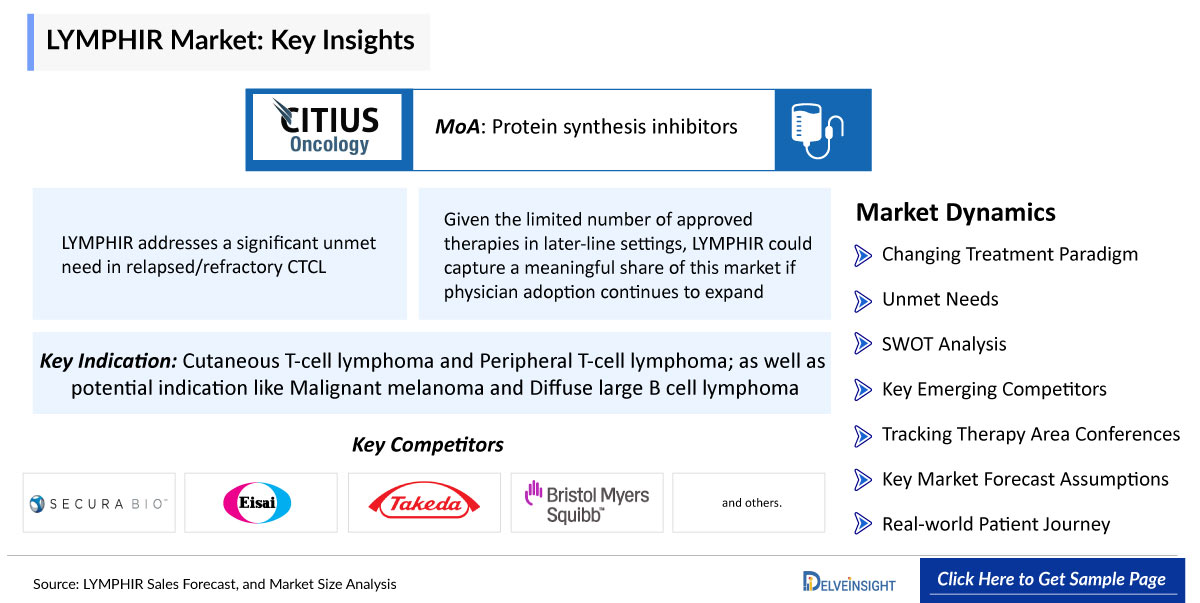
LYMPHIR addresses a significant unmet need in relapsed/refractory CTCL, a rare non-Hodgkin lymphoma with limited treatment options. According to Citius Oncology, LYMPHIR is the first FDA-approved systemic therapy for CTCL in more than seven years, providing physicians with a novel mechanism of action. In the pivotal study supporting approval, LYMPHIR achieved an overall response rate (ORR) of 36.2%, while 84% of patients experienced reduction in skin disease burden, supporting its clinical value in a difficult-to-treat population.
2. Favorable Positioning Through NCCN Guideline Inclusion
Shortly after approval, LYMPHIR was incorporated into the National Comprehensive Cancer Network (NCCN) Clinical Practice Guidelines for CTCL. NCCN inclusion is a critical commercialization catalyst because it often facilitates physician adoption, payer coverage, and treatment reimbursement. The company has also secured a permanent HCPCS J-code (J9161), simplifying reimbursement and reducing administrative barriers for providers.
3. Underserved Market with Meaningful Revenue Opportunity
Management estimates that the initial addressable U.S. market for LYMPHIR exceeds $400 million annually. CTCL remains a rare disease, but patients frequently cycle through multiple lines of therapy, creating opportunities for new agents with differentiated efficacy. Given the limited number of approved therapies in later-line settings, LYMPHIR could capture a meaningful share of this market if physician adoption continues to expand.
4. Commercial Launch Momentum and Early Revenue Generation
Citius Oncology launched LYMPHIR commercially in the United States in December 2025 and reported its first product revenue shortly thereafter. For the fiscal quarter ended December 31, 2025, the company recorded approximately $3.9 million in LYMPHIR revenue, demonstrating initial market uptake despite only a partial launch quarter. Management has stated that nationwide distribution is now established and physician onboarding is underway, which should support sequential revenue growth during 2026.
5. Potential Expansion into Combination Immunotherapy
Beyond its approved indication, management has highlighted the potential development of LYMPHIR as a combination immunotherapy, including use alongside immune checkpoint inhibitors. The company also references intellectual-property protection covering potential immuno-oncology combinations. If future clinical studies demonstrate enhanced efficacy, combination approaches could significantly expand LYMPHIR's commercial opportunity beyond CTCL.
6. International Licensing and Geographic Expansion Opportunities
Citius Oncology retains commercialization rights for LYMPHIR in most global markets outside India, Japan, and certain Asian territories. The company has publicly disclosed ongoing discussions regarding international licensing partnerships and has already initiated named-patient access programs in selected European markets. Geographic expansion could provide an additional revenue stream beyond the U.S. market and broaden the drug's long-term commercial potential.
LYMPHIR Recent Developments
In February 2026, Citius Oncology entered into an exclusive distribution agreement with Uniphar, a leading international healthcare services company, to support access to LYMPHIR (denileukin diftitox-cxdl) outside the United States. This agreement represents Citius Oncology's third international distribution partnership and further advances the Company's strategy to expand global access to LYMPHIR through established regional partners.
Under the terms of the agreement, Uniphar will serve as the exclusive distribution partner for LYMPHIR in designated international territories in Western and Eastern Europe through country-specific managed access programs, where permitted by local law. Uniphar will oversee market access and distribution activities in selected territories. Citius Oncology will supply finished product and provide ongoing support in accordance with the agreement. LYMPHIR is not approved for commercial use outside the United States and, where permitted by local law, will be provided in the territories covered by this agreement solely through country-specific managed access programs, which do not constitute marketing authorization or a commercial launch.
“LYMPHIR Sales Forecast, and Market Size Analysis – 2034” report provides comprehensive insights of LYMPHIR for approved indication like Cutaneous T-cell lymphoma and Peripheral T-cell lymphoma; as well as potential indication like Malignant melanoma and Diffuse large B cell lymphoma in the 7MM. A detailed picture of LYMPHIR’s existing usage in approved and anticipated entry and performance in potential indications in the 7MM, i.e., the United States, EU4 (Germany, France, Italy, and Spain) and the United Kingdom, and Japan for the study period 2020 –2034 is provided in this report along with a detailed description of the LYMPHIR for approved and potential indications. The LYMPHIR market report provides insights about LYMPHIR’s sales forecast, mechanism of action (MoA), dosage and administration, as well as research and development including regulatory milestones, along with other developmental activities. Further, it also consists of historical and current LYMPHIR performance, future market assessments inclusive of the LYMPHIR market forecast analysis for approved and potential indications in the 7MM, SWOT, analysts’ views, comprehensive overview of market competitors, and brief about other emerging therapies in respective indications. It also provides analysis of LYMPHIR sales forecasts, along with factors driving its market.
LYMPHIR Drug Summary
LYMPHIR is a targeted biologic therapy consisting of a recombinant fusion protein that links interleukin-2 (IL-2) to a diphtheria toxin fragment, designed to selectively bind to CD25 (IL-2 receptor α)–expressing malignant T cells and deliver a cytotoxic payload that inhibits protein synthesis, leading to cell death. It is primarily indicated for adult patients with relapsed or refractory cutaneous T-cell lymphoma (CTCL), particularly in cases where conventional systemic therapies have failed or are not suitable. By exploiting the high expression of CD25 on malignant T-cell populations, LYMPHIR enables a mechanism of targeted immune-directed cytotoxicity while sparing most normal tissues. The drug is administered via intravenous infusion under careful clinical supervision due to its potential for serious adverse effects, including capillary leak syndrome, peripheral edema, fatigue, infusion-related reactions, and laboratory abnormalities. Its clinical use reflects a precision-immunotoxin approach in oncology, bridging cytokine receptor targeting with toxin-mediated cancer cell eradication in a highly specialized treatment setting. The report provides LYMPHIR’s sales, growth barriers and drivers, post usage and approvals in multiple indications.
Scope of the LYMPHIR Market Report
The report provides insights into:
- A comprehensive product overview including the LYMPHIR MoA, description, dosage and administration, research and development activities in approved indications like Cutaneous T-cell lymphoma and Peripheral T-cell lymphoma; as well as potential indication like Malignant melanoma and Diffuse large B cell lymphoma.
- Elaborated details on LYMPHIR regulatory milestones and other development activities have been provided in LYMPHIR market report.
- The report also highlights LYMPHIR‘s cost estimates and regional variations, reported and estimated sales performance, research and development activities in approved and potential indications across the United States, Europe, and Japan.
- The LYMPHIR market report also covers the patents information, generic entry and impact on cost cut.
- The LYMPHIR market report contains current and forecasted LYMPHIR sales for approved and potential indications till 2034.
- Comprehensive coverage of the late-stage emerging therapies for respective indications.
- The LYMPHIR market report also features the SWOT analysis with analyst views for LYMPHIR in approved and potential indications.
Methodology
The LYMPHIR market report is built using data and information sourced primarily from internal databases, primary and secondary research and in-house analysis by DelveInsight’s team of industry experts. Information and data from the secondary sources have been obtained from various printable and nonprintable sources like search engines, news websites, global regulatory authorities websites, trade journals, white papers, magazines, books, trade associations, industry associations, industry portals and access to available databases.
LYMPHIR Analytical Perspective by DelveInsight
- In-depth LYMPHIR Market Assessment
This LYMPHIR sales market forecast report provides a detailed market assessment of LYMPHIR for approved indication like Cutaneous T-cell lymphoma and Peripheral T-cell lymphoma; as well as potential indication like Malignant melanoma and Diffuse large B cell lymphoma in the seven major markets, i.e., the United States, EU4 (Germany, France, Italy, and Spain) and the United Kingdom, and Japan. This segment of the report provides current and forecasted LYMPHIR sales data uptil 2034.
- LYMPHIR Clinical Assessment
The LYMPHIR market report provides the clinical trials information of LYMPHIR for approved and potential indications covering trial interventions, trial conditions, trial status, start and completion dates.
LYMPHIR Competitive Landscape
The report provides Insights on competitors and marketed products within the domain, along with a summary of emerging products and their respective launch dates, posing significant competition in the market.
LYMPHIR Market Potential & Revenue Forecast
- Projected market size for the LYMPHIR and its key indications
- Estimated LYMPHIR sales potential (LYMPHIR peak sales forecasts)
- LYMPHIR Pricing strategies and reimbursement landscape
LYMPHIR Competitive Intelligence
- Number of competing drugs in development (pipeline analysis)
- LYMPHIR Market positioning compared to existing treatments
- LYMPHIR Strengths & weaknesses relative to competitors
LYMPHIR Regulatory & Commercial Milestones
- LYMPHIR Key regulatory approvals & expected launch timelines
- Commercial partnerships, licensing deals, and M&A activity
LYMPHIR Clinical Differentiation
- LYMPHIR Efficacy & safety advantages over existing drugs
- LYMPHIR Unique selling points
LYMPHIR Market Report Highlights
- In the coming years, the LYMPHIR market scenario is set to change due to strong adoption, increased prescriptions and broader uptake in multiple immunological indications; which would expand the size of the market.
- The LYMPHIR companies are developing therapies that focus on novel approaches to treat/improve the disease condition, assess challenges, and seek opportunities that could influence LYMPHIR’s dominance.
- Other emerging products for Cutaneous T-cell lymphoma and Peripheral T-cell lymphoma; as well as potential indication like Malignant melanoma and Diffuse large B cell lymphoma are expected to give tough market competition to LYMPHIR and launch of late-stage emerging therapies in the near future will significantly impact the market.
- A detailed description of regulatory milestones, and developmental activities, provide the current development scenario of LYMPHIR in approved and potential indications.
- Analyse LYMPHIR cost, pricing trends and market positioning to support strategic decision-making in the immunology landscape.
- Our in-depth analysis of the forecasted LYMPHIR sales data uptil 2034 will support the clients in decision-making process regarding their therapeutic portfolio by identifying the overall scenario of LYMPHIR in approved and potential indications.
Key Questions
- What is the class of therapy, route of administration and mechanism of action of LYMPHIR? How strong is LYMPHIR’s clinical and commercial performance?
- What is LYMPHIR’s clinical trial status in each individual indications such as Cutaneous T-cell lymphoma and Peripheral T-cell lymphoma; as well as potential indication like Malignant melanoma and Diffuse large B cell lymphoma and study completion date?
- What are the key collaborations, mergers and acquisitions, licensing and other activities related to the LYMPHIR Manufacturers?
- What are the key designations that have been granted to LYMPHIR for approved and potential indications? How are they going to impact LYMPHIR’s penetration in various geographies?
- What is the current and forecasted LYMPHIR market scenario for approved and potential indications? What are the key assumptions behind the forecast?
- What are the current and forecasted sales of LYMPHIR in the seven major countries, including the United States, Europe (Germany, France, Italy, Spain) and the United Kingdom, and Japan?
- What are the other emerging products available and how are these giving competition to LYMPHIR for approved and potential indications?
- Which are the late-stage emerging therapies under development for the treatment of approved and potential indications?
- How cost-effective is LYMPHIR? What is the duration of therapy and what are the geographical variations in cost per patient?

