
M-701 Market Summary
Key Factors Driving M-701 Growth
1. Large unmet need in malignant ascites and pleural effusion
Malignant ascites and MPE are serious complications of advanced epithelial cancers, including gastric, colorectal and ovarian cancers, and treatment is largely palliative. Paracentesis can temporarily relieve symptoms but does not adequately control recurrent fluid accumulation. In the published Phase II M701 study, 85% of patients in the control group required ≥2 drainages within days 1–18, illustrating the burden of repeated procedures. This unmet need gives M701 a potentially differentiated position because it aims to suppress the malignant process responsible for fluid accumulation rather than simply removing fluid.
2. Novel CD3×EpCAM T-cell-engaging mechanism
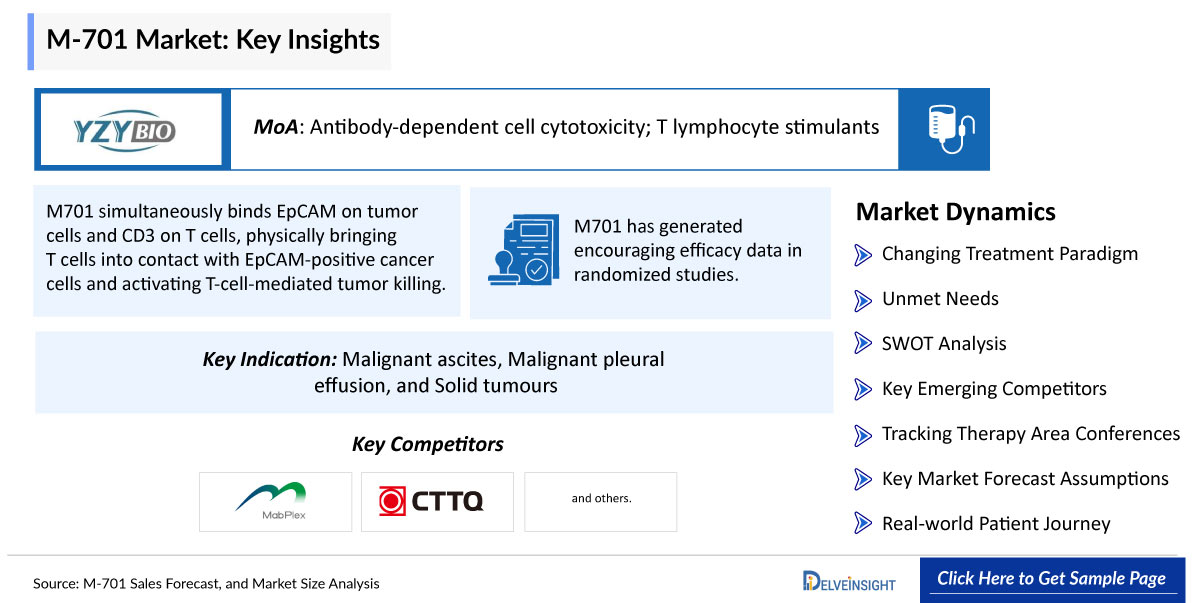
M701 simultaneously binds EpCAM on tumor cells and CD3 on T cells, physically bringing T cells into contact with EpCAM-positive cancer cells and activating T-cell-mediated tumor killing. EpCAM is expressed by many epithelial malignancies, providing a biological rationale for developing M701 across several solid-tumor-associated effusions. Preclinical studies demonstrated that M701 inhibited EpCAM-positive tumor growth, while mechanistic work supported its potential as an EpCAM-positive cancer therapy.
3. Strong clinical evidence for controlling malignant ascites
M701 has generated encouraging efficacy data in randomized studies. In the 84-patient Phase II study, median puncture-free survival (PuFS) was 75 days with M701 versus 25 days with control, corresponding to a hazard ratio of 0.43 (p=0.0065). In patients with baseline relative lymphocyte counts ≥13%, median PuFS reached 125 versus 22 days (HR 0.23; p=0.0003). Six-month survival was 33.3% versus 12.1%, although the overall-survival difference in the full population did not reach statistical significance.
More importantly for commercialization, the larger Phase III study enrolled 312 patients with malignant ascites caused by advanced gastric, colorectal or ovarian cancer. As reported for ASCO 2026, median PuFS was 87.59 days with M701 versus 49.96 days with control (HR 0.57; 95% CI 0.42–0.78; p=0.0003), while time to next paracentesis was 186.7 versus 55.1 days (HR 0.42; p<0.0001). These data materially strengthen M701's potential to become a disease-management option rather than simply another experimental bispecific.
4. Regulatory progress has substantially reduced development risk
A major catalyst occurred in May 2026, when China's NMPA accepted the NDA for M701 for malignant ascites. This followed the positive clinical-development program and moves the asset from a development-stage opportunity toward potential commercialization in China. YZY's HKEX filings also show that the company has granted domestic rights to M701 to Chia Tai Tianqing while retaining overseas rights, providing an established commercial partner for the Chinese market.
5. MPE provides a second major commercial opportunity
M701 is not limited to malignant ascites. In an interim Phase Ib study in advanced NSCLC-associated MPE, 24 patients had been enrolled by April 19, 2024, and the company reported a favorable safety profile, with no treatment-related serious adverse events and only one Grade 3 treatment-related adverse event (neutropenia). The program subsequently progressed to randomized Phase II development.
M-701 Recent Developments
In June 2024, AbbVie and FutureGen Biopharmaceutical (Beijing) announced a license agreement to develop FG-M701, a next generation TL1A antibody for the treatment of IBD currently in preclinical development.
“M-701 Sales Forecast, and Market Size Analysis – 2034” report provides comprehensive insights of M-701 for potential indication like Malignant ascites, Malignant pleural effusion, and Solid tumours in the 7MM. A detailed picture of M-701’s existing usage in anticipated entry and performance in potential indications in the 7MM, i.e., the United States, EU4 (Germany, France, Italy, and Spain) and the United Kingdom, and Japan for the study period 2020 –2034 is provided in this report along with a detailed description of the M-701 for potential indications. The M-701 market report provides insights about M-701’s sales forecast, mechanism of action (MoA), dosage and administration, as well as research and development including regulatory milestones, along with other developmental activities. Further, it also consists of historical and current M-701 performance, future market assessments inclusive of the M-701 market forecast analysis for potential indications in the 7MM, SWOT, analysts’ views, comprehensive overview of market competitors, and brief about other emerging therapies in respective indications. It also provides analysis of M-701 sales forecasts, along with factors driving its market.
M-701 Drug Summary
M-701 is an investigational bispecific antibody developed by Wuhan YZY Biopharma Co., Ltd. for the treatment of malignant pleural effusion (MPE) and malignant ascites associated with advanced epithelial solid tumors, including non-small cell lung cancer (NSCLC). M-701 is an anti-EpCAM × anti-CD3 bispecific antibody designed to simultaneously bind epithelial cell adhesion molecule (EpCAM), which is highly expressed on many epithelial tumor cells, and CD3 on T lymphocytes. By physically linking T cells to EpCAM-positive cancer cells, M-701 redirects and activates cytotoxic T cells to selectively attack and eliminate tumor cells, thereby potentially reducing malignant fluid accumulation and delaying its recurrence. The drug is administered locally by intrapleural infusion for MPE and by intraperitoneal infusion for malignant ascites, enabling direct exposure to tumor cells within the affected body cavity. Clinical studies have demonstrated a favorable safety profile and signals of efficacy in preventing re-accumulation of pleural effusions, with Phase II studies evaluating M-701 against cisplatin in MPE associated with NSCLC and further clinical development underway. The report provides M-701’s sales, growth barriers and drivers, post usage and approvals in multiple indications.
Scope of the M-701 Market Report
The report provides insights into:
- A comprehensive product overview including the M-701 MoA, description, dosage and administration, research and development activities in potential indication like Malignant ascites, Malignant pleural effusion, and Solid tumours.
- Elaborated details on M-701 regulatory milestones and other development activities have been provided in M-701 market report.
- The report also highlights M-701‘s cost estimates and regional variations, reported and estimated sales performance, research and development activities in potential indications across the United States, Europe, and Japan.
- The M-701 market report also covers the patents information, generic entry and impact on cost cut.
- The M-701 market report contains current and forecasted M-701 sales for potential indications till 2034.
- Comprehensive coverage of the late-stage emerging therapies for respective indications.
- The M-701 market report also features the SWOT analysis with analyst views for M-701 in potential indications.
Methodology
The M-701 market report is built using data and information sourced primarily from internal databases, primary and secondary research and in-house analysis by DelveInsight’s team of industry experts. Information and data from the secondary sources have been obtained from various printable and nonprintable sources like search engines, news websites, global regulatory authorities websites, trade journals, white papers, magazines, books, trade associations, industry associations, industry portals and access to available databases.
M-701 Analytical Perspective by DelveInsight
- In-depth M-701 Market Assessment
This M-701 sales market forecast report provides a detailed market assessment of M-701 for potential indication like Malignant ascites, Malignant pleural effusion, and Solid tumours in the seven major markets, i.e., the United States, EU4 (Germany, France, Italy, and Spain) and the United Kingdom, and Japan. This segment of the report provides current and forecasted M-701 sales data uptil 2034.
- M-701 Clinical Assessment
The M-701 market report provides the clinical trials information of M-701 for potential indications covering trial interventions, trial conditions, trial status, start and completion dates.
M-701 Competitive Landscape
The report provides Insights on competitors and marketed products within the domain, along with a summary of emerging products and their respective launch dates, posing significant competition in the market.
M-701 Market Potential & Revenue Forecast
- Projected market size for the M-701 and its key indications
- Estimated M-701 sales potential (M-701 peak sales forecasts)
- M-701 Pricing strategies and reimbursement landscape
M-701 Competitive Intelligence
- Number of competing drugs in development (pipeline analysis)
- M-701 Market positioning compared to existing treatments
- M-701 Strengths & weaknesses relative to competitors
M-701 Regulatory & Commercial Milestones
- M-701 Key regulatory approvals & expected launch timelines
- Commercial partnerships, licensing deals, and M&A activity
M-701 Clinical Differentiation
- M-701 Efficacy & safety advantages over existing drugs
- M-701 Unique selling points
M-701 Market Report Highlights
- In the coming years, the M-701 market scenario is set to change due to strong adoption, increased prescriptions and broader uptake in multiple immunological indications; which would expand the size of the market.
- The M-701 companies are developing therapies that focus on novel approaches to treat/improve the disease condition, assess challenges, and seek opportunities that could influence M-701’s dominance.
- Other emerging products for Malignant ascites, Malignant pleural effusion, and Solid tumours are expected to give tough market competition to M-701 and launch of late-stage emerging therapies in the near future will significantly impact the market.
- A detailed description of regulatory milestones, and developmental activities, provide the current development scenario of M-701 in potential indications.
- Analyse M-701 cost, pricing trends and market positioning to support strategic decision-making in the immunology landscape.
- Our in-depth analysis of the forecasted M-701 sales data uptil 2034 will support the clients in decision-making process regarding their therapeutic portfolio by identifying the overall scenario of M-701 in potential indications.
Key Questions
- What is the class of therapy, route of administration and mechanism of action of M-701? How strong is M-701’s clinical and commercial performance?
- What is M-701’s clinical trial status in each individual indications such as Malignant ascites, Malignant pleural effusion, and Solid tumours and study completion date?
- What are the key collaborations, mergers and acquisitions, licensing and other activities related to the M-701 Manufacturers?
- What are the key designations that have been granted to M-701 for potential indications? How are they going to impact M-701’s penetration in various geographies?
- What is the current and forecasted M-701 market scenario for potential indications? What are the key assumptions behind the forecast?
- What are the current and forecasted sales of M-701 in the seven major countries, including the United States, Europe (Germany, France, Italy, Spain) and the United Kingdom, and Japan?
- What are the other emerging products available and how are these giving competition to M-701 for potential indications?
- Which are the late-stage emerging therapies under development for the treatment of potential indications?
- How cost-effective is M-701? What is the duration of therapy and what are the geographical variations in cost per patient?

