Malignant Ascites Market
- As per DelveInsight’s estimates, The total market size of Malignant ascites in the US was nearly USD 830 million in 2025.
- Malignant ascites (MA) is a pathological condition due to a variety of primary abdominal and extra-abdominal neoplasms. It is a primary cause of morbidity and presents many difficulties and treatment challenges. Malignant ascite is a sign of peritoneal carcinomatosis, the presence of malignant cells in the peritoneal cavity.
- Malignant ascites, characterized by the abnormal accumulation of fluid in the abdominal cavity due to cancer, present with several distinct symptoms. One primary indicator is noticeable abdominal swelling or distension, often leading to an increase in girth.
- Key malignant ascites companies include Pfizer, Becton Dickinson, Fresenius, BioVie, Novartis, and others driving innovation and treatment advancements.
- The pathophysiology of Malignant ascites is multifactorial. Increased permeability of tumor vessels, with forced production and release of peritoneal fluid, is the main factor in Malignant ascites development.
.jpg)
Key Factors Driving Malignant Ascites Market
Malignant Ascites Patient Population and Epidemiology
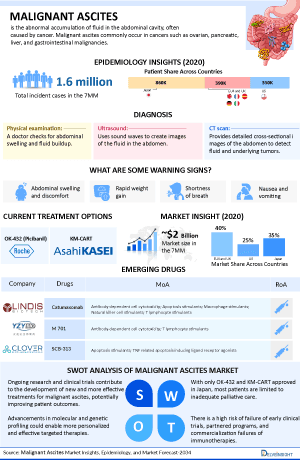
In 2022, the total incident cases of malignant ascites (MA)-associated cancers in the 7MM were approximately 1.6 million. Among all associated cancers, the highest incident cases were reported in breast cancer, with approximately 640,000 cases in 2022. Malignant ascites arises from a variety of primary malignancies including ovarian, gastric, uterine, breast, colorectal, and pancreatic cancers, which together account for 80% of cases, and is most frequently associated with ovarian cancer. It is a pathological accumulation of fluid in the abdominal cavity caused by malignancy, often indicating peritoneal carcinomatosis. Symptoms include abdominal swelling, abdominal pain, shortness of breath, nausea and vomiting, weight gain, and reduced appetite, significantly impacting patients' quality of life.
Malignant Ascites Pathophysiology and Challenges
The development of malignant ascites is multifactorial, primarily driven by increased permeability of tumor vessels and excessive production of peritoneal fluid. Contributing factors include cirrhosis, congestive heart failure, nephrosis, pancreatitis, peritonitis, primary malignancy, or hepatic metastases. Distinguishing benign from malignant ascites requires invasive testing, as physical examination and imaging alone are insufficient. This diagnostic complexity contributes to delayed intervention and management challenges.
Malignant Ascites Emerging Therapies
Several innovative therapies are under clinical development to address the unmet needs in malignant ascites. Catumaxomab by Lindis Biotech is a bispecific trifunctional antibody that targets EpCAM-positive tumor cells while activating T cells and macrophages, currently in preregistration for MA treatment. M701 by Wuhan YZY Biopharma is an asymmetric bispecific antibody targeting EpCAM and CD3, bridging T cells to tumor cells to induce cytotoxicity, and is in Phase II development for malignant ascites.
Malignant Ascites Companies and Competitive Landscape
Key companies driving innovation in the malignant ascites market include Pfizer, Becton Dickinson, Fresenius, BioVie, and Novartis. Emerging biopharmaceuticals like Catumaxomab and M701 reflect the ongoing focus on targeted immunotherapies, potentially transforming the treatment landscape beyond palliative care and addressing the significant unmet clinical needs in MA management.
DelveInsight’s " Malignant ascites Market Insights, Epidemiology, and Market Forecast – 2036" report delivers an in-depth understanding of Malignant ascites, historical and forecasted epidemiology as well as the Malignant ascites therapeutics market trends in the United States, EU4 (Germany, France, Italy, and Spain) and the United Kingdom, and Japan.
The Malignant ascites market report provides current treatment practices, emerging drugs, Malignant ascites market share of the individual therapies, and current and forecasted Malignant ascites market size from 2022 to 2036, segmented by seven major markets. The report also covers current Malignant ascites treatment practices/algorithms and unmet medical needs to curate the best of the opportunities and assess the underlying potential of the market.
|
Study Period |
2022 to 2036 |
|
Forecast Period |
2026-2036 |
|
Geographies Covered |
|
|
Malignant Ascites Market |
|
|
Malignant Ascites Market Size | |
|
Malignant Ascites Companies |
Lindis Biotech, Wuhan Yzy Biopharma Co., Ltd., Clover Biopharmaceuticals, Binhui Biopharmaceutical, Pharmacyte Biotech Inc., and others. |
|
Malignant Ascites Epidemiology Segmentation |
|
Malignant ascites Treatment Market
Malignant Ascites Overview
Malignant ascites (MA) is a pathological condition due to a variety of primary abdominal and extra-abdominal neoplasms. It is a primary cause of morbidity and presents many difficulties and treatment challenges. Malignant ascite is a sign of peritoneal carcinomatosis, the presence of malignant cells in the peritoneal cavity. Tumors causing carcinomatosis are more commonly secondary peritoneal surface malignancies, which include ovarian, colorectal, pancreatic, and uterine; extra-abdominal tumors originating from lymphoma, lung, and breast; and a small number of unknown primary tumors. Malignant ascites symptoms include abdominal swelling, pain, shortness of breath, fatigue, nausea, loss of appetite, and sudden weight gain.
Malignant ascites Diagnosis
The causes of intra-abdominal fluid production are many, including cirrhosis, congestive heart failure, nephrosis, pancreatitis, peritonitis, primary malignancy, or hepatic metastases. It is not possible to distinguish benign ascites from malignant ascites by physical exam or radiographic techniques alone. Invasive testing is necessary to differentiate the two types. Abdominal paracentesis with ascitic fluid analyses can diagnose malignant causes of ascite production in most cases, but laparoscopic tissue sampling may be necessary. Recently, several molecular profiling studies aimed at examining the different contents of MA, such as soluble molecules (proteins, DNA, and RNA), extracellular vesicles (EVs), and cells, have provided new insights into the outcome of PDAC (pancreatic ductal adenocarcinoma) patients with MA.
Further details related to diagnosis will be provided in the report…
Malignant ascites Treatment
With only two approved therapies, i.e., OK-432 and KM-CART in Japan, most patients are limited to the best palliative care, which is often inadequate to address these unmet needs. Several treatment modalities can alleviate the symptoms associated with malignant ascites. Because the natural history of ascite formation is poorly understood, these measures and quality of life data are limited, and the efficacy of existing treatments is difficult to assess. Traditional modalities for managing malignant ascites include sodium-restricted diets, diuretic therapy, serial paracentesis, and peritoneovenous shunting. Malignant ascites clinical trials explore innovative therapies to manage fluid buildup, improve patient outcomes, and enhance quality of life.
Further details related to treatment will be provided in the report…..
Malignant ascites Epidemiology
The Malignant ascites epidemiology chapter in the report provides historical as well as forecasted epidemiology segmented by the total incident cases of Malignant ascites associated cancers, total patient pool of malignant ascites in the 7MM market covering the United States, EU4 (Germany, France, Italy, and Spain) and the United Kingdom, and Japan from 2022 to 2036.
- Among the 7MM, the United States accounted for the highest incident cases of Malignant ascites in 2022, with around 350,000 cases; these cases are expected to increase during the forecast period.
- Among all the associated cancers, the highest incident cases were reported in Breast Cancer. In 2022 the total incident cases of Breast Cancer were 640,000.
- In 2022, the total patient pool of Malignant Ascites were 390,000 in the EU4 and the UK.
Stay Informed on Malignant Ascites Epidemiology! Access comprehensive data on demographics and disease burden for effective healthcare planning.
.jpg)
Malignant ascites Drug Chapters
The drug chapter segment of the Malignant ascites report encloses a detailed analysis of the early-stage (Phase I/II and Phase I), mid-stage (Phase II and Phase II/III), and late-stage (Phase III) pipeline drug. The current key players for emerging drugs and their respective drug candidates include Lindis Biotech (Catumaxomab), Wuhan YZY Biopharma (M701). The drug chapter also helps understand the Malignant ascites clinical trial details, expressive pharmacological action, agreements and collaborations, approval, and patent details, and the latest news and press releases. The Malignant Ascites Drugs Market is expanding due to rising cancer cases, increasing demand for targeted therapies, and innovation.

Emerging Malignant Ascites Drugs
M701: Wuhan YZY Biopharma
M701 is a new biological Class I drug that is being developed by Wuhan YZY Biopharma through its independently patented asymmetric bispecific antibody YBODY® platform. The drug is mainly used for the treatment of malignant ascites and malignant pleural effusion(MPE)derived from EpCAM-positive cancer.M701 dual-antibody targets the EpCAM antigen on one end, and at the same time, the CD3 antibody on the other end can bridge T cells and activate T cells to kill EpCAM-positive tumor cells. M-701 currently is in Phase III stage of development for the treatment of malignant ascites globally.
In December 2025, Wuhan YZY Biopharma announced that Phase II clinical trial data for its bispecific antibody drug candidate had been published in Experimental Hematology & Oncology. The drug demonstrated longer puncture-free survival (75 vs. 25 days; p = 0.0065) and improved overall survival, with higher 6-month survival rates (33.3% vs. 12.1%) compared with controls. Benefits were observed across gastric, colorectal, and ovarian cancers, particularly in patients with higher baseline lymphocyte counts, with no additional serious safety concerns reported.
Drug Class Insight
Antibody-dependent cell cytotoxicity
Antibody-Dependent Cellular Cytotoxicity (ADCC) is a crucial mechanism of the immune system involving the targeting and destruction of pathogenic cells by effector cells, particularly natural killer (NK) cells. ADCC is a process where specific antibodies bind to pathogens, marking them for destruction by NK cells through the injection of cytotoxic factors, leading to cell lysis. Antibodies recognize and bind to target cells, which are then attacked and destroyed by effector cells like NK cells. This process plays a vital role in immune responses against pathogens and cancer cells.
Explore the latest insights into the Malignant Ascites pipeline, emerging therapies, and future treatment potential. Stay informed today!
Malignant ascites Market Outlook
With only two approved therapies, i.e., OK-432 and KM-CART in Japan, most patients are limited to the best palliative care, which is often inadequate to address these unmet needs.. Only few key players are active in the pipeline such as Lindis Biotech and Wuhan YZY Biopharma for the treatment of Malignant ascites.
OK-432 (Picibanil) is a freeze-dried biological product that is prepared from the Su strain of Streptococcus pyogenes (group A) by treatment with benzylpenicillin and heat. OK-432 has been reported to induce various cytokines, activate immunological cells, and thus augment anticancer immunity.
KM-CART is a novel cell-free and concentrated ascites reinfusion therapy. It is modified from a conventional CART approved by the Ministry of Health, Labor and Welfare in Japan. KM-CART is easier to use and can be applied for massive malignant ascites.
Detailed market assessment will be provided in the final report....
Key Findings
- As per DelveInsight’s estimates, The total market size of Malignant ascites in the US was nearly USD 830 million in 2025.
- By 2036, among all the therapies, the highest revenue is expected to be generated by chemotherapy i.e., USD ~657 million, while the lowest revenue is expected to be generated by Concomitant diuretic therapy.
.jpg)
Malignant ascites Drugs Uptake
This section focuses on the uptake rate of potential drugs expected to be launched in the market during 2026–2036. The landscape of Malignant ascites treatment has experienced a transformation with the uptake of novel drugs. These innovative therapies are redefining standards of care. Furthermore, the increased uptake of these transformative drugs is a testament to the unwavering dedication of physicians, oncologists and the entire healthcare community in their tireless pursuit of advancing care. This momentous shift in treatment paradigms is a testament to the power of research, collaboration, and human resilience.
Malignant ascites Pipeline Development Activities
The report provides insights into different Malignant ascites clinical trials within Phase III, Phase II and Phase I. It also analyzes key players involved in developing targeted therapeutics. Companies like Lindis Biotech and Wuhan YZY Biopharma actively engage in late stage research and development efforts for Malignant ascites. The pipeline of Malignant ascites possesses few potential drugs. However, there is a positive outlook for the therapeutics market, with expectations of growth during the forecast period (2026–2036).
Pipeline Development Activities
The report covers information on collaborations, acquisitions and mergers, licensing, and patent details for Malignant ascites emerging therapy.
Market Access and Reimbursement
In the US healthcare system, both Public and Private health insurance coverage are included. Also, Medicare and Medicaid are the largest government-funded programs in the US. The major healthcare programs, including Medicare, Medicaid, the Children’s Health Insurance Program (CHIP), and the state and federal health insurance marketplaces, are overseen by the Centers for Medicare & Medicaid Services (CMS). Other than these, Pharmacy Benefit Managers (PBMs), third-party organizations that provide services and educational programs to aid patients are also present.
A zero-dollar copay program is a healthcare initiative designed to eliminate out-of-pocket costs for patients when obtaining specific medical services or prescription medications. Under this program, individuals enrolled in health insurance plans or prescription drug benefit programs can access certain services or medications without having to make any direct financial contributions in the form of copayments. The program is often implemented to improve medication adherence and access to essential healthcare services, particularly for chronic conditions. Pharmaceutical manufacturers or healthcare providers may offer zero-dollar copay programs as a strategy to make necessary treatments more affordable and accessible for patients, ultimately enhancing overall health outcomes and patient satisfaction.
Detailed market access and reimbursement assessment will be provided in the final report....
Scope of the Malignant ascites Market Report
- The report covers a segment of key events, an executive summary, and a descriptive overview of Malignant ascites, explaining its causes, signs, symptoms, pathogenesis, and currently used therapies.
- Comprehensive insight into the epidemiology segments and forecasts, disease progression, and treatment guidelines has been provided.
- Additionally, an all-inclusive account of the emerging therapies and the elaborative profiles of mid-stage and prominent therapies will impact the current treatment landscape.
- A detailed review of the Malignant ascites market, historical and forecasted market size, market share by therapies, detailed assumptions, and rationale behind our approach is included in the report, covering the 7MM drug outreach.
- The report provides an edge while developing business strategies by understanding trends through SWOT analysis and expert insights/KOL views, patient journey, and treatment preferences that help shape and drive Malignant ascites.
Malignant ascites Report Insights
- Malignant ascites Patient Population
- Malignant ascites Therapeutic Approaches
- Malignant ascites Pipeline Analysis
- Malignant ascites Market Size and Trends
- Existing and Future Market Opportunity
- Malignant ascites Druygs Market
Malignant ascites Report Key Strengths
- Eleven Years Forecast
- The 7MM Coverage
- Malignant ascites Epidemiology Segmentation
- Key Cross Competition
- Malignant ascites Drugs Uptake
- Key Malignant ascites Market Forecast Assumptions
Malignant ascites Report Assessment
- Current Malignant ascites Treatment Practices
- Malignant ascites Unmet Needs
- Malignant ascites Pipeline Product Profiles
- Malignant ascites Market Attractiveness
- Qualitative Analysis (SWOT and Analyst Views)
- Malignant ascites Market Drivers
- Malignant ascites Market Barriers
FAQs
- What was the Malignant ascites market size, the market size by therapies, market share (%) distribution in 2022, and what would it look like by 2036? What are the contributing factors for this growth?
- What can be the future treatment paradigm for Malignant ascites?
- What are the disease risks, burdens, and unmet needs of Malignant ascites? What will be the growth opportunities across the 7MM concerning the patient population with Malignant ascites?
- What are the current options for the treatment of Malignant ascites? What are the current guidelines for treating Malignant ascites in the 7MM?
- What are the recent novel therapies, targets, mechanisms of action, and technologies being developed to overcome the limitations of existing therapies?
- What is the patient share in Malignant ascites?
Reasons to Buy Malignant ascites Market Forecast Report:
- The report will help develop business strategies by understanding the latest trends and changing treatment dynamics driving Malignant ascites.
- Insights on patient burden/disease incidence, evolution in diagnosis, and factors contributing to the change in the epidemiology of the disease during the forecast years.
- Understand the existing market opportunities in varying geographies and the growth potential over the coming years.
- Identifying strong upcoming players in the market will help devise strategies to help get ahead of competitors.
- Detailed analysis ranking of class-wise potential current and emerging therapies under the analyst view section to provide visibility around leading classes.
- Highlights of access and reimbursement policies of current therapies, barriers to accessibility of expensive off-label therapies, and patient assistance programs.
- To understand Key Opinion Leaders’ perspectives around the accessibility, acceptability, and compliance-related challenges of existing treatment to overcome barriers in the future.
- Detailed insights on the unmet needs of the existing market so that the upcoming players can strengthen their development and launch strategy.