Medical Device Packaging Market Summary
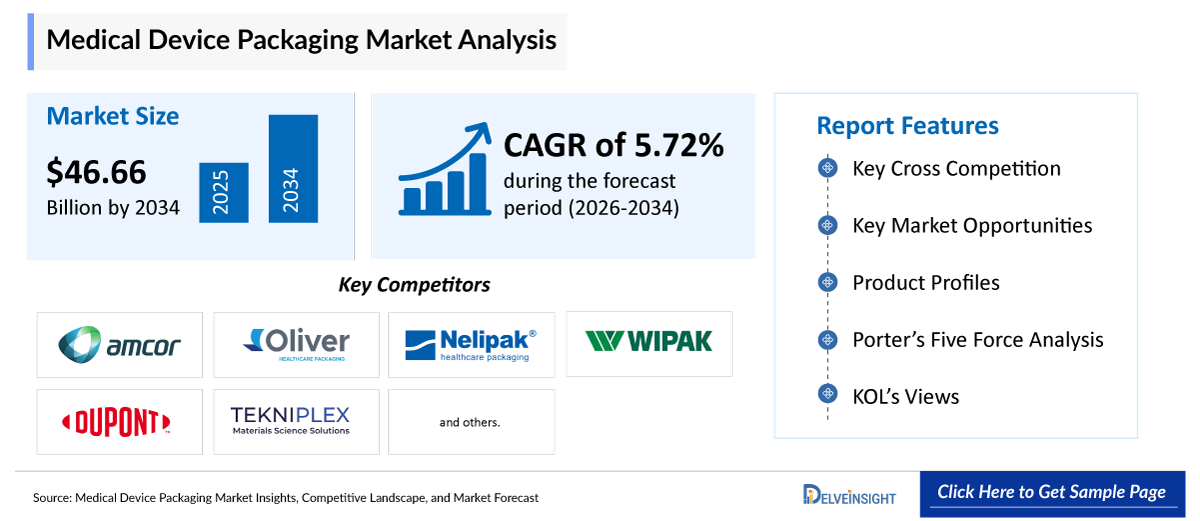
- The medical device packaging market size is estimated at USD 28.40 billion in 2025 and is projected to reach USD 46.66 billion by 2034. Growth is anchored in rising surgical procedure volumes, expanding adoption of single-use medical devices, stringent sterility and traceability regulations, and large-scale industry consolidation among leading packaging providers.
- The global medical device packaging market is growing at a CAGR of 5.72% during the forecast period from 2026 to 2034.
- By packaging type, the sterile packaging segment dominated the medical device packaging market with a 58% share in 2025.
- By product, the pouches & bags segment dominated the medical device packaging market with a 36% share in 2025.
- By material, the plastics segment dominated the medical device packaging market with a 62% share in 2025.
- By packaging technology, the thermoforming segment dominated the medical device packaging market with a 34% share in 2025.
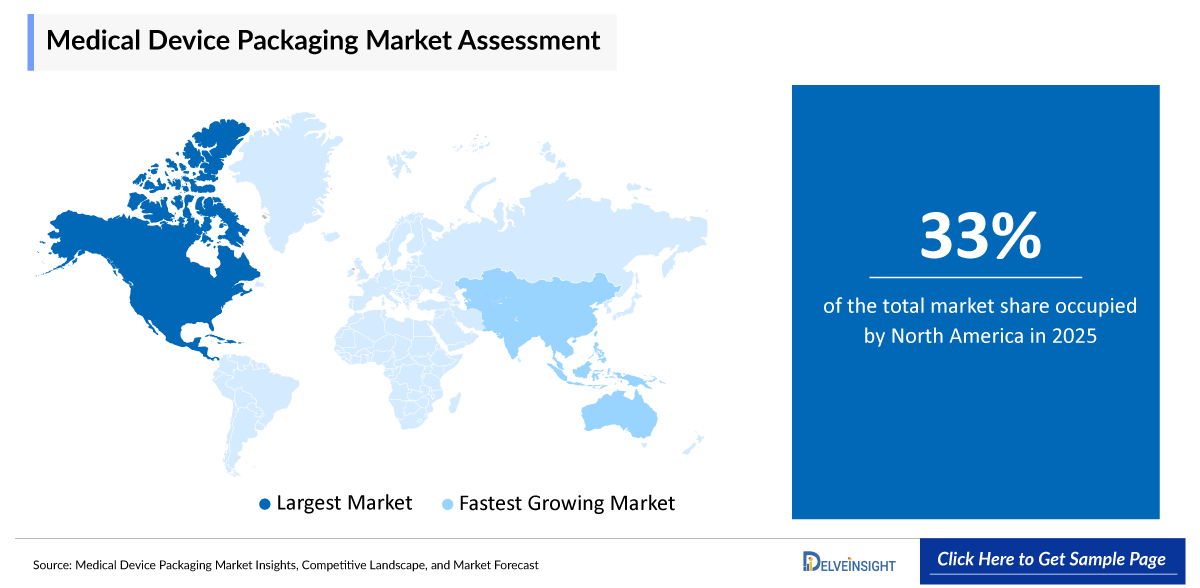
- North America dominated the global medical device packaging market revenue with a 33% share in 2025, representing the highest regional market share globally.
Medical device packaging encompasses the primary, secondary, and tertiary packaging systems that maintain sterility, protect against physical damage and contamination, and enable safe, traceable transport, storage, and handling of medical devices from manufacture to point of use. Because devices ranging from surgical instruments and implants to diagnostic and consumable products must remain sterile and intact until use, medical device manufacturers rely on validated sterile barrier systems, rigid trays, flexible pouches, and specialized labeling that comply with stringent global regulatory standards, including FDA Unique Device Identification (UDI) requirements, the EU Medical Device Regulation (MDR), and ISO 11607 sterile barrier validation.
The market is organized by packaging type across sterile and non-sterile packaging; by product, including pouches & bags, trays, containers, boxes & cartons, bottles, and others; by material, spanning plastics, paper & paperboard, aluminum foil, glass, and others; by packaging technology, including thermoforming, vacuum packaging, heat sealing, cold forming, and others; by device type, led by diagnostic devices, medical consumables, surgical instruments, and implantable medical devices; and by end user, spanning medical device manufacturers, contract packaging organizations, contract manufacturing organizations, and hospitals & healthcare facilities. Driven by rising surgical volumes, an aging global population, accelerating outsourcing to specialized packaging partners, and sweeping industry consolidation, medical device packaging has become essential infrastructure safeguarding device sterility, patient safety, and supply-chain traceability across the global healthcare system.
Medical Device Packaging Market Key Growth Drivers
- Rising global surgical procedure volumes and single-use device adoption are expanding demand, with the World Health Organization estimating approximately 234 million major surgical procedures performed worldwide each year.
- Amcor plc's completed USD 8.4 billion all-stock acquisition of Berry Global in 2025 created an integrated healthcare-focused packaging leader with roughly USD 23 billion in anticipated annual sales and a targeted USD 650 million in synergies.
- Growing outsourcing of sterile barrier packaging design, validation, and manufacturing to specialized contract packaging organizations is expanding the addressable market for dedicated providers.
- Stringent regulatory requirements, including FDA UDI rules, EU MDR sterile barrier system standards, and ISO 11607 validation protocols, are concentrating demand among compliant, experienced packaging partners.
- Rising chronic disease prevalence and an aging global population are increasing diagnostic imaging, surgical, and implantable device volumes that require compliant, validated packaging.
- Heavy capacity investment among leading providers, including DuPont's Costa Rica Tyvek expansion and TekniPlex Healthcare's new 200,000-square-foot Madison, Wisconsin facility, is expanding available sterile packaging supply.
- Advancing sustainability initiatives, such as the Coveris-SABIC closed-loop medical plastics recycling program, are reshaping material selection and packaging technology adoption across the industry.
Key Companies in Medical Device Packaging Market
The competitive landscape is led by the following active manufacturers:
- Amcor plc.
- Oliver Healthcare Packaging
- Nelipak Healthcare Packaging
- Wipak Group
- DuPont
- TekniPlex Healthcare
- Berry Global Inc.
- Sonoco Products Company
- Coveris Healthcare
- Sealed Air Corporation, and others
For illustrative purposes, only the top 10 companies are listed in the Table of Contents. The report may include analysis and references to additional companies relevant to the market assessment.
Medical Device Packaging Market Size
The following snapshot summarizes the principal report metrics for the medical device packaging market.
|
Report Metrics |
Details |
|
2025 Market Size |
USD 28.40 billion |
|
2034 Projected Market Size |
USD 46.66 billion |
|
Growth Rate (2026-2034) |
5.72% CAGR |
|
Largest Market |
North America |
|
Fastest Growing Market |
Asia-Pacific |
|
Market Structure |
Fragmented |
All market values are expressed in USD and represent DelveInsight estimates synthesized from primary and secondary research.
Factors Contributing to the Growth of the Medical Device Packaging Market
Medical Device Packaging Market Drivers
- Rising Volume of Surgical Procedures and Single-Use Medical Devices: The most powerful driver of the medical device packaging market is the sustained global rise in surgical procedures and single-use, disposable medical devices. The World Health Organization estimates that approximately 234 million major surgical procedures are performed worldwide each year, and each procedure requires validated sterile packaging for instruments, implants, and consumables to prevent contamination and ensure patient safety. The shift toward single-use devices, driven by infection-control priorities and outpatient and ambulatory surgical growth, further multiplies packaging volumes relative to reusable-device models. As minimally invasive procedures and same-day surgical volumes continue to expand, demand for high-integrity sterile barrier systems grows directly in step, anchoring market growth through 2034.
- Large-Scale Industry Consolidation Reshaping Competitive Scale: A wave of consolidation is reshaping the competitive structure of the market and expanding the scale of leading providers. Amcor plc completed its USD 8.4 billion all-stock acquisition of Berry Global in 2025, creating a healthcare-focused packaging group spanning approximately 140 countries, roughly 400 facilities, about 70,000 employees, and USD 23 billion in anticipated annual sales, with a targeted USD 650 million in cost synergies by fiscal 2028. This combination, alongside Sonoco's divestiture of its thermoformed and flexibles operations to Toppan for USD 1.8 billion to redirect capital toward high-growth performance hubs, illustrates how scale, regulatory breadth, and portfolio focus are becoming decisive competitive advantages. As integrated players expand their healthcare packaging footprints, competitive intensity and service breadth across the value chain continue to increase.
- Increasing Outsourcing to Contract Packaging and Manufacturing Organizations: A structural shift toward outsourcing is a central growth engine for the market. Validated sterile barrier packaging requires cleanroom manufacturing, specialized materials science expertise, and rigorous ISO 11607 and regulatory validation that many medical device manufacturers, particularly smaller and mid-sized OEMs, lack the infrastructure to perform in-house. Specialized providers such as Nelipak Healthcare Packaging, Oliver Healthcare Packaging, and Coveris Healthcare offer end-to-end design, prototyping, tooling, validation, and cleanroom manufacturing services that allow device makers to focus capital on core product development. As device pipelines expand and outsourcing intensity rises, the addressable market for dedicated packaging partners grows directly across the forecast period.
- Stringent Regulatory and Sterility-Assurance Requirements: The exceptional regulatory demands of medical device packaging are concentrating demand among compliant, experienced providers. Packaging systems must satisfy FDA Unique Device Identification requirements, the European Union's Medical Device Regulation sterile barrier system standards, and ISO 11607 validation for package integrity and shelf-life stability, and producers must demonstrate proven inspection and quality-management records, including ISO 13485 certification, to win OEM contracts. DuPont's 2025 Costa Rica facility expansion, which embeds ISO 11607 testing suites directly within production for Tyvek-based sterile barrier systems, illustrates how technology leadership and regulatory readiness are becoming competitive prerequisites. This dynamic sustains pricing power and reinforces the strategic value of established, validation-capable packaging partners.
- Rising Chronic Disease Burden and Aging Population: The growing global burden of chronic disease and an aging population are expanding demand for diagnostic, surgical, and implantable medical devices, and the packaging that protects them. Rising incidence of cardiovascular disease, cancer, and orthopedic conditions is driving greater volumes of surgical instruments, implantable devices, and in vitro diagnostic consumables, each requiring validated sterile or protective packaging tailored to its specific handling and shelf-life requirements. Healthcare systems seeking longer usable device life to support pandemic preparedness and rural healthcare outreach are also favoring premium barrier materials such as ethylene vinyl alcohol and metallized polyester films that extend shelf stability. As device volumes rise with demographic and epidemiological trends, the complexity and scale of packaging demand increase correspondingly.
- Capacity Investment and Geographic Expansion Among Leading Providers: Heavy capital investment in cleanroom capacity and regional manufacturing footprints is expanding supply and easing regional bottlenecks. TekniPlex Healthcare commenced production at a new 200,000-square-foot flagship facility in Madison, Wisconsin, in 2025; Nelipak Healthcare Packaging broke ground on a 60,000-square-foot facility in Costa Rica's Green Valley and opened a new Asia-Pacific Technical Development Center in Singapore, and DuPont expanded Tyvek sterile packaging capacity in Costa Rica. Coveris invested more than EUR 8 million to upgrade medical packaging production lines at its Rohrdorf and Halle sites in Germany. This wave of expansion improves regional supply reliability and supports the scale-up of validated sterile barrier manufacturing through the forecast period.
- Advancements in Sustainable and Smart Packaging Technologies: Growing sustainability initiatives and smart-packaging innovation are reshaping material and technology adoption across the industry. Coveris partnered with SABIC, Zuyderland Medical Centre, and healthcare brand Artivion to launch the first closed-loop recycling model for medical packaging, converting non-contaminated hospital plastic waste into new certified circular sterile pouches. Oliver Healthcare Packaging introduced eco-certified, high-porosity sterilization lids featuring visual indicators that change color upon optimal sterilization gas exposure, while Berry Global invested in a dedicated cleanroom facility for sustainable, bio-based medical pouches. As device manufacturers and healthcare systems prioritize recyclable, monomaterial, and traceable packaging, providers with proven sustainability platforms gain a competitive advantage.
Medical Device Packaging Market Restraints
Despite strong momentum, the medical device packaging market faces material constraints. Stringent and evolving regulatory compliance across FDA UDI rules, EU MDR sterile barrier standards, and ISO 11607 validation lengthens qualification timelines and raises costs, particularly for smaller manufacturers entering new markets. The high capital intensity of cleanroom construction, ISO 13485-certified manufacturing, and specialized barrier-material production creates significant barriers to entry and constrains expansion among smaller players. Volatility in raw material prices, particularly for medical-grade plastics, aluminum foil, and specialty films, pressures margins and complicates long-term pricing agreements. Environmental concerns and regulatory scrutiny around single-use plastic packaging are increasing pressure to develop recyclable and monomaterial alternatives without compromising sterility assurance, often requiring costly requalification. Complex, multi-tier global supply chains for barrier films, Tyvek, and specialty coatings remain vulnerable to disruption, while a shortage of packaging engineers skilled in sterile barrier validation constrains scale-up. Together, these regulatory, capital, material, sustainability, and workforce barriers temper the pace of growth, even as the underlying drivers of surgical volume growth, outsourcing, and industry consolidation remain firmly intact.
Medical Device Packaging Market Segment Analysis
The medical device packaging by packaging type (sterile packaging and non-sterile packaging), product (pouches & bags, trays, containers, boxes & cartons, bottles, and others), material (plastics, paper & paperboard, aluminum foil, glass, and others), packaging technology (thermoforming, vacuum packaging, heat sealing, cold forming, and others), device type (diagnostic devices, medical consumables, surgical instruments, implantable medical devices, and others), end user (medical device manufacturers, contract packaging organizations, contract manufacturing organizations, hospitals & healthcare facilities, and others), and Geography (North America, Europe, Asia-Pacific, and Rest of World).
By Packaging Type
Dominant Subsegment: Sterile Packaging.
The sterile packaging segment accounted for 58% of the medical device packaging market in 2025. Sterile packaging is the leading packaging type because the large majority of surgical instruments, implants, and single-use consumables must remain sterile from manufacture through point of use, requiring validated barrier systems produced under ISO Class 7 and ISO Class 8 cleanroom conditions. Rising surgical procedure volumes, growing adoption of single-use devices, and stringent FDA and EU MDR sterility-assurance requirements sustain large, recurring demand for validated sterile pouches, trays, and wraps. Providers such as Nelipak, Oliver Healthcare Packaging, and Coveris have expanded cleanroom capacity specifically to serve this segment. While non-sterile packaging, used for secondary and tertiary protection, distribution, and non-invasive devices, continues to grow steadily, the depth of regulatory requirements and clinical necessity underpinning sterile applications secure the segment's leadership across the forecast period.
By Product
Dominant Subsegment: Pouches & Bags.
The pouches & bags segment accounted for 36% of the medical device packaging market in 2025. Pouches and bags are the leading product category because they offer a favorable combination of flexibility, cost-efficiency, and compatibility with multiple sterilization methods, including ethylene oxide, gamma irradiation, and steam, making them the default choice for packaging a broad range of surgical instruments, consumables, and diagnostic products. Header bags, vented bags, and film bags are widely used across device classes, and their lightweight format reduces shipping and storage costs relative to rigid alternatives. Trays remain essential for protecting complex, high-value, and delicate devices requiring rigid support during handling and transport, and are growing quickly alongside minimally invasive surgical kits. Nonetheless, the versatility, cost advantage, and sheer breadth of applications served by pouches and bags secure the segment's leadership through 2034.
By Material
Dominant Subsegment: Plastics.
The plastics segment accounted for 62% of the medical device packaging market in 2025. Plastics, including polyethylene, polypropylene, and PVC, are the leading packaging material because of their lightweight profile, cost-effectiveness, design flexibility, and compatibility with thermoforming, sealing, and multiple sterilization methods. Plastic materials support a wide range of formats, including thermoformed blister trays, pouches, bottles, and clamshells, and are central to sterile barrier system design across surgical, diagnostic, and consumable device categories. Paper & paperboard is growing steadily as a sustainable, recyclable alternative for pouches and headerbags, while aluminum foil and glass serve specialized barrier and rigid-container applications. Sustainability pressure is accelerating adoption of monomaterial and recycled-content plastic films, exemplified by the Coveris-SABIC closed-loop initiative, but the performance advantages and processing versatility of plastics secure the segment's clear leadership across the forecast period.
By Packaging Technology
Dominant Subsegment: Thermoforming.
The thermoforming segment accounted for 34% of the medical device packaging market in 2025. Thermoforming is the leading packaging technology because thermoformed rigid trays and blisters provide superior protection for complex, high-value, and delicate medical devices during handling, transport, and storage, while offering design flexibility, stackability, and compatibility with multiple sterilization methods. Nelipak, Oliver Healthcare Packaging, and TekniPlex Healthcare have each expanded dedicated thermoforming capacity to serve minimally invasive surgical kits, implant packaging, and diagnostic device trays. Vacuum packaging and heat sealing remain essential for flexible pouch and bag production and are growing quickly alongside rising pouch demand, while cold forming serves specialized high-barrier applications. The versatility and rigid-protection advantages of thermoforming nonetheless secure its leadership across the forecast period.
By Device Type
Dominant Subsegment: Medical Consumables.
The medical consumables segment accounted for 39% of the medical device packaging market in 2025. Medical consumables, including syringes, catheters, wound-care products, and other single-use disposables, are the leading device type because they are produced and packaged in very high, recurring volumes across virtually every point of care, from hospitals to outpatient clinics and home healthcare settings. The shift toward single-use, disposable products for infection control drives sustained, high-frequency packaging demand that scales directly with procedure volumes. Surgical instruments and implantable medical devices, while requiring more specialized, higher-value packaging formats, generate lower unit volumes by comparison. Diagnostic devices are growing quickly alongside expanding in vitro diagnostic testing, but the sheer scale and recurrence of consumable-device packaging secure the segment's leadership through 2034.
By End User
Dominant Subsegment: Medical Device Manufacturers.
The medical device manufacturers segment accounted for 47% of the medical device packaging market in 2025. Medical device manufacturers are the leading end user because original equipment manufacturers bear ultimate regulatory responsibility for packaging validation and sterility assurance and therefore drive the largest, most consistent packaging procurement volumes, whether produced in-house or outsourced to specialized converters. Contract packaging organizations and contract manufacturing organizations are the fastest-growing end-user categories as OEMs increasingly outsource validated sterile barrier design and cleanroom production to specialized partners such as Nelipak and Coveris to reduce capital expenditure and accelerate time to market. Hospitals & healthcare facilities represent a smaller but steady share tied to point-of-care repackaging and kitting. The scale and regulatory centrality of device manufacturer demand secure the segment's leadership across the forecast period.
Medical Device Packaging Market Region Analysis
Dominant Region: North America
North America accounted for 33% of the global medical device packaging market revenue in 2025, representing the highest regional market share globally. The region's dominance reflects a mature medical device manufacturing base, stringent FDA regulatory standards, high healthcare expenditure, and the concentrated presence of leading packaging providers, particularly in the United States. North America hosts substantial validated sterile barrier manufacturing capacity, and sponsors benefit from proximity to major converters, including DuPont, TekniPlex Healthcare, and Nelipak. Heavy investment is expanding capacity, including TekniPlex's new Madison, Wisconsin facility and Nelipak's Costa Rica expansion serving the broader North American and Caribbean footprint, while rising surgical volumes and single-use device adoption sustain outsourced packaging demand. Strong regulatory clarity, reimbursement infrastructure, and proximity to device OEMs anchor the region's continued leadership across the forecast period.
Fastest Growing Region: Asia-Pacific
Asia-Pacific is the fastest-growing region in the medical device packaging market. The region's elevated CAGR is driven by rapid expansion of medical device manufacturing, rising healthcare investment, and growing surgical volumes across China, Japan, India, South Korea, and Australia. China is scaling domestic device manufacturing and packaging capacity, Japan's aging population is driving diagnostic and implantable device demand, and India is emerging as a lower-cost manufacturing and packaging hub attracting global capacity investment, illustrated by Sonoco's redirection of capital toward high-growth performance hubs in India. Nelipak's new Asia-Pacific Technical Development Center in Singapore reflects the strategic importance of the region to global packaging providers. Government healthcare investment, expanding device manufacturing ecosystems, and rising regional demand for validated sterile packaging position Asia-Pacific as the principal source of incremental growth over the forecast period.
Medical Device Packaging Market Regional Commentary
North America
North America accounted for 33% of the global medical device packaging market revenue in 2025. The United States dominates on the strength of its device manufacturing base, FDA regulatory clarity, and concentrated presence of leading packaging converters, while heavy investment in new cleanroom capacity and Amcor's newly expanded healthcare packaging scale following the Berry Global acquisition reinforce the region's leadership.
Europe
Europe is a large and advanced regional market, supported by a strong medical device manufacturing base, established EU MDR regulatory frameworks, and growing sustainable packaging capacity. Capacity investments such as Coveris's Rohrdorf and Halle site upgrades in Germany and DuPont's continued Tyvek innovation reinforce the region's role in supplying validated sterile and sustainable packaging across Germany, France, the United Kingdom, Italy, and Spain.
Asia-Pacific
Asia-Pacific is the fastest-growing region, propelled by rapid device manufacturing expansion, rising healthcare investment, and growing surgical and diagnostic volumes across China, Japan, India, South Korea, and Australia. Nelipak's new Singapore Technical Development Center and Sonoco's India-focused capital redirection are accelerating regional packaging capacity and capability build-out.
Rest of World
The Rest of World region, spanning Latin America, the Middle East, and Africa, is an emerging growth frontier. Expanding medical device manufacturing and healthcare infrastructure, rising demand for sterile and traceable packaging, and efforts to align regulatory frameworks with global standards are gradually broadening access, while international partnerships and capacity investment, including Nelipak's continued Costa Rica expansion, support the build-out of regional capacity.
Medical Device Packaging Market Competitive Landscape
The medical device packaging market is classified as Fragmented. A group of large, diversified packaging groups with global scale and integrated manufacturing, including Amcor (following its 2025 acquisition of Berry Global), DuPont, and Sonoco, anchor the top tier, while specialized and fast-scaling healthcare-focused providers such as Nelipak, Oliver Healthcare Packaging, Wipak Group, TekniPlex Healthcare, Coveris Healthcare, and Sealed Air Corporation compete through cleanroom customization, sterile barrier expertise, and regional footprints, increasing competition across sterile packaging and specialty device segments.
The competitive landscape can be evaluated across the following dimensions:
- Market concentration: Fragmented, with large diversified packaging groups leading and a broad field of specialized healthcare packaging providers.
- Leading players: Amcor, DuPont, and Sonoco anchor the top tier through global scale, integrated manufacturing, and healthcare-focused portfolio breadth.
- Geographic reach: Leaders operate global, regionally distributed cleanroom networks; Amcor's combined footprint following the Berry Global acquisition spans approximately 140 countries and around 400 facilities.
- Service portfolio strength: Top players offer end-to-end design, prototyping, tooling, validation, cleanroom manufacturing, and sterile barrier testing.
- Material and technology access: Proprietary barrier films, Tyvek-based systems, and validated thermoforming and sealing technologies are decisive competitive advantages.
- Strategic partnerships: Collaborations such as Coveris's closed-loop recycling initiative with SABIC and healthcare-brand partnerships extend sustainability and material reach.
- M&A activity: Active consolidation, including Amcor's acquisition of Berry Global, Nelipak's acquisition of Merrill's Packaging, and Sonoco's divestiture of thermoformed and flexibles operations to Toppan.
- Manufacturing capabilities: ISO 13485-certified cleanroom manufacturing, automated sealing and inspection lines, and validated sterile barrier production are key competitive moats.
- Innovation focus: Sustainable and recyclable materials, closed-loop recycling, smart sterilization indicators, and expanded cleanroom capacity in emerging markets.
Medical Device Packaging Market Recent Developmental Activities
- In 2025, Amcor plc completed its USD 8.4 billion all-stock acquisition of Berry Global, creating a healthcare-focused packaging group spanning approximately 140 countries with roughly USD 23 billion in anticipated annual sales. Strategic significance: Establishes Amcor as an integrated global leader in healthcare and consumer packaging with substantial synergy targets.
- In January 2026, Amcor plc completed the acquisition of a specialized medical film converter to expand production capacity for high-barrier thermoformed trays across European clinical hubs. Strategic significance: Strengthens Amcor's European sterile barrier trays capacity and clinical-market reach.
- In April 2026, Oliver Healthcare Packaging introduced a new line of eco-certified, high-porosity sterilization lids featuring visual indicators that change color when optimal sterilization gas exposure is achieved. Strategic significance: Advances sustainable, functionally differentiated sterile barrier products for device manufacturers.
- In December 2025, Nelipak Healthcare Packaging completed the acquisition of Merrill's Packaging, a custom thermoformed packaging specialist with sites in Burlingame, California and Alajuela, Costa Rica. Strategic significance: Expands Nelipak's thermoforming capacity and North and Central American footprint.
- In March 2026, Nelipak Healthcare Packaging opened a new Asia-Pacific Technical Development Center in Singapore to serve the region's medtech and biomedical industries directly. Strategic significance: Establishes a strategic Asia-Pacific presence supporting Nelipak's global sterile barrier packaging platform.
- In 2023, Wipak Group expanded its flexible film and sterile barrier production capacity in Asia-Pacific, including a Shanghai-based medical packaging business, to deepen regional coverage. Strategic significance: Strengthens Wipak's decentralized regional supply for growing Asia-Pacific medical device demand.
- In 2025, DuPont expanded its Costa Rica facility by approximately 16,000 square feet dedicated to sterile Tyvek-based packaging, embedding ISO 11607 testing suites within production. Strategic significance: Accelerates customer validation timelines and strengthens DuPont's sterile barrier systems leadership.
- In June 2025, TekniPlex Healthcare commenced production at its new 200,000-square-foot flagship facility in Madison, Wisconsin, purpose-built as an innovation hub for future capability expansions. Strategic significance: Establishes a major U.S. barrier protection systems manufacturing hub for TekniPlex Healthcare.
- In October 2025, Berry Global Inc. (now part of Amcor plc) announced a substantial investment in a new advanced cleanroom facility dedicated to producing sustainable, bio-based medical pouches for device manufacturers. Strategic significance: Expands sustainable sterile pouch capacity ahead of integration into Amcor's healthcare packaging platform.
- In 2025, Sonoco Products Company divested its thermoformed and flexibles operations to Toppan for USD 1.8 billion, redirecting capital toward high-growth performance packaging hubs in India. Strategic significance: Sharpens Sonoco's portfolio focus and expands its emerging-market packaging footprint.
- In October 2025, Coveris Healthcare partnered with SABIC, Zuyderland Medical Centre, and healthcare brand Artivion to launch the first closed-loop recycling model for medical packaging, converting non-contaminated hospital plastic waste into new sterile pouches. Strategic significance: Pioneers circular economy adoption in sterile medical packaging and strengthens Coveris's sustainability platform.
- In April 2026, Sealed Air Corporation completed its acquisition by funds affiliated with CD&R at an enterprise value of USD 10.3 billion, becoming a privately held company. Strategic significance: Positions Sealed Air for long-term capacity investment and innovation under private ownership, including its medical and life science packaging business.
Medical Device Packaging Market Segmentation
- Medical Device Packaging Market by Packaging Type
- Sterile Packaging
- Non-Sterile Packaging
- Medical Device Packaging Market by Product
- Pouches & Bags
- Trays
- Containers
- Boxes & Cartons
- Bottles
- Others
- Medical Device Packaging Market by Material
- Plastics
- Paper & Paperboard
- Aluminum Foil
- Glass
- Others
- Medical Device Packaging Market by Packaging Technology
- Thermoforming
- Vacuum Packaging
- Heat Sealing
- Cold Forming
- Others
- Medical Device Packaging Market by Device Type
- Diagnostic Devices
- Medical Consumables
- Surgical Instruments
- Implantable Medical Devices
- Others
- Medical Device Packaging Market by End User
- Medical Device Manufacturers
- Contract Packaging Organizations
- Contract Manufacturing Organizations
- Hospitals & Healthcare Facilities
- Others
Medical Device Packaging Market by Geography
- North America Medical Device Packaging Market
- United States Medical Device Packaging Market Size in USD million (2023-2034)
- Canada Medical Device Packaging Market Size in USD million (2023-2034)
- Mexico Medical Device Packaging Market Size in USD million (2023-2034)
- Europe Medical Device Packaging Market
- Germany Medical Device Packaging Market Size in USD million (2023-2034)
- United Kingdom Medical Device Packaging Market Size in USD million (2023-2034)
- France Medical Device Packaging Market Size in USD million (2023-2034)
- Italy Medical Device Packaging Market Size in USD million (2023-2034)
- Spain Medical Device Packaging Market Size in USD million (2023-2034)
- Rest of Europe Medical Device Packaging Market Size in USD million (2023-2034)
- Asia-Pacific Medical Device Packaging Market
- China Medical Device Packaging Market Size in USD million (2023-2034)
- Japan Medical Device Packaging Market Size in USD million (2023-2034)
- India Medical Device Packaging Market Size in USD million (2023-2034)
- Australia Medical Device Packaging Market Size in USD million (2023-2034)
- South Korea Medical Device Packaging Market Size in USD million (2023-2034)
- Rest of Asia-Pacific Medical Device Packaging Market Size in USD million (2023-2034)
- Rest of the World (RoW) Medical Device Packaging Market
- Middle East Medical Device Packaging Market Size in USD million (2023-2034)
- Africa Medical Device Packaging Market Size in USD million (2023-2034)
- South America Medical Device Packaging Market Size in USD million (2023-2034)
Medical Device Packaging Market Recent Industry Trends and Milestones (2023-2026):
|
Category |
Key Developments |
|
Medical Device Packaging Market Product Approval |
Sustainability and functional innovation are reshaping product development. Oliver Healthcare Packaging launched eco-certified, high-porosity sterilization lids with color-changing visual indicators, while Coveris and SABIC pioneered the first closed-loop recycling model for medical packaging, converting non-contaminated hospital plastic waste into new sterile pouches supplying healthcare brand Artivion. Berry Global invested in cleanroom capacity for sustainable, bio-based medical pouches, and DuPont continued Tyvek-based barrier innovation with expanded ISO 11607 testing capability. |
|
Medical Device Packaging Market Expansion |
Providers broadened capacity across the value chain. TekniPlex Healthcare opened a new 200,000-square-foot flagship facility in Madison, Wisconsin, Nelipak broke ground on a 60,000-square-foot Costa Rica facility and opened an Asia-Pacific Technical Development Center in Singapore, DuPont expanded Costa Rica sterile Tyvek capacity, and Coveris upgraded its Rohrdorf and Halle sites in Germany with new pouch and extrusion lines. |
|
Medical Device Packaging Market Investment |
Capital and consolidation accelerated sharply. Amcor completed its USD 8.4 billion all-stock acquisition of Berry Global (2025) and acquired a specialized European medical film converter (January 2026). Sonoco divested thermoformed and flexibles operations to Toppan for USD 1.8 billion, Nelipak acquired Merrill's Packaging (December 2025), and Sealed Air completed its USD 10.3 billion enterprise-value acquisition by CD&R (April 2026), becoming privately held. |
|
Company Strategy |
Amcor plc: Integrated global leadership through the Berry Global combination and targeted synergies. DuPont: Sterile Tyvek and testing-suite leadership through Costa Rica expansion. TekniPlex Healthcare: U.S. capacity leadership through the Madison flagship facility. Nelipak Healthcare Packaging: Global footprint expansion through the Merrill's Packaging acquisition and Asia-Pacific entry. Sonoco Products Company: Portfolio focus and India growth-hub investment. Wipak Group, Oliver Healthcare Packaging, Coveris Healthcare, and Sealed Air Corporation: Specialized sterile barrier capacity, sustainability platforms, and regional footprint expansion. |
|
Emerging Technologies |
Sustainable and circular packaging is the leading edge of innovation, with closed-loop recycling, monomaterial films, and bio-based pouches gaining adoption, supported by new supply partnerships and dedicated cleanroom facilities. Smart sterilization indicators, automated sealing and inspection lines, and RFID-enabled traceability labels address rising regulatory and quality-assurance demands, while collaborations between packaging providers, material scientists, and healthcare facilities are accelerating adoption of next-generation sterile barrier systems. |
Medical Device Packaging Market Startup Funding and Investment Trends
Investment in the Medical Device Packaging ecosystem has concentrated on cleanroom capacity, sustainable and circular materials, and regional expansion into Asia-Pacific and Latin America. The following companies illustrate recent funding and investment activity and technology focus.
|
Company |
Total Funding |
Funding Stage |
Main Offering |
Core Technology |
|
Nelipak Healthcare Packaging |
Private equity backed |
Growth / Buyout (Ares Capital, Kohlberg & Company) |
Rigid & flexible sterile barrier packaging |
Custom thermoformed tray and pouch manufacturing |
|
Request for unlocking the report of the @ Medical Device Packaging Market Insights | ||||
Capital is flowing toward providers that scale sterile barrier manufacturing and sustainable materials platforms. Nelipak Healthcare Packaging's December 2025 acquisition of Merrill's Packaging, backed by private equity investors Ares Capital Corporation and Kohlberg & Company, underscores the strategic value of thermoforming capacity expansion. Coveris Healthcare, a Sun Capital Partners portfolio company, is scaling closed-loop recycling capability through its SABIC partnership. Collectively, these investments signal conviction that cleanroom capacity, sustainable materials innovation, and regional expansion will define the next phase of competitive advantage in the global medical device packaging market.
Key Takeaways from the Medical Device Packaging Market Report Study
- Market size analysis for the current medical device packaging market size (2025), and market forecast for 9 years (2026 to 2034).
- Top key product/technology developments, mergers, acquisitions, partnerships, and joint ventures that happened over the last 3 years.
- Key companies dominating the global medical device packaging market.
- Various opportunities available for competitors in the medical device packaging market space.
- What are the top-performing segments in 2025? How will these segments perform in 2034?
- Which are the top-performing regions and countries in the current medical device packaging market scenario?
- Which are the regions and countries where companies should concentrate their opportunities for medical device packaging market growth in the future?
Target audience who can benefit from this medical device packaging market report study
- Medical device packaging product providers
- Research organizations and consulting companies
- Medical device packaging-related organizations, associations, forums, and other alliances
- Government and corporate offices
- Start-up companies, venture capitalists, and private equity firms
- Distributors and traders dealing in medical device packaging
- Various end-users who want to know more about the medical device packaging market and the latest technological developments in the medical device packaging market.

