
Medical Rehabilitation Services Market Summary
- The global medical rehabilitation services market was valued at USD 22.50 billion in 2025 and is projected to reach USD 41.80 billion by 2034.
- The market is expected to expand at a CAGR of 7.1% during the forecast period 2026-2034, supported by the aging population and rising burden of chronic and disabling conditions, the growth of stroke, orthopedic, and neurological rehabilitation demand, the shift toward value-based and post-acute care, and the expansion of outpatient and home-based rehabilitation.
- By service type, the physical therapy segment dominated the medical rehabilitation services market with a 46% share in 2025.
- By condition, the neurological rehabilitation segment dominated the medical rehabilitation services market with a 32% share in 2025.
- By setting, the outpatient rehabilitation segment dominated the medical rehabilitation services market with a 40% share in 2025.
- By age group, the adults segment dominated the medical rehabilitation services market with a 52% share in 2025.
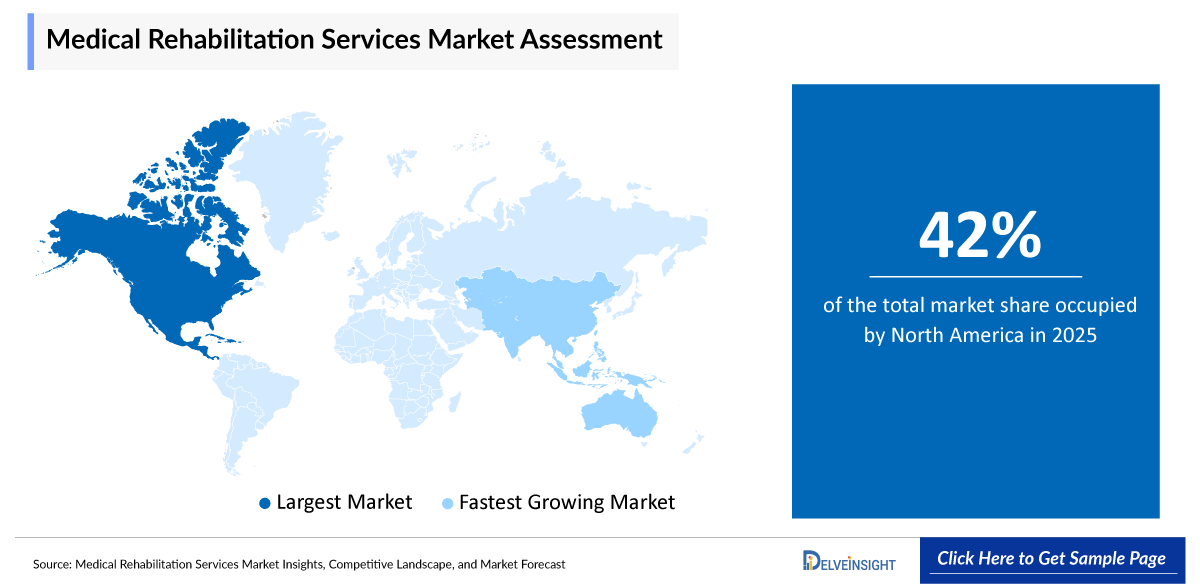
- North America accounted for the largest share of the medical rehabilitation services market at 42% in 2025, while Asia-Pacific is anticipated to register the fastest growth through 2034.
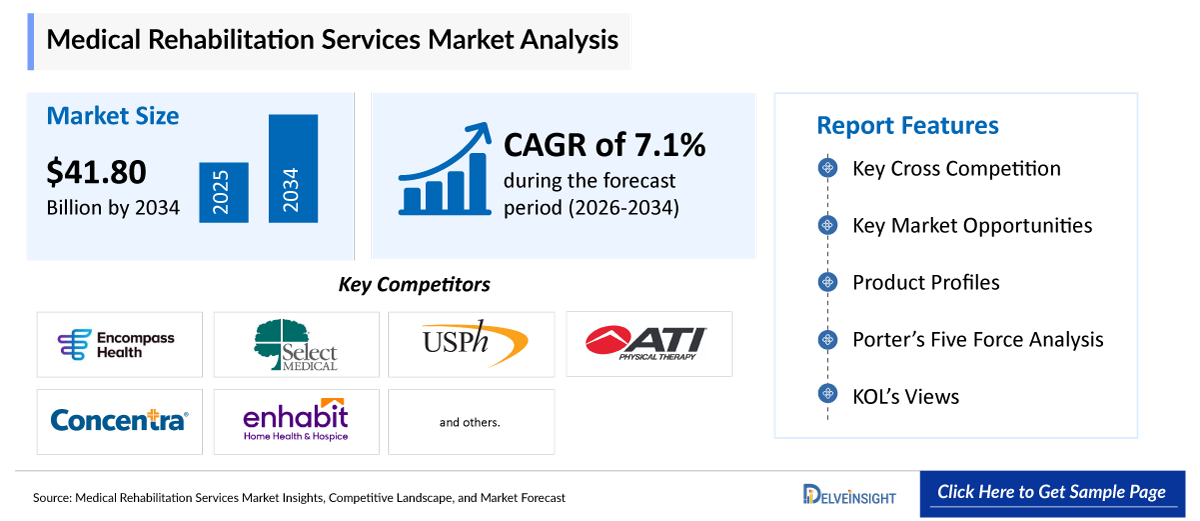
Medical rehabilitation services are the therapeutic services delivered by rehabilitation professionals to restore function, mobility, independence, and quality of life to patients recovering from injury, illness, surgery, or disabling conditions. The scope encompasses physical therapy, which restores movement, strength, and mobility and manages pain; occupational therapy, which restores the skills of daily living; and speech-language therapy, which restores communication, cognition, and swallowing, delivered across inpatient rehabilitation facilities, outpatient clinics, skilled nursing facilities, and home-based settings. Leading providers include Encompass Health, the largest network of inpatient rehabilitation hospitals; Select Medical; and hospital systems and outpatient and home-based providers, and inpatient rehabilitation is delivered by interdisciplinary teams of physicians of rehabilitation medicine, physical, occupational, and speech therapists, and rehabilitation nurses. Rehabilitation care treats neurological, orthopedic, cardiopulmonary, and other conditions across the continuum from acute care through post-acute and outpatient settings, and the contemporary market is shaped by the aging population, the growth of post-acute care, and the shift toward value-based and home-based rehabilitation.
Medical Rehabilitation Services Market Key Growth Drivers
- Aging population and rising burden of chronic and disabling conditions that increase the number of patients requiring rehabilitation.
- Growth of stroke, orthopedic, and neurological rehabilitation demand, driven by the rising incidence of stroke, the growth of joint replacement, and the prevalence of neurological conditions.
- Shift toward value-based and post-acute care that emphasizes functional recovery, reduced readmission, and coordinated post-acute rehabilitation.
- Expansion of outpatient and home-based rehabilitation that provides accessible and cost-effective care outside the inpatient setting.
- Growth of joint replacement and orthopedic surgery that requires postoperative rehabilitation.
- Recognition of the clinical and functional value of rehabilitation in recovery, independence, and quality of life.
- Adoption of technology, including telerehabilitation and rehabilitation technologies, that extends and enhances rehabilitation services.
Key Companies in Medical Rehabilitation Services Market
The leading participants in the medical rehabilitation services market include the following:
- Encompass Health Corporation
- Select Medical Holdings Corporation
- U.S. Physical Therapy, Inc.
- ATI Holdings, LLC
- Concentra Group Holdings Parent, Inc.
- Enhabit, Inc.
- Brooks Rehabilitation
- Kessler Institute for Rehabilitation
- Shirley Ryan AbilityLab
- NHS Trusts
For illustrative purposes, only the top 10 companies are listed in the Table of Contents. The report may include analysis and references to additional organizations relevant to the market assessment.
Medical Rehabilitation Services Market Size
The following table summarizes the headline market metrics for the global medical rehabilitation services market across the base year and the forecast horizon.
|
Report Metrics |
Details |
|
2025 Market Size |
USD 22.50 billion |
|
2034 Projected Market Size |
USD 41.80 billion |
|
Growth Rate (2026-2034) |
7.1% CAGR |
|
Largest Market |
North America (42% share in 2025) |
|
Fastest Growing Market |
Asia-Pacific |
|
Market Structure |
Fragmented |
All market values are expressed in USD and represent DelveInsight estimates synthesized from primary and secondary research.
Factors Contributing to the Growth of the Medical Rehabilitation Services Market
Market Drivers
Aging Population and Rising Burden of Chronic and Disabling Conditions
The foundational driver of the medical rehabilitation services market is the aging of the population and the rising burden of chronic and disabling conditions, which increase the number of patients requiring rehabilitation. The aging of the population increases the incidence of stroke, falls and fractures, joint degeneration, cardiovascular and pulmonary disease, and neurological conditions, all of which require rehabilitation to restore function and independence, and the growth of the elderly population enlarges the population needing rehabilitative care. The rising prevalence of chronic and disabling conditions, including the sequelae of stroke, cardiovascular disease, diabetes, and musculoskeletal disorders, increases the demand for the physical, occupational, and speech therapy that restores function and manages disability. Rehabilitation is essential to the recovery and independence of patients following stroke, surgery, injury, and illness, and the growing population of older and chronically ill patients increases the volume of rehabilitation. As the population ages and as the burden of chronic and disabling conditions rises, the number of patients requiring rehabilitation to recover function and independence grows in step. The relentless growth in the aging and chronically ill population, and the disability it entails, sustains steady demand for medical rehabilitation services across the forecast period and anchors the growth of the market.
Growth of Stroke, Orthopedic, and Neurological Rehabilitation Demand
The growth of stroke, orthopedic, and neurological rehabilitation demand is a major driver, since these conditions are among the largest and most rehabilitation-intensive areas of care. Stroke is a leading cause of long-term disability, and the rising incidence of stroke and the improvement in acute survival increase the population of stroke survivors requiring intensive neurological rehabilitation to restore movement, communication, and function. Orthopedic rehabilitation demand grows with the rising volume of joint replacement, spine surgery, and fracture care, all of which require postoperative rehabilitation to restore mobility and function, and the growth of joint replacement with the aging population drives orthopedic rehabilitation. Neurological rehabilitation demand grows with the prevalence of neurological conditions, including brain and spinal cord injury, Parkinson's disease, multiple sclerosis, and other conditions that require intensive, specialized rehabilitation. Rehabilitation providers deliver specialized neurological, orthopedic, and cardiopulmonary rehabilitation programs, treating conditions including stroke, brain and spinal cord injury, and orthopedic and neurological conditions. As the incidence of stroke rises, as joint replacement and orthopedic surgery grow, and as neurological conditions become more prevalent, the demand for the specialized rehabilitation that these conditions require grows. The growth of stroke, orthopedic, and neurological rehabilitation demand sustains demand for medical rehabilitation services across the forecast period.
Shift Toward Value-Based and Post-Acute Care
The shift toward value-based and post-acute care is a defining driver that emphasizes the functional recovery and coordinated post-acute rehabilitation that rehabilitation services provide. Value-based care rewards outcomes, functional recovery, and the reduction of readmissions, and rehabilitation is central to restoring function, enabling patients to return home, and preventing the complications and readmissions that follow acute care. Post-acute care, including inpatient rehabilitation, skilled nursing, and home-based rehabilitation, manages the recovery of patients following acute hospitalization, and the coordination of post-acute rehabilitation is a focus of value-based and bundled payment arrangements. Rehabilitation improves functional outcomes, reduces the length of acute stays, enables discharge to home, and prevents readmissions, aligning with the goals of value-based care, and the emphasis on functional recovery and the management of the post-acute period drives the demand for rehabilitation. The alignment of rehabilitation with the goals of value-based and post-acute care, and the recognition of its role in functional recovery and the reduction of cost and readmission, drive the adoption and value of rehabilitation services. As care shifts toward value and as the management of the post-acute period becomes central, demand for the rehabilitation that restores function and prevents readmission grows. The shift toward value-based and post-acute care sustains demand for medical rehabilitation services across the forecast period.
Expansion of Outpatient and Home-Based Rehabilitation
The expansion of outpatient and home-based rehabilitation is a powerful driver that broadens access and shifts care toward accessible and cost-effective settings. Rehabilitation is increasingly delivered in outpatient clinics and in the home, providing accessible, convenient, and cost-effective care outside the inpatient setting, and the growth of outpatient and home-based rehabilitation expands the reach and volume of rehabilitation services. Outpatient rehabilitation provides physical, occupational, and speech therapy for patients who do not require inpatient care, serving the large population recovering from surgery, injury, and illness, and home-based rehabilitation brings therapy to patients in their homes, supporting recovery and independence and reducing the need for facility-based care. The shift toward outpatient and home-based care is driven by cost, patient preference, and the value-based emphasis on care in the least intensive appropriate setting, and providers expand their outpatient and home-based rehabilitation to meet this demand. Direct access to physical therapy in many jurisdictions, which allows patients to access therapy without a physician order, further expands outpatient rehabilitation. As rehabilitation shifts toward outpatient and home-based settings for access, cost, and preference, demand for these services grows. The expansion of outpatient and home-based rehabilitation broadens the market and sustains demand across the forecast period.
Growth of Joint Replacement and Orthopedic Surgery
The growth of joint replacement and orthopedic surgery drives the demand for the postoperative rehabilitation that restores mobility and function. Joint replacement, including hip and knee replacement, is among the most common elective surgical procedures, and its volume grows with the aging population and the rising prevalence of osteoarthritis; each procedure requires postoperative rehabilitation to restore mobility, strength, and function. Spine surgery, fracture care, and other orthopedic procedures also require rehabilitation, and the growth of orthopedic surgery increases the volume of postoperative rehabilitation. Rehabilitation following joint replacement and orthopedic surgery is essential to the restoration of function and the success of the procedure, and it is delivered across inpatient, outpatient, and home-based settings. The growth of joint replacement and orthopedic surgery, driven by the aging population and the demand for mobility and quality of life, increases the volume of postoperative rehabilitation and the demand for rehabilitation services. As joint replacement and orthopedic surgery grow, the demand for rehabilitation that restores function following these procedures grows. The growth of joint replacement and orthopedic surgery sustains demand for medical rehabilitation services across the forecast period.
Recognition of the Clinical and Functional Value of Rehabilitation
The recognition of the clinical and functional value of rehabilitation in recovery, independence, and quality of life drives the adoption and demand for rehabilitation services. Rehabilitation restores function, mobility, communication, and independence, enabling patients to recover from injury, illness, and surgery and to return to their lives, and the recognition of its value in recovery and quality of life drives its adoption. Rehabilitation improves functional outcomes, reduces disability, enables independence and return to home and work, and improves quality of life, and its role in the recovery of patients following stroke, surgery, injury, and illness is well established. The growing recognition of the value of rehabilitation, the emphasis on functional recovery and quality of life, and the evidence of the benefit of rehabilitation drive the demand for rehabilitation services across conditions and settings. Healthcare systems, payers, and patients recognize the value of rehabilitation in restoring function and independence and in reducing the cost and burden of disability, and this recognition drives the adoption and demand for rehabilitation. As the value of rehabilitation in recovery, independence, and quality of life is recognized, demand for rehabilitation services grows. The recognition of the clinical and functional value of rehabilitation sustains demand for medical rehabilitation services across the forecast period.
Adoption of Technology and Telerehabilitation
The adoption of technology, including telerehabilitation and rehabilitation technologies, extends and enhances rehabilitation services and drives their growth. Telerehabilitation delivers rehabilitation remotely through video and connected technology, extending the reach of rehabilitation to patients at home and in remote areas and supporting the continuity of care, and its adoption has expanded and continues to grow as a complement to in-person rehabilitation. Rehabilitation technologies, including robotics, virtual reality, sensors, and connected devices, enhance the delivery and outcomes of rehabilitation, enabling intensive, measurable, and engaging therapy, and providers adopt these technologies to enhance their services. Technology extends the reach of rehabilitation, enhances its intensity and measurement, supports the continuity of care, and improves engagement and outcomes; its adoption enhances the value and accessibility of rehabilitation services. The adoption of telerehabilitation and rehabilitation technologies enables providers to extend their reach, enhance their outcomes, and differentiate their services. As telerehabilitation and rehabilitation technologies advance and as providers adopt them, the reach, quality, and value of rehabilitation services grow. The adoption of technology and telerehabilitation sustains the growth and modernization of the medical rehabilitation services market across the forecast period.
Market Restraints
The medical rehabilitation services market faces several interrelated restraints that temper its growth. The foremost is reimbursement pressure and complexity, since rehabilitation services depend heavily on reimbursement from Medicare, Medicaid, and other payers, and the constraints, adjustments, and complexity of reimbursement, including the inpatient rehabilitation facility prospective payment system, therapy payment policies, and coverage requirements, pressure the margins and viability of rehabilitation providers. The regulatory and coverage requirements for rehabilitation, including the inpatient rehabilitation facility sixty percent rule, the intensity-of-therapy requirements, and the documentation and coverage rules, add compliance burden and constrain admission and reimbursement, and audits and coverage denials pose financial risk. The shortage of rehabilitation professionals, including physical, occupational, and speech therapists and rehabilitation nurses, constrains the capacity of providers to deliver services and increases labor costs, and the reliance on skilled clinical labor makes rehabilitation labor-intensive and sensitive to workforce shortages and wage pressure. The cost of rehabilitation care and the variability of coverage constrain access for some patients, and the out-of-pocket cost and coverage limits can limit the use of services. The competition among inpatient, skilled nursing, outpatient, and home-based settings and the pressure to deliver care in the least intensive setting can shift volume and pressure on providers. The measurement and demonstration of functional outcomes, increasingly required by payers and value-based arrangements, add reporting burden. The variability of rehabilitation infrastructure and access across regions, particularly in lower-resource settings, constrains the market. Together, these factors moderate the pace and scope of growth and require providers to demonstrate outcomes, efficiency, and value and to manage reimbursement, regulation, and workforce to sustain growth.
Medical Rehabilitation Services Market Segment Analysis
The global medical rehabilitation services market is segmented by service type (physical therapy, occupational therapy, speech-language therapy, and others), by condition (neurological rehabilitation, orthopedic and musculoskeletal rehabilitation, cardiopulmonary rehabilitation, and others), by setting (inpatient rehabilitation facilities, outpatient rehabilitation, skilled nursing facilities and home-based rehabilitation), by age group (afults, geriatric, and pediatric), and by geography (North America, Europe, Asia-Pacific, and the Rest of the World).
By Service Type
Dominant Subsegment: Physical Therapy.
The physical therapy category is expected to dominate the market. The physical therapy segment accounted for a 46% share of the medical rehabilitation services market in 2025. Physical therapy, which restores movement, strength, mobility, and function and manages pain, is the leading service type because it is the most widely delivered rehabilitation service, addressing the mobility and functional needs of the largest population of rehabilitation patients across conditions and settings. The dominance of the segment reflects the centrality of physical therapy to rehabilitation, the breadth of conditions it addresses, and its delivery across inpatient, outpatient, and home-based settings. Physical therapists develop individualized treatment plans to improve the ability to move, build strength, manage pain, and prevent disability, and physical therapy is central to the rehabilitation of orthopedic, neurological, cardiopulmonary, and other conditions. Physical therapy is delivered to patients recovering from surgery, injury, stroke, and illness across the continuum of care, and it is the most common rehabilitation service. The breadth of conditions, the centrality of mobility and function to recovery, and the delivery across settings drive the physical therapy segment. While occupational therapy and speech-language therapy are essential and complementary services, the breadth, centrality, and volume of physical therapy sustain the leadership of the physical therapy segment across the forecast period.
By Condition
Dominant Subsegment: Neurological Rehabilitation.
The neurological rehabilitation category is expected to dominate the market. The neurological rehabilitation segment accounted for a 32% share of the medical rehabilitation services market in 2025. Neurological rehabilitation, which addresses stroke, brain and spinal cord injury, and neurological conditions, is the leading condition category because it is among the most rehabilitation-intensive areas of care, requiring intensive, specialized, and prolonged rehabilitation across physical, occupational, and speech therapy. The dominance of the segment reflects the high burden of stroke and neurological conditions, the intensity and duration of neurological rehabilitation, and the centrality of neurological conditions to inpatient and specialized rehabilitation. Stroke is a leading cause of long-term disability and requires intensive rehabilitation to restore movement, communication, and function, and brain and spinal cord injury and neurological diseases require specialized, intensive rehabilitation. Neurological rehabilitation engages the full interdisciplinary team and the full range of therapies over an extended course, making it intensive and resource-intensive, and it is a central focus of inpatient rehabilitation facilities. The high burden of stroke and neurological conditions, the intensity and duration of neurological rehabilitation, and its centrality to specialized rehabilitation drive the segment. While orthopedic, cardiopulmonary, and other conditions are significant, the burden, intensity, and centrality of neurological rehabilitation sustain the leadership of the neurological rehabilitation segment across the forecast period.
By Setting
Dominant Subsegment: Outpatient Rehabilitation.
The outpatient rehabilitation category is expected to dominate the market. The outpatient rehabilitation segment accounted for a 40% share of the medical rehabilitation services market in 2025. Outpatient rehabilitation, which delivers physical, occupational, and speech therapy to patients who do not require inpatient care, is the leading setting because it serves the largest population of rehabilitation patients, providing accessible and cost-effective care for the many patients recovering from surgery, injury, and illness. The dominance of the segment reflects the large volume of outpatient rehabilitation, the shift toward care in the least intensive appropriate setting, and the accessibility and cost-effectiveness of outpatient care. Outpatient clinics provide rehabilitation for patients recovering from orthopedic surgery, injury, and a range of conditions, serving a large and growing population, and direct access to physical therapy in many jurisdictions expands the reach of outpatient rehabilitation. The shift toward outpatient and ambulatory care, driven by cost, preference, and the value-based emphasis on the least intensive setting, concentrates volume in outpatient rehabilitation. While inpatient rehabilitation facilities, skilled nursing facilities, and home-based rehabilitation are essential settings, the large volume, accessibility, and cost-effectiveness of outpatient rehabilitation sustain the leadership of the outpatient rehabilitation segment across the forecast period.
By Age Group
Dominant Subsegment: Adults.
The adults category is expected to dominate the market. The adults segment accounted for a 52% share of the medical rehabilitation services market in 2025. Adults, encompassing the working-age and older adult population, are the leading age group because they represent the largest population requiring rehabilitation, driven by the incidence of stroke, orthopedic surgery, injury, and chronic and disabling conditions across the adult and aging population. The dominance of the segment reflects the concentration of rehabilitation need in the adult and older adult population, the high incidence of stroke, joint replacement, and injury among adults, and the growth of the aging adult population. Adults require rehabilitation following stroke, joint replacement, spine surgery, injury, cardiovascular and pulmonary disease, and neurological conditions, and the aging of the adult population increases the incidence of the conditions that require rehabilitation. The large and growing adult and older adult population, and the concentration of rehabilitation-requiring conditions among adults, drive the adults segment. While pediatric rehabilitation is an important and specialized area addressing developmental, congenital, and injury-related conditions in children, the large volume and growth of the adult and older adult population sustain the leadership of the adults segment across the forecast period, and it shapes the direction of the market.
Medical Rehabilitation Services Market Region Analysis
Dominant Region: North America
North America accounted for a 42% share of the global medical rehabilitation services market in 2025, representing the highest regional market share globally. The leadership of the region reflects the developed rehabilitation infrastructure, the reimbursement of rehabilitation by Medicare and other payers, the concentration of large rehabilitation providers, and the aging population. The United States is the largest national market, supported by the extensive network of inpatient rehabilitation facilities, outpatient clinics, and home-based providers, the reimbursement of rehabilitation under the Medicare inpatient rehabilitation facility prospective payment system and outpatient therapy payment, the presence of large rehabilitation providers, and the aging population and high burden of stroke, orthopedic, and chronic conditions. The Centers for Medicare and Medicaid Services reimburses inpatient rehabilitation under a prospective payment system with classification and coverage requirements, including the sixty percent rule and intensity-of-therapy requirements, and accreditation by the Commission on Accreditation of Rehabilitation Facilities supports quality. The leading providers, including the large inpatient rehabilitation and post-acute care networks and the outpatient and home-based providers, operate extensively in the region, and the rehabilitation infrastructure is developed. The developed infrastructure, the reimbursement of rehabilitation, the concentration of providers, and the aging population reinforce the leadership of the region. The combination of infrastructure, reimbursement, provider presence, and demographic demand sustains the position of North America as the largest regional market across the forecast period.
Fastest Growing Region: Asia-Pacific
Asia-Pacific is projected to register the fastest compound annual growth rate through 2034. The region combines large and aging populations, the rising burden of stroke and chronic conditions, the expansion of rehabilitation infrastructure, and the growth of healthcare investment, which drives the fast growth of the market. China, India, and Japan are the principal national markets, supported by the aging of large populations, the rising incidence of stroke and disabling conditions, the growth of orthopedic and neurological care, the expansion of rehabilitation infrastructure and workforce, and the growth of healthcare investment and access. The growth of the population requiring rehabilitation, the expansion of rehabilitation services and infrastructure, and the rising recognition of the value of rehabilitation enlarge the demand for rehabilitation services. As populations age, as the burden of stroke and chronic conditions rises, and as rehabilitation infrastructure expands, the region increases its provision of rehabilitation services from a growing base, and the scale of the aging population and the expansion of infrastructure create substantial long-term demand. The combination of aging populations, rising disease burden, infrastructure expansion, and healthcare investment positions Asia-Pacific as the fastest-growing regional market, and it attracts investment and the expansion of rehabilitation providers and services.
Regional Commentary
North America
North America leads the market, supported by the developed rehabilitation infrastructure, the reimbursement of rehabilitation by Medicare and other payers, the concentration of large rehabilitation providers, and the aging population. The United States dominates the region through its extensive network of inpatient, outpatient, and home-based rehabilitation, the reimbursement of rehabilitation under the Medicare prospective payment system, and the presence of large providers. The coverage requirements and accreditation of rehabilitation shape the market, and the aging population sustains demand.
Europe
Europe is a substantial market shaped by developed healthcare systems, the provision of rehabilitation through public and private providers, and the aging population. Germany, the United Kingdom, France, Italy, and Spain are the principal national markets, supported by the provision of rehabilitation through national health systems and private providers, the aging population, and the burden of stroke, orthopedic, and chronic conditions. Demand is sustained by the aging population, the burden of disabling conditions, and the emphasis on functional recovery and rehabilitation.
Asia-Pacific
Asia-Pacific is the fastest-growing region, driven by large and aging populations, the rising burden of stroke and chronic conditions, the expansion of rehabilitation infrastructure, and the growth of healthcare investment across China, India, and Japan. Aging populations, rising disease burden, and infrastructure expansion sustain rapid growth, and the region attracts investment and the expansion of rehabilitation services.
Rest of World
The Rest of World, spanning Latin America, the Middle East, and Africa, represents an emerging opportunity as rehabilitation infrastructure expands and as the burden of disabling conditions grows. Growth is supported by the aging of populations, the rising burden of stroke and injury, and the expansion of rehabilitation services and access, though rehabilitation infrastructure and access vary and remain limited in lower-resource settings. Providers and health systems expand rehabilitation services to meet growing demand.
Medical Rehabilitation Services Market Competitive Landscape
The global medical rehabilitation services market is classified as Fragmented. A large and diverse group of providers delivers rehabilitation services, including inpatient rehabilitation and post-acute care networks, outpatient rehabilitation providers, home-based rehabilitation providers, hospital systems, and public health systems, and no single provider holds a dominant share of the global market, which is delivered across many settings, regions, and health systems. Competition centers on the quality and outcomes of rehabilitation, the breadth of services and settings, the specialization in conditions such as stroke and neurological rehabilitation, geographic reach and access, payer relationships and reimbursement, and accreditation and reputation, and the expansion of providers, partnerships, and the shift toward outpatient and home-based care intensify the contest. The competitive landscape is evaluated across the following dimensions:
- Market concentration: Fragmented, with inpatient rehabilitation and post-acute care networks, outpatient rehabilitation providers, home-based providers, hospital systems, and public health systems, and no single provider holding a dominant share of the global market.
- Leading players: Encompass Health, the largest network of inpatient rehabilitation hospitals, and Select Medical lead in inpatient and post-acute rehabilitation; U.S. Physical Therapy, ATI, and Concentra lead in outpatient rehabilitation; Enhabit leads in home-based rehabilitation, and Brooks Rehabilitation, Kessler Institute, Shirley Ryan AbilityLab, and public health systems provide specialized and system-based rehabilitation.
- Geographic reach: The large providers operate extensive networks of facilities and clinics, concentrated in North America, and hospital systems and public health systems provide rehabilitation across regions.
- Service portfolio strength: Competitive advantage rests on the breadth of services across physical, occupational, and speech therapy and across inpatient, outpatient, and home-based settings, and on the specialization in conditions such as stroke and neurological rehabilitation.
- Pipeline strength: Development is concentrated in the expansion of outpatient and home-based rehabilitation, specialized condition programs, telerehabilitation and rehabilitation technology, and value-based and outcomes-focused care.
- Strategic partnerships: Collaboration spans joint ventures between rehabilitation providers and hospital systems, partnerships across the post-acute continuum, and alliances that extend reach and services.
- M&A activity: Consolidation has shaped the field, with rehabilitation providers acquiring and building facilities and clinics and expanding across settings, and the field includes large public companies and networks alongside many local and regional providers.
- Innovation focus: Innovation is shifting toward outpatient and home-based rehabilitation, telerehabilitation and rehabilitation technology, specialized condition programs, and value-based and outcomes-focused care.
- Regulatory standing: Compliance with the Medicare inpatient rehabilitation facility prospective payment system and coverage requirements, including the sixty percent rule and intensity-of-therapy requirements, and accreditation by the Commission on Accreditation of Rehabilitation Facilities and other bodies, are decisive competitive credentials and a principal axis of competition among the providers.
Medical Rehabilitation Services Market Recent Developmental Activities
In 2024 and 2025, the Centers for Medicare and Medicaid Services issued the inpatient rehabilitation facility prospective payment system final rules for federal fiscal years 2024, 2025, and 2026, updating payment rates and policies and the quality reporting program, with the fiscal year 2026 rule effective October 1, 2025. Strategic significance: the rules updated the reimbursement and policy framework for inpatient rehabilitation and shaped the operating environment for providers.
In 2024 and 2025, Encompass Health Corporation expanded its network of inpatient rehabilitation hospitals, the largest such network, through the construction and acquisition of hospitals and joint ventures with health systems. Strategic significance: the expansion reinforced the leadership of the largest inpatient rehabilitation provider and increased access to inpatient rehabilitation.
In 2024 and 2025, Encompass Health Corporation received recognition for patient experience, ranking among the top large United States health systems for delivering outstanding care. Strategic significance: the recognition reinforced the reputation and quality position of the leading inpatient rehabilitation provider.
In 2024 and 2025, Select Medical Holdings Corporation advanced its inpatient rehabilitation, outpatient rehabilitation, and specialty hospital operations, including specialized neurological and orthopedic rehabilitation programs. Strategic significance: the developments reinforced the position of a leading provider across inpatient and outpatient rehabilitation.
In 2024 and 2025, U.S. Physical Therapy, Inc. and ATI Holdings, LLC expanded their outpatient physical therapy clinic networks through the addition and acquisition of clinics. Strategic significance: the expansion reinforced the growth of outpatient rehabilitation and the position of leading outpatient providers.
In 2024 and 2025, Enhabit, Inc. advanced its home health and home-based rehabilitation services, delivering rehabilitation to patients in their homes. Strategic significance: the developments reinforced the growth of home-based rehabilitation and the shift of care toward the home.
In 2024 and 2025, rehabilitation providers expanded telerehabilitation and the adoption of rehabilitation technologies, including robotics, virtual reality, and connected devices, to extend and enhance rehabilitation. Strategic significance: The adoption of technology extended the reach and enhanced the outcomes of rehabilitation services.
In 2024 and 2025, hospital systems and rehabilitation providers formed joint ventures to develop and operate inpatient rehabilitation hospitals and units, combining hospital systems' patients with rehabilitation providers' expertise. Strategic significance: the joint ventures expanded inpatient rehabilitation capacity and integrated rehabilitation with acute care systems.
In 2024 and 2025, specialized rehabilitation providers including Brooks Rehabilitation, Kessler Institute for Rehabilitation, and Shirley Ryan AbilityLab advanced their specialized neurological, spinal cord injury, and brain injury rehabilitation programs and research. Strategic significance: the developments reinforced the role of specialized rehabilitation providers in complex neurological and injury rehabilitation.
In 2024 and 2025, providers expanded specialized condition programs, including stroke, brain and spinal cord injury, orthopedic, cardiopulmonary, and oncology rehabilitation. Strategic significance: the expansion of specialized programs reinforced the depth and differentiation of rehabilitation services across conditions.
In 2024 and 2025, providers advanced value-based and outcomes-focused rehabilitation, measuring and demonstrating functional outcomes and reducing readmissions in alignment with value-based care. Strategic significance: The emphasis on outcomes and value aligned rehabilitation with value-based care and reinforced its role in functional recovery.
In 2024 and 2025, the leading providers advanced the expansion of outpatient and home-based rehabilitation, specialized condition programs, telerehabilitation and technology, and value-based care across medical rehabilitation services. Strategic significance: the convergence of the providers on outpatient and home-based care, specialization, technology, and value confirmed these as the defining directions of the market and signaled a market advancing toward accessible, specialized, and outcomes-focused rehabilitation.
Medical Rehabilitation Services Market Segmentation
Medical Rehabilitation Services Market Assessment by Service Type
- Physical Therapy
- Occupational Therapy
- Speech-Language Therapy
- Others
Medical Rehabilitation Services Market Assessment by Condition
- Neurological Rehabilitation
- Orthopedic and Musculoskeletal Rehabilitation
- Cardiopulmonary Rehabilitation
- Others
Medical Rehabilitation Services Market Assessment by Setting
- Inpatient Rehabilitation Facilities
- Outpatient Rehabilitation
- Skilled Nursing Facilities
- Home-Based Rehabilitation
Medical Rehabilitation Services Market Assessment by Age Group
- Adults
- Geriatric
- Pediatric
Medical Rehabilitation Services Market Assessment by Geography
- North America
- United States Medical Rehabilitation Services Market Size in USD million (2023-2034)
- Canada Medical Rehabilitation Services Market Size in USD million (2023-2034)
- Mexico Medical Rehabilitation Services Market Size in USD million (2023-2034)
- Europe
- Germany Medical Rehabilitation Services Market Size in USD million (2023-2034)
- United Kingdom Medical Rehabilitation Services Market Size in USD million (2023-2034)
- France Medical Rehabilitation Services Market Size in USD million (2023-2034)
- Italy Medical Rehabilitation Services Market Size in USD million (2023-2034)
- Spain Medical Rehabilitation Services Market Size in USD million (2023-2034)
- Rest of Europe Medical Rehabilitation Services Market Size in USD million (2023-2034)
- Asia-Pacific
- China Medical Rehabilitation Services Market Size in USD million (2023-2034)
- Japan Medical Rehabilitation Services Market Size in USD million (2023-2034)
- India Medical Rehabilitation Services Market Size in USD million (2023-2034)
- Australia Medical Rehabilitation Services Market Size in USD million (2023-2034)
- South Korea Medical Rehabilitation Services Market Size in USD million (2023-2034)
- Rest of Asia-Pacific Medical Rehabilitation Services Market Size in USD million (2023-2034)
- Rest of the World
- Middle East Medical Rehabilitation Services Market Size in USD million (2023-2034)
- Africa Medical Rehabilitation Services Market Size in USD million (2023-2034)
- South America Medical Rehabilitation Services Market Size in USD million (2023-2034)
Medical Rehabilitation Services Market Recent Industry Trends and Milestones (2023-2026)
|
Category |
Key Developments |
|
Medical Rehabilitation Services Market Service Advancement |
The period was defined by the expansion of settings and the advancement of specialized and technology-enabled rehabilitation. Encompass Health expanded the largest network of inpatient rehabilitation hospitals, Select Medical advanced inpatient and outpatient rehabilitation, U.S. Physical Therapy and ATI expanded outpatient clinics, and Enhabit advanced home-based rehabilitation. Specialized providers advanced neurological and injury rehabilitation, and providers adopted telerehabilitation and rehabilitation technology. Together, these advances concentrated competition in accessible, specialized, and technology-enabled rehabilitation. |
|
Medical Rehabilitation Services Market Service Expansion |
Service expansion advanced along three axes. The first is outpatient and home-based rehabilitation, as providers expanded clinics and home-based services to deliver accessible and cost-effective care. The second is specialized condition programs, as providers advanced stroke, neurological, orthopedic, cardiopulmonary, and oncology rehabilitation. The third is technology, as providers adopted telerehabilitation, robotics, virtual reality, and connected devices to extend and enhance rehabilitation. Providers also advanced value-based and outcomes-focused care and formed joint ventures with hospital systems. |
|
Medical Rehabilitation Services Market Investment |
Investment was shaped by the expansion of settings and the consolidation of providers. Rehabilitation providers invested in building and acquiring inpatient hospitals and outpatient clinics, forming joint ventures with hospital systems, and expanding home-based rehabilitation. Investment flowed into telerehabilitation and rehabilitation technology, specialized condition programs, and value-based and outcomes-focused care, and providers navigated the reimbursement and coverage framework of the inpatient rehabilitation facility prospective payment system and therapy payment. |
|
Company Strategy |
The unifying strategic theme is the delivery of accessible, specialized, and outcomes-focused rehabilitation across the continuum of settings. Encompass Health and Select Medical are advancing inpatient and post-acute rehabilitation, U.S. Physical Therapy, ATI, and Concentra are advancing outpatient rehabilitation, and Enhabit is advancing home-based rehabilitation. Brooks Rehabilitation, Kessler Institute, Shirley Ryan AbilityLab, and public health systems are advancing specialized rehabilitation. Across the field, strategy centers on outpatient and home-based expansion, specialization, technology, and value-based care. |
|
Emerging Technologies |
The defining emerging technologies are telerehabilitation that delivers rehabilitation remotely and extends its reach; rehabilitation robotics and exoskeletons that enable intensive and measurable therapy; virtual and augmented reality that provides engaging and functional therapy; and sensors and connected devices that measure and support rehabilitation. Supporting these are outcome measurement and analytics, value-based care models, and the integration of rehabilitation across the post-acute continuum. Across these, the trajectory is toward rehabilitation that is accessible, specialized, technology-enabled, and outcomes-focused, improving the recovery, function, and independence of patients across conditions and settings. |
Medical Rehabilitation Services Market Startup Funding and Investment Trends
Investment in the medical rehabilitation field has concentrated on models and technologies that make rehabilitation more accessible, more measurable, and more effective, namely outpatient and home-based rehabilitation, telerehabilitation, rehabilitation technology, and value-based care. Because the market is fragmented across large provider networks and many local and specialized providers, investment includes the consolidation of providers and the funding of technologies and models that extend and enhance rehabilitation. The table below summarizes representative companies advancing the next generation of rehabilitation services and technology.
|
Company |
Total Funding |
Funding Stage |
Main Product/Offering |
Core Technology |
|
Hinge Health, Inc. |
Publicly listed |
Commercial stage |
Digital musculoskeletal care |
Virtual physical therapy and monitoring |
|
Sword Health |
Venture-backed |
Commercial stage |
Digital physical therapy |
Virtual rehabilitation and sensors |
|
Request for unlocking the report of the @ Medical Rehabilitation Services Market | ||||
Capital formation in this field is shaped by the presence of large provider networks and a broad base of local and specialized providers, so investment has favored the consolidation of providers and the funding of digital, home-based, and technology-enabled rehabilitation that extends access and enhances outcomes. Digital and virtual rehabilitation is a clear thesis, delivering physical therapy remotely and at scale for musculoskeletal and other conditions. Home-based and on-demand rehabilitation constitutes a second thesis, bringing therapy to the patient, and rehabilitation technology a third, enabling intensive and measurable therapy. The archetypal outcome is growth into a provider or platform, acquisition by a rehabilitation or healthcare company, or partnership with payers and employers, which provides a path that sustains investment. The principal risks are the reimbursement and coverage of rehabilitation, the workforce shortage of therapists, the regulation and coverage requirements, and the competition across settings and providers.
Key Takeaways from the Medical Rehabilitation Services Market Report Study
- Market size analysis for the current medical rehabilitation services market size (2025) and market forecast for 9 years (2026 to 2034).
- Top key service, program, and technology developments, partnerships, joint ventures, and expansions that happened over the last 3 years.
- Key providers dominating the global medical rehabilitation services market.
- Various opportunities available for competitors in the medical rehabilitation services market space.
- What are the top-performing segments in 2025? How will these segments perform in 2034?
- Which are the top-performing regions and countries in the current medical rehabilitation services market scenario?
- Which are the regions and countries where providers should concentrate their opportunities for medical rehabilitation services market growth in the future?
Target audience who can benefit from this medical rehabilitation services market report study
- Medical rehabilitation service providers and post-acute care organizations
- Research organizations and consulting companies
- Rehabilitation-related organizations, associations, forums, and other alliances
- Government and corporate offices
- Start-up companies, venture capitalists, and private equity firms
- Hospitals, health systems, and payers dealing in rehabilitation services
- Various end-users who want to know more about the medical rehabilitation services market and the latest developments in the medical rehabilitation services market.

