Menkes Disease Market Summary
- The Menkes Disease Market Size is anticipated to grow with a significant CAGR during the study period (2022-2036).
- The leading Menkes Disease companies developing therapies in the treatment market include - Sentynl Therapeutics, Cyprium, and others.
Menkes Disease Market & Epidemiology Insights
- Menkes disease is a rare X-linked recessive pediatric disease caused by gene mutations of the copper transporter ATP7A. The minimum birth prevalence for Menkes disease is believed to be 1 in 34,810 live male births, and potentially as high as 1 in 8,664 live male births, based on recent genome-based ascertainment
- People with Menkes disease are born with the inability to absorb dietary copper and subsequently have impaired copper transport across the blood-brain barrier, and, until now, there has been no approved treatment in the United States.
- As per The Menkes Foundation, the minimum birth prevalence for Menkes disease is believed to be 1 in 34,810 live male births, and potentially as high as 1 in 8,664 live male births.
- Menkes disease is a devastating disorder, with death usually occuring between 6 months and 3 years of age.
- Copper histidinate (ZYCUBO) is the only approved therapy specifically developed for Menkes disease. The treatment has become the standard of care by addressing systemic copper deficiency and demonstrating the greatest clinical benefit when initiated during the neonatal period before significant neurological damage occurs.
- The Menkes disease pipeline remains limited, reflecting the challenges associated with ultra-rare disease drug development.
- One of the most notable investigational assets is AAV-ATP7A gene therapy, which aims to address the underlying genetic defect responsible for the disease rather than simply replacing deficient copper.
- The Menkes disease market remains highly underserved due to the ultra-rare nature of the disorder, limited treatment options, and the critical importance of early diagnosis and intervention to improve neurological outcomes.
- Despite the availability of copper replacement therapy, substantial unmet needs remain, as many patients are diagnosed after symptom onset when treatment efficacy is significantly reduced and irreversible neurological injury has already occurred.
Menkes Disease Market Size and Forecast in the 7MM
- 2025 Menkes Disease Market Size: ~XX million
- 2036 Projected Menkes Disease Market Size: ~XX million
- Menkes Disease Growth Rate (2026–2036): ~XX% CAGR
Request for unlocking the sample page of the "Menkes Disease Market Forecast"
Key Factors Driving the Menkes Disease Market
- Growing Focus on Rare Disease Research: Rising investments in rare disease research by academic institutions, biotechnology companies, patient advocacy groups, and government agencies are accelerating the development of novel therapies for Menkes disease.
- Development of Gene Therapy Approaches: The emergence of gene replacement strategies, including AAV-ATP7A gene therapy, has generated significant interest due to their potential to address the underlying genetic cause of Menkes disease and provide long-term clinical benefit.
- Supportive Regulatory Incentives for Rare Diseases: Orphan Drug Designation (ODD), Rare Pediatric Disease Designation, priority review pathways, and other regulatory incentives continue to encourage investment in Menkes disease drug development.
Scope of the Menkes Disease Market Report | |
|
Study Period |
2022–2036 |
|
Historical Year |
2022–2025 |
|
Forecast Period |
2026–2036 |
|
Base Year |
2026 |
|
Geographies Covered |
ü North America: The US; ü Europe: Germany, France, Italy, Spain and the UK; ü Asia-Pacific: Japan; |
|
Menkes Disease Market CAGR (Forecast period) |
~XX% (2026–2036) |
|
Menkes Disease Epidemiology Segmentation Analysis |
Patient Burden Assessment
|
|
Menkes Disease Companies |
· Sentynl Therapeutics · NICHD · Cyprium, and others |
|
Menkes Disease Therapies |
· Copper histidinate (ZYCUBO) · AAV-ATP7A Gene Therapy, and others |
|
Menkes Disease Market |
Segmented by · Region/Geographies · Drugs/Therapies |
|
Analysis |
· Addressable Patient Population · Market Drivers and Market Barriers · Cost Assumptions and Pricing Analogues · KOL Views · SWOT Analysis · Reimbursement · Conjoint Analysis · Unmet Need |
DelveInsight's "Menkes Disease Market Insights, Epidemiology and Market Forecast – 2036" report delivers an in-depth understanding of the Menkes disease, historical and forecasted epidemiology, as well as the Menkes disease market trends in the United States, EU4 (Germany, Spain, Italy, and France) and the United Kingdom, and Japan.
The Menkes disease market report delivers a comprehensive analysis of the current treatment landscape, including standards of care, clinical practices, and evolving therapeutic algorithms. It evaluates Menkes disease patient burden trends, revenue & market share dynamics, peak patient share & therapy uptake analysis, and provides an in-depth market size assessment, and growth rate projections (Historical & Forecast 2022–2036) across global regions. The report highlights key unmet medical needs in Menkes disease and maps the competitive and clinical landscape to uncover high-value opportunities, providing a clear outlook on future market growth potential.
Menkes Disease Disease Understanding
Menkes Disease Overview and Diagnosis
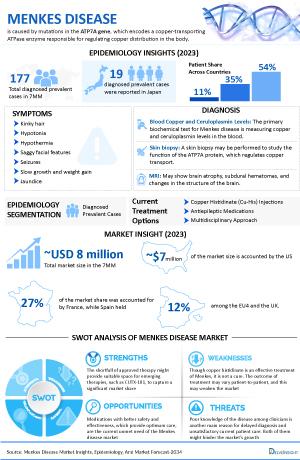
Menkes disease is a rare, X-linked recessive neurodegenerative disorder caused by mutations in the ATP7A gene, which encodes a copper-transporting ATPase essential for copper absorption and distribution throughout the body. Defective ATP7A function results in systemic copper deficiency and impaired activity of multiple copper-dependent enzymes, leading to progressive neurological deterioration, connective tissue abnormalities, developmental delay, seizures, hypotonia, and failure to thrive. The disease primarily affects males and typically presents during infancy. Characteristic clinical features include sparse, kinky or brittle hair, feeding difficulties, developmental regression, and severe neurological impairment. Without treatment, Menkes disease is often fatal in early childhood.
Diagnosis of Menkes disease is based on clinical presentation, biochemical findings, and genetic confirmation. Laboratory evaluation commonly reveals low serum copper and ceruloplasmin levels, while molecular testing identifies pathogenic variants in the ATP7A gene. Neuroimaging may demonstrate cerebral atrophy, delayed myelination, and vascular abnormalities associated with copper deficiency. Early diagnosis is critical because therapeutic outcomes are highly dependent on treatment initiation before significant neurological damage occurs. Increasing use of next-generation sequencing and expanded genetic testing panels is improving diagnostic accuracy and facilitating earlier detection of affected infants.
Further details are provided in the report...
Current Menkes Disease Treatment Landscape
Current treatment primarily involves parenteral copper replacement therapy, most commonly copper histidinate, which aims to restore copper availability and support the function of copper-dependent enzymes. Clinical benefit is greatest when treatment is initiated during the neonatal period, particularly before the onset of neurological symptoms. However, existing therapies do not fully correct the underlying genetic defect and may have limited efficacy in patients diagnosed later in the disease course. As a result, significant research efforts are focused on developing disease-modifying approaches, including AAV-ATP7A gene therapy and other genetic medicine strategies, with the goal of improving neurological outcomes and addressing the root cause of Menkes disease.
Further details related to country-based variations are provided in the report...
Menkes Disease Unmet Needs
The section “unmet needs of Menkes disease” outlines the critical gaps between the current state of patient care, diagnosis, and the ideal & effective management of the disease. It highlights the obstacles experienced by patients, clinicians, and researchers and identifies potential solutions for future progress.
1. Delayed diagnosis and limited newborn screening
2. Lack of curative and disease-modifying therapies
3. High morbidity and early mortality
4. Challenges in clinical trial recruitment and patient identification, and others…..
Note: Comprehensive unmet needs insights in Menkes Disease and their strategic implications are provided in the full report...
Menkes Disease Epidemiology
The Menkes Disease epidemiology section provides insights about the historical and current Menkes Disease patient pool and forecasted trends for individual seven major countries. It helps to recognize the causes of current and forecasted trends by exploring numerous studies and views of key opinion leaders. This part of the Menkes Disease market report also provides the diagnosed patient pool and their trends along with assumptions undertaken.
Key Findings from Menkes Disease Epidemiological Analysis and Forecast
- The US (~60%) accounted for the highest diagnosed prevalent cases of Menkes disease.
- France recorded the highest number of diagnosed prevalent cases of Menkes disease among the EU4 and the UK, followed by Germany.
- It is more common in boys, represent more than 90% of affected children.
- Menkes disease is more prevalent in males (~95%) than in females.
- The incidence of Menkes disease is about 1 in 35,000 live male births. The majority of diagnosed infants are male; however, MD may still occur in females, related to unusual genetic circumstances.
Menkes Disease Epidemiology Segmentation
- Menkes Disease Total Incident Cases
- Menkes Disease Total Prevalent Cases
- Menkes Disease Total Diagnosed Prevalent Cases
- Menkes Disease Treated Cases
Menkes Disease Drug Analysis & Competitive Landscape
The Menkes disease drug chapter provides a detailed, market-focused review of the emerging pipeline across preclinical clinical trials and preclinical trials. It covers the mechanism of action, Menkes Disease clinical trial data, regulatory approvals, patents, collaborations, and strategic partnerships for each therapy, along with their advantages, limitations, and recent developments. This section offers critical insights into the Menkes disease treatment landscape, supporting market assessment, competitive analysis, and growth forecasting for the Menkes disease therapeutics market.
Approved Therapies for Menkes Disease
Copper histidinate (ZYCUBO): Sentynl Therapeutics and Cyprium Therapeutics
Copper histidinate is the first and only FDA-approved, bioavailable copper replacement therapy for the treatment of Menkes disease, a copper transport deficiency caused by mutations in ATP7A. Copper histidinate is a SC injectable formulation of copper histidinate that is given daily to deliver elemental copper to the body. It demonstrated significant improvement in overall survival for Menkes disease patients with a nearly 80% reduction in the risk of death compared to the overall survival of patients in the untreated contemporaneous external control cohort.
The US FDA granted Breakthrough Therapy, Orphan Drug, Fast Track, and Rare Pediatric Disease (RPD) Designations. The EMA has also granted Orphan Drug Designation. The US FDA granted RPD Priority Review Voucher (PRV) and announced the closing of the sale of the PRV for USD 205 million in March 2026. Sentynl is the responsible party for commercialization of copper histidinate. Cyprium is eligible to receive tiered royalties on net sales and up to ~ USD 128 million in aggregate sales milestones.
Competitive Landscape of Menkes Disease Marketed/Approved Therapies | ||||||
|
Drug/Therapy |
Company |
Indication |
Molecule Type |
MoA |
RoA |
Marketed Region |
|
Copper histidinate (ZYCUBO) |
Sentynl Therapeutics and Cyprium Therapeutics |
Menkes disease |
Small molecule |
Copper replacement therapy |
SC |
US: 2026 |
Note: Detailed marketed therapies assessment will be provided in the final report...
Menkes Disease Pipeline Analysis
AAV-ATP7A Gene Therapy: Cyprium Therapeutics
AAV-ATP7A gene therapy, which is currently in preclinical development at NICHD, has demonstrated the ability to rescue neurological phenotypes and improve survival when co-administered with copper injections in a mouse model of Menkes disease. Cyprium and NICHD entered into a worldwide, exclusive license agreement to develop and commercialize adeno-associated virus (AAV)-based gene therapy, called AAV-ATP7A. It has received FDA ODD.
Competitive Landscape of Menkes Disease Pipeline Drugs | ||||||
|
Drug Name |
Company |
Highest Phase |
Indication |
RoA |
MoA |
Anticipated Launch in the US |
|
AAV-ATP7A Gene Therapy |
Cyprium Therapeutics |
Preclinical |
Menkes Disease |
IV |
AAV vector |
Information is available in the full report |
|
Note: Launch insights are provisional and may change with future report updates or the occurrence of major key catalysts. | ||||||
Note: Detailed emerging therapies assessment will be provided in the final report...
Menkes Disease Key Players, Market Leaders and Emerging Companies
- Sentynl Therapeutics
- Cyprium, and others
Menkes Disease Market Outlook
The Menkes disease treatment landscape remains highly concentrated, with therapy primarily focused on correcting the underlying copper deficiency caused by mutations in the ATP7A gene. Unlike many rare neurological disorders, the market currently has only one approved disease-specific therapy and a limited but potentially transformative pipeline.
Copper histidinate remains the standard of care and the only approved treatment specifically indicated for Menkes disease. The therapy has demonstrated the greatest clinical benefit when initiated early in life, particularly before the onset of significant neurological symptoms. Strong clinical experience and the absence of alternative approved options are expected to sustain its dominant market position throughout the forecast period. However, treatment outcomes remain highly dependent on early diagnosis, and many patients continue to experience disease progression despite therapy, highlighting significant unmet needs.
The most promising emerging therapy is AAV-ATP7A gene therapy, which is designed to deliver a functional ATP7A gene and restore copper transport at the molecular level. Unlike copper replacement therapy, this approach has the potential to address the underlying genetic defect responsible for Menkes disease and may provide more durable neurological benefits. If clinical development is successful, AAV-ATP7A gene therapy could fundamentally reshape the competitive landscape by moving treatment beyond copper supplementation toward a disease-modifying or potentially transformative therapeutic strategy.
Overall, the Menkes disease market is expected to experience modest growth across the 7MM. While copper histidinate is expected to remain the leading therapy during the forecast period, the successful development of AAV-ATP7A gene therapy could significantly alter treatment paradigms by offering a more comprehensive approach to disease management and improving long-term neurological outcome.
Further details will be provided in the report...
Drug Class/Insights into Leading Emerging and Marketed Therapies in Menkes Disease (2022–2036 Forecast)
The Menkes disease market (2022–2036 forecast) is evolving from a treatment paradigm centered on copper replacement therapy toward one that may ultimately incorporate disease-modifying genetic medicines.
Copper Replacement Therapies: Copper histidinate belongs to the copper replacement therapy class and is currently the standard of care for Menkes disease. By supplying bioavailable copper, the therapy partially restores the activity of copper-dependent enzymes that are impaired due to defective ATP7A-mediated copper transport.
AAV-Mediated Gene Therapies: AV-ATP7A gene therapy belongs to the AAV-based gene therapy class. The therapy is designed to deliver a functional copy of the ATP7A gene, thereby restoring copper transport at the molecular level and addressing the underlying genetic cause of Menkes disease. Unlike copper replacement therapy, which manages the biochemical consequences of ATP7A deficiency, gene therapy has the potential to provide more durable and potentially disease-modifying clinical benefits.
Overall, innovation in Menkes disease is increasingly centered on genetic medicines. While copper replacement therapy is expected to remain the cornerstone of treatment in the near term, advances in AAV-mediated gene therapy could transform the therapeutic landscape by shifting the focus from symptomatic management toward long-term restoration of ATP7A function and improved neurological outcomes.
Menkes Disease Drug Uptake
This section focuses on the uptake rate of potential Menkes Disease drugs expected to be launched in the market during the forecast period (2026–2036). The analysis covers the Menkes disease drug’s uptake, performance at peak, factors affecting performance during prime years of growth, patient uptake by therapy, and anticipated sales generated by each drug.
Copper histidinate is expected to maintain its position as the dominant therapy in the Menkes disease market, supported by its status as the only approved disease-specific treatment and its established role as the standard of care. Uptake is expected to remain closely linked to improvements in early diagnosis, genetic testing, and newborn screening initiatives, as clinical outcomes are highly dependent on treatment initiation before significant neurological damage occurs. Given the absence of approved therapeutic alternatives and the ultra-rare nature of the disease, copper histidinate is anticipated to retain a substantial share of the treated patient population throughout the forecast period. However, its inability to fully correct the underlying ATP7A defect and limited efficacy in patients diagnosed after symptom onset continue to highlight the need for more transformative therapies.
AAV-ATP7A gene therapy represents the most promising pipeline asset and has the potential to significantly alter future treatment dynamics. Unlike copper replacement therapy, AAV-ATP7A aims to restore functional ATP7A expression and address the root genetic cause of Menkes disease, potentially enabling sustained copper transport and improved neurological development. If clinical studies demonstrate meaningful long-term efficacy and safety, uptake is expected to be strongest among newly diagnosed infants, where the opportunity to prevent irreversible neurodegeneration is greatest. Future competition in the Menkes disease market is likely to be driven not by incremental improvements in copper supplementation, but by the ability of gene therapies to deliver durable disease modification and superior neurological outcomes.
Detailed insights of emerging therapies' drug uptake is included in the report...
Market Access and Reimbursement of Approved Therapies in Menkes Disease
Reimbursement is a crucial factor that affects the drug’s access to the market. Often, the decision to reimburse comes down to the price of the drug relative to the benefit it produces in treated patients. To reduce the healthcare burden of these high-cost therapies, many payment models are being considered by payers and other industry insiders.
The United States
The US Reimbursement of Therapies Approved for Menkes Disease | |
|
Drug/Therapy |
Access Program |
|
ZYCUBO |
Zycubo Patient Support Program |
NOTE: Further Details are provided in the final report...
Menkes Disease Therapies Price Scenario & Trends
Pricing and analogue assessment of Menkes disease therapies highlights evolving price dynamics structures. This section summarizes the cost of approved treatments, closest and most appropriate analogue selection for emerging therapies, and understanding of how pricing influences market access, adherence, and long-term uptake.
Industry Experts and Physician Views for Menkes Disease
To keep up with Menkes disease market trends, we take Key Opinion Leaders (KOLs) and Subject Matter Experts (SMEs) opinions working in the domain through primary research to fill the data gaps and validate our secondary research. Industry experts were contacted for insights on the Menkes disease emerging therapies, evolving treatment landscape, patient adherence to conventional therapies, therapy switching trends, drug adoption and uptake, accessibility challenges, and epidemiology and real-world prescription patterns in Menkes disease, including MD, PhD, Instructor, Postdoctoral Researcher, Professor, Researcher, and others.
DelveInsight’s analysts connected with 15+ KOLs to gather insights at the country level. Centers such as The Ohio State University, Tours University Hospital, and University Hospital Heidelberg, etc. were contacted. Their opinion helps understand and validate current and emerging Menkes disease therapies, highlight unmet medical needs, provide epidemiological context, and support strategic decisions for market access, therapy adoption, and pipeline prioritization in Menkes disease.
|
Region |
Key Opinion Leaders (KOLs) and Subject Matter Experts (SMEs) |
|
United States |
“Even after so much advancement in modern sciences, it is difficult to know how many cases are actually diagnosed. There are various hurdles to ascertainment of cases.” |
|
Germany |
“The only available and possible treatment to date is copper histidine and/or other copper replacement therapy which is again only efficient against certain genetic anomalies. Along with this factor, very early administration is very crucial.” |
Menkes Disease Report Qualitative Analysis: SWOT and Conjoint Analysis
We perform qualitative and market Intelligence analysis using various approaches, such as SWOT analysis and conjoint analysis.
In the SWOT analysis of Menkes disease, strengths, weaknesses, opportunities, and threats in terms of disease diagnosis, patient awareness, patient burden, competitive landscape, cost-effectiveness, and geographical Menkes diseaseessibility of therapies are provided.
Conjoint analysis analyzes emerging therapies based on relevant attributes such as safety, efficacy, frequency of administration, route of administration, and order of entry. Scoring is given based on these parameters to analyze the effectiveness of therapy.
The team of analysts analyzes promising emerging therapies based on relevant attributes such as safety, efficacy, frequency of administration, route of administration, and order of entry. In efficacy, the trial’s primary and secondary outcome measures are evaluated, whereas the therapies’ safety is evaluated, wherein the acceptability, tolerability, and adverse events are majorly observed. In addition, the scoring is also based on the route of administration, order of entry, probability of success, and the addressable patient pool for each therapy. According to these parameters, the final weightage score and the ranking of the emerging therapies are decided.
Scope of the Menkes Disease Market Report
- The report covers a segment of key events, an executive summary, a descriptive overview of Menkes disease, explaining their causes, signs and symptoms, pathogenesis, and currently available treatments.
- Comprehensive insight has been provided into the epidemiology segments and forecasts, the future growth potential of the diagnosis rate, and disease progression along treatment guidelines.
- Additionally, an all-inclusive account of both the current and emerging treatments, along with the elaborative profiles of late-stage and prominent therapies, will have an impact on the current treatment landscape.
- A detailed review of the Menkes disease market, historical and forecasted market size, market share by therapies, detailed assumptions, and rationale behind our approach is included in the report, covering the 7MM drug outreach.
- The report provides an edge while developing business strategies by understanding trends through SWOT analysis and expert insights/KOL views, patient journey, and treatment preferences that help in shaping and driving the 7MM Menkes disease market.
Menkes Disease Market Report Insights
- Menkes Disease Patient Population Forecast
- Menkes Disease Therapeutics Market Size
- Menkes Disease Pipeline Analysis
- Menkes Disease Market Size and Trends
- Menkes Disease Market Opportunity (Current and forecasted)
Menkes Disease Market Report Key Strengths
- Menkes Disease Epidemiology-based (Epi-based) Bottom-up Forecasting
- Artificial Intelligence (AI)-Enabled Market Research Report
- 11-Year Forecast
- Menkes Disease Market Outlook (North America, Europe, Asia-Pacific)
- Menkes Disease Patient Burden Trends (By Geography)
- Menkes Disease Treatment Addressable Market (TAM)
- Menkes Disease Competitve Landscape
- Menkes Disease Major Companies Insights
- Menkes Disease Price Trends and Analogue Assessment
- Menkes Disease Therapies Drug Adoption/Uptake
- Menkes Disease Therapies Peak Patient Share Analysis
Menkes Disease Market Report Assessment
- Menkes Disease Current Treatment Practices
- Menkes Disease Unmet Needs
- Menkes Disease Clinical Development Analysis
- Menkes Disease Emerging Drugs Product Profiles
- Menkes Disease Market attractiveness
- Menkes Disease Qualitative Analysis (SWOT and conjoint analysis)
- Menkes Disease Market Drivers
- Menkes Disease Market Barriers
FAQs Related to the Menkes Disease Market Report:
Menkes Disease Market Insights
- What was the Menkes disease market size, the market size by therapies, market share (%) distribution in 2025, and what would it look like by 2036? What are the contributing factors for this growth?
- What are the anticipated pricing variations among different geographies for the emerging therapies in the future?
- What can be the future treatment paradigm of Menkes disease?
- What are the disease risks, burdens, and unmet needs of Menkes disease? What will be the growth opportunities across the 7MM concerning the Menkes disease patient population?
- Who is the major future competitor in the market, and how will the competitors affect their market share?
- What are the current options for the treatment of Menkes disease? What are the current guidelines for treating Menkes disease in the US, Europe, and Japan?
Reasons to Buy Menkes Disease Market Forecast Report
- The report will help in developing business strategies by understanding the latest trends and changing treatment dynamics driving the Menkes disease market.
- Bottom up forecasting builds from the affected population to product forecasts, delivering a robust, data driven approach ideal for new therapies and novel classes.
- Insights on patient burden/disease incidence, evolution in diagnosis, and factors contributing to the change in the epidemiology of the disease during the forecast years.
- Understand the existing market opportunities in varying geographies and the growth potential over the coming years.
- Identifying strong upcoming players in the market will help devise strategies to help get ahead of competitors.
- Detailed analysis and ranking of class-wise potential emerging therapies under the conjoint analysis section to provide visibility around leading classes.
- To understand KOLs’ perspectives on the accessibility, acceptability, and compliance-related challenges of existing treatment to overcome barriers in the future.
- Detailed insights on the unmet needs of the existing market so that the upcoming players can strengthen their development and launch strategy.
- This Artificial Intelligence (AI) enabled report summarize and simplify complex datasets with in the report into clear, actionable insights for stakeholders, investors, and healthcare providers, enabling faster, data driven decisions.