
Mental Health Screening Market Summary
- The Mental Health Screening market is estimated at USD 2.50 billion in 2025 and is projected to reach USD 6.20 billion by 2034. Growth is anchored in the rising global prevalence of depression, anxiety, and other behavioral health conditions, the expansion of AI-enabled and voice-biomarker screening technologies, and growing employer, school, and payer investment in early behavioral health identification.
- The global Mental Health Screening market is growing at a CAGR of 10.6% during the forecast period from 2026 to 2034.
- By component, the software segment dominated the Mental Health Screening market with an 85% share in 2025.
- By screening type, the depression segment dominated the Mental Health Screening market with a 35% share in 2025.
- By screening method, the self-reported questionnaires & surveys segment dominated the Mental Health Screening market with a 60% share in 2025.
- By solution type, the digital screening platforms segment dominated the Mental Health Screening market with a 34% share in 2025.
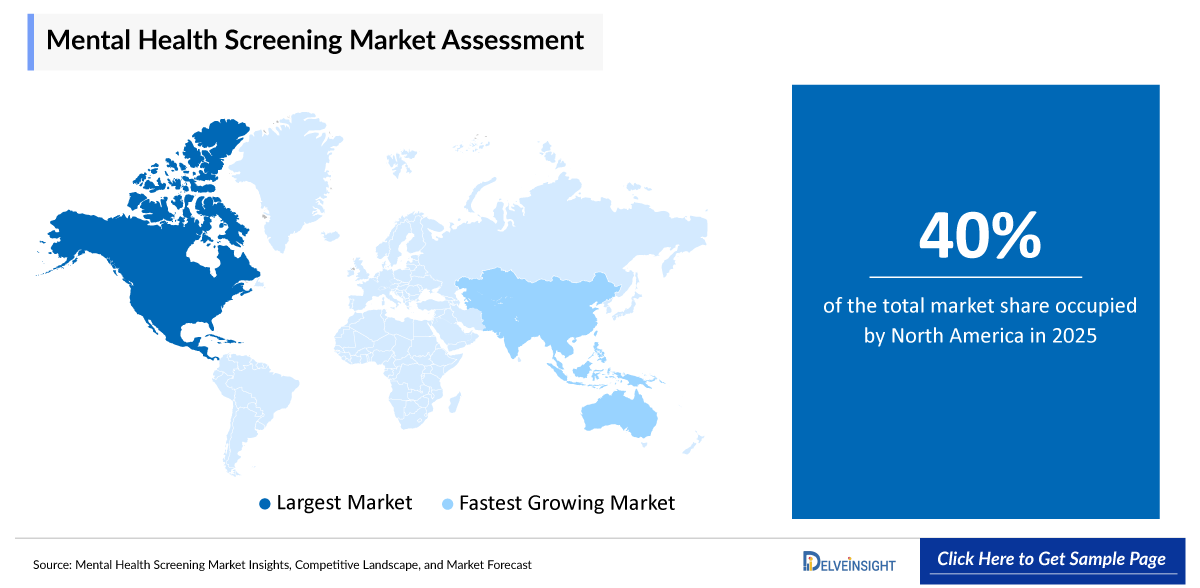
- North America dominated the global Mental Health Screening market revenue with a 40% share in 2025, representing the highest regional market share globally.
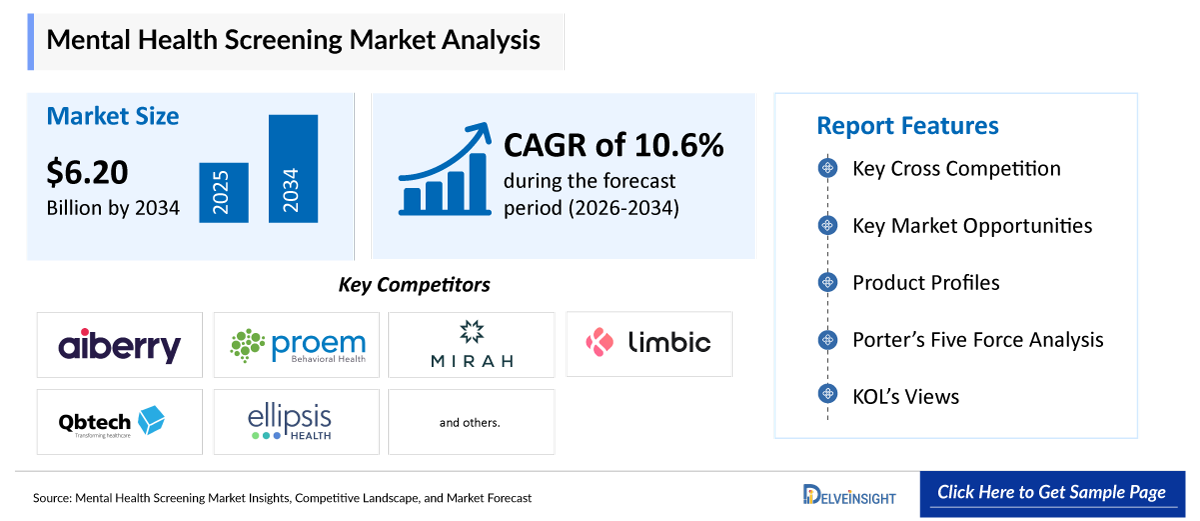
Mental health screening refers to the use of standardized questionnaires, structured clinical interviews, behavioral and cognitive assessments, and emerging biomarker-based tools to identify individuals who may be at risk of depression, anxiety, post-traumatic stress disorder (PTSD), bipolar disorder, and other behavioral health conditions. As global awareness of mental illness rises and health systems, employers, schools, and payers increasingly recognize the value of early identification, demand for scalable, validated, and technology-enabled screening solutions has accelerated. The market spans hardware, software, and services components; is delivered through digital screening platforms, mobile-based screening solutions, clinical screening solutions, corporate and workplace screening programs, and school-based screening solutions; and serves hospitals and clinics, mental health and psychiatric facilities, primary care settings, and other end-users including schools, universities, and community organizations. Driven by rising disease burden, the proliferation of AI-driven and voice-biomarker screening technologies, growing policy mandates for routine screening, and expanding employer and payer investment in behavioral health, mental health screening solutions have become an increasingly essential entry point into the broader behavioral healthcare continuum.
Mental Health Screening Market Key Growth Drivers
- The rising global burden of depression, anxiety, and other behavioral health conditions is expanding demand for early identification tools, with an estimated one in two people projected to experience a mental health condition at some point in their lives.
- Increasing adoption of AI-powered and voice-biomarker screening technologies, led by companies such as Aiberry, Ellipsis Health, and Scienza Health, is improving the sensitivity, scalability, and accessibility of screening compared with traditional self-report tools.
- Growing employer and corporate wellness investment in behavioral health screening is expanding workplace-based programs as organizations seek to reduce absenteeism, presenteeism, and healthcare costs linked to untreated mental illness.
- Expanding school-based and pediatric screening mandates, following recommendations such as the U.S. Preventive Services Task Force guidance on anxiety screening in children and adolescents, are driving adoption of platforms such as Maro and Mindei.
- Health systems and payers are increasingly embedding measurement-based care and routine behavioral health screening into primary care and collaborative care workflows, supporting platforms such as Mirah and Proem Behavioral Health.
- National health systems, including the NHS in the United Kingdom, are scaling AI-enabled triage and self-referral tools such as Limbic to manage rising demand for talking therapies amid clinician shortages.
- Rising government and private investment in digital mental health infrastructure across emerging markets, including India, is broadening access to screening through platforms such as NWNT and Mindei.
- The convergence of AI innovation, policy support, employer engagement, and rising disease burden is expected to sustain double-digit growth in the market through 2034.
Key Companies in Mental Health Screening Market
The competitive landscape is led by the following active device manufacturers:
- Aiberry
- Proem Behavioral Health
- Mirah
- Limbic
- Qbtech
- Ellipsis Health
- Scienza Health
- Maro
- NWNT – No Worry No Tension
- Mindei
For illustrative purposes, only the top 10 companies are listed in the Table of Contents. The report may include analysis and references to additional companies relevant to the market assessment.
Mental Health Screening Market Size
The following snapshot summarizes the principal report metrics for the mental health screening market.
|
Report Metrics |
Details |
|
2025 Market Size |
USD 2.50 billion |
|
2034 Projected Market Size |
USD 6.20 billion |
|
Growth Rate (2026-2034) |
10.6% CAGR |
|
Largest Market |
North America |
|
Fastest Growing Market |
Asia-Pacific |
|
Market Structure |
Fragmented |
All market values are expressed in USD and represent DelveInsight estimates synthesized from primary and secondary research.
Factors Contributing to the Growth of the Mental Health Screening Market
Market Drivers
Rising Global Prevalence of Mental Health Conditions
The most powerful driver of the Mental Health Screening market is the escalating global burden of depression, anxiety, PTSD, and bipolar disorder. Public health authorities estimate that roughly one in two people globally will experience a diagnosable mental health condition during their lifetime, and a substantial share of affected individuals never receive a formal diagnosis or treatment. This treatment gap has placed screening, as the first and lowest-cost step in the behavioral health care pathway, at the center of efforts to close access gaps. As health systems, employers, and schools increasingly treat mental health screening as a routine part of overall wellness, akin to blood pressure or cholesterol checks, demand for scalable and validated screening tools expands directly, anchoring market growth through 2034.
Proliferation of AI-Powered and Voice-Biomarker Screening Technologies
A wave of innovation in artificial intelligence and voice-biomarker technology is transforming mental health screening from static, self-reported questionnaires into dynamic, conversational, and passive assessment tools. Companies such as Aiberry and Ellipsis Health use natural language processing and acoustic analysis of speech to detect depression and anxiety with reported sensitivity advantages over traditional instruments such as the PHQ-9 and GAD-7, while Scienza Health is extending ambient, voice-based screening across consumer devices. These technologies reduce the time and burden of screening, enable continuous monitoring, and improve detection among populations that under-report symptoms on self-administered forms, expanding the addressable market for technology-enabled screening solutions.
Growing Employer and Corporate Wellness Investment
Employers are increasingly investing in workplace mental health screening as part of broader corporate wellness strategies, driven by rising awareness of the cost of untreated mental illness in absenteeism, turnover, and reduced productivity. Corporate and workplace screening programs, supported by platforms capable of integrating with existing wellness benefits, are becoming a standard component of employee benefits packages. As more employers adopt population-level screening and analytics to identify at-risk employees and direct them to appropriate resources, this channel is expected to be among the fastest-growing solution types through the forecast period.
Expansion of School-Based and Pediatric Screening Mandates
Regulatory and clinical guidance increasingly supports routine screening of children and adolescents, including recommendations from the U.S. Preventive Services Task Force for anxiety screening in youth aged 8 to 18. State-level mandates, such as Colorado's requirement for mental health screening in grades 6 through 12, are accelerating adoption of school-based screening platforms such as Maro and Mindei, which combine questionnaire-based and multi-signal screening with referral pathways to connect flagged students with clinical support. As more school districts and universities adopt universal screening protocols, this end-user segment is expected to expand steadily through 2034.
Integration of Measurement-Based and Collaborative Care Models
Health systems and payers are embedding routine, standardized screening into measurement-based care and collaborative care models that bring behavioral health assessment into primary care settings. Platforms such as Mirah and Proem Behavioral Health provide clinicians with libraries of validated instruments, automated workflows, and integration with electronic health records, enabling primary care providers, who now manage a majority of behavioral health encounters, to screen, track, and refer patients efficiently. As reimbursement codes for structured screening and monitoring expand, this integration is expected to be a durable driver of software and services demand.
National Health System Adoption of AI-Enabled Triage
National health systems facing rising demand and clinician shortages are scaling AI-enabled self-referral and triage tools to manage intake volumes. In the United Kingdom, the NHS has deployed Limbic's AI chatbot across a significant share of NHS Talking Therapies services, improving referral accuracy and reducing assessment time while broadening access among historically underserved groups. As other national health systems seek similar efficiency gains, adoption of AI-enabled screening and triage technology is expected to expand beyond the UK market.
Rising Investment in Emerging-Market Digital Mental Health Infrastructure
Government and private investment in digital mental health infrastructure is expanding access to screening in emerging markets, particularly across Asia-Pacific. In India, platforms such as NWNT and Mindei are extending questionnaire-based and multi-signal screening to corporate, school, and community settings, supported by rising public discourse around routine emotional wellness screening. As governments in China, India, and elsewhere increase healthcare investment and digital infrastructure, this expansion is expected to be a principal source of incremental market growth.
Market Restraints
Despite strong momentum, the Mental Health Screening market faces material constraints. Persistent stigma around mental illness continues to limit participation in screening programs in many communities and workplaces, particularly in regions where mental health remains a culturally sensitive topic. Reimbursement for behavioral health screening remains inconsistent across geographies and payers, and many primary care settings lack the billing infrastructure or clinical capacity to act on positive screens, creating a gap between identification and treatment. Data privacy and security concerns surrounding sensitive behavioral health information, particularly for AI-powered tools that analyze voice, video, or facial-pattern data, raise regulatory and consumer-trust barriers to adoption. The clinical validation and regulatory clearance requirements for novel biomarker-based and AI-driven screening tools are extensive and evolving, slowing time to market and limiting adoption among risk-averse health systems. A global shortage of mental health professionals means that even effective screening can outpace the system's capacity to provide timely follow-up care, and uneven broadband and smartphone access constrains adoption of digital and mobile-based screening solutions in lower-income and rural populations. Together, these stigma, reimbursement, regulatory, workforce, and access barriers temper the pace of growth, even as the underlying drivers of rising disease burden, AI innovation, and institutional investment remain firmly intact.
Mental Health Screening Market Segment Analysis
The mental health screening market by component (hardware, software, and services), screening type (depression, anxiety, ptsd, bipolar disorder, and others), screening method (self-reported questionnaires & surveys, clinical interviews, behavioral & cognitive assessments, biomarker-based testing, and others), solution type (digital screening platforms, mobile-based screening solutions, clinical screening solutions, corporate/workplace screening programs, school-based screening solutions), end-users (hospitals & clinics, mental health & psychiatric facilities, primary care settings, and others), and Geography (North America, Europe, Asia-Pacific, and Rest of World).
By Component
Dominant Subsegment: Software.
The software segment accounted for 85% of the Mental Health Screening market in 2025. Software is significantly boosting the mental health screening market by making screening more accessible, scalable, cost-effective, and data-driven across clinical and non-clinical settings. Digital screening platforms and mobile applications enable individuals to complete validated questionnaires and assessments remotely, reducing dependence on in-person appointments and allowing healthcare providers to screen larger populations in shorter periods. Software solutions can also automate scoring, generate risk profiles, track changes in symptoms over time, and integrate screening results into electronic health records, thereby improving clinical workflow and supporting earlier identification of conditions such as depression, anxiety, PTSD, and substance use disorders. Furthermore, the integration of artificial intelligence (AI), machine learning, natural-language processing, and voice-based analysis is expanding the capabilities of mental health screening software by enabling the identification of subtle behavioral, linguistic, and emotional patterns that may indicate mental health risks. Increasing adoption of telehealth, remote healthcare, workplace wellness programs, and school-based mental health initiatives is further creating demand for scalable software-based screening solutions. As a result, the shift from traditional paper-based assessments toward digital, AI-enabled, cloud-based, and remote screening platforms is expected to expand the reach and utilization of mental health screening services and contribute to overall market growth.
By Screening Type
Dominant Subsegment: Depression.
The depression segment accounted for 35% of the Mental Health Screening market in 2025. Depression is the leading screening type because it is among the most prevalent and most extensively studied behavioral health conditions worldwide, with validated instruments such as the PHQ-9 embedded across primary care, corporate wellness, and school-based screening programs. Depression screening is also the primary use case for leading AI and voice-biomarker platforms, including Aiberry and Ellipsis Health, which market their technology as more sensitive alternatives to standard self-report tools. Anxiety screening is expanding rapidly alongside new pediatric screening guidance, and PTSD and bipolar disorder screening are growing within specialized clinical and veteran-focused settings, but the breadth of depression screening across nearly every care setting secures its leadership across the forecast period.
By Screening Method
Dominant Subsegment: Self-Reported Questionnaires & Surveys.
The self-reported questionnaires & surveys segment accounted for 60% of the Mental Health Screening market in 2025. Standardized, validated instruments such as the PHQ-9, GAD-7, and M3 Checklist, licensed and delivered digitally by providers such as Proem Behavioral Health and Mirah, remain the clinical and regulatory gold standard for screening and are embedded into reimbursement codes and clinical guidelines across most health systems. Their low cost, ease of deployment, and broad clinical acceptance sustain large-scale adoption across hospitals, primary care, schools, and workplaces. Biomarker-based testing, led by voice and multimodal analysis from Aiberry, Ellipsis Health, and Scienza Health, is the fastest-growing method as evidence accumulates on its ability to detect symptoms that self-report tools miss, while clinical interviews and behavioral and cognitive assessments continue to anchor specialized diagnostic settings such as Qbtech's objective ADHD testing.
By Solution Type
Dominant Subsegment: Digital Screening Platforms.
The digital screening platforms segment accounted for 34% of the Mental Health Screening market in 2025. Digital screening platforms are the leading solution type because they offer health systems, payers, and institutions a flexible, web-based way to deploy validated screening instruments across large populations without requiring dedicated hardware or in-person visits, as demonstrated by Limbic's integration into NHS Talking Therapies referral pathways and Mirah's assessment engine embedded in outpatient behavioral health workflows. Mobile-based screening solutions are the fastest-growing solution type as consumer-facing apps extend screening directly to individuals, while corporate and workplace screening programs and school-based screening solutions, exemplified by Maro and Mindei, are expanding quickly as institutional buyers prioritize early identification. Clinical screening solutions remain essential for structured diagnostic settings but represent a smaller share given their higher cost and narrower deployment.
By End-Users
Dominant Subsegment: Hospitals & Clinics
The hospitals & clinics segment accounted for 40% of the Mental Health Screening market in 2025. Hospitals and clinics remain the leading end-user because they represent the primary point of contact for structured mental health screening, supported by reimbursement pathways, clinical governance, and integration with electronic health records, as reflected in Proem Behavioral Health's and Mirah's deployments across hospital systems, outpatient clinics, and substance use disorder treatment centers. Mental health and psychiatric facilities represent a concentrated, high-intensity segment reliant on specialized assessment tools such as Qbtech's objective ADHD testing. Primary care settings are the fastest-growing end-user as collaborative care and measurement-based care models push routine behavioral health screening into general medical visits, while schools, universities, and community organizations, captured under other end-users, are expanding quickly on the back of mandated pediatric screening programs.
Mental Health Screening Market Region Analysis
Dominant Region: North America
North America accounted for 40% of the global mental health screening market revenue in 2025, representing the highest regional market share globally. The region's dominance reflects high awareness of mental health conditions, established reimbursement pathways for behavioral health screening, a dense concentration of digital health innovators, and strong employer investment in workplace wellness programs, particularly in the United States. North America hosts a large share of leading AI-powered and measurement-based-care screening providers, including Aiberry, Ellipsis Health, Mirah, Proem Behavioral Health, and Maro, alongside deep venture capital investment supporting continued innovation. Growing state-level mandates for school-based screening, expanding integration of behavioral health screening into primary care, and rising corporate wellness spending sustain the region's leadership across the forecast period.
Fastest Growing Region: Asia-Pacific
Asia-Pacific is the fastest-growing region in the Mental Health Screening market. The region's elevated CAGR is driven by rising awareness of mental health conditions, expanding government investment in digital mental health infrastructure, and growing corporate and educational adoption of screening across China, India, Japan, South Korea, and Australia. India is emerging as a significant growth market, with providers such as NWNT and Mindei extending questionnaire-based and AI-enabled screening to corporate, school, and community settings, while China is scaling psychiatric hospital capacity and workforce training, and Japan and South Korea are integrating digital screening into workplace mental health programs. Rising disease burden, expanding smartphone penetration, and growing public discourse around routine emotional wellness screening position Asia-Pacific as the principal source of incremental market growth through 2034.
Regional Commentary
North America
North America accounted for 40% of the global Mental Health Screening market revenue in 2025. The United States dominates on the strength of its dense digital health innovation ecosystem, employer-funded wellness benefits, and expanding integration of screening into primary and collaborative care, while venture investment in AI-powered screening technology and growing state-level school screening mandates reinforce its leadership.
Europe
Europe is a large and advanced regional market, supported by national health systems seeking efficiency gains amid clinician shortages. The United Kingdom's NHS has scaled AI-enabled self-referral and triage technology from Limbic across a significant share of Talking Therapies services, while Qbtech's Swedish origins and pan-European ADHD testing footprint reinforce the region's role in specialized clinical screening across Germany, France, the United Kingdom, Italy, and Spain.
Asia-Pacific
Asia-Pacific is the fastest-growing region, propelled by rising mental health awareness, expanding government healthcare investment, and growing adoption of digital and school-based screening across China, Japan, India, South Korea, and Australia. India's growing digital mental health ecosystem, including providers such as NWNT and Mindei, and China's psychiatric infrastructure build-out are accelerating regional adoption and clinical partnership activity.
Rest of World
The Rest of World region, spanning Latin America, the Middle East, and Africa, is an emerging growth frontier. Expanding mental health awareness campaigns, rising demand for accessible, low-cost digital screening tools, and gradual efforts to integrate behavioral health screening into primary care and workplace settings are broadening access, while international partnerships and donor-funded programs support the build-out of regional screening infrastructure.
Mental Health Screening Market Competitive Landscape
The Mental Health Screening market is classified as Fragmented. A group of established, scale providers with broad clinical validation and health-system integration, including Qbtech, Limbic, and Mirah, anchor the more mature tier of the market, while specialized and fast-scaling AI-native providers such as Aiberry, Ellipsis Health, Scienza Health, Proem Behavioral Health, Maro, NWNT, and Mindei compete through technology differentiation, niche end-user focus, and geographic specialization, sustaining intense competition and continued new-entrant activity across the fastest-growing screening methods and solution types.
The competitive landscape can be evaluated across the following dimensions:
- Market concentration: Fragmented, with a small number of established, clinically validated platforms competing alongside a large and growing field of AI-native and regionally specialized entrants.
- Leading players: Qbtech, Limbic, and Mirah anchor the more established tier through regulatory clearance, health-system integration, and large-scale deployment.
- Geographic reach: Leaders operate across multiple countries; Qbtech has operations in 13 countries, and Limbic is deployed across a significant share of NHS Talking Therapies services in the United Kingdom.
- Solution portfolio strength: Top players offer end-to-end screening, assessment libraries, clinical decision support, EHR integration, and outcomes tracking.
- Technology differentiation: Ownership of proprietary AI, voice-biomarker, and multimodal analysis technology, such as Aiberry's Botberry conversational assistant, Ellipsis Health's vocal biomarker engine, and Mindei's MindVoice platform, is a decisive competitive advantage.
- Strategic partnerships: Tie-ups with health systems, device makers, and clinical research organizations, such as Scienza Health's collaboration with Samsung and Mirah's partnership with M3 Information, extend reach.
- Funding activity: Active venture investment, including Ellipsis Health's USD 45 million Series A led by Salesforce, Khosla Ventures, and CVS Health Ventures, underscores continued investor confidence in the sector.
- Clinical validation: FDA clearance, medical device certification, and peer-reviewed outcomes data, such as Qbtech's FDA-cleared ADHD tests and Limbic's Class IIa UKCA certification, are key competitive moats.
- Innovation focus: AI-driven conversational and voice-biomarker screening, multimodal risk detection, school and workplace deployment models, and expansion into emerging markets.
Mental Health Screening Market Recent Developmental Activities
In 2025, Ellipsis Health secured a USD 45 million Series A funding round led by Salesforce, Khosla Ventures, and CVS Health Ventures, bringing its total funding to USD 75 million. Strategic significance: Validates investor confidence in voice-biomarker screening technology and expands resources for clinical validation and commercial scale-up.
In October 2025, Scienza Health announced a collaboration with Samsung to deliver AI-powered cognitive and behavioral health screening across Galaxy smartphones, tablets, and TVs through its digitalhumanOS platform. Strategic significance: Extends ambient, voice-based screening to a mass-market consumer device ecosystem without requiring app downloads.
In October 2024, Qbtech reached its one millionth patient milestone using its FDA-cleared QbTest and QbCheck objective ADHD assessment tools and expanded its United States presence with new Houston-based teams. Strategic significance: Reinforces Qbtech's scale leadership in objective, hardware-based behavioral assessment.
In January 2025, Limbic partnered with Rogers Behavioral Health to deploy its AI-powered screening chatbot in the United States, extending a technology already used across a significant share of NHS Talking Therapies services in the United Kingdom. Strategic significance: Marks Limbic's expansion beyond the NHS into the U.S. behavioral health market.
In May 2024, Mirah announced a partnership with M3 Information, LLC to make the M3 Checklist, a multi-dimensional behavioral health screening instrument, available within its measurement-based care platform. Strategic significance: Broadens Mirah's assessment library beyond single-condition screens such as the PHQ-9 to support primary care behavioral health integration.
In April 2024, Proem Behavioral Health introduced a touchless mental health workflow enabling patients to complete electronic screening during intake, with results integrating automatically into the electronic health record. Strategic significance: Streamlines screening workflows for primary care, pediatric, and behavioral health providers.
In October 2023, Proem Behavioral Health was selected by Neurobehavioral Hospitals of the Palm Beaches to deploy its licensed digital structured interview and screening platform. Strategic significance: Extends Proem's exclusively licensed assessment library into inpatient and outpatient behavioral health treatment settings.
In 2023, Aiberry expanded deployment of its AI-powered mental health screening platform across corporate wellness programs, building on clinical findings that its conversational assessment detected depression missed by standard self-report questionnaires. Strategic significance: Strengthens Aiberry's position in the fast-growing corporate and workplace screening segment.
In 2022, Maro launched Maro for Schools, a universal screening platform for anxiety and depression, with more than 350 schools signed up to screen over 100,000 students across 40 U.S. states. Strategic significance: Positions Maro as a leading platform for mandated school-based mental health screening in the United States.
In 2025, Mindei expanded its MindAssure+ and MindVoice screening tools, combining questionnaire-based and multi-signal AI screening for child and adolescent mental health, across schools and universities in India. Strategic significance: Extends India-first, age-appropriate behavioral screening infrastructure for a large and underserved pediatric population.
In 2025, NWNT - No Worry No Tension, expanded its counseling, wellness assessment, and corporate emotional wellness screening services across India, contributing to a broader national conversation on routine emotional wellness screening. Strategic significance: Strengthens access to mental health screening and support services in a large, fast-growing emerging market.
Mental Health Screening Market Segmentation
Mental Health Screening Market by Component
- Hardware
- Software
- Services
Mental Health Screening Market by Screening Type
- Depression
- Anxiety
- PTSD
- Bipolar Disorder
- Others
Mental Health Screening Market by Screening Model
- Self-Reported Questionnaires & Surveys
- Clinical Interviews
- Behavioral & Cognitive Assessments
- Biomarker-Based Testing
- Others
Mental Health Screening Market by Solution Type
- Digital Screening Platforms
- Mobile-Based Screening Solutions
- Clinical Screening Solutions
- Corporate/Workplace Screening Programs
- School-Based Screening Solutions
Mental Health Screening Market by End-Users
- Hospitals & Clinics
- Mental Health & Psychiatric Facilities
- Primary Care Settings
- Others
Mental Health Screening Market by Geography
- North America Mental Health Screening Market
- United States Mental Health Screening Market Size in USD million (2023-2034)
- Canada Mental Health Screening Market Size in USD million (2023-2034)
- Mexico Mental Health Screening Market Size in USD million (2023-2034)
- Europe Mental Health Screening Market
- Germany Mental Health Screening Market Size in USD million (2023-2034)
- United Kingdom Mental Health Screening Market Size in USD million (2023-2034)
- France Mental Health Screening Market Size in USD million (2023-2034)
- Italy Mental Health Screening Market Size in USD million (2023-2034)
- Spain Mental Health Screening Market Size in USD million (2023-2034)
- Rest of Europe Mental Health Screening Market Size in USD million (2023-2034)
- Asia-Pacific Mental Health Screening Market
- China Mental Health Screening Market Size in USD million (2023-2034)
- Japan Mental Health Screening Market Size in USD million (2023-2034)
- India Mental Health Screening Market Size in USD million (2023-2034)
- Australia Mental Health Screening Market Size in USD million (2023-2034)
- South Korea Mental Health Screening Market Size in USD million (2023-2034)
- Rest of Asia-Pacific Mental Health Screening Market Size in USD million (2023-2034)
- Rest of the World (RoW) Mental Health Screening Market
- Middle East Mental Health Screening Market Size in USD million (2023-2034)
- Africa Mental Health Screening Market Size in USD million (2023-2034)
- South America Mental Health Screening Market Size in USD million (2023-2034)
Mental Health Screening Market Recent Industry Trends and Milestones (2023-2026)
|
Category |
Key Developments |
|
Mental Health Screening Market Product Approval |
Regulatory and clinical guidance is expanding routine screening requirements. The U.S. Preventive Services Task Force recommended anxiety screening in children and adolescents aged 8 to 18, and state-level mandates such as Colorado's requirement for grades 6 through 12 are driving school-based adoption. Limbic became the first mental health AI chatbot to receive Class IIa UKCA medical device certification in the United Kingdom, while Qbtech's QbTest and QbCheck remain FDA-cleared for ADHD evaluation. Each expansion of screening guidance and regulatory clearance creates durable demand for compliant, validated screening tools across health systems, schools, and employers. |
|
Mental Health Screening Market Expansion |
Providers broadened capability across AI-driven and voice-biomarker screening. Aiberry and Ellipsis Health expanded conversational and vocal-biomarker screening for depression and anxiety, Scienza Health extended ambient screening across Samsung's Galaxy device ecosystem, and Mindei introduced MindVoice multimodal screening for child and adolescent mental health. Qbtech surpassed one million patients tested with its objective, motion-tracking ADHD assessment platform, and Limbic expanded its AI triage chatbot from the NHS into U.S. behavioral health providers. |
|
Mental Health Screening Market Investment |
Capital continued to flow toward AI-native and measurement-based-care screening platforms. Ellipsis Health closed a USD 45 million Series A led by Salesforce, Khosla Ventures, and CVS Health Ventures in 2025, bringing total funding to USD 75 million. Maro raised early-stage funding to expand school-based screening across the United States, and Qbtech continued to scale under private ownership backed by Verdane. Investment activity reflects growing conviction that AI-enabled, scalable screening technology will define competitive advantage in the sector. |
|
Company Strategy |
Qbtech: Scale leadership in FDA-cleared, objective ADHD testing with operations across 13 countries. Limbic: NHS-scale AI triage and self-referral, expanding into U.S. behavioral health. Mirah: Measurement-based care platform with a library of 400-plus validated assessments. Proem Behavioral Health: Exclusive digital licensee of gold-standard screening and structured interview tools. Aiberry and Ellipsis Health: AI and voice-biomarker screening for depression and anxiety. Scienza Health: Ambient, device-embedded cognitive and behavioral screening. Maro and Mindei: School and pediatric screening platforms. NWNT: Corporate and community emotional wellness screening in India. |
|
Emerging Technologies |
AI-powered conversational and voice-biomarker screening are the leading edge of innovation, with providers demonstrating improved sensitivity over traditional self-report instruments. Multimodal analysis combining speech, facial-pattern, and gaze-dynamics data, as used by Mindei's MindVoice, is expanding the scope of passive and continuous screening. Ambient, device-embedded screening delivered through consumer electronics, exemplified by Scienza Health's Samsung collaboration, is emerging as a channel to extend screening beyond clinical and institutional settings, while integration of screening data into electronic health records and collaborative care workflows is accelerating. |
Mental Health Screening Market Startup Funding and Investment Trends
Investment in the Mental Health Screening ecosystem has concentrated on AI-driven and voice-biomarker screening technology, school and pediatric screening infrastructure, and measurement-based care platforms. The following companies illustrate recent funding and investment activity and technology focus.
|
Company |
Total Funding |
Funding Stage |
Main Offering |
Core Technology |
|
Ellipsis Health |
USD 75 million total |
Series A (2025) |
AI voice-biomarker screening |
Natural language processing and acoustic vocal analysis |
|
Request for unlocking the report of the @ Mental Health Screening Market | ||||
Capital is flowing toward providers that combine clinical validation with scalable AI technology. Ellipsis Health's USD 45 million Series A, led by Salesforce, Khosla Ventures, and CVS Health Ventures, underscores strong investor confidence in voice-biomarker screening infrastructure. Emerging providers such as Maro and Mindei are scaling school and pediatric screening models, while Scienza Health is extending ambient AI screening across consumer device ecosystems through its Samsung partnership. Collectively, these investments signal conviction that AI-driven detection accuracy, school and workplace deployment, and integration with consumer and clinical technology ecosystems will define the next phase of competitive advantage in the global Mental Health Screening market.
Key Takeaways from the Mental Health Screening Market Report Study
- Market size analysis for the current mental health screening market size (2025), and market forecast for 9 years (2026 to 2034).
- Top key product/technology developments, mergers, acquisitions, partnerships, and joint ventures that happened over the last 3 years.
- Key companies dominating the global mental health screening market.
- Various opportunities available for competitors in the mental health screening market space.
- What are the top-performing segments in 2025? How will these segments perform in 2034?
- Which are the top-performing regions and countries in the current mental health screening market scenario?
- Which are the regions and countries where companies should concentrate their opportunities for mental health screening market growth in the future?
Target audience who can benefit from this mental health screening market report study
- Mental health screening product providers
- Research organizations and consulting companies
- Mental health screening-related organizations, associations, forums, and other alliances
- Government and corporate offices
- Start-up companies, venture capitalists, and private equity firms
- Distributors and traders dealing in mental health screening
- Various end-users who want to know more about the mental health screening market and the latest technological developments in the mental health screening market.

