-market.png&w=256&q=75)
Metastatic Uveal Melanoma Market
Key Highlights
- The disease epidemiology covered in the report provides historical as well as forecasted Metastatic Uveal Melanoma epidemiology scenario in the 7MM covering the United States, EU4 countries (Germany, Spain, Italy, and France) and the United Kingdom, and Japan from 2020 to 2034.
- Uveal melanoma is a rare condition accounting for only 5% of all primary melanoma cases. Still, it is the most frequently diagnosed primary intraocular malignant tumor in adults. Early diagnosis and local treatment is crucial, as survival correlates with primary tumor size. However, approximately 50% of patients will develop metastatic disease with 6–12 months’ survival from metastatic diagnosis.
- Uveal Melanoma epidemiology is segmented as Total Incident Cases of Uveal Melanoma, Gender-specific cases of Uveal Melanoma, Age-specific cases of Uveal Melanoma, and Type-specific cases of Uveal Melanoma] in the Metastatic Uveal Melanoma market report.
Request for unlock CAGR of Metastatic Uveal Melanoma Market
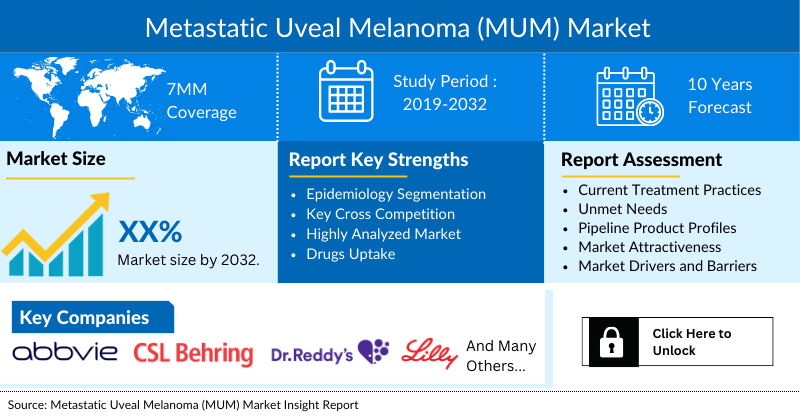
DelveInsight's "Metastatic Uveal Melanoma Market Insights, Epidemiology, and Market Forecast — 2034" report delivers an in-depth understanding of the Metastatic Uveal Melanoma, historical and forecasted epidemiology as well as the Metastatic Uveal Melanoma market trends in the United States, EU4 (Germany, Spain, Italy, and France) and the United Kingdom, and Japan.
The Uveal Melanoma market report provides current treatment practices, emerging drugs, Metastatic Uveal Melanoma market share of the individual therapies, current and forecasted Metastatic Uveal Melanoma market Size from 2020 to 2034 segmented by seven major markets. The Report also covers current Metastatic Uveal Melanoma treatment practice/algorithm, and unmet medical needs to curate best of the opportunities and assesses the underlying potential of the market.
Geography Covered
- The United States
- EU4 (Germany, Spain, Italy, and France) and the United Kingdom
- Japan
Study Period: 2020-2034
Metastatic Uveal Melanoma Market Disease: Understanding and Treatment Algorithm
The DelveInsight’s Metastatic Uveal Melanoma market report gives a thorough understanding of Metastatic Uveal Melanoma by including details such as disease definition, symptoms, causes, pathophysiology, diagnosis, and treatment. Uveal melanoma (UM) is the most common intraocular malignancy and arises from melanocytes in the iris, ciliary body, or choroid. This malignancy arises from melanocytes in the choroid, ciliary body, or iris. The choroid posterior to the equator, hereafter referred to as the posterior choroid, is the most common site involved with approximately 85% of cases localized to this region.
The most common primary symptom in UM is blurred vision (37.8%), however, many patients are asymptomatic at the time of diagnosis (30.2%). Other common symptoms at presentation include photopsia (8.6%), floaters (7%), visual field loss (6.1%), visible tumor (3.1%), pain (2.4%), and metamorphopsia (2.2%).
Metastatic Uveal Melanoma Diagnosis
The diagnosis is based principally on clinical examination of the tumor with biomicroscopy and indirect ophthalmoscopy and confirmed by diagnostic techniques such as ultrasonography, fundus fluorescein angiography and optical coherence tomography. The clinical diagnosis of posterior uveal melanomas can be made when the classical appearance of a pigmented dome-shaped mass is detected on dilated fundus exam. Uveal melanomas classically show low to medium reflectivity on A-scan ultrasonography and on B-scan ultrasonography the tumor appears as a hyperechoic, acoustically hollow intraocular mass.
Metastatic Uveal Melanoma Treatment
Surgery is the most common treatment for Uveal (Intraocular) melanoma. The following types of surgery are used:
- Resection: Surgery to remove the tumor and a small amount of healthy tissue around it
- Enucleation: Surgery to remove the eye and part of the optic nerve. This is done if vision cannot be saved and the tumor is large, has spread to the optic nerve, or causes high pressure inside the eye. After surgery, the patient is usually fitted for an artificial eye to match the size and color of the other eye.
- Exenteration: In this surgery the eye and eyelid are removed along with muscles, nerves, and fat in the eye socket.
PDT using verteporfin as a photosensitizer has been FDA approved in ophthalmology since the 2000's for the selective treatment of choroidal neovascularization secondary to various conditions due to minimal surrounding destruction.
Metastatic Uveal Melanoma Epidemiology
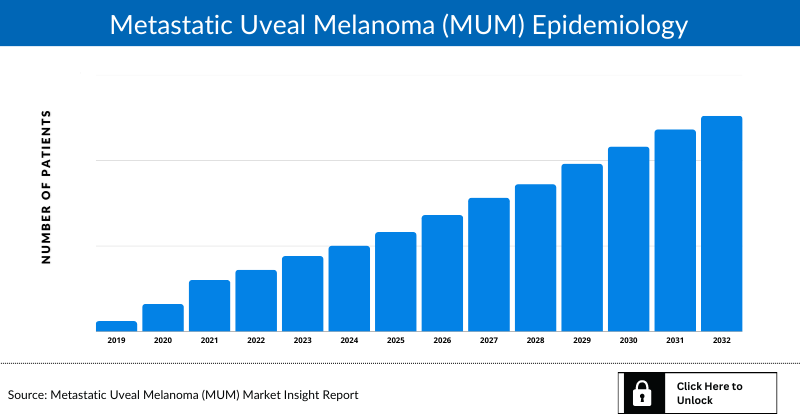
The Uveal Melanoma epidemiology section provides insights about historical and current Metastatic Uveal Melanoma patient pool and forecasted trends for individual seven major countries. It helps to recognize the causes of current and forecasted trends by exploring numerous studies and views of key opinion leaders. This part of the report also provides the diagnosed patient pool and their trends along with assumptions undertaken.
Key Findings
- The disease epidemiology covered in the report provides historical as well as forecasted Metastatic Uveal Melanoma epidemiology scenario in the 7MM covering the United States, EU4 countries (Germany, Spain, Italy, and France) and the United Kingdom, and Japan from 2020 to 2034.
- Uveal melanoma is a rare condition accounting for only 5% of all primary melanoma cases. Still, it is the most frequently diagnosed primary intraocular malignant tumor in adults. Early diagnosis and local treatment is crucial, as survival correlates with primary tumor size. However, approximately 50% of patients will develop metastatic disease with 6–12 months’ survival from metastatic diagnosis.
- The disease epidemiology covered in the report provides historical as well as forecasted Uveal Melanoma epidemiology [segmented as Total Incident Cases of Uveal Melanoma, Gender-specific cases of Uveal Melanoma, Age-specific cases of Uveal Melanoma, and Type-specific cases of Uveal Melanoma] in the 7MM covering the United States, EU4 countries (Germany, France, Italy, and Spain) and the United Kingdom, and Japan from 2020 to 2034.
Country Wise - Metastatic Uveal Melanoma Epidemiology
This section provides a glimpse of the Metastatic Uveal Melanoma epidemiology in the United States, EU4 (Germany, Spain, Italy, and France) and the United Kingdom, and Japan.
Learn more about the evolving epidemiology trends and key developments: Metastatic Uveal Melanoma Epidemiology Forecast
Uveal Melanoma Drug Chapters
The drug chapter segment of the Metastatic Uveal Melanoma report encloses the detailed analysis of Uveal Melanoma marketed drugs and late stage (Phase-III and Phase-II) pipeline drugs. It also helps to understand the Metastatic Uveal Melanoma clinical trial details, expressive pharmacological action, agreements and collaborations, approval and patent details, advantages and disadvantages of each included drug, and the latest news and press releases.
Uveal Melanoma Marketed Drugs
Tebentafusp: Immunocore
In January, 2022, the Food and Drug Administration approved tebentafusp-tebn (Kimmtrak, Immunocore), a bispecific gp100 peptide-HLA-directed CD3 T cell engager, for HLA-A*02:01-positive adult patients with unresectable or metastatic uveal melanoma. Tebentafusp is a novel bispecific protein composed of a soluble T cell receptor fused to an anti-CD3 immune-effector function. Tebentafusp specifically targets gp100, a lineage antigen expressed in melanocytes and melanoma, and is the first molecule developed using Immunocore’s ImmTAC technology platform designed to redirect and activate T cells to recognize and kill tumor cells.
It has been granted Breakthrough Therapy Designation, Fast Track designation and orphan drug designation by the FDA in the United States and Promising Innovative Medicine (PIM) designation under the UK Early Access to Medicines Scheme for metastatic uveal melanoma.
Note: Detailed Current therapies assessment will be provided in the full report of Metastatic Uveal Melanoma
Metastatic Uveal Melanoma Emerging Drugs
Relatlimab is a LAG-3-blocking antibody, which is being investigated for the treatment of metastatic UM, in combination with Nivolumab, as a key strategy to more effectively potentiate anti-tumor immune activity. Lymphocyte-activation gene 3 (LAG-3) is a cell-surface molecule expressed on effector T cells and regulatory T cells (Tregs) and functions to control T-cell response, activation and growth. In June 2021, US FDA granted Priority Review for the combination, as a treatment for UM, with an action target date of March, 2022.
FHD-286 is a highly potent, selective, allosteric and orally available, small-molecule, enzymatic inhibitor of BRG1 and BRM, two highly similar proteins that are the ATPases, or the catalytic engines across all forms of the BAF complex, one of the key regulators of the chromatin regulatory system. It is currently in Phase I to evaluate safety, tolerability, pharmacokinetics (PK), pharmacodynamics (PD), and preliminary clinical activity of FHD-286 oral monotherapy in subjects with metastatic Uveal Melanoma (UM).
Note: Detailed emerging therapies assessment will be provided in the full report of Metastatic Uveal Melanoma
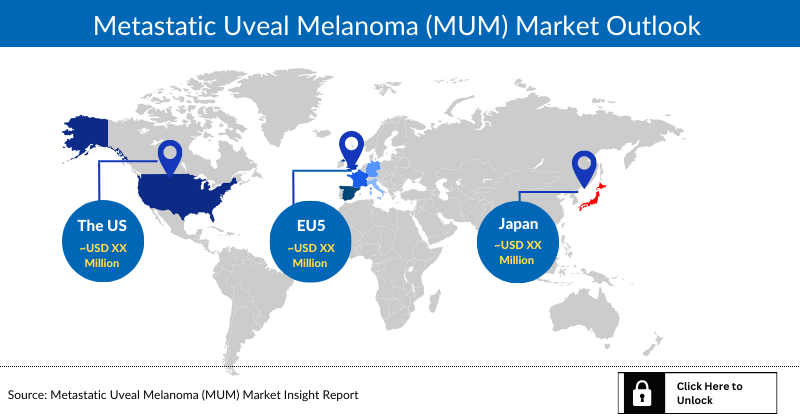
Metastatic Uveal Melanoma Market Outlook
The development of an efficient Metastatic Uveal Melanoma screening tool will play a significant role in early detection and subsequent mortality reduction. To reduce the rate of late-stage illness and mortality there is a need for appropriate screening techniques. To meet these criteria, groundbreaking companion diagnostic tests will lead to rapid acceptance among doctors and patient populations. Novel, innovative and insurance-covered, genetic-profiling kits for diagnosis, increasing incidence, and better awareness are likely to fuel the growth of the UM treatment market during the study period.
The main goals of ocular melanoma treatment are to destroy the tumor, prevent recurrence and metastasis, and conserve vision. The current treatment landscape of Uveal Melanoma includes Surgery, radiation therapy, laser treatment, and Photodynamic therapy. In laser treatment, a laser is used to kill the melanoma cells may be an option in certain situations. Photodynamic therapy is used in smaller tumors, as it isn't effective for larger cancers. Photon radiotherapy has developed into a primary treatment option as it is efficient in controlling the tumor in 96% of the cases with a 5-year survival rate of 76%.
The market has a promising outlook with the emerging therapies. Some of the major companies in the global UM market with late-stage Metastatic Uveal Melanoma clinical trial development candidates are Tebentafusp (Immunocore), Relatlimab (Bristol-Myers Squibb), FHD 286 (Foghon Therapeutics), among others.
According to DelveInsight, Metastatic Uveal Melanoma market in 7MM is expected to witness a major change in the study period 2020-2034.
Analyst Commentary
- The pipeline of Metastatic Uveal Melanoma is very robust, many potential therapies are being investigated for the treatment of Uveal Melanoma, and it is safe to predict that the treatment space will experience a significant impact on the market during the forecast period.
- The expected introduction of emerging therapies with improved efficacy, more awareness initiatives programs, and further improvement in the diagnosis rate, are likely to boost the growth of the Metastatic Uveal Melanoma market in the 7MM. Aside from that, the market size of Uveal Melanoma may flourish due to increased research and development, label-expansion of approved therapies into other epilepsy in this field.
- The market growth of Metastatic Uveal Melanoma may be offset by failures and/or discontinuation of the emerging therapies, unaffordable pricing, market access and reimbursement issues, and a scarcity of healthcare specialists.
Metastatic Uveal Melanoma Drugs Uptake
This section focuses on the rate of uptake of the potential drugs recently launched in the Uveal Melanoma market or expected to get launched in the market during the study period 2020-2034. The analysis covers Metastatic Uveal Melanoma market uptake by drugs; patient uptake by therapies; and sales of each drug.
This helps in understanding the drugs with the most rapid uptake, reasons behind the maximal use of new drugs, and allows the comparison of the drugs based on market share and size which again will be useful in investigating factors important in market uptake and in making financial and regulatory decisions.
Note: Detailed emerging therapies assessment will be provided in full report of Metastatic Uveal Melanoma
Metastatic Uveal Melanoma Pipeline Development Activities
The report provides insights into different therapeutic candidates in Phase II and Phase III stage. It also analyzes Metastatic Uveal Melanoma companies involved in developing targeted therapeutics.
Metastatic Uveal Melanoma Clinical Trial Development Activities
The Metastatic Uveal Melanoma clinical trial report covers the detailed information of collaborations, acquisition and merger, licensing, patent details and other information for Metastatic Uveal Melanoma emerging therapies.
Learn more about the emerging therapies and key companies active in the therapeutics segment: Metastatic Uveal Melanoma Pipeline Insight
Reimbursement Scenario in Metastatic Uveal Melanoma
Approaching reimbursement proactively can have a positive impact both during the late stages of product development and well after product launch. In a report, we consider reimbursement to identify economically attractive indications and market opportunities. When working with finite resources, the ability to select the markets with the fewest reimbursement barriers can be a critical business and price strategy.
KOL- Views
To keep up with current market trends, we take KOLs and SMEs ' opinions working in the Uveal Melanoma domain through primary research to fill the data gaps and validate our secondary research. Their opinion helps to understand and validate current and emerging therapies treatment patterns or Metastatic Uveal Melanoma market trends. This will support the clients in potential upcoming novel treatment by identifying the overall scenario of the market and the unmet needs.
Competitive Intelligence Analysis
We perform Competitive and Market Intelligence analysis of the Metastatic Uveal Melanoma Market by using various Competitive Intelligence tools that include - SWOT analysis, PESTLE analysis, Porter's five forces, BCG Matrix, Market entry strategies etc. The inclusion of the analysis entirely depends upon the data availability.
|
Report Metrics |
Details |
|
Study Period |
2020 to 2034 |
|
Forecast Period |
2023 to 2034 |
|
Market CAGR | Request Sample to Know |
|
Metastatic Uveal Melanoma Market Size | USD XX million by 2034 |
|
Key Metastatic Uveal Melanoma Companies | Bristol-Myers Squibb, Merck & Co, Verastem Oncology, AstraZeneca, Novartis, BioMed Valley Discoveries, Miltenyi Biomedicine GmbH, IDEAYA Biosciences, Vanquish Oncology, Viralytics, Hoffmann-La Roche, Bellicum Pharmaceuticals, Linnaeus Therapeutics, Immunocore, and many others. |
Scope of the Metastatic Uveal Melanoma Market Report
- The report covers the descriptive overview of Metastatic Uveal Melanoma, explaining its causes, signs and symptoms, pathophysiology, diagnosis, and currently available therapies
- Comprehensive insight has been provided into the Uveal Melanoma epidemiology and treatment in the 7MM
- Additionally, an all-inclusive account of both the current and emerging therapies for Metastatic Uveal Melanoma are provided, along with the assessment of new therapies, which will have an impact on the current treatment landscape
- A detailed review of the Metastatic Uveal Melanoma market; historical and forecasted is included in the report, covering drug outreach in the 7MM
- Detailed Patient Based Market Forecasting determines the trends shaping and driving the Global Metastatic Uveal Melanoma market
Metastatic Uveal Melanoma Market Report Highlights
- In the coming years, the Metastatic Uveal Melanoma market is set to change due to the rising awareness of the disease, and incremental healthcare spending across the world; which would expand the size of the market to enable the drug manufacturers to penetrate more into the market
- The companies and academics are working to assess challenges and seek opportunities that could influence Metastatic Uveal Melanoma R&D. The therapies under development are focused on novel approaches to treat/improve the disease condition
- Several major Metastatic Uveal Melanoma companies are active in the market and developing therapies for better treatment outlook. The launch of emerging therapies will significantly impact the Metastatic Uveal Melanoma market
- A better understanding of disease pathogenesis will also contribute to the development of novel therapeutics for Metastatic Uveal Melanoma
- Our in-depth analysis of the pipeline assets across different stages of development (Phase III and Phase II), different emerging trends, and comparative analysis of pipeline products with detailed clinical profiles, key cross-competition, launch date along with product development activities will support the clients in the decision-making process regarding their therapeutic portfolio by identifying the overall scenario of the research and development activities
Metastatic Uveal Melanoma Report Insights
- Patient-Based Market Forecasting
- Metastatic Uveal Melanoma Therapeutic Approaches
- Uveal Melanoma Pipeline Analysis
- Uveal Melanoma Market Size and Trends
- Metastatic Uveal Melanoma Market Opportunities
- Impact of Upcoming Metastatic Uveal Melanoma Therapies
Metastatic Uveal Melanoma Report Key Strengths
- 10 Years Forecast
- 7MM Coverage
- Uveal Melanoma Epidemiology Segmentation
- Key Cross Competition
- Highly Analyzed Market
- Metastatic Uveal Melanoma Drugs Uptake
Metastatic Uveal Melanoma Report Assessment
- Current Metastatic Uveal Melanoma Treatment Practices
- Metastatic Uveal Melanoma Unmet Needs
- Metastatic Uveal Melanoma Pipeline Product Profiles
- Metastatic Uveal Melanoma Market Attractiveness
Key Questions
Market Insights:
- What was the Metastatic Uveal Melanoma drug class share (%) distribution in 2024 and how it would look like in 2034?
- What would be the Metastatic Uveal Melanoma total market size as well as market size by therapies across the 7MM during the forecast period (2024-2034)?
- What are the key findings of the market across 7MM and which country will have the largest Metastatic Uveal Melanoma market size during the forecast period (2024-2034)?
- At what CAGR, the Metastatic Uveal Melanoma market is expected to grow by 7MM during the forecast period (2024-2034)?
- What would be the Metastatic Uveal Melanoma market outlook across the 7MM during the forecast period (2024-2034)?
- What would be the Metastatic Uveal Melanoma market growth till 2034, and what will be the resultant market Size in the year 2034?
- How would the unmet needs affect the market dynamics and subsequent analysis of the associated trends?
Epidemiology Insights:
- What are the disease risk, burden, and regional/ethnic differences of Metastatic Uveal Melanoma?
- What are the key factors driving the epidemiology trend for seven major markets covering the United States, EU4 (Germany, Spain, France, and Italy) and the UK, and Japan?
- What is the historical Metastatic Uveal Melanoma patient pool in seven major markets covering the United States, EU4 (Germany, Spain, France, and Italy) and the UK, and Japan?
- What would be the forecasted patient pool of Metastatic Uveal Melanoma in seven major markets covering the United States, EU4 (Germany, Spain, France, and Italy) and the UK, and Japan?
- Where will be the growth opportunities in the 7MM concerning to the pertaining Metastatic Uveal Melanoma patient population?
- Out of all 7MM countries, which country would have the highest prevalent Metastatic Uveal Melanoma population during the forecast period (2024-2034)?
- At what CAGR the Metastatic Uveal Melanoma patient population is expected to grow by 7MM during the forecast period (2024-2034)?
Current Treatment Scenario, Marketed Drugs, and Emerging Therapies:
- What are the current options for the Metastatic Uveal Melanoma treatment in addition to the approved therapies?
- What are the current treatment guidelines for the treatment of Metastatic Uveal Melanoma in the USA, EU4 (Germany, Spain, France, and Italy) and the UK, and Japan?
- What are the Metastatic Uveal Melanoma marketed drugs and their respective MOA, regulatory milestones, product development activities, advantages, disadvantages, safety, efficacy, etc.?
- How many major Metastatic Uveal Melanoma companies are developing therapies for better treatment outlook?
- How many therapies are in-development by each company for Metastatic Uveal Melanoma treatment?
- How many are emerging therapies in mid-stage, and late stage of development for Metastatic Uveal Melanoma treatment?
- What are the key collaborations (Industry - Industry, Industry-Academia), Mergers and acquisitions, licensing activities related to the Uveal Melanoma therapies?
- What are the recent novel therapies, targets, mechanisms of action, and technologies being developed to overcome the limitation of existing therapies?
- What are the clinical studies going on for Metastatic Uveal Melanoma and its status?
- What are the current challenges faced in drug development?
- What are the key designations that have been granted for the emerging therapies for Metastatic Uveal Melanoma?
- What are the global historical and forecasted markets of Metastatic Uveal Melanoma?
Reasons to buy
- The Patient Based Market Forecasting analysis will help in developing business strategies by understanding trends shaping and driving the Metastatic Uveal Melanoma market
- Organize sales and marketing efforts by identifying the best opportunities for Metastatic Uveal Melanoma in the US, EU4 (Germany, Spain, France, and Italy) and the UK, and Japan
- Identification of strong upcoming players in the market will help in devising strategies that will help in getting ahead of competitors
- Organize sales and marketing efforts by identifying the best opportunities for the Metastatic Uveal Melanoma market
- To understand the future market competition in the Metastatic Uveal Melanoma market