
Mild Cognitive Impairment Market
Key Highlights
- The Mild Cognitive Impairment market size of the 7MM was ~USD 2,836 million in 2023, which is further anticipated to increase during the study period (2022-2036).
- In 2023, the market size of Mild Cognitive Impairment was highest in the US among the 7MM, accounting for approximately USD 1,467 million which is further expected to increase by 2036.
- In 2023, the total diagnosed prevalence of Mild Cognitive Impairment in Parkinson’s disease was highest in Germany among the EU4 and the UK, accounting for nearly 223 thousand cases which is further expected to increase by 2034.
- In the US, in 2023, ~6,978 thousand people were affected with Alzheimer disease, accounting for the highest number of cases in the 7MM. DelveInsight estimates that these numbers will increase by 2034.
- In 2023, among the 7MM, the US accounted for the highest prevalent cases of Mild Cognitive Impairment, representing 42% of the total cases, followed by Japan (27%), Germany (10%), and France (7%). Analysis by DelveInsight’s experts indicates that the overall diagnosed prevalent cases of Mild Cognitive Impairment are expected to rise in the coming years.
- The current market of Mild Cognitive Impairment includes approved therapies such as LEQEMBI (lecanemab), along with off-label therapies like cholinesterase inhibitors, memantine, and others, contributing to a market size of USD 222 million in the 7MM in 2023. The market size is expected to increase with the projected launch of emerging therapies during the forecast period (2026–2036).

Key Factors Driving Mild Cognitive Impairment Market
Mild Cognitive Impairment Rising Prevalence
Mild Cognitive Impairment (MCI) prevalence is increasing globally, primarily driven by aging populations and associated risk factors. Studies indicate that prevalence rates rise significantly with age, with higher occurrence observed in individuals above 60 years. Variability exists depending on diagnostic criteria and population settings, with reported prevalence ranging widely across regions. Research highlights that both Cognitive Impairment No Dementia (CIND) and MCI increase with advancing age, emphasizing aging as the strongest contributing factor. Additionally, lifestyle-related factors such as cardiovascular conditions, diabetes, and environmental influences contribute to the growing burden, along with improved awareness and diagnosis.
Mild Cognitive Impairment Current Treatment Landscape
The MCI treatment market includes FDA-approved therapies such as LEQEMBI (lecanemab) and off-label treatments like cholinesterase inhibitors and memantine. LEQEMBI, a humanized IgG1 monoclonal antibody, directly targets amyloid ß (Aß) pathology, reducing both soluble and insoluble forms to slow disease progression. KISUNLA (donanemab-azbt), approved in July 2024, addresses insoluble N-truncated pyroglutamate amyloid plaques and offers structured intravenous dosing with the potential to halt treatment once plaques are cleared, optimizing efficacy and costs.
Mild Cognitive Impairment Market Growth Drivers
The market size of MCI was approximately USD 222 million in the 7MM in 2023, with Japan contributing nearly USD 670 million. Growth is anticipated due to ongoing prescription expansion of existing therapies, increasing patient awareness, and the projected launch of emerging therapies. Early diagnosis and confirmation of amyloid pathology are expected to drive adoption of disease-modifying treatments, improving patient outcomes and fueling market expansion.
Mild Cognitive Impairment Clinical Trials and Competitive Landscape
The competitive landscape is robust, with emerging candidates such as Valiltramiprosate (ALZ-801) by Alzheon Inc., Mirodenafil (AR1001) by AriBio Co., Ltd., and Hydromethylthionine Mesylate (HMTM/TRx0237) by TauRx Therapeutics in development. Ongoing clinical trials aim to provide targeted, disease-modifying interventions for patients with early symptomatic Alzheimer’s disease and MCI, positioning the MCI market for significant innovation and growth over the forecast period.
DelveInsight’s “Mild Cognitive Impairment Market Insights, Epidemiology, and Market Forecast – 2036” report delivers an in-depth understanding of the Mild Cognitive Impairment, historical and forecasted epidemiology as well as the Mild Cognitive Impairment therapeutics market trends in the United States, EU4 and the UK (Germany, France, Italy, Spain) and the United Kingdom, and Japan.
The Mild Cognitive Impairment market report provides current treatment practices, emerging drugs, and market share of the individual therapies, current and forecasted 7MM Mild Cognitive Impairment market size from 2022 to 2036. The Report also covers current Mild Cognitive Impairment treatment practice, market drivers, market barriers, SWOT analysis, reimbursement and market access, and unmet medical needs to curate the best of the opportunities and assess the underlying potential of the market.
Mild Cognitive Impairment Treatment Market
Mild Cognitive Impairment Overview
Mild Cognitive Impairment is a transitional stage between normal cognitive aging and dementia, characterized by noticeable cognitive decline that does not yet interfere significantly with daily functioning. Individuals with Mild Cognitive Impairment experience memory issues, attention deficits, and impaired judgment, making them more vulnerable to progressing into Alzheimer’s disease or other dementias.
Mild Cognitive Impairment’s growing prevalence, especially among aging populations, emphasizes the need for early detection and effective management strategies.
Mild Cognitive Impairment Diagnosis
Diagnosing Mild Cognitive Impairment involves a comprehensive cognitive assessment, often including memory tests, attention evaluations, and other cognitive performance measures. Neurological exams, imaging, and biomarker analyses further confirm the condition and rule out other causes. Early diagnosis is essential, as it allows clinicians to monitor cognitive progression, assess the risk of developing dementia, and implement supportive interventions to help maintain cognitive function.
Despite advancements in Mild Cognitive Impairment diagnosis, significant unmet needs persist. Challenges due to the subtlety of early symptoms, which often overlap with normal aging or other neurological conditions. Cognitive testing alone may not capture Mild Cognitive Impairment’s nuanced presentation, and even with imaging or biomarkers, distinguishing Mild Cognitive Impairment from early-stage dementia remains difficult. Variability in symptoms and progression further complicates diagnosis, often delaying intervention. Additionally, a lack of standardized diagnostic criteria across medical practices limits consistency, making early and accurate identification challenging.
Further details related to diagnosis are provided in the report…
Mild Cognitive Impairment Treatment
Currently, Mild Cognitive Impairment treatment focuses on slowing cognitive decline and supporting overall brain health, with therapies such as LEQEMBI and KISUNLA showing promise. Additionally, off-label treatments like cholinesterase inhibitors and memantine, often used in Alzheimer’s, are considered to help with Mild Cognitive Impairment symptoms. Non-pharmacological interventions, including cognitive training, lifestyle changes, and regular exercise, complement medical therapies, creating a comprehensive approach to managing Mild Cognitive Impairment.
Treatment of Mild Cognitive Impairment is equally complex, as no approved therapies exist specifically for Mild Cognitive Impairment, and available off-label treatments yield variable results. Pharmacological options, such as cholinesterase inhibitors and memantine, are not universally effective, and their benefits remain uncertain in Mild Cognitive Impairment cases.
Furthermore, non-pharmacological interventions, though beneficial, require sustained lifestyle adjustments that may be challenging for patients to maintain. With Mild Cognitive Impairment's unpredictable progression toward dementia, creating personalized treatment plans that effectively slow cognitive decline remains an ongoing challenge for clinicians.
Further details related to treatment are provided in the report…
Mild Cognitive Impairment Epidemiology
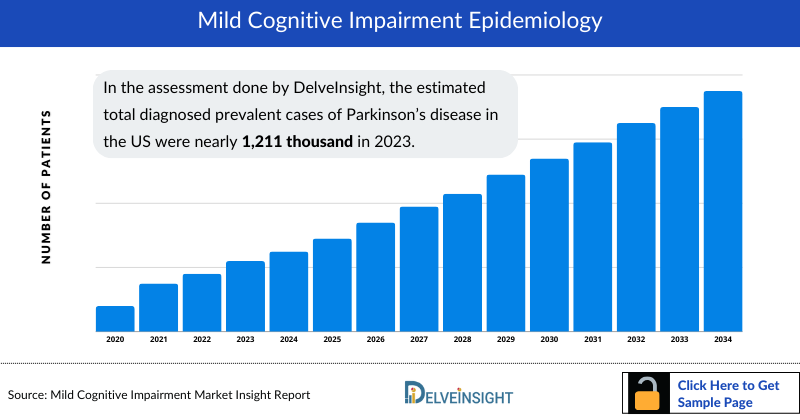
As the market is derived using a patient-based model, the Mild Cognitive Impairment epidemiology chapter in the report provides historical as well as forecasted epidemiology segmented by, Total Diagnosed Prevalent Cases of Parkinson’s Disease, Total Diagnosed Prevalent Cases of Alzheimer’s Disease, and Total Diagnosed Prevalent Cases of Mild Cognitive Impairment in the 7MM covering, the United States, EU4 countries (Germany, France, Italy, and Spain), United Kingdom, and Japan from 2022 to 2036.
- According to DelveInsight estimates, the US reported approximately 3.5 million cases of MCI due to Alzheimer’s disease in 2025, while Japan accounted for around 2.5 million cases in the same year, highlighting a substantial disease burden and regional variability.
- In a study conducted in the UK, MCI prevalence has been estimated to range between <1 and 42% in older populations depending on the classification criteria used and setting (e.g., clinical vs. population-based).
- A research study from Japan reported crude prevalence rates of 10.9% for amnestic MCI, 12.6% for non-amnestic MCI, and 16.4% for dementia, highlighting the significant burden of cognitive impairment in the population.
Stay ahead with insights on Mild Cognitive Impairment prevalence and patient population projections.
Mild Cognitive Impairment Drug Chapters
The drug chapter segment of the Mild Cognitive Impairment report encloses a detailed analysis of Mild Cognitive Impairment off-label drugs and late-stage (Phase-III and Phase-II) pipeline drugs. It also helps to understand the Mild Cognitive Impairment clinical trial details, expressive pharmacological action, agreements and collaborations, approval and patent details, advantages and disadvantages of each included drug, and the latest news and press releases.
Mild Cognitive Impairment Marketed Drugs
LEQEMBI (lecanemab): Biogen Inc./Eisai Co., Ltd.
LEQEMBI, an FDA-approved treatment for Alzheimer’s, specifically targets patients in the Mild Cognitive Impairment or mild dementia stages. Developed as a humanized IgG1 monoclonal antibody, LEQEMBI addresses amyloid ß (Aß) pathology by reducing both soluble and insoluble forms of Aß to slow disease progression.
With ongoing prescription expansion, the focus includes customized facility information on the drug, reimbursement support, and system efficiency enhancements. Approved by regulatory bodies in Great Britain (August 2024) and Japan (September 2023), LEQEMBI marks a significant milestone as the first approved therapy in Europe to target an Alzheimer’s-related pathology directly.
KISUNLA (Donanemab): Eli Lilly and Company
KISUNLA (donanemab-azbt), developed by Eli Lilly, targets amyloid plaques in patients with Mild Cognitive Impairment or early symptomatic Alzheimer’s disease confirmed by amyloid pathology. This humanized IgG1 monoclonal antibody addresses amyloid ß accumulation—a key contributor to Alzheimer’s by focusing on insoluble N-truncated pyroglutamate amyloid beta plaques.
Administered intravenously every four weeks, KISUNLA’s structured dosing regimen was informed by Phase III TRAILBLAZER-ALZ 2 trial data, supporting approvals in the US (July 2024) and Japan (September 2024). Unique to KISUNLA is the potential to halt treatment once plaques clear, which may optimize efficacy and lower treatment costs.
Emerging Mild Cognitive Impairment Drugs
AGB101: AgeneBio
AGB101 is an investigational therapy targeting hippocampal overactivity in patients with mild cognitive impairment due to Alzheimer’s disease, aiming to slow progression to dementia. It is based on AgeneBio’s broader Gamma-aminobutyric Acid Type A (GABAA) receptor α5 program, which is focused on modulating GABAA α5 receptors highly expressed in the hippocampus.
TRx0237/Hydromethylthionine Mesylate (HMTM): TauRx Therapeutics
TauRx Therapeutics’ TRx0237/Hydromethylthionine Mesylate (HMTM) is an orally active second-generation Tau protein Aggregation Inhibitor (TAI). It is a small-molecule drug being tested for its ability to inhibit the aggregation of tau (a protein) that forms neurofibrillary tangles in the brains of people with Alzheimer’s disease and other neurodegenerative diseases.
OLX-07010: Oligomerix
Oligomerix has advanced its lead compound, OLX-07010, a small-molecule inhibitor of tau self-association, into first-in-human Phase Ia trials. The company’s pipeline indicates that OLX-07010 is in active development for MCI and mild Alzheimer’s disease.
Stay ahead with key updates on Mild Cognitive Impairment treatments. Access the 2025 pipeline report for exclusive insights!
Latest Developments in the Mild Cognitive Impairment Market
- In April 2026, TauRx reported findings from a confirmatory study published in The Journal of Prevention of Alzheimer’s Disease, using external control datasets to validate the clinical impact of HMTM. The analysis showed statistically significant improvements in cognitive outcomes and disease progression in patients with MCI, reinforcing prior evidence of disease-modifying potential.
- In February 2026, AgeneBio reported data supporting its lead candidate AGB101, a low-dose extended-release formulation of levetiracetam, for patients with MCI due to Alzheimer’s disease. The company highlighted findings from Northwestern University demonstrating prevention of amyloid-beta plaque formation.
- In January 2026, TauRx reported Phase III LUCIDITY trial results, published in The Journal of Prevention of Alzheimer’s Disease, showing that HMTM achieved statistically significant cognitive improvement over 18 months in patients with MCI due to Alzheimer’s disease, with no meaningful decline observed over two years.
Mild Cognitive Impairment Market Outlook
Mild Cognitive Impairment presents as cognitive decline that exceeds typical age-related changes but does not significantly disrupt daily living. Its progression to dementia, particularly Alzheimer’s disease, underscores the importance of early detection and intervention. Treatment strategies focus on modifiable risk factors, such as dietary habits, hypertension, and physical activity. While pharmacological options like cholinesterase inhibitors (ChEIs) and memantine may be employed in Alzheimer’s-related cases, non-pharmacological interventions including cognitive training, exercise, and lifestyle changes are vital for managing Mild Cognitive Impairment.
The absence of a standardized treatment necessitates personalized management approaches, particularly in patients with comorbid conditions. Although ChEIs are frequently prescribed for Alzheimer’s, their efficacy in Mild Cognitive Impairment remains unproven, leading to potential deprescribing recommendations. Established treatments like donepezil, rivastigmine, and galantamine show modest and temporary benefits, while memantine proves effective in moderate to severe cases.
With a growing focus on advanced treatment options, the market for Mild Cognitive Impairment is expanding, highlighting opportunities for innovation and investment in new therapies and technologies.
The Mild Cognitive Impairment market is poised for transformation with the anticipated introduction of therapies like Valiltramiprosate, Mirodenafil, Hydromethylthionine mesylate (HMTM), and others. The approval of these therapies could significantly impact market dynamics, although their success rates remain uncertain.
- The market size of Mild Cognitive Impairment in the 7MM was ~USD 2,836 million in 2023, which is further anticipated to increase during the forecast period.
- The United States accounted for the highest market size of Mild Cognitive Impairment approximately 52% of the total market size in 7MM in 2023, in comparison to the other major markets i.e., EU4 countries (Germany, France, Italy, and Spain), and the United Kingdom, and Japan.
- Among the EU countries, Germany had the highest market size with USD 222 million in 2023, while the UK had the lowest market size for Mild Cognitive Impairment with USD ~88 million in 2023.
- The market size for Mild Cognitive Impairment in Japan was estimated to be about USD 670 million in 2023.
- With the expected launch of upcoming therapies, such as Valiltramiprosate, Mirodenafil, and Hydromethylthionine mesylate (HMTM), among others, the total market size of Mild Cognitive Impairment is expected to show change in the upcoming years.

Mild Cognitive Impairment Drugs Uptake
This section focuses on the uptake rate of potential drugs expected to launch in the market during 2020–2034. For example, Valiltramiprosate in the US is expected to be launched by 2025 with a peak share of 1.0%. Mirodenafil is anticipated to take 7 years to peak with a slow medium uptake.
Further detailed analysis of emerging therapies drug uptake in the report…
Mild Cognitive Impairment Pipeline Development Activities
The report provides insights into different Mild Cognitive Impairment clincial trials within Phase III, Phase II, and Phase I stage. It also analyzes key players involved in developing targeted therapeutics.
Pipeline Development Activities
The report covers information on collaborations, acquisitions and mergers, licensing, and patent details for Mild Cognitive Impairment emerging therapies.
KOL Views
To keep up with current market trends, we take KOLs and SMEs’ opinions working in the domain through primary research to fill the data gaps and validate the secondary research. Industry Experts were contacted for insights on Mild Cognitive Impairment evolving treatment landscape, patient reliance on conventional therapies, patient therapy switching acceptability, and drug uptake along with challenges related to accessibility, including KOL from Boston University School of Public Health, Department of Epidemiology, US, Department of Psychiatry and Human Behavior, Brown University Warren Alpert Medical School, Providence, Department of Neurology, Taub Institute for Research on Alzheimer’s Disease and the Aging Brain,vNew York US, Psychiatric Practice Bohlken, Berlin, Germany, Department of Biology, E´cole Normale Supe´rieure de Lyon, Lyon, France, Geriatric, Local Health Authority, Pistoia Italy, Department of Psychiatry, Universidad Autónoma de Madrid, Madrid, Spain, and Department of Occupational Therapy, Graduate School of Medicine, Akita University, Japan.
Delveinsight’s analysts connected with 50+ KOLs to gather insights; however, interviews were conducted with 15+ KOLs in the 7MM. Their opinion helps understand and validate current and emerging therapies, treatment patterns, or Mild Cognitive Impairment market trends. This will support the clients in potential upcoming novel treatments by identifying the overall scenario of the market and the unmet needs.
Qualitative Analysis
We perform Qualitative and market Intelligence analysis using various approaches, such as SWOT and Conjoint Analysis. In the SWOT analysis, strengths, weaknesses, opportunities, and threats in terms of disease diagnosis, patient awareness, patient burden, competitive landscape, cost-effectiveness, and geographical accessibility of therapies are provided. These pointers are based on the Analyst’s discretion and assessment of the patient burden, cost analysis, and existing and evolving treatment landscape.
Conjoint Analysis analyzes multiple approved and emerging therapies based on relevant attributes such as safety, efficacy, frequency of administration, route of administration, and order of entry. Scoring is given based on these parameters to analyze the effectiveness of therapy.
Further, the therapies’ safety is evaluated wherein the acceptability, tolerability, and adverse events are majorly observed, and it sets a clear understanding of the side effects posed by the drug in the trials. In addition, the scoring is also based on the route of administration, order of entry and designation, probability of success, and the addressable patient pool for each therapy. According to these parameters, the final weightage score and the ranking of the emerging therapies are decided.
Market Access and Reimbursement
The high cost of therapies for the treatment is a major factor restraining the growth of the global drug market. Because of the high cost, the economic burden is increasing, leading the patient to escape from proper treatment.
The report further provides detailed insights on the country-wise accessibility and reimbursement scenarios, cost-effectiveness scenario of approved therapies, programs making accessibility easier and out-of-pocket costs more affordable, insights on patients insured under federal or state government prescription drug programs, etc.
Scope of the Mild Cognitive Impairment Report
- The report covers a segment of key events, an executive summary, descriptive overview of Mild Cognitive Impairment, explaining its causes, signs and symptoms, and currently available therapies.
- Comprehensive insight has been provided into the epidemiology segments and forecasts, the future growth potential of diagnosis rate, disease progression, and treatment guidelines.
- Additionally, an all-inclusive account of the current and emerging therapies and the elaborative profiles of late-stage and prominent therapies will impact the current treatment landscape.
- A detailed review of the Mild Cognitive Impairment market, historical and forecasted market size, market share by therapies, detailed assumptions, and rationale behind the approach is included in the report covering the 7MM drug outreach.
- The report provides an edge while developing business strategies, by understanding trends, through SWOT analysis and expert insights/KOL views, patient journey, and treatment preferences that help shape and drive the 7MM Mild Cognitive Impairment market.
Mild Cognitive Impairment Report Insights
- Mild Cognitive Impairment Patient Population
- Mild Cognitive Impairment Therapeutic Approaches
- Mild Cognitive Impairment Pipeline Analysis
- Mild Cognitive Impairment Market Size and Trends
- Existing and Future Market Opportunity
Mild Cognitive Impairment Report Key Strengths
- 11 years Forecast
- The 7MM Coverage
- Mild Cognitive Impairment Epidemiology Segmentation
- Key Cross Competition
- Conjoint Analysis
- Mild Cognitive Impairment Drugs Uptake
- Key Mild Cognitive Impairment Market Forecast Assumptions
Mild Cognitive Impairment Report Assessment
- Current Mild Cognitive Impairment Treatment Practices
- Mild Cognitive Impairment Unmet Needs
- Mild Cognitive Impairment Pipeline Product Profiles
- Mild Cognitive Impairment Market Attractiveness
- Qualitative Analysis (SWOT and Conjoint Analysis)
- Mild Cognitive Impairment Market Drivers
- Mild Cognitive Impairment Market Barriers
Key Questions Answered In The Mild Cognitive Impairment Market Report:
Mild Cognitive Impairment Market Insights
- What was the Mild Cognitive Impairment market share (%) distribution in 2022 and how it would look like in 2036?
- What would be the Mild Cognitive Impairment total market size as well as market size by therapies across the 7MM during the forecast period (2026–2036)?
- What are the key findings pertaining to the market across the 7MM and which country will have the largest Mild Cognitive Impairment market size during the forecast period (2026–2036)?
- At what CAGR, the Mild Cognitive Impairment market is expected to grow at the 7MM level during the forecast period (2026–2036)?
- What would be the Mild Cognitive Impairment market outlook across the 7MM during the forecast period (2026–2036)?
- What would be the Mild Cognitive Impairment market growth till 2034 and what will be the resultant market size in the year 2034?
- How would the market drivers, barriers, and future opportunities affect the market dynamics and subsequent analysis of the associated trends?
Mild Cognitive Impairment Epidemiology Insights
- What is the disease risk, burden, and unmet needs of Mild Cognitive Impairment?
- What is the historical Mild Cognitive Impairment patient population in the United States, EU5 (Germany, France, Italy, Spain, and the UK), and Japan?
- What would be the forecasted patient population of Mild Cognitive Impairment at the 7MM level?
- What will be the growth opportunities across the 7MM with respect to the patient population pertaining to Mild Cognitive Impairment?
- Out of the above-mentioned countries, which country would have the highest prevalent population of Mild Cognitive Impairment during the forecast period (2026–2036)?
- At what CAGR the population is expected to grow across the 7MM during the forecast period (2026–2036)?
Current Mild Cognitive Impairment Treatment Scenario, Marketed Drugs, and Emerging Therapies
- What are the current options for the treatment of Mild Cognitive Impairment along with the approved therapy?
- What are the current treatment guidelines for the treatment of Mild Cognitive Impairment in the US, Europe, And Japan?
- What are the Mild Cognitive Impairment marketed drugs and their MOA, regulatory milestones, product development activities, advantages, disadvantages, safety, and efficacy, etc.?
- How many companies are developing therapies for the treatment of Mild Cognitive Impairment?
- How many emerging therapies are in the mid-stage and late stages of development for the treatment of Mild Cognitive Impairment?
- What are the key collaborations (Industry–Industry, Industry-Academia), Mergers and acquisitions, licensing activities related to the Mild Cognitive Impairment therapies?
- What are the recent therapies, targets, mechanisms of action and technologies developed to overcome the limitation of existing therapies?
- What are the clinical studies going on for Mild Cognitive Impairment and their status?
- What are the key designations that have been granted for the emerging therapies for Mild Cognitive Impairment?
- What are the 7MM historical and forecasted market of Mild Cognitive Impairment?
Reasons to Buy Mild Cognitive Impairment Market Forecast Report
- The report will help in developing business strategies by understanding the latest trends and changing treatment dynamics driving the Mild Cognitive Impairment Market.
- Insights on patient burden/disease incidence, evolution in diagnosis, and factors contributing to the change in the epidemiology of the disease during the forecast years.
- To understand the existing market opportunity in varying geographies and the growth potential over the coming years.
- Distribution of historical and current patient share based on real-world prescription data along with reported sales of approved products in the US, EU4 (Germany, France, Italy, and Spain), the United Kingdom, and Japan.
- Identification of strong upcoming players in the market will help in devising strategies that will help in getting ahead of competitors.
- Detailed analysis and potential of current and emerging therapies under the conjoint analysis section to provide visibility around leading emerging drugs.
- Highlights of Access and Reimbursement policies of approved therapies, barriers to accessibility of off-label expensive therapies, and patient assistance programs.
- To understand the perspective of Key Opinion Leaders around the accessibility, acceptability, and compliance-related challenges of existing treatment to overcome barriers in future.
- Detailed insights on the unmet need of the existing market so that the upcoming players can strengthen their development and launch strategy.
Frequently Asked Questions
1. What is the forecast period covered in the report?
The Mild Cognitive Impairment Epidemiology and Market Insight report for the 7MM covers the forecast period from 2026 to 2036, providing a projection of market dynamics and trends during this timeframe.
2. Who are the key players in the Mild Cognitive Impairment market?
The Mild Cognitive Impairment market is quite robust. The major layers are Alzheon Inc., AriBio Co., Ltd., TauRx Therapeutics Ltd, and others which are currently developing drugs for the treatment of Mild Cognitive Impairment.
3. How is the market size estimated in the forecast report?
The market size is estimated through data analysis, statistical modeling, and expert opinions. It may consider factors such as prevalent cases, treatment costs, revenue generated, and market trends.
4. What is the key driver of the Mild Cognitive Impairment market?
The increase in diagnosed prevalent cases of Mild Cognitive Impairment and the launch of emerging therapies are attributed to be the key drivers for increasing the Mild Cognitive Impairment market.
5. What is the expected impact of emerging therapies or advancements in Mild Cognitive Impairment treatment on the market?
Introducing new therapies, advancements in diagnostic techniques, and innovations in treatment approaches can significantly impact the Mild Cognitive Impairment treatment market. Market forecast reports may provide analysis and predictions regarding the potential impact of these developments.
6. Does the report provide insights into the competitive landscape of the market?
The market forecast report may include information on the competitive landscape, profiling key market players, their product offerings, partnerships, and strategies, and helping stakeholders understand the competitive dynamics of the Mild Cognitive Impairment market.