
MNKD-101 Market Summary
Key Factors Driving MNKD-101 Growth
1. Recent Clinical Setback with Phase III Trial Discontinuation
• MannKind discontinued the Phase III ICoN-1 global clinical trial of MNKD-101 after an interim analysis showed no sputum culture conversions in the first 46 participants, meaning it was unlikely to meet its primary efficacy endpoint.
• An independent Data Safety Monitoring Board (DSMB) agreed with the decision to halt the trial for futility, though it specifically noted no safety concerns during the study.
2. Regulatory Incentives and Past Progress
Before the Phase III halt, MNKD-101 had significant regulatory support intended to accelerate development:
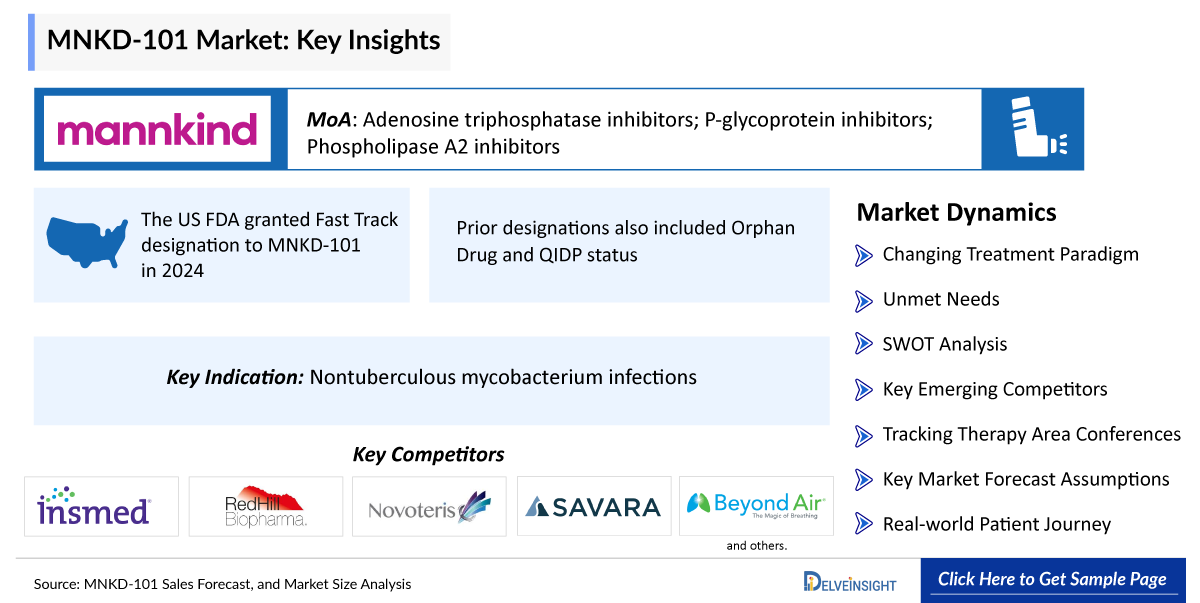
• The US FDA granted Fast Track designation to MNKD-101 in 2024 to support expedited development and review. This was based on the drug’s potential to address serious unmet needs in NTM lung disease.
• Prior designations also included Orphan Drug and QIDP status, which provide incentives such as market exclusivity, priority review, and additional regulatory benefits.
3. Shift to Next-Gen Formulation (MNKD-102)
• Despite the Phase III discontinuation, MannKind stated it remains focused on MNKD-102, a dry powder inhaler (DPI) formulation of clofazimine, which has been progressing toward Phase 1 development.
• Management intends to apply learnings from the MNKD-101 results to optimize MNKD-102, which is hoped to improve lung delivery and therapeutic potential compared with the nebulized suspension.
4. Broader Company Pipeline and Strategic Drivers
Although MNKD-101 has faced setbacks, company efforts and broader portfolio dynamics still support growth:
• MannKind’s inhalation drug delivery platform (Technosphere) continues to be a strategic focus, and the company’s existing products (e.g., Afrezza inhaled insulin) provide revenue and manufacturing scale.
• Other pipeline assets like MNKD-201 (a dry powder inhalation formulation of nintedanib for idiopathic pulmonary fibrosis) are progressing, which could diversify future revenue sources.
• Past financial reporting showed pipeline investment rising, with R&D costs increasing to support programs including MNKD-101 development.
5. Market Context and Forecast Implications
NTM lung disease itself represents an emerging but growing therapeutic market:
• An estimated 122,000–159,000 U.S. and Japanese patients lived with NTM lung disease as of 2022, and prevalence has been increasing at ~8% annually.
• However, market size and forecast estimates for this specific condition vary; some analyses project the broader NTM therapy market to exceed USD 1 billion by the end of this decade
MNKD-101 Recent Developments
• In November 2025, MannKind discontinued the Phase 3 ICoN-1 global clinical trial of MNKD-101 after an interim analysis showed no sputum culture conversions in the first 46 participants, meaning it was unlikely to meet its primary efficacy endpoint.
“MNKD-101 Sales Forecast, and Market Size Analysis – 2034” report provides comprehensive insights of MNKD-101 for potential indication like Nontuberculous mycobacterium infections in the 7MM. A detailed picture of MNKD-101’s existing usage in anticipated entry and performance in potential indications in the 7MM, i.e., the United States, EU4 (Germany, France, Italy, and Spain) and the United Kingdom, and Japan for the study period 2020 –2034 is provided in this report along with a detailed description of the MNKD-101 for potential indications. The MNKD-101 market report provides insights about MNKD-101’s sales forecast, mechanism of action (MoA), dosage and administration, as well as research and development including regulatory milestones, along with other developmental activities. Further, it also consists of historical and current MNKD-101 performance, future market assessments inclusive of the MNKD-101 market forecast analysis for potential indications in the 7MM, SWOT, analysts’ views, comprehensive overview of market competitors, and brief about other emerging therapies in respective indications. It also provides analysis of MNKD-101 sales forecasts, along with factors driving its market.
MNKD-101 Drug Summary
MNKD-101 (clofazimine inhalation suspension) is an investigational nebulized formulation of clofazimine, a lipophilic antibiotic that inhibits mycobacterial growth by binding preferentially to mycobacterial DNA, developed by MannKind Corporation using their Technosphere platform for targeted pulmonary delivery to treat nontuberculous mycobacterial (NTM) lung disease, particularly infections caused by Mycobacterium avium complex (MAC) in patients on guideline-based therapy (GBT). The report provides MNKD-101’s sales, growth barriers and drivers, post usage and approvals in multiple indications.
Scope of the MNKD-101 Market Report
The report provides insights into:
• A comprehensive product overview including the MNKD-101 MoA, description, dosage and administration, research and development activities in potential indication like Nontuberculous mycobacterium infections.
• Elaborated details on MNKD-101 regulatory milestones and other development activities have been provided in MNKD-101 market report.
• The report also highlights MNKD-101‘s cost estimates and regional variations, reported and estimated sales performance, research and development activities in potential indications across the United States, Europe, and Japan.
• The MNKD-101 market report also covers the patents information, generic entry and impact on cost cut.
• The MNKD-101 market report contains current and forecasted MNKD-101 sales for potential indications till 2034.
• Comprehensive coverage of the late-stage emerging therapies for respective indications.
• The MNKD-101 market report also features the SWOT analysis with analyst views for MNKD-101 in potential indications.
Methodology
The MNKD-101 market report is built using data and information sourced primarily from internal databases, primary and secondary research and in-house analysis by DelveInsight’s team of industry experts. Information and data from the secondary sources have been obtained from various printable and nonprintable sources like search engines, news websites, global regulatory authorities websites, trade journals, white papers, magazines, books, trade associations, industry associations, industry portals and access to available databases.
MNKD-101 Analytical Perspective by DelveInsight
• In-depth MNKD-101 Market Assessment
This MNKD-101 sales market forecast report provides a detailed market assessment of MNKD-101 for potential indication like Nontuberculous mycobacterium infections in the seven major markets, i.e., the United States, EU4 (Germany, France, Italy, and Spain) and the United Kingdom, and Japan. This segment of the report provides current and forecasted MNKD-101 sales data uptil 2034.
• MNKD-101 Clinical Assessment
The MNKD-101 market report provides the clinical trials information of MNKD-101 for potential indications covering trial interventions, trial conditions, trial status, start and completion dates.
MNKD-101 Competitive Landscape
The report provides Insights on competitors and marketed products within the domain, along with a summary of emerging products and their respective launch dates, posing significant competition in the market.
MNKD-101 Market Potential & Revenue Forecast
• Projected market size for the MNKD-101 and its key indications
• Estimated MNKD-101 sales potential (MNKD-101 peak sales forecasts)
• MNKD-101 Pricing strategies and reimbursement landscape
MNKD-101 Competitive Intelligence
• Number of competing drugs in development (pipeline analysis)
• MNKD-101 Market positioning compared to existing treatments
• MNKD-101 Strengths & weaknesses relative to competitors
MNKD-101 Regulatory & Commercial Milestones
• MNKD-101 Key regulatory approvals & expected launch timelines
• Commercial partnerships, licensing deals, and M&A activity
MNKD-101 Clinical Differentiation
• MNKD-101 Efficacy & safety advantages over existing drugs
• MNKD-101 Unique selling points
MNKD-101 Market Report Highlights
• In the coming years, the MNKD-101 market scenario is set to change due to strong adoption, increased prescriptions and broader uptake in multiple immunological indications; which would expand the size of the market.
• The MNKD-101 companies are developing therapies that focus on novel approaches to treat/improve the disease condition, assess challenges, and seek opportunities that could influence MNKD-101’s dominance.
• Other emerging products for corneal disorders are expected to give tough market competition to MNKD-101 and launch of late-stage emerging therapies in the near future will significantly impact the market.
• A detailed description of regulatory milestones, and developmental activities, provide the current development scenario of MNKD-101 in potential indications.
• Analyse MNKD-101 cost, pricing trends and market positioning to support strategic decision-making in the immunology landscape.
• Our in-depth analysis of the forecasted MNKD-101 sales data uptil 2034 will support the clients in decision-making process regarding their therapeutic portfolio by identifying the overall scenario of MNKD-101 in potential indications.
Key Questions
• What is the class of therapy, route of administration and mechanism of action of MNKD-101? How strong is MNKD-101’s clinical and commercial performance?
• What is MNKD-101’s clinical trial status in each individual indications such as Nontuberculous mycobacterium infections and study completion date?
• What are the key collaborations, mergers and acquisitions, licensing and other activities related to the MNKD-101 Manufacturers?
• What are the key designations that have been granted to MNKD-101 for potential indications? How are they going to impact MNKD-101’s penetration in various geographies?
• What is the current and forecasted MNKD-101 market scenario for potential indications? What are the key assumptions behind the forecast?
• What are the current and forecasted sales of MNKD-101 in the seven major countries, including the United States, Europe (Germany, France, Italy, Spain) and the United Kingdom, and Japan?
• What are the other emerging products available and how are these giving competition to MNKD-101 for potential indications?
• Which are the late-stage emerging therapies under development for the treatment of potential indications?
• How cost-effective is MNKD-101? What is the duration of therapy and what are the geographical variations in cost per patient?

