
Molecular Modeling Market Summary
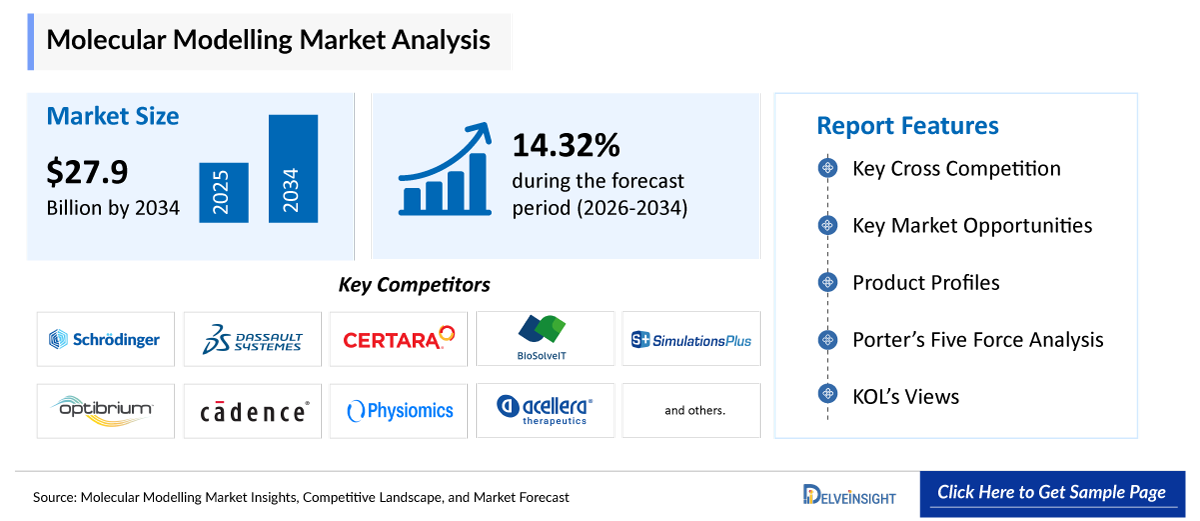
- The Global Molecular Modelling Market is expected to increase from USD 8,438.64 million in 2025 to USD 27,999.65 million by 2034, reflecting strong and sustained growth.
- The Global Molecular Modelling Market is growing at a CAGR of 14.32% during the forecast period from 2026 to 2034.
Molecular Modeling Market Insights & Forecast
- The Molecular Modelling Market is being strongly driven by the combined impact of rising drug discovery demand, rapid advancements in computational power and AI, and the growing complexity of modern therapeutics. As pharmaceutical and biotech companies accelerate R&D pipelines, Molecular Modelling enables faster and more cost-effective identification of viable drug candidates through in-silico simulations.
- At the same time, advancements in high-performance computing and AI platforms—adopted by companies such as Schrödinger, Inc. and Dassault Systèmes—are significantly improving the speed, scalability, and predictive accuracy of molecular interactions. Additionally, the increasing focus on biologics, including monoclonal antibodies and complex protein-based therapies, requires sophisticated modelling tools to analyze large, intricate molecular structures that traditional methods cannot efficiently handle. Together, these factors are enhancing research efficiency, reducing development timelines, and expanding the application scope of Molecular Modelling, thereby driving overall Market growth.
- The leading Molecular Modeling Companies such as Schrödinger, Inc., Dassault Systèmes, Certara, BioSolveIT GmbH, Simulations Plus, Altaris, LLC, Optibrium, Ltd., Cadence Design Systems, Inc., Wavefunction, Inc., Physiomics Plc, Gaussian Inc., Acellera Therapeutics Inc., Cresset, Fujitsu Limited, Molsoft LLC, and others.
- North America is expected to dominate the Molecular Modelling Market due to the strong presence of leading pharmaceutical and biotechnology companies, advanced research infrastructure, and early adoption of cutting-edge computational technologies. The region benefits from high R&D investments, particularly in the United States, along with widespread use of AI and high-performance computing platforms by companies such as Schrödinger, Inc. and Certara. Additionally, increasing drug discovery activities, a robust regulatory framework, and strong collaborations between academia and industry further support Market growth in the region.
- In the technology/solution type segment of the Molecular Modelling Market, the molecular docking category is estimated to account for the largest Market share in 2025.
Request for Unlocking the Report of the @ Molecular Modelling Market
Molecular Modelling Market Size and Forecasts
|
Report Metrics |
Details |
|
2025 Market Size | |
|
2034 Projected Market Size | |
|
Growth Rate (2026-2034) | |
|
Largest Market |
North America |
|
Fastest Growing Market |
Asia-Pacific |
|
Market Structure |
Moderately Concentrated |
Factors Contributing to the Growth of the Molecular Modelling Market
-
Rising demand for drug discovery & development leading to a surge in Molecular Modelling
One of the strongest drivers is the increasing need to accelerate drug discovery while reducing costs. Molecular Modelling tools, especially techniques like molecular docking and virtual screening, help researchers predict how drug molecules interact with biological targets before lab testing. This significantly shortens the early-stage drug development timeline and minimizes expensive experimental failures, making it highly valuable for pharmaceutical and biotechnology companies.
-
Growth of computational power and AI integration
Advancements in high-performance computing (HPC), cloud computing, and artificial intelligence are transforming Molecular Modelling. AI and machine learning algorithms can analyze massive datasets, optimize molecular structures, and predict outcomes with higher accuracy. This technological evolution enables faster simulations and more reliable results, driving widespread adoption across research institutions and industries.
-
Rising prevalence of chronic and complex diseases
The Global increase in diseases such as cancer, autoimmune disorders, and neurological conditions is pushing demand for innovative therapeutics. Molecular Modelling helps researchers understand disease mechanisms at the molecular level, enabling the development of more effective treatments.
Molecular Modelling Market Report Segmentation
This Molecular Modelling Market Report offers a comprehensive overview of the Global Molecular Modelling Market, highlighting key trends, growth drivers, challenges, and opportunities. It covers detailed Market segmentation by Technology/Solution Type (Molecular Docking, Molecular Dynamics Simulation, AI/ML-based Molecular Modeling, and Others), Component (Software and Services), Application (Drug Discovery & Drug Design, Protein Modeling, Academic Research, and Others), Deployment Type (Cloud-based Platforms, On-premise Solutions, and Hybrid), End-Users (Pharmaceutical & Biotechnology Companies, CROs/CDMOs, Academic & Research Institutes, and Others), and geography.
The Molecular Modeling Market Report provides valuable insights into the competitive landscape, regulatory environment, and Market dynamics across major Markets, including North America, Europe, and Asia-Pacific. Featuring in-depth profiles of leading industry players and recent product innovations, this report equips businesses with essential data to identify Market potential, develop strategic plans, and capitalize on emerging opportunities in the rapidly growing Molecular Modelling Market.
Molecular Modelling is a technique in chemistry that uses computers to represent, visualize, and study the structure and behaviour of molecules. In simple terms, it’s like creating a 3D digital model of molecules (such as proteins, DNA, or drugs) to understand how they look, move, and interact.
The Molecular Modelling Market is being strongly driven by the combined impact of rising drug discovery demand, rapid advancements in computational power and AI, and the growing complexity of modern therapeutics. As pharmaceutical and biotechnology companies continue to expand and accelerate their R&D pipelines, there is an increasing need for efficient, cost-effective tools to identify and optimize drug candidates. Molecular Modelling addresses this need by enabling in-silico simulations that predict molecular behavior, binding affinity, and toxicity early in the development process, thereby reducing reliance on time-consuming and expensive laboratory experiments.
At the same time, continuous improvements in high-performance computing (HPC), cloud infrastructure, and artificial intelligence are significantly enhancing the capabilities of modelling platforms. Molecular Modeling Companies such as Schrödinger, Inc. and Dassault Systèmes are leveraging AI-driven algorithms and physics-based simulations to deliver faster, more accurate, and scalable solutions. These technologies allow researchers to process vast chemical datasets, perform complex simulations in shorter timeframes, and improve the predictability of molecular interactions, which is critical for successful drug design.
Furthermore, the growing emphasis on biologics and complex molecules, including monoclonal antibodies, peptides, and recombinant proteins, is adding another layer of demand for advanced modelling tools. Unlike small molecules, these large and structurally intricate therapeutics require sophisticated computational approaches to understand folding patterns, stability, and target interactions. Molecular Modelling plays a crucial role in addressing these challenges, enabling precise design and optimization of next-generation therapies. Collectively, these factors are not only improving research productivity and reducing development timelines but also broadening the application scope of Molecular Modelling across pharmaceuticals, biotechnology, and emerging fields such as gene and cell therapy, thereby driving sustained Market growth.
Get More Insights into the Report @ Molecular Modelling Market
What are the latest Molecular Modelling Market Dynamics and Trends?
The increasing demand for drug discovery and development is a major factor driving the growth of the Molecular Modelling Market, as pharmaceutical and biotechnology companies seek faster, more cost-effective ways to develop new therapies. With the rising prevalence of chronic and complex diseases such as cancer, autoimmune disorders, and neurological conditions, drug pipelines are expanding significantly, creating a strong need for advanced computational tools. According to the data provided by the International Agency for Research on Cancer (2026), there would be approximately 32.6 million new cases of cancer across the world by 2045.
Molecular Modelling addresses this need by enabling in-silico techniques such as virtual screening, molecular docking, QSAR modelling, and molecular dynamics, which allow researchers to design, analyze, and optimize drug candidates before moving into expensive laboratory and clinical testing. This not only reduces the time and cost associated with traditional drug development, often spanning over a decade, but also improves the success rate of early-stage discovery by minimizing trial-and-error experimentation.
In addition, the integration of artificial intelligence (AI) and machine learning (ML) with Molecular Modelling platforms is transforming drug discovery workflows. These technologies enable researchers to screen vast chemical libraries, predict ADMET properties more accurately, and make data-driven decisions in real time. As a result, Molecular Modelling has become an essential tool for accelerating lead identification and optimization, supporting the industry’s shift toward precision medicine and targeted therapies. The growing reliance on computational approaches is further increasing demand for modelling software, cloud-based platforms, and associated services, thereby contributing directly to overall Market expansion.
Recent company-specific developments further highlight this trend. In November 2025, Optibrium Ltd. launched StarDrop™ 8, a major upgrade to its flagship molecular design platform, enhancing compound optimization capabilities and improving drug discovery efficiency. Subsequently, in March 2026, Optibrium introduced an updated graphical interface for QuanSA™, aimed at strengthening ligand-based affinity prediction and decision-making in molecular design workflows.
Similarly, Cresset released Flare™ V11 in December 2025, incorporating advanced AI features and improved free energy perturbation capabilities to enhance modelling accuracy and productivity. In another strategic move, Cresset acquired Molab.ai in July 2025, reinforcing its position in AI-driven Molecular Modelling and expanding its capabilities in computational drug discovery.
Overall, these advancements demonstrate that the growing demand for faster, more efficient drug development is directly accelerating innovation and adoption of Molecular Modelling technologies, making them a critical component of modern pharmaceutical R&D and a key driver of Market growth.
Thus, the factors mentioned above are expected to boost the overall Molecular Modelling Market during the forecast period.
However, the accuracy and predictive limitations, along with high computational costs and infrastructure requirements, act as key restraints on the Molecular Modelling Market. Despite advancements, modelling results may not always fully replicate real biological systems due to approximations in algorithms and incomplete data, which can lead to unreliable predictions and the need for extensive experimental validation. This reduces user confidence, especially in critical drug development decisions.
Additionally, advanced molecular simulations require significant investment in high-performance computing (HPC), specialized software, and skilled expertise, making adoption costly for small and mid-sized organizations. Together, these challenges limit widespread accessibility and slow down the overall adoption of Molecular Modelling technologies.
Molecular Modelling Market Segment Analysis
Molecular Modelling Market by Technology/Solution Type (Molecular Docking, Molecular Dynamics Simulation, AI/ML-based Molecular Modeling, and Others), Component (Software and Services), Application (Drug Discovery & Drug Design, Protein Modeling, Academic Research, and Others), Deployment Type (Cloud-based Platforms, On-premise Solutions, and Hybrid), End-Users (Pharmaceutical & Biotechnology Companies, CROs/CDMOs, Academic & Research Institutes, and Others), and Geography (North America, Europe, Asia-Pacific, and Rest of the World)
By Technology/Solution Type: Molecular docking is expected to dominate the Market with the largest revenue share
In the technology/solution type segment of the Molecular Modelling Market, the molecular docking category is contributing to 37% of the total Market revenue in 2025. Molecular docking, as a core technology within Molecular Modelling, is significantly boosting the overall Market by enabling researchers to accurately predict how a drug molecule (ligand) interacts with a biological target (such as a protein), thereby transforming the efficiency and success rate of drug discovery processes.
Docking plays a central role in structure-based drug design, allowing scientists to identify binding sites, estimate binding affinity, and determine the most stable orientation (pose) of a molecule within a target protein, which is critical for understanding drug efficacy. This capability has dramatically reduced the reliance on traditional trial-and-error experimental approaches, as pharmaceutical companies can now perform high-throughput virtual screening of large compound libraries, prioritizing only the most promising candidates for synthesis and testing.
As a result, molecular docking directly contributes to cost reduction, faster lead identification, and improved decision-making, making it one of the most widely adopted and commercially valuable technologies in Molecular Modelling platforms. Furthermore, with the integration of artificial intelligence and advanced scoring algorithms, docking tools are becoming more accurate and scalable, enabling the analysis of complex molecules such as macrocycles and biologics.
This has expanded the scope of Molecular Modelling applications across drug discovery, agrochemicals, and material science, thereby increasing demand for docking-enabled software solutions and services and driving overall Market growth.
Recent company-specific developments further highlight the growing importance of molecular docking in advancing the Molecular Modelling Market. For instance, in February 2025, Optibrium expanded access to its docking technology by introducing a PyMOL interface for Surflex-Dock, enabling broader usability among researchers and enhancing integration with existing workflows.
In parallel, companies like Cresset continue to strengthen docking-enabled modelling platforms; for example, Flare™ integrates both ligand-based and structure-based methods to accelerate molecule discovery and optimize binding interactions, helping scientists focus on the most promising compounds before laboratory testing.
Moreover, in December 2025, Cresset introduced AI-driven enhancements in Flare™ V11, improving computational efficiency and decision-making in molecular design workflows.
Overall, these developments demonstrate that molecular docking is not only a foundational technology but also a major growth engine for the Molecular Modelling Market, as continuous innovations in accuracy, scalability, and integration are enabling faster, more reliable drug discovery, thereby increasing adoption across pharmaceutical and biotechnology industries.
By Component: Software category dominates the Market
Within the component segment of the Molecular Modelling Market, the software category is anticipated to dominate, accounting for around 60% of the Market share in 2025, due to its critical role in enabling structure-based drug design, molecular docking, quantum chemistry simulations, and AI-assisted virtual screening workflows. Pharmaceutical and biotechnology companies increasingly rely on advanced computational software platforms to reduce drug discovery timelines, improve prediction accuracy, and lower experimental R&D costs.
The growing integration of AI and machine learning into Molecular Modelling software, along with the rapid adoption of cloud-based simulation environments, is further strengthening its dominance over services and other components. Additionally, software platforms such as molecular dynamics, pharmacophore modelling, and virtual screening tools are now central to early-stage drug discovery pipelines, making them the most widely deployed and revenue-generating segment in the component landscape.
Recent Developments further reinforce this dominance
For instance, in June 2025, Dassault Systèmes’ BIOVIA launched an AI-assisted Molecular Modelling workflow integrated into its 3DEXPERIENCE platform, enabling automated docking and predictive analytics for pharmaceutical R&D. Similarly, Schrödinger enhanced its Glide docking suite in October 2024 with water-energetics-based pose prediction improvements, improving accuracy in virtual screening and lead optimization. In February 2025, Schrödinger also expanded its FEP+ platform to support RNA-targeted drug design, reflecting rising demand for RNA-based therapeutics.
Additionally, ChemAxon’s May 2025 partnership with Rigaku integrated cheminformatics with crystallography tools to streamline structure-based drug design workflows, highlighting continuous innovation in software ecosystems. These advancements collectively demonstrate how software-driven innovation is accelerating adoption and solidifying its leadership position in the Molecular Modelling Market.
By Application: Drug discovery & drug design category dominates the Market
Within the application segment of the Molecular Modelling Market, the drug discovery & drug design category is anticipated to dominate, accounting for around 45% of the Market share in 2025, due to its central role in accelerating and optimizing the early stages of pharmaceutical development. Molecular Modelling techniques such as molecular docking, molecular dynamics simulations, and structure-based drug design are extensively used to identify novel drug targets, predict ligand-receptor interactions, and optimize lead compounds with higher precision and lower experimental cost.
This dominance is further supported by the increasing adoption of AI- and machine learning enabled virtual screening platforms, which significantly reduce the time required for hit identification and lead optimization while improving success rates in clinical pipelines. The rising burden of chronic diseases, oncology research expansion, and demand for faster, cost-efficient drug development are further strengthening the reliance on computational drug discovery tools. Industry reports also indicate that drug discovery remains the largest application area in Molecular Modelling, accounting for a significant share of usage across pharmaceutical and biotechnology companies due to its direct impact on reducing late-stage drug failure and R&D expenditure.
Recent Developments also highlight strong industry momentum in this segment
For example, Schrödinger expanded its FEP+ platform in February 2025 to support RNA-targeted drug discovery, enabling more accurate free-energy calculations for next-generation therapeutics. In October 2024, Dassault Systèmes (BIOVIA) enhanced its drug design workflow within the 3DEXPERIENCE platform, integrating AI-driven predictive modeling for faster candidate selection. These advancements collectively reinforce drug discovery and drug design as the most influential and revenue-driving application segment in the Molecular Modelling Market.
By Deployment Type Type: Cloud-based Platforms category dominates the Market
Within the deployment type segment of the Molecular Modelling Market, the cloud-based platforms category is anticipated to dominate, accounting for around 43% of the Market share in 2025, due to their scalability, cost efficiency, and ability to support high-performance computing (HPC) workloads required for complex molecular simulations. Cloud-based Molecular Modelling solutions enable researchers to perform large-scale molecular dynamics, virtual screening, and AI-driven drug discovery without the need for expensive on-premise infrastructure, making advanced computational capabilities more accessible to small and mid-sized biotech firms as well as academic research institutes.
The increasing volume of multi-omics data, growing complexity of biologics and small-molecule pipelines, and rising adoption of collaborative drug discovery models are further driving demand for cloud deployment. Additionally, cloud platforms allow seamless integration of AI/ML algorithms, real-time data sharing, and remote collaboration between geographically distributed research teams, significantly improving productivity and reducing time-to-Market for drug candidates. Industry analyses consistently indicate that cloud-based deployment is becoming the preferred model across pharmaceutical R&D due to its flexibility, lower upfront capital investment, and ability to dynamically scale computing resources during intensive simulation workflows.
Recent developments further reinforce this dominance
For instance, Schrödinger expanded its cloud-native computational chemistry platform in March 2025, enabling scalable access to its FEP+ and molecular dynamics tools via cloud HPC infrastructure. Similarly, Dassault Systèmes enhanced its BIOVIA cloud deployment within the 3DEXPERIENCE platform in June 2025, integrating AI-powered simulation workflows accessible through SaaS models for pharmaceutical clients. In addition, Amazon Web Services (AWS) strengthened its life sciences cloud offerings in 2024 by expanding partnerships with biotech companies for drug discovery workloads, providing optimized environments for Molecular Modelling and bioinformatics simulations. These developments collectively highlight how cloud-based platforms are transforming computational drug discovery, making them the dominant deployment model in the Molecular Modelling Market.
By End-Users: Pharmaceutical & biotechnology companies category dominates the Market
Within the end-user segment of the Molecular Modelling Market, pharmaceutical and biotechnology companies dominate the Market due to their heavy reliance on computational tools for drug discovery, lead optimization, and target identification. These organizations extensively use Molecular Modelling techniques such as molecular docking, dynamics simulations, and AI-based virtual screening to accelerate R&D timelines, reduce experimental costs, and improve drug success rates. The growing focus on precision medicine, biologics, and complex disease areas like oncology and autoimmune disorders further strengthens adoption. As a result, Molecular Modelling has become a core part of modern drug development workflows in pharma and biotech firms, making them the leading end-user segment in the Market.
Molecular Modelling Market Regional Analysis
North America Molecular Modelling Market Trends
North America is expected to account for the highest proportion of 41% of the Molecular Modelling Market in 2025, out of all regions. North America plays a dominant and highly influential role in boosting the Global Molecular Modelling Market, driven by its strong pharmaceutical ecosystem, advanced research infrastructure, high R&D investments, and rapid adoption of cutting-edge technologies such as artificial intelligence and high-performance computing. Additionally, the U.S. is home to some of the world’s leading pharmaceutical and biotechnology companies, including Pfizer, Merck, and Johnson & Johnson, which continuously invest billions of dollars into drug discovery and development, thereby creating substantial demand for Molecular Modelling tools and platforms.
In addition, the U.S. leads in AI-driven pharmaceutical innovation, with the AI in pharma Market expected to grow at a rapid pace due to increased research spending and demand for faster, data-driven drug development processes. Molecular Modelling is a critical component of these AI-enabled workflows, allowing researchers to analyze complex biological data, predict molecular interactions, and accelerate lead identification.
The presence of top academic institutions, strong intellectual property frameworks, and significant venture capital funding further strengthens the innovation ecosystem, enabling continuous advancements in computational chemistry and modelling technologies.
Recent company-specific developments clearly illustrate how the United States is actively driving innovation in Molecular Modelling. For instance, in January 2026, AstraZeneca acquired Modella AI, a Boston-based company, to enhance AI-driven drug discovery and integrate advanced modelling capabilities into its R&D pipeline, while also committing USD 50 billion in U.S. investments by 2030 to expand its presence and research capabilities.
Similarly, in March 2025, Sapio Sciences integrated NVIDIA BioNeMo into its platform, enabling AI-powered Molecular Modelling applications such as protein structure prediction and docking simulations, thereby strengthening in-silico research workflows. Furthermore, in February 2026, Isomorphic Labs introduced its Drug Design Engine, which significantly improved protein–ligand prediction accuracy and reduced computational time, demonstrating the rapid advancement of AI-driven Molecular Modelling technologies.
In addition, major U.S.-linked pharmaceutical companies are increasingly forming strategic partnerships to accelerate AI-based drug discovery; for example, in February 2026, Takeda entered a $1.7 billion collaboration with Iambic Therapeutics to leverage AI models for predicting molecular binding interactions, a core aspect of Molecular Modelling, while Eli Lilly expanded its partnership with Insilico Medicine in 2026 with deals worth up to $2.75 billion, focusing on AI-driven drug design and modelling approaches.
Overall, North America is boosting the Molecular Modelling Market through a powerful combination of large-scale drug discovery activities, technological innovation, AI integration, and strategic industry collaborations, making it the leading hub for the development and adoption of advanced Molecular Modelling solutions and a key driver of Global Market growth.
Europe Molecular Modelling Market Trend
The Molecular Modelling Market in Europe is witnessing strong and sustained growth, driven by the region’s well-established pharmaceutical and biotechnology industry, increasing adoption of AI-based drug discovery tools, and strong government and academic–industry collaborations. Europe benefits from a highly developed research ecosystem, particularly in countries such as Germany, the U.K., France, and Switzerland, where pharmaceutical companies are increasingly integrating Molecular Modelling platforms for structure-based drug design, virtual screening, and predictive toxicology.
The region’s emphasis on innovation-driven drug development, regulatory compliance, and cost-efficient R&D workflows is accelerating the shift from traditional experimental methods to advanced computational modelling techniques. Additionally, rising investments in precision medicine, biologics development, and collaborative EU-funded research programs are further strengthening Market expansion. Europe also hosts several leading Molecular Modelling software providers such as Dassault Systèmes (BIOVIA), BioSolveIT (Germany), Optibrium (U.K.), and Schrödinger’s strong European collaborations, which are actively supporting pharmaceutical clients with advanced simulation and AI-enabled drug discovery platforms.
Recent company-specific developments further highlight this growth momentum. In June 2025, Dassault Systèmes (BIOVIA) expanded its 3DEXPERIENCE platform capabilities for life sciences in Europe, enhancing cloud-based molecular simulation and AI-driven drug design workflows for pharmaceutical customers. These developments reflect the region’s accelerating adoption of next-generation Molecular Modelling technologies, reinforcing Europe’s position as a key and rapidly expanding Market driven by innovation, collaboration, and digital transformation in drug discovery.
Asia-Pacific Molecular Modelling Market Trends
The Asia Pacific (APAC) region is emerging as a major growth driver for the Molecular Modelling Market due to the rapid expansion of the pharmaceutical and biotechnology industries, increasing investment in drug discovery infrastructure, and growing adoption of AI- and cloud-based computational tools. Countries such as China, India, Japan, and South Korea are strengthening their R&D capabilities through government support, rising clinical research activities, and collaborations with Global pharma companies.
The region also benefits from a large pool of skilled computational scientists and cost-effective research operations, making it attractive for outsourcing Molecular Modelling and drug design projects. In addition, the increasing burden of chronic diseases and growing focus on precision medicine are accelerating the demand for faster and more efficient drug discovery processes, further boosting the adoption of Molecular Modelling technologies across APAC.
Who are the major players in the Molecular Modelling Market?
The following are the leading companies in the Molecular Modelling Market. These Molecular Modeling Companies collectively hold the largest Market share and dictate industry trends.
- Schrödinger, Inc.
- Dassault Systèmes
- Certara
- BioSolveIT GmbH
- Simulations Plus
- Altaris, LLC
- Optibrium, Ltd.
- Cadence Design Systems, Inc.
- Wavefunction, Inc.
- Physiomics Plc
- Gaussian Inc.
- Acellera Therapeutics Inc.
- Cresset
- Fujitsu Limited
- Molsoft LLC
- Others
How is the competitive landscape shaping the Molecular Modelling Market?
The competitive landscape of the Molecular Modelling Market is highly dynamic and innovation-driven, characterized by the presence of established computational chemistry leaders, enterprise software providers, and rapidly emerging AI-native drug discovery companies. Key players such as Schrödinger, Dassault Systèmes (BIOVIA), Certara, Chemical Computing Group, and OpenEye Scientific dominate through advanced physics-based simulation platforms, integrated cheminformatics solutions, and strong pharmaceutical partnerships.
At the same time, AI-first companies like Insilico Medicine, Exscientia, Recursion Pharmaceuticals, and BenevolentAI are reshaping competition by leveraging large-scale biological datasets and machine learning models to accelerate drug discovery timelines and improve prediction accuracy. The Market is also witnessing increasing consolidation and collaboration, as seen in major M&A activity and pharma–tech partnerships, which are intensifying competition while expanding technological capabilities. Overall, competition in the Market is shaped by the race to combine high-accuracy simulation, AI/ML integration, and scalable cloud platforms, with companies differentiating themselves through data advantage, computational precision, and depth of pharma collaborations.
Molecular Modelling Market Recent Breakthroughs and Developments
- In March 2026, Optibrium introduced an updated graphical interface for QuanSA™, aimed at strengthening ligand-based affinity prediction and decision-making in molecular design workflows.
- In February 2026, Isomorphic Labs introduced its Drug Design Engine, which significantly improved protein–ligand prediction accuracy and reduced computational time, demonstrating the rapid advancement of AI-driven Molecular Modelling technologies.
- In February 2026, Takeda entered a $1.7 billion collaboration with Iambic Therapeutics to leverage AI models for predicting molecular binding interactions, a core aspect of Molecular Modelling.
- In January 2026, AstraZeneca acquired Modella AI, a Boston-based company, to enhance AI-driven drug discovery and integrate advanced modelling capabilities into its R&D pipeline, while also committing USD 50 billion in U.S. investments by 2030 to expand its presence and research capabilities.
- In December 2025, Cresset introduced AI-driven enhancements in Flare™ V11, improving computational efficiency and decision-making in molecular design workflows.
- In November 2025, Optibrium Ltd. launched StarDrop™ 8, a major upgrade to its flagship molecular design platform, enhancing compound optimization capabilities and improving drug discovery efficiency.
- In June 2025, Dassault Systèmes’ BIOVIA launched an AI-assisted Molecular Modelling workflow integrated into its 3DEXPERIENCE platform, enabling automated docking and predictive analytics for pharmaceutical R&D.
- In March 2025, Sapio Sciences integrated NVIDIA BioNeMo into its platform, enabling AI-powered Molecular Modelling applications such as protein structure prediction and docking simulations, thereby strengthening in-silico research workflows.
Report Metrics |
Details |
|
Study Period |
2023 to 2034 |
|
Base Year |
2025 |
|
Forecast Period |
2026 to 2034 |
|
Molecular Modelling Market CAGR | |
|
Molecular Modelling Companies |
Schrödinger, Inc., Dassault Systèmes, Certara, BioSolveIT GmbH, Simulations Plus, Altaris, LLC, Optibrium, Ltd., Cadence Design Systems, Inc., Wavefunction, Inc., Physiomics Plc, Gaussian Inc., Acellera Therapeutics Inc., Cresset, Fujitsu Limited, Molsoft LLC, and others. |
|
Molecular Modelling Market Segments |
by Technology/Solution Type, by Component, by Application, by Deployment Type, by End-Users, and by Geography |
|
Molecular Modelling Regional Scope |
North America, Europe, Asia Pacific, Middle East, Africa, and South America |
|
Molecular Modelling Country Scope |
U.S., Canada, Mexico, Germany, United Kingdom, France, Italy, Spain, China, Japan, India, Australia, South Korea, and key Countries |
Molecular Modelling Market Segmentation
- Molecular Modelling by Technology/Solution Type Exposure
- Molecular Docking
- Molecular Dynamics Simulation
- AI/ML-based Molecular Modeling
- Others
- Molecular Modelling by Component Exposure
- Software
- Services
- Molecular Modelling Application Exposure
- Drug Discovery & Drug Design
- Protein Modeling
- Academic Research
- Others
- Molecular Modelling Deployment Type Exposure
- Cloud-based Platforms
- On-premise Solutions
- Hybrid
- Molecular Modelling End-Users Exposure
- Pharmaceutical & Biotechnology Companies
- CROs/CDMOs
- Academic & Research Institutes
- Others
- Molecular Modelling Geography Exposure
- North America Molecular Modelling Market
- United States Molecular Modelling Market
- Canada Molecular Modelling Market
- Mexico Molecular Modelling Market
- Europe Molecular Modelling Market
- United Kingdom Molecular Modelling Market
- Germany Molecular Modelling Market
- France Molecular Modelling Market
- Italy Molecular Modelling Market
- Spain Molecular Modelling Market
- Rest of Europe Molecular Modelling Market
- Asia-Pacific Molecular Modelling Market
- China Molecular Modelling Market
- Japan Molecular Modelling Market
- India Molecular Modelling Market
- Australia Molecular Modelling Market
- South Korea Molecular Modelling Market
- Rest of Asia-Pacific Molecular Modelling Market
- Rest of the World Molecular Modelling Market
- South America Molecular Modelling Market
- Middle East Molecular Modelling Market
- Africa Molecular Modelling Market
Molecular Modelling Market Recent Industry Trends and Milestones (2023-2026)
|
Category |
Key Developments |
|
Molecular Modelling Acquisition |
AstraZeneca acquired Modella AI |
|
Molecular Modelling Product Expansion |
Optibrium expanded access to its docking technology by introducing a PyMOL interface for Surflex-Dock, and Schrödinger expanded its FEP+ platform. |
|
Molecular Modelling Product Partnership |
ChemAxon’s partnership with Rigaku integrated cheminformatics with crystallography tools to streamline structure-based drug design workflows |
|
Molecular Modelling Product Launch |
Optibrium Ltd. launched StarDrop™ 8, and Dassault Systèmes’ BIOVIA launched an AI-assisted Molecular Modelling workflow integrated into its 3DEXPERIENCE platform. |
|
Company Strategy |
Schrödinger
Dassault Systèmes BIOVIA
|
|
Emerging Technology |
AI and machine learning–driven Molecular Modelling, generative chemistry models, quantum computing and quantum chemistry simulations, Cloud-based high-performance computing (HPC), digital twin technology for biological systems, and others |
Impact Analysis
AI-Powered Innovations and Applications:
AI-powered innovations in Molecular Modelling are transforming drug discovery by making simulations faster, more accurate, and highly predictive. Machine learning and deep learning models are widely used for virtual screening, protein structure prediction, and binding affinity estimation, significantly reducing the time required to identify promising drug candidates. Generative AI is enabling de novo molecular design, where entirely new compounds are created with optimized efficacy, safety, and pharmacokinetic properties.
AI is also being integrated with molecular dynamics and docking tools to improve prediction accuracy and reduce computational errors. In addition, AI-driven platforms support multi-target drug discovery, toxicity prediction, and biomarker identification, helping pharmaceutical companies streamline early-stage R&D. Overall, AI is making Molecular Modelling more data-driven, automated, and efficient, accelerating the development of next-generation therapeutics.
U.S. Tariff Impact Analysis on Molecular Modelling Market
The U.S. tariff impact on the Molecular Modelling Market is primarily indirect but significant, as tariffs on pharmaceuticals, chemicals, and high-performance computing (HPC) hardware can increase the cost of software infrastructure, cloud computing services, and R&D inputs used in Molecular Modelling workflows. Since Molecular Modelling depends heavily on imported computational hardware (GPUs, servers, and storage systems) and Global cloud infrastructure, higher tariffs can raise operational costs for pharmaceutical and biotech companies, potentially slowing investment in advanced simulation platforms and AI-driven drug discovery tools.
Tariffs may also disrupt Global supply chains for research equipment and reduce cross-border collaboration between U.S. and international life sciences firms. However, leading software providers are increasingly shifting toward cloud-based and SaaS models, which partially mitigate tariff exposure by reducing dependence on physical infrastructure. Overall, while the Market is not directly tariff-sensitive like manufacturing sectors, U.S. tariff policies can still influence cost structures, adoption speed, and R&D scalability in the Molecular Modelling ecosystem.
How This Analysis Helps Clients
- Cost Management: By understanding the tariff landscape, clients can anticipate cost increases and adjust pricing strategies accordingly, ensuring profitability.
- Supply Chain Optimization: Clients can identify alternative sourcing options and diversify their supply chains to reduce dependency on high-tariff regions, enhancing resilience.
- Regulatory Navigation: Expert guidance on navigating the evolving regulatory environment helps clients maintain compliance and avoid potential legal challenges.
- Strategic Planning: Insights into tariff impacts enable clients to make informed decisions about manufacturing locations, partnerships, and Market entry strategies.
Key Takeaways from the Molecular Modelling Market Report Study
- Market size analysis for the current Molecular Modelling Market size (2025), and Market forecast for 8 years (2026 to 2034)
- Top key product/technology developments, mergers, acquisitions, partnerships, and joint ventures happened over the last 3 years.
- Key companies dominating the Molecular Modelling Market.
- Various opportunities available for the other competitors in the Molecular Modelling Market space.
- What are the top-performing segments in 2025? How these segments will perform in 2034?
- Which are the top-performing regions and countries in the current Molecular Modelling Market scenario?
- Which are the regions and countries where companies should have concentrated on opportunities for the Molecular Modelling Market growth in the future.tartup Funding & Investment Trends
|
Company Name |
Total Funding |
Stage of Development |
Main Product |
Core Technology |
|
Isomorphic Labs |
$2.1 Billion |
Series B |
AI Drug Design Engine (based on AlphaFold ecosystem) |
AI-driven protein structure prediction & Molecular Modelling |
Stay updated with us for Recent Articles @ New Delveinsight Blogs

