
Musculoskeletal Pain Epidemiology
Musculoskeletal Pain Insights and Trends
- The burden of Musculoskeletal Pain is unevenly distributed across disease subtypes, with GBD analyses consistently showing that low back pain, osteoarthritis, and neck pain account for the majority of musculoskeletal related disability, while other conditions such as gout and inflammatory arthritis contribute a comparatively smaller proportion of total burden.
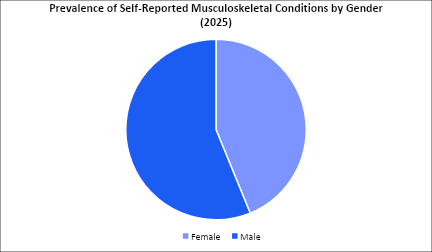
- Musculoskeletal conditions have a strong gender based and age dependent burden pattern, with higher overall disability burden observed in females for most conditions (e.g., osteoarthritis, rheumatoid arthritis, low back pain) and a marked increase in prevalence and disability with advancing age due to degenerative and cumulative exposure effects.
- Persistent pain in childhood and adolescence can have long-term consequences, increasing the risk of chronic pain in later life.
- Musculoskeletal conditions are among the leading causes of long-term disability globally, contributing substantially to years lived with disability (YLDs), with low back pain consistently identified as the single largest contributor across global burden estimates.
- The prevalence of musculoskeletal conditions is strongly associated with modifiable risk factors such as obesity, physical inactivity, and occupational strain, which contribute to increasing disease burden across both developed and developing regions.
Musculoskeletal Pain Epidemiology Forecast in the 7MM
- 2025 Diagnosed Prevalent Cases of Musculoskeletal Pain : ~XX
- 2036 Projected Diagnosed Prevalent Cases of Musculoskeletal Pain : ~XX
- Musculoskeletal Pain Growth Rate (2026–2036): ~XX% CAGR
DelveInsight's ‘Musculoskeletal Pain – Epidemiology Forecast – 2036’ report delivers an in-depth understanding of the Musculoskeletal Pain , historical and forecasted epidemiology, in the United States, EU4 (Germany, Spain, Italy, and France) and the United Kingdom, and Japan.
|
Study Period |
2022–2036 |
|
Historical Year |
2022–2025 |
|
Forecast Period |
2026–2036 |
|
Base Year |
2026 |
|
Geographies Covered |
|
|
Musculoskeletal Pain Epidemiology CAGR (Forecast period) |
~XX% (2026–2036) |
|
Musculoskeletal Pain Epidemiology Segmentation Analysis |
Patient Burden Assessment
|
Musculoskeletal Pain Understanding and Diagnostic Algorithm
Musculoskeletal Pain Overview and Diagnosis
Musculoskeletal pain refers to pain arising from the muscles, bones, joints, tendons, ligaments, and other supporting structures of the body. It encompasses a wide range of acute and chronic conditions, including osteoarthritis, low back pain, neck pain, rheumatoid arthritis, and sports-related injuries. Musculoskeletal pain can vary in severity and duration, often leading to reduced mobility, physical disability, and impaired quality of life. Owing to its diverse causes and significant impact on daily functioning, it represents a major clinical and public health burden worldwide.
Diagnosis of musculoskeletal pain is based on clinical evaluation and patient history, supported by targeted investigations to identify the underlying cause. A detailed physical examination assesses pain location, range of motion, tenderness, swelling, and functional impairment. Imaging techniques such as X-ray, MRI, and CT are used to detect structural, degenerative, or soft tissue abnormalities, with MRI preferred for soft tissue and nerve involvement. In suspected inflammatory or autoimmune conditions, laboratory tests including ESR, CRP, RF, and anti-CCP antibodies help support diagnosis. Ultrasound may also be used to evaluate joint inflammation and effusion.
Further details are provided in the report.
Musculoskeletal Pain Epidemiology
Key Findings from Musculoskeletal Pain Epidemiological Analysis and Forecast
- Musculoskeletal conditions affect approximately 1.7 billion people globally, making them one of the most prevalent causes of long-term disability, as reported by the World Health Organization (WHO).
- Musculoskeletal Pain is highly prevalent among the general population. In the United States, it affects almost 37% population.
- Low back pain is the leading cause of disability worldwide, consistently ranking highest in years lived with disability (YLDs) across Global Burden of Disease (GBD) studies.
- The burden of musculoskeletal disorders increases significantly with age, with higher prevalence of osteoarthritis, spinal disorders, and chronic back pain in older populations due to degenerative changes.
- Musculoskeletal pain is strongly associated with functional impairment and reduced quality of life, contributing substantially to global work absenteeism and productivity loss, particularly in working-age adults.
- The prevalence of musculoskeletal conditions is rising due to population aging, obesity, sedentary lifestyles, and occupational risk factors, driving increasing healthcare demand worldwide.
- Musculoskeletal disorders account for a major share of global healthcare utilization, with a high proportion of patients requiring long-term pain management and rehabilitation services.
Scope of the Report
- The report covers a segment of a descriptive overview of musculoskeletal pain, explaining their causes, signs and symptoms, and pathogenesis.
- Comprehensive insight has been provided into the epidemiology segments and forecasts, the future growth potential of the diagnosis rate, and disease progression.
Report Insights
Musculoskeletal Pain Patient Population Forecast
Report Key Strengths
- Epidemiology‑based (Epi‑based) Bottom‑up Forecasting
- 11-year Forecast
- Patient Burden Trends (by Geography)
FAQs
- What are the disease risks, burdens, and unmet needs of musculoskeletal pain? What will be the growth opportunities across the 7MM concerning the patient population with musculoskeletal pain?
- What is the historical and forecasted musculoskeletal pain patient pool in the US, EU4 (Germany, France, Italy, and Spain), the UK, and Japan?
Reasons to Buy
- Insights on patient burden/disease prevalence, evolution in diagnosis, and factors contributing to the change in the epidemiology of the disease during the forecast years.
- To understand key opinion leaders’ perspectives around the diagnostic challenges to overcome barriers in the future.
- Detailed insights on various factors hampering disease diagnosis and other existing diagnostic challenges.