NADPH Oxidase (NOX)-Replacement Therapies Market Summary
- The NADPH oxidases market in the 7MM is projected to grow at a significant CAGR by 2034 in leading countries (US, EU4, UK and Japan).
NADPH Oxidases Replacement Therapies Market and Epidemiology Analysis
- In 2027, the United States held the largest share of the total NADPH Oxidase-Replacement Therapies market among the 7MM.
- NADPH oxidases (NOX enzymes) are a family of enzymes that play a pivotal role in generating reactive oxygen species (ROS) — molecules critical in immune defense, cell signaling, and various physiological processes. Among the NOX family, NOX2 is perhaps the best characterized, primarily due to its essential function in phagocytes, where it helps eliminate pathogens by producing ROS.
- Elevated levels of NOX1, NOX2, NOX4, and NOX5, as well as their regulatory subunits, have been observed in various cultured cancer cell lines and human tumors at both early and advanced stages of tumor development. This suggests that these enzymes play a significant role in the initiation and progression of cancer. NOX1, NOX2, and NOX4 contribute to cardiovascular conditions like atherosclerosis and hypertension by driving oxidative stress and inflammation.
- ROS produced by NADPH oxidases are major contributors to oxidative damage under pathological conditions. As a result, inhibiting the harmful activity of these enzymes has emerged as a promising therapeutic strategy for the treatment of a wide range of diseases associated with oxidative stress.
- NOX enzymes can influence stem cell proliferation and differentiation, making them promising candidates as both tools and therapeutic targets in stem cell-based therapies, tissue engineering, and regenerative medicine.
- Understanding the specific roles of individual NADPH oxidases offers the potential to modulate intracellular signaling pathways. In recent years, the range of tools available to analyze and target NADPH oxidases has steadily expanded.
- Setanaxib is currently being investigated in Phase II clinical trials for multiple indications, including primary biliary cholangitis (PBC), idiopathic pulmonary fibrosis (IPF), Alport syndrome, and solid tumors such as head and neck cancer.
- AptaBio Therapeutics, Glixogen Therapeutics, Prime Medicine, ImmunoVec, and Orchard Therapeutics are developing NADPH oxidase therapies in early and preclinical phases.
DelveInsight’s “NADPH Oxidase (NOX)-Replacement Therapies – Target Population, Competitive Landscape, and Market Forecast – 2034” report delivers an in-depth understanding of the NADPH Oxidase (NOX), historical and Competitive Landscape as well as the NADPH Oxidase (NOX) Replacement Therapies market trends in the United States, EU4 (Germany, France, Italy, and Spain) and the United Kingdom, and Japan.
The NADPH Oxidase (NOX) Replacement Therapies market report provides current treatment practices, emerging drugs, market share of individual therapies, and current and forecasted NADPH Oxidase (NOX) Replacement Therapies market size across 7MM from 2020 to 2034. The report also covers current NADPH Oxidase (NOX)-Replacement Therapies treatment practices/algorithms and unmet medical needs to curate the best opportunities and assess the market’s potential.
Geography Covered
- The United States
- EU4 (Germany, France, Italy, and Spain) and the United Kingdom
- Japan
Scope of the NADPH Oxidases Replacement Therapies Market Report
|
Study Period |
2020–2034 |
|
Forecast Period |
2025–2034 |
|
Geographies Covered |
US, EU4 (Germany, France, Italy, and Spain) the UK, and Japan |
|
NADPH Oxidase (NOX)-Replacement Therapies Epidemiology |
Segmented by:
|
|
NADPH Oxidase (NOX)-Replacement Therapies Key Companies |
|
|
NADPH Oxidase (NOX)-Replacement Therapies Key Therapies |
|
|
NADPH Oxidase (NOX)-Replacement Therapies Market Segmentation |
Segmented by:
|
|
NADPH Oxidase (NOX)-Replacement Therapies Market Analysis |
|
Understanding NADPH Oxidase (NOX) Replacement Therapies
NADPH Oxidase (NOX) Overview
NADPH oxidases (NOX enzymes) are a family of membrane-bound enzymes responsible for producing reactive oxygen species (ROS), which play essential roles in host defense, cell signaling, and tissue homeostasis. Among the seven NOX isoforms (NOX1–5, DUOX1, DUOX2), NOX2 is the most well-characterized, particularly for its role in the innate immune system. While physiological levels of ROS are crucial for normal cellular functions, excessive or deficient ROS production can lead to a wide range of diseases, including chronic inflammation, fibrosis, neurodegeneration, cancer, and rare immunodeficiencies.
NOX replacement therapy is primarily targeted at patients with inherited NOX2 deficiencies, such as Chronic Granulomatous Disease (CGD). This rare genetic disorder is caused by mutations in genes encoding NOX2 subunits, leading to defective ROS production in phagocytes and resulting in severe, recurrent infections and granuloma formation. Current replacement strategies include:
- Gene therapy using lentiviral or CRISPR platforms to restore NOX2 function.
- mRNA-based approaches aiming to transiently express functional NOX subunits.
- Stem cell transplantation which remains a curative option in severe cases.
These therapies are designed to restore proper immune function by re-establishing controlled ROS production.
NOX inhibitor therapies are developed to suppress overactive NOX enzymes, especially NOX1, NOX2, and NOX4, that contribute to pathological oxidative stress in various chronic diseases. Increased ROS generation has been linked to tissue damage and disease progression in conditions such as:
- Idiopathic pulmonary fibrosis (IPF)
- Primary biliary cholangitis (PBC)
- Alzheimer’s disease and Parkinson’s disease
- Cardiovascular disease
- Solid tumors (e.g., head and neck cancer)
Further details related to country-based variations are provided in the report…
NADPH Oxidase (NOX) Replacement Therapies Epidemiology
The NADPH Oxidase (NOX)-Replacement Therapies epidemiology chapter in the report provides historical as well as forecasted epidemiology segmented as total cases of selected indication for NADPH Oxidase Replacement Therapies, total eligible NADPH Oxidase Replacement Therapies patient pool in selected indication, total treated NADPH Oxidase Replacement Therapies cases in selected indication across 7MM covering the United States, EU4 (Germany, France, Italy, and Spain), and the United Kingdom, and Japan from 2020 to 2034.
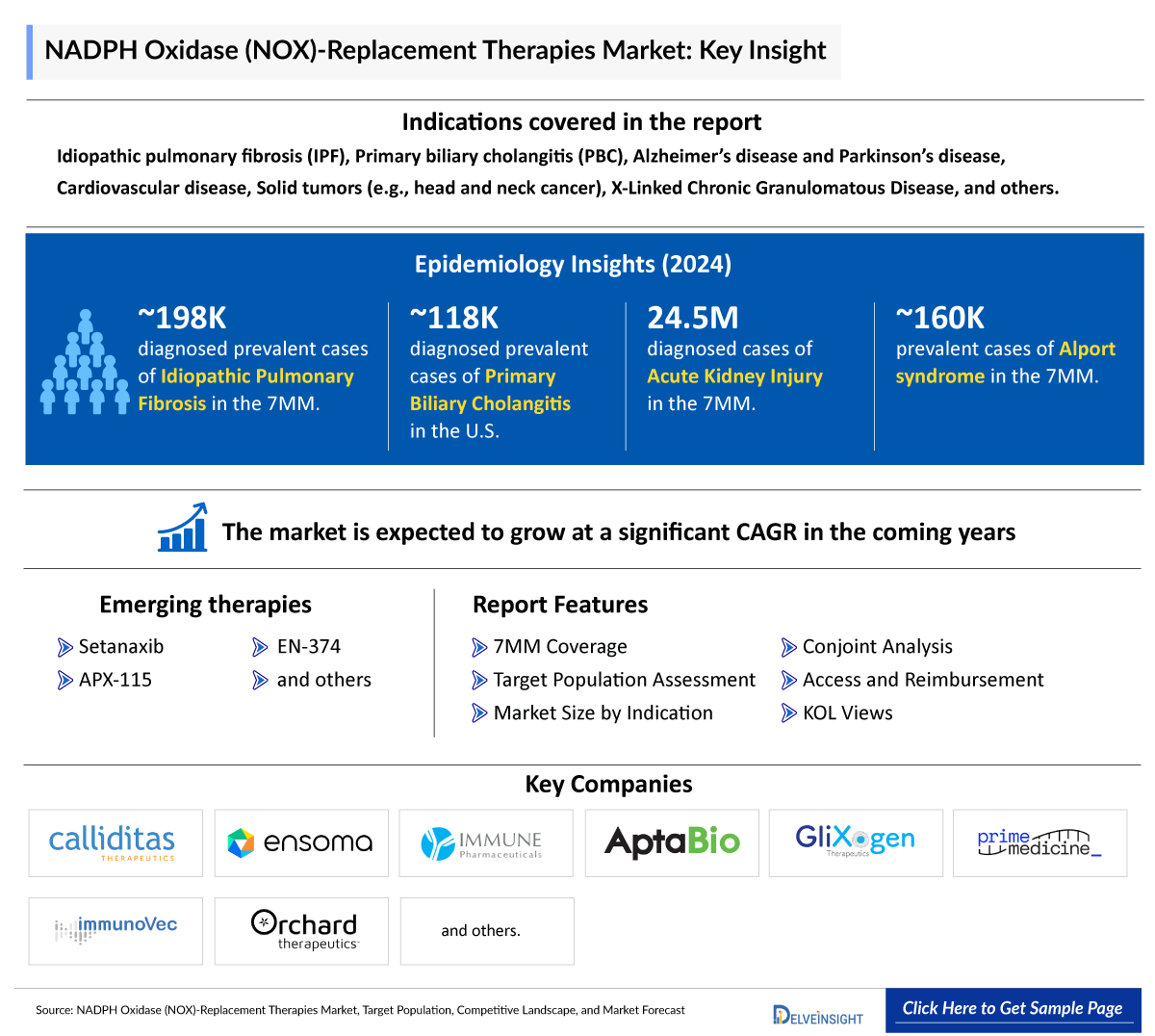
- In 2024, there were approximately 198,000 diagnosed Idiopathic Pulmonary Fibrosis prevalent cases reported in the 7MM.
- The US accounted for the highest number of diagnosed Primary Biliary Cholangitis prevalent cases, with approximately 118,000 cases among 7MM.
- In the 7MM, there were approximately 24,501,600 diagnosed Acute Kidney Injury cases in 2024.
- The total Alport syndrome prevalent cases in the 7MM, comprised nearly 160,500 in 2024, which is estimated to increase by 2034.
NADPH Oxidase (NOX) Replacement Therapies Drug Chapters
The drug chapter segment of the NADPH Oxidase (NOX)-Replacement Therapies reports encloses a detailed analysis of late-stage (Phase II and Phase I) pipeline drugs. It also helps understand the NADPH Oxidase (NOX)-Replacement Therapies’ clinical trial details, expressive pharmacological action, agreements and collaborations, approval and patent details, advantages and disadvantages of each included drug, and the latest news and press releases.
NADPH Oxidase (NOX) Replacement Therapies Emerging Drugs
Setanaxib (GKT831/ GKT-137831): Calliditas Therapeutics
Setanaxib is an orally bioavailable inhibitor of the nicotinamide adenine dinucleotide phosphate (NADPH) oxidases (NOX) 1 and 4, with potential anti-inflammatory, anti-fibrotic and antineoplastic activities. Upon oral administration, setanaxib targets, binds to and inhibits the activity of NOX1 and NOX4. This inhibits NOX1- and NOX4- mediated signal transduction pathways, thereby reducing inflammation and fibrosis. By targeting NOX4-overexpressing cancer-associated fibroblasts (CAFs) in the tumor microenvironment (TME), setanaxib may also inhibit myofibroblastic activation and enhance both the penetration of tumor-infiltrating lymphocytes (TILs) and antitumor T-cell immune responses. The NOX enzymes NOX1 and NOX4 primarily produce reactive oxygen species, which play important roles in cellular signaling processes that regulate cell proliferation, differentiation, and migration, and inflammation and fibrosis.
Setanaxib targets key aspects of primary biliary cholangitis that are not addressed by any currently approved or Phase III therapies. As a novel anti-fibrotic agent, it has the potential to slow disease progression and reduce the need for liver transplantation. What sets Setanaxib apart is its demonstrated positive impact on critical quality-of-life measures, particularly fatigue. Additionally, Setanaxib directly inhibits fibrogenesis in the liver, offering a unique and comprehensive approach to PBC management.
- The US FDA and EMA granted Orphan Drug Designation (ODD) for the Alport syndrome treatment with setanaxib in September and October of 2023, respectively. A Phase II randomized, controlled trial was initiated in November 2023.
- Setanaxib has received ODD from both the FDA and EMA, as well as Fast Track Designation (FTD) from the FDA for PBC treatment.
APX-115: AptaBio
APX-115 is a first-in-class pan-NADPH oxidase (NOX) inhibitor with a Ki value of 0.57–1.08 μM for NOX isozymes. Blocking the activity of NOX with APX-115 inhibited the responses of BMMs to RANKL, including reactive oxygen species (ROS) generation, activation of mitogen-activated protein (MAP) kinases and NF-κB, and OC differentiation. It is being developed as a fundamental treatment to prevent renal and tubular damage caused by oxidative stress and to improve inflammatory cell infiltration in renal tissue. It also serves as a fundamental treatment to prevent damage to glomerular podocytes and tubular epithelial cells caused by oxidative stress.
In October 2023, AptaBio updated that its Acute Kidney Injury Treatment ‘APX-115’ was proven safe in Phase II Clinical Trials by the US FDA.
Comparison of Key Emerging Drugs | |||
|
Product |
Company |
Phase |
Indication |
|
Setanaxib |
Calliditas Therapeutics |
II |
Primary biliary cholangitis (PBC), Idiopathic pulmonary fibrosis (IPF), Alport syndrome, Solid tumors (Head and neck cancer) |
|
APX-115 |
AptaBio |
II |
Acute Kidney Injury in Subjects Undergoing PCI |
|
EN-374 |
Ensoma |
I/II |
X-Linked Chronic Granulomatous Disease |
Note: Detailed emerging therapies assessment will be provided in the final report.
NADPH Oxidase (NOX) Replacement Therapies Market Outlook
NADPH oxidase replacement and inhibitor therapies are increasingly optimistic, driven by growing recognition of NOX enzymes as key regulators of reactive oxygen species (ROS) and their role in a wide range of diseases. NOX replacement therapies are primarily focused on rare genetic disorders such as Chronic Granulomatous Disease (CGD), where loss-of-function mutations in NOX2 impair the immune system’s ability to fight infections. These therapies, including gene and mRNA-based approaches, are gaining traction due to advances in gene therapy platforms and supportive regulatory frameworks, including Orphan Drug and Breakthrough Therapy designations. Though still niche, this segment holds strong commercial potential due to its curative promise and high cost-offset in treating life-threatening rare diseases.
In contrast, NOX inhibitor therapies are poised to tap into much broader markets. Excessive ROS production driven by overactive NOX enzymes, particularly NOX1, NOX2, and NOX4, has been implicated in a range of chronic conditions including idiopathic pulmonary fibrosis (IPF), primary biliary cholangitis (PBC), neurodegenerative diseases like Alzheimer’s and Parkinson’s, cardiovascular disorders, and certain cancers. Agents such as Setanaxib, currently in Phase II trials and designated as an Orphan Drug with Fast Track status, exemplify the growing interest in NOX inhibition as a disease-modifying strategy. These therapies offer a novel mechanism of action for conditions characterized by oxidative stress and fibrosis, areas where current treatment options are limited.
Looking ahead, the NOX-targeted therapy market is expected to expand significantly over the upcoming years as more therapies move into late-stage development and gain regulatory approval. Key drivers include increasing demand for targeted therapies, expanding indications, strategic partnerships, and ongoing scientific validation of NOX pathways in disease pathology. While NOX replacement therapies will likely remain specialized for rare diseases, the broader application of NOX inhibitors in prevalent conditions presents a compelling commercial opportunity, making this an emerging space to watch in the future of precision medicine.
Several key companies, including Calliditas Therapeutics, Innoxid Therapeutics, Ensoma, Glixogen Therapeutics, and others, are involved in developing drugs for NADPH Oxidase (NOX) therapies for various indications such as Primary biliary cholangitis, Idiopathic pulmonary fibrosis, Alport syndrome, and others. Overall, this is an exciting new class of agents with great potential for development. The maturation of current studies over the next few years will lead to a better understanding of the NADPH Oxidase therapeutic area.
NADPH Oxidase (NOX) Replacement Therapies Drugs Uptake
This section focuses on the uptake rate of potential emerging NADPH Oxidase (NOX)-Replacement Therapies expected to be launched in the market during 2025–2034.
NADPH Oxidase (NOX)-Replacement Therapies Pipeline Development Activities
The report provides insights into different therapeutic candidates in Phase III, Phase II, and Phase I. It also analyzes NADPH Oxidase (NOX)-Replacement Therapy key companies involved in developing targeted therapeutics.
The presence of numerous drugs at different stages is expected to generate immense opportunities for NADPH Oxidase (NOX) Replacement Therapies market growth over the forecast period.
Pipeline Development Activities
The report covers information on collaborations, acquisitions and mergers, licensing, and patent details for NADPH Oxidase (NOX) Replacement Therapies.
Latest KOL Views on NADPH oxidases Patient Pool and Market
To keep up with current and future market trends, we take Industry Experts’ opinions working in the domain through primary research to fill the data gaps and validate our secondary research. Industry experts were contacted for insights on NADPH Oxidase (NOX)-Replacement Therapies' evolving treatment landscape, patient reliance on conventional therapies, patient therapy switching acceptability, drug uptake, along challenges related to accessibility.
DelveInsight’s analysts connected with 15+ KOLs to gather insights; however, interviews were conducted with 10+ KOLs in the 7MM. Centers such as Johns Hopkins Sidney Kimmel Cancer Center, UCSF Health, Memorial Sloan Kettering Cancer Center, and others.
Their opinion helps understand and validate current and emerging therapy treatment patterns or NADPH Oxidase (NOX)-Replacement Therapies market trends. This will support the clients in potential upcoming novel treatments by identifying the overall scenario of the market and the unmet needs.
|
KOL Views |
|
“NADPH Oxidase (NOX) has regulatory activity being that it’s expressed by both tumor cells as well as myeloid cells that will infiltrate into the tumors.” Professor, Northwestern University Feinberg School of Medicine in Chicago |
Qualitative Analysis
We perform Qualitative and market Intelligence analysis using various approaches, such as SWOT analysis and Conjoint Analysis. In the SWOT analysis, strengths, weaknesses, opportunities, and threats in terms of gaps in disease diagnosis, patient awareness, physician acceptability, competitive landscape, cost-effectiveness, and geographical accessibility of therapies are provided.
Conjoint Analysis analyzes multiple approved and emerging therapies based on relevant attributes such as safety, efficacy, frequency of administration, route of administration, and order of entry. Scoring is given based on these parameters to analyze the effectiveness of therapy.
In efficacy, the trial’s primary and secondary outcome measures are evaluated; for instance, in event-free survival, one of the most important primary outcome measures is event-free survival and overall survival.
Further, the therapies’ safety is evaluated wherein the acceptability, tolerability, and adverse events are majorly observed, and it sets a clear understanding of the side effects posed by the drug in the trials. In addition, the scoring is also based on the probability of success, and the addressable patient pool for each therapy. According to these parameters, the final weightage score and the ranking of the emerging therapies are decided.
NADPH Oxidases Market Access and Reimbursement
Reimbursement may be referred to as the negotiation of a price between a manufacturer and a payer that allows the manufacturer access to the market. It is provided to reduce the high costs and make the essential drugs affordable. Health technology assessment (HTA) plays an important role in reimbursement decision-making and recommending the use of a drug. These recommendations vary widely throughout the seven major markets, even for the same drug.
In the US healthcare system, both Public and Private health insurance coverage are included. Also, Medicare and Medicaid are the largest government-funded programs in the US. The major healthcare programs, including Medicare, Medicaid, the Children's Health Insurance Program (CHIP), and the state and federal health insurance marketplace,s are overseen by the Centers for Medicare & Medicaid Services (CMS). Other than these, Pharmacy Benefit Managers (PBMs), and third party organizations that provide services and educational programs to aid patients are also present.
The report further provides detailed insights on the country-wise accessibility and reimbursement scenarios, cost-effectiveness scenario of approved therapies, programs making accessibility easier and out-of-pocket costs more affordable, insights on patients insured under federal or state government prescription drug programs, etc.
Key Updates on NADPH Oxidase (NOX) Replacement Therapies
This section provides recent development updates related to the drug and associated company. It includes information on regulatory milestones, clinical trial results, conference presentations, agreements, collaborations, and merger and acquisition activities.
The abstract list is not exhaustive, will be provided in the final report...
Scope of the NADPH Oxidases Replacement Therapies Market Report
- The report covers a segment of key events, an executive summary, and a descriptive overview of the NADPH Oxidase (NOX)-Replacement Therapies, explaining its mechanism and emerging therapies.
- Comprehensive insight into the NADPH Oxidase (NOX)-Replacement Therapy Competitive Landscape, and forecasts, the future growth potential of treatment rate, drug uptake, and drug information have been provided.
- Additionally, an all-inclusive account of emerging therapies and the elaborate profiles of late-stage and prominent therapies will impact the current landscape.
- A detailed review of the NADPH Oxidase (NOX)-Replacement Therapies market, historical and forecasted market size, market share by therapies, detailed assumptions, and rationale behind our approach is included in the report, covering the 7MM drug outreach.
- The report provides an edge while developing business strategies, by understanding trends, through SWOT analysis, expert insights/KOL views, and treatment preferences that help shape and drive the 7MM NADPH oxidase (NOX)-replacement therapies market.
NADPH Oxidase (NOX)-Replacement Therapies Report Insights
- NADPH Oxidase (NOX)-Replacement Therapies Targeted Patient Pool
- Therapeutic Approaches
- NADPH Oxidase (NOX)-Replacement Therapies Pipeline Analysis
- NADPH Oxidase (NOX)-Replacement Therapies Market Size and Trends
- Existing and Future Market Opportunities
NADPH Oxidase (NOX)-Replacement Therapies Report Key Strengths
- 10 years Forecast
- The 7MM Coverage
- Key Cross Competition
- Drugs Uptake and Key Market Forecast Assumptions
NADPH Oxidase (NOX)-Replacement Therapies Report Assessment
- Current Treatment Practices
- NADPH Oxidase (NOX) Replacement Therapy Unmet Needs
- NADPH Oxidase (NOX) Replacement Therapy Pipeline Product Profiles
- NADPH Oxidase (NOX) Replacement Therapy Market Attractiveness
- Qualitative Analysis (SWOT and Conjoint Analysis)
Latest Key Questions Answered in the NADPH Oxidases Replacement Therapies Market Report
- What was the NADPH Oxidase (NOX)-Replacement Therapies total market size, the market size by therapies, market share (%) distribution, and what would it look like in 2034? What are the contributing factors for this growth?
- Which drug is going to be the largest contributor in 2034?
- Which is the most lucrative market for NADPH Oxidase (NOX)-Replacement Therapies?
- What are the risks, burdens, and unmet needs of treatment with NADPH Oxidase (NOX)-Replacement Therapies based therapies? What will be the growth opportunities across the 7MM for the patient population of NADPH Oxidase (NOX)-Replacement Therapies based therapies?
- What are the key factors hampering the growth of the NADPH Oxidase (NOX)-Replacement Therapies market?
- What are the indications for which recent novel therapies and technologies have been developed to overcome the limitations of existing treatments?
- What key designations have been granted to the therapies for NADPH Oxidase (NOX)-Replacement Therapies?
- What is the cost burden of approved therapies on the patient?
- Patient acceptability in terms of preferred therapy options as per real-world scenarios?
- What are the country-specific accessibility issues of expensive, recently approved therapies?
Reasons to buy the NADPH Oxidases Replacement Therapies Market Report
- The report will help develop business strategies by understanding the latest trends and changing dynamics driving the NADPH Oxidase (NOX)-Replacement Therapies Market.
- Understand the existing market opportunities in varying geographies and the growth potential over the coming years.
- Distribution of historical and current patient share based on real-world prescription data along with reported sales of approved products in the US, EU4 (Germany, France, Italy, and Spain), the United Kingdom, and Japan.
- Identifying strong upcoming players in the market will help devise strategies to help get ahead of competitors.
- Detailed analysis and ranking of indication-wise current and emerging therapies under the conjoint analysis section to provide visibility around leading indications.
- Highlights of Access and Reimbursement policies of approved therapies, barriers to accessibility of expensive off-label therapies, and patient assistance programs.
- To understand Key Opinion Leaders’ perspectives around the accessibility, acceptability, and compliance-related challenges of existing treatment to overcome barriers in the future.
- Detailed insights on the unmet needs of the existing market so that the upcoming players can strengthen their development and launch strategy.

