
Navtemadlin Market Summary
Key Factors Driving Navtemadlin Growth
1. First-in-class MDM2 inhibitor with potential disease-modifying activity in myelofibrosis
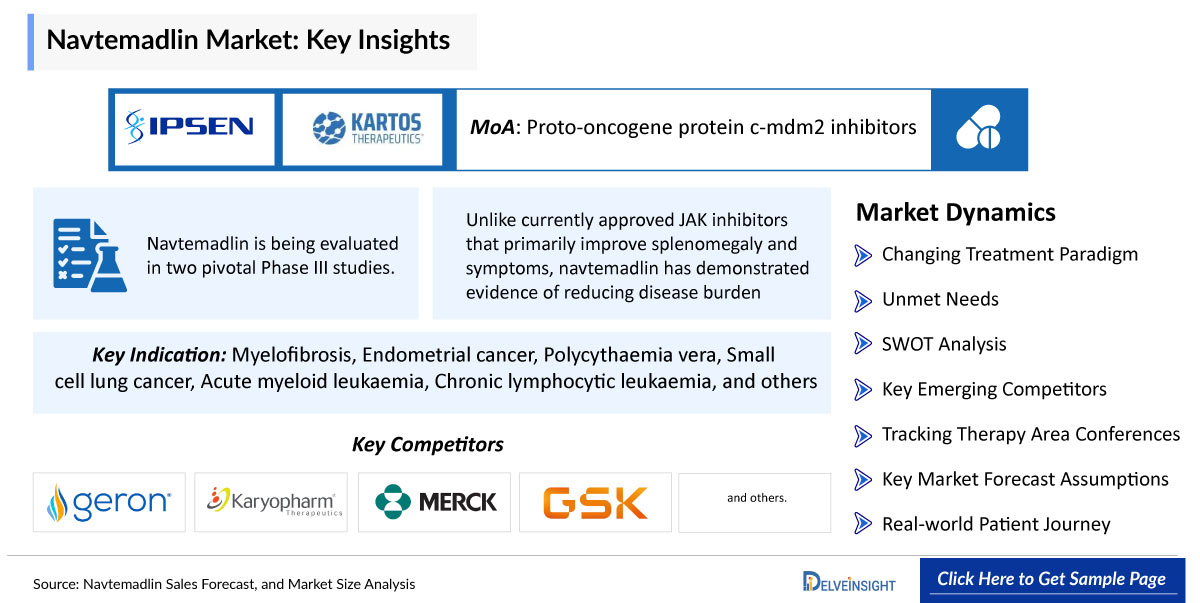
Navtemadlin (KRT-232) is an investigational, orally administered MDM2 inhibitor designed to restore wild-type p53 tumor suppressor activity, leading to apoptosis of malignant hematopoietic stem and progenitor cells. Unlike currently approved JAK inhibitors that primarily improve splenomegaly and symptoms, navtemadlin has demonstrated evidence of reducing disease burden, including improvements in bone marrow fibrosis and reductions in driver mutation allele frequency. This differentiated mechanism positions the drug as a potential disease-modifying therapy in myelofibrosis (MF), supporting strong long-term commercial potential.
2. Promising Phase Ib/II efficacy supports continued clinical development
Early clinical data have demonstrated meaningful efficacy, particularly in patients with suboptimal responses to ruxolitinib. In the Phase Ib/II KRT-232-109 study presented at the European Hematology Association (EHA), 32% of patients achieved ≥35% spleen volume reduction (SVR35), 32% achieved ≥50% improvement in total symptom score (TSS50), 71% of evaluable patients experienced at least a 20% reduction in driver mutation variant allele frequency, and 57% demonstrated at least a one-grade improvement in bone marrow fibrosis by central review. These findings suggest activity beyond symptom control, strengthening physician interest in the program.
3. Large unmet need among patients with inadequate response to JAK inhibitors
Although ruxolitinib remains the standard first-line therapy for MF, a substantial proportion of patients develop inadequate responses or progressive disease. Current JAK inhibitors have limited ability to reverse bone marrow fibrosis or substantially alter disease biology. Navtemadlin is being developed specifically to address this unmet need, either as monotherapy in relapsed/refractory disease or as an add-on to ruxolitinib in patients with suboptimal responses, potentially expanding its addressable patient population.
4. Multiple Phase III studies increase the probability of commercialization
Navtemadlin is being evaluated in two pivotal Phase III studies. The BOREAS trial investigates navtemadlin versus best available therapy in patients with relapsed or refractory myelofibrosis following JAK inhibitor treatment, while the POIESIS trial is evaluating navtemadlin in combination with ruxolitinib in approximately 600 patients with intermediate- or high-risk TP53 wild-type myelofibrosis who have had a suboptimal response to frontline ruxolitinib. The combination strategy substantially broadens the commercial opportunity if successful. Top-line results from POIESIS are expected in 2027.
Navtemadlin Recent Developments
In June 2026, Ipsen and Kartos Therapeutics, announced they had entered into a definitive merger agreement under which Ipsen has agreed to acquire Kartos Therapeutics. The acquisition adds Navtemadlin, an investigational MDM2 inhibitor designed to restore the natural tumor-suppressing function of p53, a critical tumor-suppressor in myelofibrosis. Data show strong therapeutic potential of Navtemadlin for intermediate and high-risk TP53 wild-type (wt) myelofibrosis as an add-on treatment for patients with a suboptimal response to standard of care ruxolitinib.
“Navtemadlin Sales Forecast, and Market Size Analysis – 2034” report provides comprehensive insights of Navtemadlin for potential indication like Myelofibrosis, Endometrial cancer, Polycythaemia vera, Small cell lung cancer, Acute myeloid leukaemia, Chronic lymphocytic leukaemia, Chronic myeloid leukaemia, Diffuse large B cell lymphoma, Malignant melanoma, and Merkel cell carcinoma in the 7MM. A detailed picture of Navtemadlin’s existing usage in anticipated entry and performance in potential indications in the 7MM, i.e., the United States, EU4 (Germany, France, Italy, and Spain) and the United Kingdom, and Japan for the study period 2020 –2034 is provided in this report along with a detailed description of the Navtemadlin for potential indications. The Navtemadlin market report provides insights about Navtemadlin’s sales forecast, mechanism of action (MoA), dosage and administration, as well as research and development including regulatory milestones, along with other developmental activities. Further, it also consists of historical and current Navtemadlin performance, future market assessments inclusive of the Navtemadlin market forecast analysis for potential indications in the 7MM, SWOT, analysts’ views, comprehensive overview of market competitors, and brief about other emerging therapies in respective indications. It also provides analysis of Navtemadlin sales forecasts, along with factors driving its market.
Navtemadlin Drug Summary
Navtemadlin (KRT-232) is an investigational, orally administered murine double minute 2 (MDM2) inhibitor being developed for the treatment of hematologic malignancies and selected solid tumors, including myelofibrosis, where activation of the p53 tumor suppressor pathway may provide therapeutic benefit. Navtemadlin works by selectively blocking the interaction between MDM2 and wild-type p53, leading to p53 stabilization and activation, which promotes cell cycle arrest and apoptosis in malignant cells while potentially reducing disease burden. In clinical studies, Navtemadlin has been evaluated both as monotherapy and in combination with JAK inhibitors such as ruxolitinib for patients with relapsed or refractory myelofibrosis, demonstrating encouraging activity in reducing spleen volume, improving symptom control, and showing potential survival benefits in TP53 wild-type disease. The most commonly reported adverse events include nausea, vomiting, diarrhea, fatigue, thrombocytopenia, and neutropenia, which are generally manageable with dose modifications and supportive care. Although not yet approved by regulatory authorities, Navtemadlin continues to advance through clinical development as a promising targeted therapy with the potential to address unmet needs in myelofibrosis and other malignancies driven by dysregulated MDM2–p53 signaling. The report provides Navtemadlin’s sales, growth barriers and drivers, post usage and approvals in multiple indications.
Scope of the Navtemadlin Market Report
The report provides insights into:
- A comprehensive product overview including the Navtemadlin MoA, description, dosage and administration, research and development activities in potential indication like Myelofibrosis, Endometrial cancer, Polycythaemia vera, Small cell lung cancer, Acute myeloid leukaemia, Chronic lymphocytic leukaemia, Chronic myeloid leukaemia, Diffuse large B cell lymphoma, Malignant melanoma, and Merkel cell carcinoma.
- Elaborated details on Navtemadlin regulatory milestones and other development activities have been provided in Navtemadlin market report.
- The report also highlights Navtemadlin‘s cost estimates and regional variations, reported and estimated sales performance, research and development activities in potential indications across the United States, Europe, and Japan.
- The Navtemadlin market report also covers the patents information, generic entry and impact on cost cut.
- The Navtemadlin market report contains current and forecasted Navtemadlin sales for potential indications till 2034.
- Comprehensive coverage of the late-stage emerging therapies for respective indications.
- The Navtemadlin market report also features the SWOT analysis with analyst views for Navtemadlin in potential indications.
Methodology
The Navtemadlin market report is built using data and information sourced primarily from internal databases, primary and secondary research and in-house analysis by DelveInsight’s team of industry experts. Information and data from the secondary sources have been obtained from various printable and nonprintable sources like search engines, news websites, global regulatory authorities websites, trade journals, white papers, magazines, books, trade associations, industry associations, industry portals and access to available databases.
Navtemadlin Analytical Perspective by DelveInsight
- In-depth Navtemadlin Market Assessment
This Navtemadlin sales market forecast report provides a detailed market assessment of Navtemadlin for potential indication like Myelofibrosis, Endometrial cancer, Polycythaemia vera, Small cell lung cancer, Acute myeloid leukaemia, Chronic lymphocytic leukaemia, Chronic myeloid leukaemia, Diffuse large B cell lymphoma, Malignant melanoma, and Merkel cell carcinoma in the seven major markets, i.e., the United States, EU4 (Germany, France, Italy, and Spain) and the United Kingdom, and Japan. This segment of the report provides current and forecasted Navtemadlin sales data uptil 2034.
- Navtemadlin Clinical Assessment
The Navtemadlin market report provides the clinical trials information of Navtemadlin for potential indications covering trial interventions, trial conditions, trial status, start and completion dates.
Navtemadlin Competitive Landscape
The report provides Insights on competitors and marketed products within the domain, along with a summary of emerging products and their respective launch dates, posing significant competition in the market.
Navtemadlin Market Potential & Revenue Forecast
- Projected market size for the Navtemadlin and its key indications
- Estimated Navtemadlin sales potential (Navtemadlin peak sales forecasts)
- Navtemadlin Pricing strategies and reimbursement landscape
Navtemadlin Competitive Intelligence
- Number of competing drugs in development (pipeline analysis)
- Navtemadlin Market positioning compared to existing treatments
- Navtemadlin Strengths & weaknesses relative to competitors
Navtemadlin Regulatory & Commercial Milestones
- Navtemadlin Key regulatory approvals & expected launch timelines
- Commercial partnerships, licensing deals, and M&A activity
Navtemadlin Clinical Differentiation
- Navtemadlin Efficacy & safety advantages over existing drugs
- Navtemadlin Unique selling points
Navtemadlin Market Report Highlights
- In the coming years, the Navtemadlin market scenario is set to change due to strong adoption, increased prescriptions and broader uptake in multiple immunological indications; which would expand the size of the market.
- The Navtemadlin companies are developing therapies that focus on novel approaches to treat/improve the disease condition, assess challenges, and seek opportunities that could influence Navtemadlin’s dominance.
- Other emerging products for Myelofibrosis, Endometrial cancer, Polycythaemia vera, Small cell lung cancer, Acute myeloid leukaemia, Chronic lymphocytic leukaemia, Chronic myeloid leukaemia, Diffuse large B cell lymphoma, Malignant melanoma, and Merkel cell carcinoma are expected to give tough market competition to Navtemadlin and launch of late-stage emerging therapies in the near future will significantly impact the market.
- A detailed description of regulatory milestones, and developmental activities, provide the current development scenario of Navtemadlin in potential indications.
- Analyse Navtemadlin cost, pricing trends and market positioning to support strategic decision-making in the immunology landscape.
- Our in-depth analysis of the forecasted Navtemadlin sales data uptil 2034 will support the clients in decision-making process regarding their therapeutic portfolio by identifying the overall scenario of Navtemadlin in potential indications.
Key Questions
- What is the class of therapy, route of administration and mechanism of action of Navtemadlin? How strong is Navtemadlin’s clinical and commercial performance?
- What is Navtemadlin’s clinical trial status in each individual indications such as Myelofibrosis, Endometrial cancer, Polycythaemia vera, Small cell lung cancer, Acute myeloid leukaemia, Chronic lymphocytic leukaemia, Chronic myeloid leukaemia, Diffuse large B cell lymphoma, Malignant melanoma, and Merkel cell carcinoma and study completion date?
- What are the key collaborations, mergers and acquisitions, licensing and other activities related to the Navtemadlin Manufacturers?
- What are the key designations that have been granted to Navtemadlin for potential indications? How are they going to impact Navtemadlin’s penetration in various geographies?
- What is the current and forecasted Navtemadlin market scenario for potential indications? What are the key assumptions behind the forecast?
- What are the current and forecasted sales of Navtemadlin in the seven major countries, including the United States, Europe (Germany, France, Italy, Spain) and the United Kingdom, and Japan?
- What are the other emerging products available and how are these giving competition to Navtemadlin for potential indications?
- Which are the late-stage emerging therapies under development for the treatment of potential indications?
- How cost-effective is Navtemadlin? What is the duration of therapy and what are the geographical variations in cost per patient?

