Neuroendocrine Prostate Cancer Epidemiology
Key Highlights
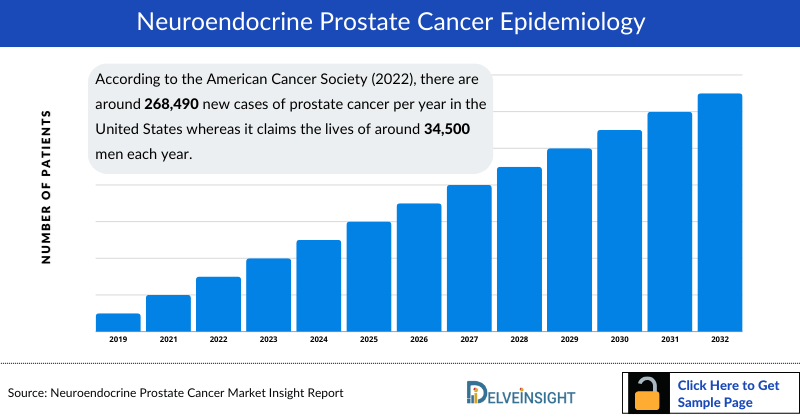
- According to the American Cancer Society (2022), there are around 268,490 new cases of prostate cancer per year in the United States whereas it claims the lives of around 34,500 men each year.
- Neuroendocrine Prostate Cancer epidemiology is segmented as Total Incident Cases of Prostate Cancer, Total Incident Cases of Neuroendocrine Prostate Cancer, Type-specific Cases of Neuroendocrine Prostate Cancer, and Diagnosed and Treated Cases of Neuroendocrine Prostate Cancer] in the Neuroendocrine Prostate Cancer epidemiology report.
Request for unlocking of Neuroendocrine Prostate Cancer Epidemiology
DelveInsight's ‘Neuroendocrine Prostate Cancer Epidemiology Forecast — 2034’ report delivers an in-depth understanding of the disease, historical and forecasted Neuroendocrine Prostate Cancer epidemiology in the United States, EU5 (Germany, Spain, Italy, France, and United Kingdom), and Japan.
Geography Covered
- The United States
- EU5 (Germany, France, Italy, Spain, and the United Kingdom)
- Japan
Study Period: 2021-2034
Neuroendocrine Prostate Cancer Epidemiology Disease Understanding
The DelveInsight’s Neuroendocrine Prostate Cancer market report gives a thorough understanding of Neuroendocrine Prostate Cancer by including details such as disease definition, symptoms, causes, pathophysiology, and diagnosis. Neuroendocrine prostate cancer is a histological variant of prostate cancer that is characterized by aggressiveness, poor clinical outcomes and expression of neuroendocrine markers. The term ‘Neuroendocrine Prostate Cancer (NEPC)’ is commonly used to encompass both small-cell carcinoma and mixed tumors with both prostate adenocarcinoma and small-cell morphologies present.
Neuroendocrine prostate cancer is more common in late-stage prostate cancer patients who have had numerous rounds of anti-androgen therapy, although it can also happen in treatment-naive patients. Current treatments for neuroendocrine prostate cancer are mostly based on their efficacy in treating individuals with small cell lung cancer, which has a neuroendocrine character similar to neuroendocrine prostate cancer.
Symptoms of Neuroendocrine Prostate Cancer include frequent visceral and bulky soft-tissue metastases, as well as a short duration of response to hormonal and cytotoxic treatment. Neuroendocrine cells, which do not display generic Prostate Cancer markers like AR, P501S, PSMA, PSAP, or PSA but do express neuroendocrine markers such chromogranin A, synaptophysin, CD56, and NSE, distinguish Neuroendocrine Prostate Cancer from ordinary prostate cancer histologically.
Neuroendocrine Prostate Cancer Diagnosis
The tests and procedures a patient undergoes for diagnosis depends on the tumor location. In general, tests include physical exam, tests to look for excess hormones, imaging tests, and biopsies. Additional tests might also be done to determine the extent of malignancy.
De novo (first occurrence) Neuroendocrine Prostate Cancer is uncommon, occurring in about 0.5 percent to 2% of primary prostatic cancers. Treatment-emergent neuroendocrine prostate cancer is a kind of advanced castration-resistant prostate cancer induced by the transition of regular prostate adenocarcinoma after androgen deprivation treatment.
Neuroendocrine Prostate Cancer Recent Developments
- On Feb. 12, 2024, BioXcel Therapeutics, Inc. announced that the FDA granted Fast Track designation for BXCL701 with a CPI to treat metastatic small cell neuroendocrine prostate cancer (SCNC) in patients progressing on chemotherapy. This designation allows for expedited development and review by the FDA.
Neuroendocrine Prostate Cancer Epidemiology
The Neuroendocrine Prostate Cancer epidemiology section provides insights about historical and current Neuroendocrine Prostate Cancer patient pool and forecasted trends for individual seven major countries. It helps to recognize the causes of current and forecasted trends by exploring numerous studies and views of key opinion leaders. This part of the report also provides the diagnosed patient pool and their trends along with assumptions undertaken.
Key Findings
- According to the American Cancer Society (2022), there are around 268,490 new cases of prostate cancer per year in the United States whereas it claims the lives of around 34,500 men each year.
- The disease epidemiology covered in the report provides historical as well as forecasted Neuroendocrine Prostate Cancer epidemiology [segmented as Total Incident Cases of Prostate Cancer, Total Incident Cases of Neuroendocrine Prostate Cancer, Type-specific Cases of Neuroendocrine Prostate Cancer, and Diagnosed and Treated Cases of of Neuroendocrine Prostate Cancer] in the 7MM covering the United States, EU5 countries (Germany, France, Italy, Spain, and the United Kingdom), and Japan from 2021 to 2034.
Country Wise- Neuroendocrine Prostate Cancer Epidemiology
This section provides a glimpse of the Neuroendocrine Prostate Cancer epidemiology in the United States, EU5 (Germany, Spain, Italy, France, and United Kingdom), and Japan.
KOL- Views
To keep up with the current Neuroendocrine Prostate Cancer patient pool and forecasted trend, we take KOLs and SMEs ' opinions working in the Neuroendocrine Prostate Cancer domain through primary research to fill the data gaps and validate our secondary research. Their opinion helps to understand and validate the patient pool and forecasted trend.
Learn how the therapeutic market will evolve and grow in the coming years: Neuroendocrine Prostate Cancer Market
Scope of the Neuroendocrine Prostate Cancer Epidemiology Report
- The report covers the descriptive overview of Neuroendocrine Prostate Cancer, explaining their causes, symptoms, pathophysiology, and genetic basis
- The report provides insight into the 7MM historical and forecasted patient pool covering the United States, EU5 countries (Germany, France, Italy, Spain, and the United Kingdom), and Japan
- The report assesses the disease risk and burden and highlights the unmet needs of Neuroendocrine Prostate Cancer
- The report helps to recognize the growth opportunities in the 7MM concerning the patient population
- The report provides the segmentation of the disease epidemiology for 7MM by Total Incident Cases of Prostate Cancer, Total Incident Cases of Neuroendocrine Prostate Cancer, Type-specific Cases of Neuroendocrine Prostate Cancer, and Diagnosed and Treated Cases of of Neuroendocrine Prostate Cancer
Neuroendocrine Prostate Cancer Epidemiology Report Highlights
- The companies and academics are working to assess challenges and seek opportunities that could influence Neuroendocrine Prostate Cancer R&D. The therapies under development are focused on novel approaches to treat/improve the disease condition
- A better understanding of disease pathogenesis will also contribute to the development of novel therapeutics for Neuroendocrine Prostate Cancer
- Our in-depth analysis of the pipeline assets across different stages of development (Phase III and Phase II), different emerging trends, and comparative analysis of pipeline products with detailed clinical profiles, key cross-competition, launch date along with product development activities will support the clients in the decision-making process regarding their therapeutic portfolio by identifying the overall scenario of the research and development activities
Neuroendocrine Prostate Cancer Report Insights
- Patient Population
- Therapeutic Approaches
Neuroendocrine Prostate Cancer Report Key Strengths
- 11 Years Forecast
- 7MM Coverage
- Neuroendocrine Prostate Cancer Epidemiology Segmentation
Neuroendocrine Prostate Cancer Report Assessment
- Disease Understanding
- Current Diagosis Practices and Guidelines
- Epidemiology Trends
Key Questions
Epidemiology Insights:
- What are the disease risk, burden, and regional/ethnic differences of Neuroendocrine Prostate Cancer?
- What are the key factors driving the epidemiology trend for seven major markets covering the United States, EU5 (Germany, Spain, France, Italy, UK), and Japan?
- What is the historical Neuroendocrine Prostate Cancer patient pool in seven major markets covering the United States, EU5 (Germany, Spain, France, Italy, UK), and Japan?
- What would be the forecasted patient pool of Neuroendocrine Prostate Cancer in seven major markets covering the United States, EU5 (Germany, Spain, France, Italy, UK), and Japan?
- Where will be the growth opportunities in the 7MM concerning the patient population about Neuroendocrine Prostate Cancer?
- Out of all 7MM countries, which country would have the highest incident population of Neuroendocrine Prostate Cancer during the forecast period (2025-2034)?
- At what CAGR the patient population is expected to grow by 7MM during the forecast period (2025-2034)?
Reasons to buy
- The report will help in developing business strategies by understanding trends shaping and driving the Neuroendocrine Prostate Cancer Disease market
- To understand the future market competition in the Neuroendocrine Prostate Cancer Disease market and Insightful review of the key market drivers and barriers
- Organize sales and marketing efforts by identifying the best opportunities for Neuroendocrine Prostate Cancer Disease in the US, Europe (Germany, Spain, Italy, France, and the United Kingdom), and Japan
- Identification of strong upcoming players in the market will help in devising strategies that will help in getting ahead of competitors
- Organize sales and marketing efforts by identifying the best opportunities for the Neuroendocrine Prostate Cancer Disease market
- To understand the future market competition in the Neuroendocrine Prostate Cancer Disease market