
Neuroendocrine Tumors (NETs) Epidemiology Forecast
Key Highlights
- In 2023, there were around 29,460 incident cases of NETs in the US, which is expected to rise by 2034.
- Germany had the highest number of incident cases of NETs in the EU4 countries, followed by France, whereas Spain had the lowest number of cases.
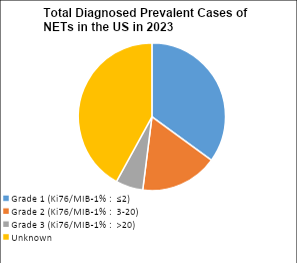
- When it comes to NETs by grade, the unknown cases of NETs had the highest number of cases, accounting for nearly 12,380 in the US, followed by 10,310 cases for Grade 1, and the least number of cases were observed to be 1,770 for Grade 3 in 2023.
- Around 2,680 cases were observed in early-stage NETs and around 3,700 were observed to be for locally advanced or metastatic NETs in the UK in 2023.
- In 2023, there were nearly 3,510 cases of functional NETs and 4,470 cases of non-functional/asymptomatic/unknown NETs in Japan in 2023.
- DelveInsight’s “Neuroendocrine Tumors (NETs) – Epidemiology Forecast – 2034” report delivers an in-depth understanding of r, historical and forecasted epidemiology in the US, EU4 (Germany, France, Italy, and Spain) and the UK, and Japan.
Geography Covered
- The US
- EU4 (Germany, France, Italy, and Spain) and the UK
- Japan
Study Period: 2021-2034
NETs Disease Understanding
NETs Overview
NETs can start in different parts of the body. Like all cancers, NETs are named after the place they start growing. For example, a NET that starts in the lung is called a lung NET. This is the primary cancer. If the cancer spreads to another part of the body, it’s called secondary cancer. The maximum number of times, NETs start from the digestive system, affecting the stomach, small bowel, large bowel, pancreas, and rectum. The least number of NETs start from the lungs. The NETs can also start from the esophagus, appendix, skin, prostate, womb, adrenal, and other body parts. There are ways of classifying NETs. They can be classified as functional as well as nonfunctional. They can be indolent or aggressive. WHO has given a separate classification of grouping NETs. The exact causes of NETs are unknown, but there are numerous associated risk factors, including pituitary adenoma, Von Hippel-Lindau (VHL), pheochromocytomas, etc.
NETs grow at different rates, but they often grow very slowly. Some might not grow at all for months or years. So, it might not need treatment straight away.
NETs Diagnosis
Various tests are used, including urine test, CT scan, ultrasound, MRI, PET-CT scan, radioactive scan, colonoscopy, endoscopy, biopsy, and other blood tests to diagnose NETs. The diagnostic tests that health care experts use are determined by several factors, including the type of NETs suspected, the signs and symptoms expected, age and general health, and the results of previous medical tests. Testing can help the doctor understand the specifics of the tumor and develop a treatment plan for the neuroendocrine cancer. The tests recommended are as follows:
- Imaging Tests
- Computed Tomography (CT)
- Magnetic Resonance Imaging (MRI)
- Positron Emission Tomography (PET)
- Somatostatin Receptor Scintigraphy (SRS)
- Gallium 68 (Ga-68) or Copper-64 (Cu-64) scan
- Octreoscan
- FDG (Fluorodeoxyglucose) scan
- MIBG (Meta-iodobenzylguanidine) scan
- Endoscopy
- Colonoscopy
- Upper GI Endoscopy
- Bronchoscopy
- Tissue Testing
- Endoscopic Ultrasound-Guided Fine-Needle Aspirations (EUS-FNA)
- Biopsies For lung Fine-Needle Aspiration (FNA)
- Laboratory tests for tumor tissue samples Immunohistochemistry (IHC)
- 5-HIAA Tests
- Blood Tests
- Chromogranin A (CGA)
- Blood chemistry tests
- NETest
- Barriers to diagnosis and community recommendations
Further details related to diagnosis will be provided in the report.
NETs Epidemiology
The NETs epidemiology chapter in the report provides historical as well as forecasted epidemiology segmented by Total Incident Cases of NETs, Cases of NETs by Grade, Stage-specific Cases of NETs, Cases of NETs by Site, and Cases of NETs by Functional Status in the 7MM covering the United States, EU4 (Germany, France, Italy, and Spain), UK, and Japan from 2021 to 2034.
- The total number of incident cases of NETs in the 7MM was nearly 60,000 cases in 2023 and is projected to increase during the forecasted period.
- Non-functional/Asymptomatic/Unknown NETs hold the largest contributors to the overall NETs by functional status. The incident cases of NETs in the US were nearly 16,000 for Non-functional/Asymptomatic/Unknown NETs and nearly 15,000 for Functional NETs in 2023.
- Among EU4 and the UK, the highest number of cases for NETs was found in the UK, which was estimated to be nearly 30% of cases in EU4 and the UK in 2023.
- The establishment of comprehensive cancer registries and better reporting systems are now providing more accurate data on the incidence of NETs. This is helping in understanding the true incidence of these tumors.
- In the 7MM, approximately 35–37% of patients had low-grade neuroendocrine neoplasms. Intermediate-grade neoplasms followed this in 17–24% of patients, while only 6–7% of patients had high-grade disease. The grade status of the majority of patients remains unknown.
KOL Views
To keep up with current market trends, we take KOLs and SMEs’ opinions working in the domain through primary research to fill the data gaps and validate our secondary research. Industry Experts contacted for insights on NET's evolving treatment landscape, patient reliance on conventional therapies, patient therapy switching acceptability, and drug uptake, along with challenges related to accessibility, including oncologists, radiation oncologists, surgical oncologists, and others.
Delveinsight’s analysts connected with 30+ KOLs to gather insights; however, interviews were conducted with 15+ KOLs in the 7MM. Centers such as - Fukuoka Sanno Hospital, Smilow Cancer Hospital, Yale Cancer Center, National Institutes of Health in the USA, Moffitt Cancer Center, MD Anderson Cancer Center Madrid, Moffitt Cancer Center in Florida, University of Miami, etc., were contacted. Their opinion helps understand and validate current and emerging therapy treatment patterns or NET market trends. This will support the clients in potential upcoming novel treatments by identifying the overall scenario of the market and the unmet needs.
NETs Report Insights
NETs Report Insights
- Patient population
- Country-wise epidemiology distribution
NETs Report Key Strengths
- Eleven years forecast
- 7MM coverage
- NETs epidemiology segmentation
Neuroendocrine Tumors (NETs) Report Assessment
- Unmet needs
- Current diagnostic practices
FAQs
- What are the disease risks, burdens, and unmet needs of NETs? What will be the growth opportunities across the 7MM concerning the patient population with NETs?
- What is the historical and forecasted CHF patient pool in the US, EU4 (Germany, France, Italy, and Spain), the UK, and Japan?
- Reasons to Buy
- Insights on patient burden/disease prevalence, evolution in diagnosis, and factors contributing to the change in the epidemiology of the disease during the forecast years.
- To understand Key Opinion Leaders’ perspectives around the accessibility, acceptability, and compliance-related challenges of existing treatment to overcome barriers in the future.
- Detailed insights on various factors hampering disease diagnosis and other existing diagnostic challenges.


