Neurothrombectomy Devices Market
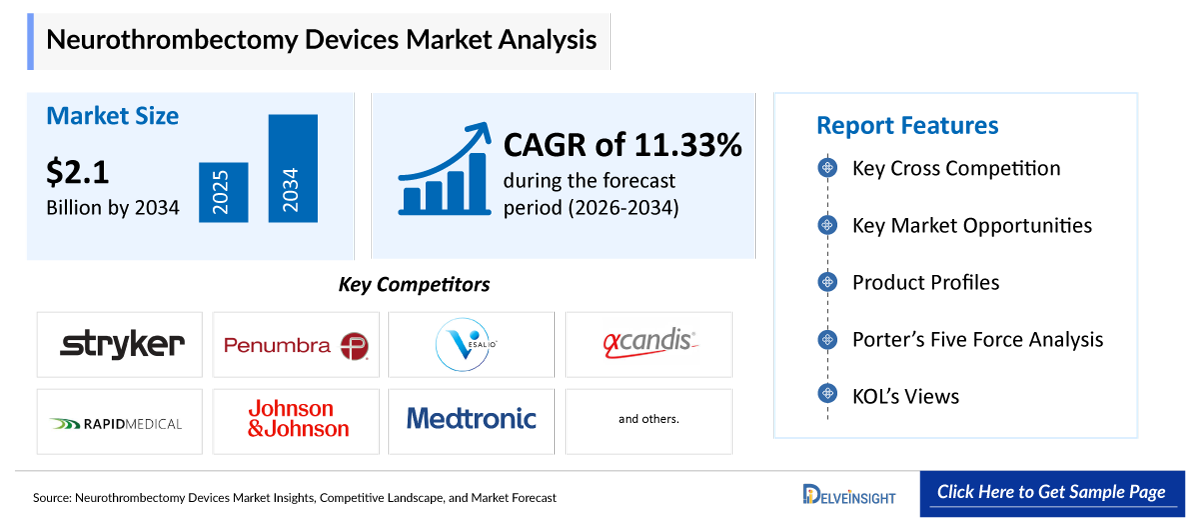
- The Neurothrombectomy Devices market is estimated at USD 809.85 million in 2025 and is projected to reach USD 2,106.16 million by 2034. Growth is anchored in the rising global burden of ischemic stroke, expanding endovascular stroke centers, and continuous innovation in stent retriever and aspiration catheter design.
- The global Neurothrombectomy Devices market is growing at a CAGR of 11.33% during the forecast period from 2026 to 2034.
- By product type, the stent retrievers segment dominated the Neurothrombectomy Devices market with a 45% share in 2025.
- By function, the mechanical non-aspiration segment dominated the Neurothrombectomy Devices market with a 57% share in 2025.
- By end-user, the hospitals segment dominated the Neurothrombectomy Devices market with a 68% share in 2025.
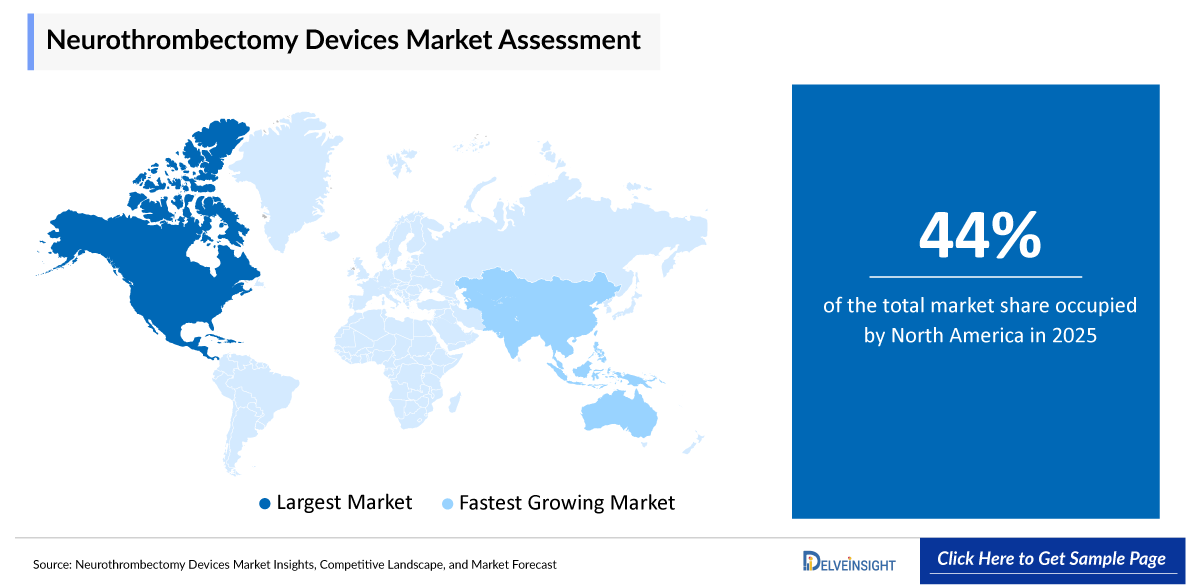
- North America dominated the global Neurothrombectomy Devices market revenue with a 44% share in 2025, representing the highest regional market share globally.
A neurothrombectomy device is a specialized endovascular tool used by interventional neurologists and neuroradiologists to mechanically remove blood clots from the intracranial vasculature during an acute ischemic stroke caused by large vessel occlusion. Because timely restoration of cerebral blood flow is directly linked to reduced disability and mortality, hospitals and comprehensive stroke centers increasingly rely on mechanical thrombectomy as the standard of care alongside or in place of intravenous thrombolysis. These devices function through two principal mechanisms: mechanical non-aspiration systems, including stent retrievers and clot retrievers that trap and withdraw the thrombus, and mechanical aspiration systems that use vacuum-based catheters to ingest the clot. The market is organized by product type across clot retrievers, stent retrievers, aspiration devices, and others; by function across mechanical non-aspiration and mechanical aspiration; and by end-user, led by hospitals with comprehensive and primary stroke center capabilities. Driven by the rising global incidence of stroke, guideline-backed adoption following the DAWN and DEFUSE-3 trials, rapid technological refinement of stent and aspiration platforms, and expanding endovascular infrastructure across emerging markets, neurothrombectomy devices have become essential tools underpinning modern acute stroke care.
Neurothrombectomy Devices Market Key Growth Drivers
- The rising global burden of stroke is a foundational driver, with the AHA 2025 Heart Disease and Stroke Statistics Update and the Global Burden of Disease 2021 study estimating that stroke affects nearly 94 million people worldwide and causes more than 7.2 million deaths annually, with roughly 11.9 million new strokes occurring each year.
- Growing incidence of hypertension, diabetes, and obesity is expanding the population at risk of ischemic stroke and large vessel occlusion, sustaining demand for mechanical thrombectomy across both developed and emerging markets.
- Guideline-driven adoption following the landmark DAWN and DEFUSE-3 trials has extended the eligible treatment window for mechanical thrombectomy up to 24 hours from symptom onset, meaningfully broadening the addressable patient population.
- Continuous technological advancement in device design, including next-generation stent retrievers, large-bore aspiration catheters, and computer-assisted vacuum thrombectomy platforms, is improving first-pass recanalization rates and reducing procedure time.
- Increasing product development and launch activity among key market players, including new FDA clearances and CE-marked devices, is intensifying competition and expanding physician choice across clot morphologies.
- Rapid expansion of comprehensive stroke centers and neuro-interventional capacity, particularly the growth of neuro-ICU beds and hybrid angiography suites in tier-2 cities across China and India, is broadening procedural access.
- Emerging AI-enabled stroke triage and imaging software is shortening door-to-puncture times and identifying a larger pool of eligible large-vessel-occlusion patients, indirectly driving device volumes.
- The convergence of rising stroke burden, guideline expansion, device innovation, and stroke-center infrastructure build-out is expected to sustain double-digit growth in the market through 2034.
Key Companies in Neurothrombectomy Devices Market
The competitive landscape is led by the following active manufacturers:
- Stryker
- Penumbra, Inc.
- Vesalio, LLC.
- Acandis GmbH
- Rapid Medical
- Johnson & Johnson Services Inc.
- Teleflex Incorporated
- Medtronic
- NeuroVasc Technologies, Inc.
- Perflow Medical
For illustrative purposes, only the top 10 companies are listed in the Table of Contents. The report may include analysis and references to additional companies relevant to the market assessment.
Neurothrombectomy Devices Market Size
The following snapshot summarizes the principal report metrics for the Neurothrombectomy Devices market.
|
Report Metrics |
Details |
|
2025 Market Size |
USD 809.85 million |
|
2034 Projected Market Size |
USD 2,106.16 million |
|
Growth Rate (2026-2034) |
11.33% CAGR |
|
Largest Market |
North America |
|
Fastest Growing Market |
Asia-Pacific |
|
Market Structure |
Moderately Fragmented |
All market values are expressed in USD and represent DelveInsight estimates synthesized from primary and secondary research.
Factors Contributing to the Growth of the Neurothrombectomy Devices Market
Market Drivers
Rising Global Burden of Stroke
The single most powerful driver of the Neurothrombectomy Devices market is the sheer and growing global burden of stroke. According to the American Heart Association's 2025 Heart Disease and Stroke Statistics Update, drawing on the Global Burden of Disease 2021 study, stroke affects nearly 94 million people globally and causes more than 7.2 million deaths each year, with approximately 11.9 million new strokes occurring annually. Ischemic stroke, caused by a blood clot obstructing an intracranial vessel, accounts for the large majority of cases and is the primary indication for mechanical thrombectomy. As aging populations grow and cardiovascular risk factors accumulate, the pool of patients eligible for large-vessel-occlusion stroke intervention continues to expand, directly increasing procedural volumes and anchoring long-term device demand.
Rising Incidence of Hypertension, Diabetes, and Obesity
The escalating global prevalence of hypertension, diabetes, and obesity is compounding the risk of ischemic stroke and expanding the addressable patient base for neurothrombectomy devices. These metabolic and cardiovascular risk factors accelerate atherosclerosis and large-vessel disease, key precursors to embolic and thrombotic occlusions in the cerebral vasculature. As unhealthy lifestyle patterns and sedentary behavior become more widespread across both developed and emerging economies, the population at risk of large vessel occlusion stroke grows correspondingly, translating into sustained and growing demand for mechanical clot-retrieval and aspiration devices across the forecast period.
Guideline-Driven Adoption Following DAWN and DEFUSE-3
A structural shift in clinical practice has been driven by the landmark DAWN and DEFUSE-3 trials, which demonstrated substantial clinical benefit from mechanical thrombectomy performed well beyond the traditional treatment window, in select patients up to 24 hours after symptom onset. This evidence has been incorporated into international stroke management guidelines, materially broadening the pool of patients considered eligible for endovascular intervention. As hospitals and comprehensive stroke centers adopt extended-window imaging-based patient selection protocols, procedure volumes for stent retrievers and aspiration devices continue to rise, reinforcing the guideline-backed foundation of market growth.
Continuous Technological Advancement in Device Design
Ongoing innovation in device engineering is a central growth engine for the market. Manufacturers are refining stent retriever architecture for better clot integration and vessel wall apposition, while aspiration catheter platforms are advancing toward larger bore diameters, computer-assisted vacuum control, and integrated clot-detection algorithms that improve first-pass recanalization and reduce procedure time and radiation exposure. Braided nitinol stent designs, radially adjustable retrievers, and hybrid stent-aspiration workflows are expanding physician options for treating diverse clot morphologies, including hard, organized, and calcified thrombi that are more resistant to conventional retrieval.
Increasing Product Development and Launch Activity
A wave of new product clearances and launches is intensifying competition and expanding the addressable procedure base. Companies are securing FDA 510(k) clearances and CE marks for next-generation stent retrievers, large-bore aspiration catheters, and access devices, while integrating mechanical retrieval and aspiration technologies into unified thrombectomy ecosystems. This steady cadence of product development, combined with growing clinical evidence supporting newer platforms, is expanding procedural choice for neurointerventionalists and sustaining recurring device replacement and adoption cycles.
Expansion of Stroke-Center Infrastructure and Neuro-Interventional Capacity
Rapid growth in comprehensive and primary stroke center capacity, particularly the expansion of neuro-ICU beds and hybrid angiography suites in tier-2 and tier-3 cities across China, India, and other emerging markets, is broadening access to mechanical thrombectomy. Government initiatives to strengthen stroke-care pathways, combined with growing awareness of the time-critical nature of large-vessel-occlusion treatment, are accelerating the build-out of endovascular capacity and directly expanding the population of patients who can be treated with neurothrombectomy devices within clinically effective timeframes.
Emerging Role of AI-Enabled Stroke Triage
Artificial-intelligence-enabled imaging and triage software is increasingly integrated into stroke pathways to rapidly identify large-vessel-occlusion candidates and shorten door-to-puncture times. By automating detection of occlusions and estimating salvageable brain tissue from CT and MRI perfusion imaging, these tools are broadening the pool of patients identified as eligible for thrombectomy and streamlining referral from primary to comprehensive stroke centers, indirectly supporting higher device utilization across the forecast period.
Market Restraints
Despite strong momentum, the Neurothrombectomy Devices market faces material constraints. The risk of procedural complications, including vessel perforation, distal embolization, and damage to surrounding brain tissue, requires highly skilled operators and can limit adoption in less experienced centers. Stringent regulatory requirements for product approval across major markets lengthen development timelines and raise costs for new entrants. High device and procedure costs in emerging markets, combined with limited access to modern imaging and hybrid operating suites, constrain penetration outside well-funded urban centers. A persistent shortage of trained neuro-interventionists outside major metropolitan areas restricts the number of centers capable of offering timely thrombectomy, while uneven reimbursement policies across geographies further temper adoption. Together, these clinical, regulatory, financial, and workforce barriers moderate the pace of growth, even as the underlying drivers of rising stroke burden and technological innovation remain firmly intact.
Neurothrombectomy Devices Market Segment Analysis
The neurothrombectomy devices market by product type (clot retrievers, stent retrievers, aspiration devices, and others), function (mechanical non-aspiration and mechanical aspiration), end-user (hospitals, specialty centers, and others), and geography (North America, Europe, Asia-Pacific, and Rest of World).
By Product Type
Dominant Subsegment: Stent Retrievers.
The stent retrievers segment accounted for 45% of the Neurothrombectomy Devices market in 2025. Stent retrievers are the leading product type because they are the most extensively validated mechanical thrombectomy technology, supported by more than a decade of randomized clinical evidence demonstrating high recanalization rates and improved functional outcomes in large-vessel-occlusion stroke. Their self-expanding or manually adjustable stent architecture allows reliable clot capture across a broad range of vessel diameters and clot compositions, and their widespread integration into stroke-center workflows since the pivotal 2015 thrombectomy trials has made them the default first-line device for many neurointerventionalists. Aspiration devices are the fastest-growing product type, propelled by larger-bore catheter designs and computer-assisted vacuum platforms that improve first-pass success, while clot retrievers and combined stent-aspiration approaches continue to gain share in complex or resistant clot cases. Nonetheless, the depth of clinical evidence, physician familiarity, and broad anatomical applicability secure stent retrievers' leadership across the forecast period.
By Function
Dominant Subsegment: Mechanical Non-aspiration.
The mechanical non-aspiration segment accounted for 57% of the Neurothrombectomy Devices market in 2025. Mechanical non-aspiration devices, primarily stent and clot retrievers, are the leading function category because they physically capture and withdraw the thrombus through a stent-based mesh, a mechanism with the longest track record of randomized clinical validation and broad reimbursement support across major markets. Their compatibility with a wide range of vessel anatomies and clot types has made them the foundation of standard mechanical thrombectomy protocols worldwide. Mechanical aspiration, which uses vacuum-based catheters to ingest the clot, is the fastest-growing function as evidence mounts for higher first-pass recanalization rates, reduced procedure time, and lower radiation exposure, particularly for proximal occlusions treated with large-bore catheters. Combined stent-retriever-plus-aspiration techniques are also gaining adoption as physicians seek to maximize first-pass success. Even so, the clinical depth and procedural familiarity of mechanical non-aspiration devices secure their leadership across the forecast period.
By End-User
Dominant Subsegment: Hospitals.
The hospitals segment accounted for 68% of the Neurothrombectomy Devices market in 2025. Hospitals, particularly comprehensive stroke centers equipped with 24/7 neuro-interventional teams, hybrid angiography suites, and advanced perfusion imaging, are the leading end-user because acute ischemic stroke is a time-critical emergency that requires immediate multidisciplinary care spanning emergency medicine, neurology, and interventional radiology. The concentration of thrombectomy-capable infrastructure, on-call neurointerventionalists, and post-procedural neuro-ICU care within hospital settings makes them the default site of care for nearly all mechanical thrombectomy procedures. Specialty centers, including dedicated neurovascular and stroke institutes, are growing quickly as healthcare systems establish hub-and-spoke stroke networks to extend thrombectomy access beyond flagship comprehensive stroke centers. Nonetheless, the breadth of emergency infrastructure and specialist availability keep hospitals the dominant end-user across the forecast period.
Neurothrombectomy Devices Market Region Analysis
Dominant Region: North America
North America accounted for 44% of the global Neurothrombectomy Devices market revenue in 2025, representing the highest regional market share globally. The region's dominance reflects a mature stroke-care ecosystem, dense network of comprehensive stroke centers, strong reimbursement support for endovascular procedures, and clear FDA regulatory pathways, particularly in the United States. North America hosts the largest concentration of neuro-interventional specialists and hybrid angiography suites, and sponsors benefit from early and rapid adoption of newly cleared stent retriever and aspiration platforms from Stryker, Medtronic, Penumbra, and Johnson & Johnson. Guideline-driven expansion of the treatment window following the DAWN and DEFUSE-3 trials, combined with well-established emergency stroke pathways and public awareness campaigns, drives substantial procedure volumes. Strong reimbursement, regulatory clarity, and the depth of the region's neuro-interventional workforce anchor its continued leadership across the forecast period.
Fastest Growing Region: Asia-Pacific
Asia-Pacific is the fastest-growing region in the Neurothrombectomy Devices market. The region's elevated CAGR is driven by rising stroke incidence, rapid expansion of neuro-interventional infrastructure, and growing healthcare investment across China, Japan, India, South Korea, and Australia. China is rapidly scaling hybrid angiography suites and neuro-ICU capacity in tier-2 and tier-3 cities, Japan continues to refine stroke-network protocols to reduce door-to-puncture times, and India is expanding access to endovascular stroke care through public health initiatives and growing private hospital investment. Rising prevalence of hypertension, diabetes, and obesity across the region is compounding stroke risk, while government healthcare investment and growing awareness of the time-critical nature of large-vessel-occlusion treatment are accelerating device adoption. The combination of high disease burden, infrastructure build-out, and growing clinical training capacity positions Asia-Pacific as the principal source of incremental growth over the forecast period.
Regional Commentary
North America
North America accounted for 44% of the global Neurothrombectomy Devices market revenue in 2025. The United States dominates on the strength of its dense comprehensive stroke center network, favorable reimbursement environment, FDA regulatory clarity, and rapid clinical adoption of new stent retriever and aspiration platforms, while ongoing investment in neuro-interventional training and stroke-network expansion reinforces its leadership.
Europe
Europe is a large and advanced regional market, supported by well-established stroke-unit networks, CE-marking regulatory pathways, and strong clinical research activity across Germany, France, the United Kingdom, Italy, and Spain. Regional manufacturers including Acandis and Phenox, alongside global players, reinforce the region's role in supplying both stent-based and aspiration-based neurothrombectomy technologies to a mature hospital network.
Asia-Pacific
Asia-Pacific is the fastest-growing region, propelled by rising stroke incidence, rapid neuro-interventional infrastructure build-out, and growing healthcare investment across China, Japan, India, South Korea, and Australia. China's expanding stroke-center network, Japan's refined stroke pathways, India's growing endovascular capacity, and rising regional awareness of time-critical stroke intervention are accelerating device adoption and clinical training activity.
Rest of World
The Rest of World region, spanning Latin America, the Middle East, and Africa, is an emerging growth frontier. Expanding hospital infrastructure, rising awareness of stroke as a treatable emergency, and gradual growth in the number of neuro-interventional specialists are broadening access, while international training partnerships and public health initiatives support the build-out of regional thrombectomy capacity.
Neurothrombectomy Devices Market Competitive Landscape
The Neurothrombectomy Devices market is classified as Moderately Fragmented. A group of large, diversified medical device companies with broad neurovascular portfolios and global commercial reach, including Stryker, Medtronic, Penumbra, and Johnson & Johnson Services Inc., anchors the top tier, while specialized and fast-scaling providers such as Vesalio, Acandis, Rapid Medical, Teleflex, NeuroVasc Technologies, and Perflow Medical compete through differentiated stent and aspiration technology, clinical evidence generation, and targeted geographic expansion, increasing competition across both mechanical non-aspiration and mechanical aspiration segments.
The competitive landscape can be evaluated across the following dimensions:
- Market concentration: Moderately fragmented, with large diversified neurovascular players leading and a growing field of specialized stent-retriever and aspiration-catheter innovators.
- Leading players: Stryker, Medtronic, Penumbra, and Johnson & Johnson Services Inc. anchor the top tier through broad product portfolios and established hospital relationships.
- Geographic reach: Leading players operate global commercial and clinical training networks essential for driving adoption of newly cleared devices across comprehensive stroke centers worldwide.
- Product portfolio strength: Top players offer integrated stent retriever, aspiration catheter, access sheath, and thrombectomy-ecosystem portfolios spanning multiple clot morphologies and vessel anatomies.
- Clinical evidence generation: Sponsorship of randomized trials and registries, such as those supporting extended treatment windows and distal vessel occlusion treatment, is a decisive competitive advantage.
- Strategic partnerships: Collaborations with academic stroke centers and clinical registries extend real-world evidence and support guideline inclusion for newer platforms.
- Product development activity: Active pipeline expansion, including new FDA 510(k) clearances and CE-marked device launches across stent retriever and aspiration platforms.
- Manufacturing capabilities: Precision catheter and nitinol stent manufacturing, combined with regulatory quality systems, are key competitive moats.
- Innovation focus: Large-bore aspiration catheter design, computer-assisted vacuum thrombectomy, radially adjustable and distal-vessel stent retrievers, and AI-enabled stroke triage integration.
Neurothrombectomy Devices Market Recent Developmental Activities
In 2026, Penumbra, Inc., introduced its CAVT (Computer-Assisted Vacuum Thrombectomy) platform to its neuro thrombectomy portfolio, leveraging proprietary algorithms for clot detection, fatigue, and ingestion at the site of occlusion. Strategic significance: Strengthens Penumbra's aspiration-based neuro thrombectomy platform and reinforces its leadership in vacuum-based clot removal technology.
In November 2025, Vesalio, LLC, received two FDA 510(k) clearances for new aspiration devices designed for peripheral and neurovascular applications, expanding its thrombectomy portfolio alongside its flagship NeVa stent retriever platform. Strategic significance: Extends Vesalio's comprehensive thrombectomy ecosystem by integrating mechanical retrieval with aspiration technology across multiple vascular territories.
In 2025, Johnson & Johnson Services Inc. (CERENOVUS) continued to expand its stroke solutions suite of neurothrombectomy technologies, building on its EMBOTRAP stent retriever platform and large-bore aspiration catheter portfolio to support comprehensive stroke center workflows. Strategic significance: Reinforces CERENOVUS's multi-device stroke solutions strategy and its position among the leading stent retriever suppliers.
In July 2024, Vesalio, LLC, launched its NeVa NET 4.0 mm device for acute ischemic stroke caused by large vessel occlusion, featuring an integrated micro-filter designed to prevent clot escape during retrieval. Strategic significance: Broadens Vesalio's stent retriever portfolio with enhanced clot-capture and embolic-protection functionality.
In March 2024, Stryker received FDA clearance for its enhanced Trevo NXT Stent Retriever, building on its established Trevo platform used widely in comprehensive stroke centers. Strategic significance: Reinforces Stryker's position among the leading stent retriever suppliers and supports continued adoption in large-vessel-occlusion stroke treatment.
In 2024, Rapid Medical continued expanding clinical evidence for its Tigertriever active, radially adjustable stent retriever platform, including comparative real-world studies against established stent retrievers and distal-vessel occlusion data supporting its Tigertriever 13 device. Strategic significance: Strengthens Rapid Medical's differentiated active-thrombectomy positioning and supports expansion into distal and medium vessel occlusion treatment.
In 2024, Medtronic continued to expand adoption of its Solitaire X revascularization platform alongside its Phenom family of delivery catheters, supporting comprehensive stroke center procedures globally. Strategic significance: Reinforces Medtronic's broad neurovascular portfolio and its role as one of the most widely adopted stent retriever suppliers worldwide.
In 2024, Acandis GmbH continued to expand its mechanical thrombectomy device portfolio across the European market, supporting the region's growing base of comprehensive stroke centers. Strategic significance: Strengthens Acandis's position as a specialized European neurothrombectomy device manufacturer.
In 2023-2024, Teleflex Incorporated continued to broaden its neurovascular access and delivery device portfolio in support of mechanical thrombectomy procedures performed by interventional neuroradiologists. Strategic significance: Reinforces Teleflex's role as a supplier of complementary access and delivery technologies within the neurothrombectomy procedural ecosystem.
In 2023, Perflow Medical continued to expand clinical adoption of its Stream Dynamic Neuro-Thrombectomy Net across European and international markets, building on its differentiated braided-net clot retrieval design. Strategic significance: Extends Perflow Medical's presence in the mechanical non-aspiration segment through differentiated clot-retention technology.
Neurothrombectomy Devices Market Segmentation
Neurothrombectomy Devices Market by Product Type
- Clot Retrievers
- Stent Retrievers
- Aspiration Devices
- Others
Neurothrombectomy Devices Market by Function
- Mechanical Non-aspiration
- Mechanical Aspiration
Neurothrombectomy Devices Market by End-Users
- Hospitals
- Specialty Centers
- Others
Neurothrombectomy Devices Market by Geography
- North America Neurothrombectomy Devices Market
- United States Neurothrombectomy Devices Market Size in USD million (2023-2034)
- Canada Neurothrombectomy Devices Market Size in USD million (2023-2034)
- Mexico Neurothrombectomy Devices Market Size in USD million (2023-2034)
- Europe Neurothrombectomy Devices Market
- Germany Neurothrombectomy Devices Market Size in USD million (2023-2034)
- United Kingdom Neurothrombectomy Devices Market Size in USD million (2023-2034)
- France Neurothrombectomy Devices Market Size in USD million (2023-2034)
- Italy Neurothrombectomy Devices Market Size in USD million (2023-2034)
- Spain Neurothrombectomy Devices Market Size in USD million (2023-2034)
- Rest of Europe Neurothrombectomy Devices Market Size in USD million (2023-2034)
- Asia-Pacific Neurothrombectomy Devices Market
- China Neurothrombectomy Devices Market Size in USD million (2023-2034)
- Japan Neurothrombectomy Devices Market Size in USD million (2023-2034)
- India Neurothrombectomy Devices Market Size in USD million (2023-2034)
- Australia Neurothrombectomy Devices Market Size in USD million (2023-2034)
- South Korea Neurothrombectomy Devices Market Size in USD million (2023-2034)
- Rest of Asia-Pacific Neurothrombectomy Devices Market Size in USD million (2023-2034)
- Rest of the World (RoW) Neurothrombectomy Devices Market
- Middle East Neurothrombectomy Devices Market Size in USD million (2023-2034)
- Africa Neurothrombectomy Devices Market Size in USD million (2023-2034)
- South America Neurothrombectomy Devices Market Size in USD million (2023-2034)
Neurothrombectomy Devices Market Recent Industry Trends and Milestones (2023-2026)
|
Category |
Key Developments |
|
Neurothrombectomy Devices Market Product Approval |
Regulatory momentum continues to expand the addressable procedure base. Stryker received FDA clearance for its enhanced Trevo NXT Stent Retriever in March 2024, Vesalio received two FDA 510(k) clearances for new aspiration devices in November 2025, and CERENOVUS (Johnson & Johnson) continued to expand its EMBOTRAP stent retriever and stroke solutions suite. Each clearance broadens physician choice across clot morphologies and reinforces guideline-backed adoption of mechanical thrombectomy. |
|
Neurothrombectomy Devices Market Expansion |
Manufacturers broadened clinical and commercial capability across the value chain. Penumbra introduced its CAVT computer-assisted vacuum thrombectomy platform to its neuro portfolio in 2026, Rapid Medical expanded clinical evidence for its Tigertriever active thrombectomy platform including distal-vessel occlusion data, and Vesalio integrated aspiration technology alongside its NeVa stent retriever line to build a unified thrombectomy ecosystem. |
|
Neurothrombectomy Devices Market Investment |
Capital investment concentrated on stroke-center infrastructure expansion and clinical evidence generation. Hospitals across Asia-Pacific accelerated build-out of neuro-ICU beds and hybrid angiography suites, while manufacturers invested in randomized trials and registries, including studies supporting extended treatment windows and comparative device performance, to strengthen guideline positioning and reimbursement support. |
|
Company Strategy |
Stryker: Broad stent retriever portfolio leadership through continuous Trevo platform enhancement. Medtronic: Global Solitaire X adoption supported by its Phenom delivery catheter family. Penumbra, Inc.: Aspiration and computer-assisted vacuum thrombectomy leadership through its CAVT platform. Johnson & Johnson Services Inc. (CERENOVUS): Multi-device stroke solutions strategy spanning stent retrievers and large-bore aspiration catheters. Vesalio, LLC: Comprehensive thrombectomy ecosystem integrating mechanical retrieval and aspiration technologies. Rapid Medical, Acandis GmbH, Teleflex Incorporated, NeuroVasc Technologies, Inc., and Perflow Medical: Differentiated stent retriever and clot-retention technology, clinical evidence generation, and targeted regional expansion. |
|
Emerging Technologies |
Large-bore aspiration catheters and computer-assisted vacuum thrombectomy are the leading edge of innovation, supported by growing evidence for higher first-pass recanalization rates. Radially adjustable and distal-vessel stent retrievers are expanding treatment to smaller and more distal occlusions, while AI-enabled stroke triage and imaging software are broadening the eligible patient pool and shortening door-to-puncture times. Hybrid stent-plus-aspiration workflows and combined clot-detection algorithms are improving procedural efficiency across increasingly complex clot presentations. |
Neurothrombectomy Devices Market Startup Funding and Investment Trends
|
Company |
Total Funding |
Funding Stage |
Main Offering |
Core Technology |
|
ForSight Robotics |
$125 million |
Series B |
ORYOM Robotic Surgery Platform |
AI-powered intraocular robotic system for automated/high-precision cataract and ophthalmic surgery |
|
Request to unlock the report on the @ Neurothrombectomy Devices Market | ||||
Investment in the Neurothrombectomy Devices ecosystem has concentrated on aspiration catheter innovation, computer-assisted vacuum thrombectomy, active and radially adjustable stent retriever platforms, and clinical evidence generation supporting extended treatment windows and distal-vessel occlusion indications.
Established players continue to fund randomized trials and registries to strengthen guideline positioning, while specialized innovators such as Rapid Medical, Vesalio, and Perflow Medical attract strategic and venture capital to scale differentiated clot-retrieval technology and expand commercial presence across Europe, North America, and Asia-Pacific. Capital is increasingly flowing toward companies that can demonstrate superior first-pass recanalization rates and expand treatment eligibility to distal and medium-vessel occlusions, an area of active clinical research and device innovation. Collectively, these investments signal conviction that device miniaturization, aspiration performance, and expanded treatment-window eligibility will define the next phase of competitive advantage in the global Neurothrombectomy Devices market.
Key Takeaways from the Neurothrombectomy Devices Market Report Study
- Market size analysis for the current Neurothrombectomy Devices market size (2025), and market forecast for 9 years (2026 to 2034).
- Top key product/technology developments, mergers, acquisitions, partnerships, and joint ventures that happened over the last 3 years.
- Key companies dominating the global Neurothrombectomy Devices market.
- Various opportunities available for competitors in the Neurothrombectomy Devices market space.
- What are the top-performing segments in 2025? How will these segments perform in 2034?
- Which are the top-performing regions and countries in the current Neurothrombectomy Devices market scenario?
- Which are the regions and countries where companies should concentrate their opportunities for Neurothrombectomy Devices market growth in the future?
Target audience who can benefit from this Neurothrombectomy Devices market report study
- Neurothrombectomy Devices product providers
- Research organizations and consulting companies
- Neurothrombectomy Devices -related organizations, associations, forums, and other alliances
- Government and corporate offices
- Start-up companies, venture capitalists, and private equity firms
- Distributors and traders dealing in Neurothrombectomy Devices
- Various end-users who want to know more about the Neurothrombectomy Devices market and the latest technological developments in the Neurothrombectomy Devices market.

