Night Vision Disturbances Market
- Night Vision Disturbance Market Size was highest in the US among the 7MM, accounting for approximately USD 1,754 Million in 2023, which is further expected to rise at CAGR of 1.08% by 2034.
- In 2023, the Night Vision Disturbance Prevalence was highest in the US among the 7MM, accounting for nearly 24 million cases which is further expected to increase by 2034.
- The current Night Vision Disturbance Market includes Supportive care, making up a market size of USD 3,216 Million in the 7MM in 2023. The Night Vision Disturbance Market Size is expected to increase with the projected launch of emerging therapies during the forecast period (2024–2034).
- As awareness of night vision issues increases, so does the demand for effective solutions. However, this expanding market faces significant barriers, including high treatment costs and a limited range of available options. Regulatory hurdles further complicate the landscape, making it challenging for new treatments to gain approval. Adding to these difficulties, reimbursement challenges arise from inconsistent coverage, a lack of standardization, and the complexity of approval processes.
- In January 2024, Ocuphire Pharma secured US FDA Agreement under an SPA, leading to the initiation of the LYNX-2 Phase III trial in April 2024 to evaluate Phentolamine Ophthalmic Solution for improving night vision post-refractive surgery.
- The total market size of the Night Vision Disturbance treatment market is anticipated to experience growth during the forecast period due to the emergence of new and effective treatment, namely, NYXOL (phentolamine ophthalmic solution 0.75%.).
Request for unlocking the Sample Page of the "Night Vision Disturbances Treatment Market"
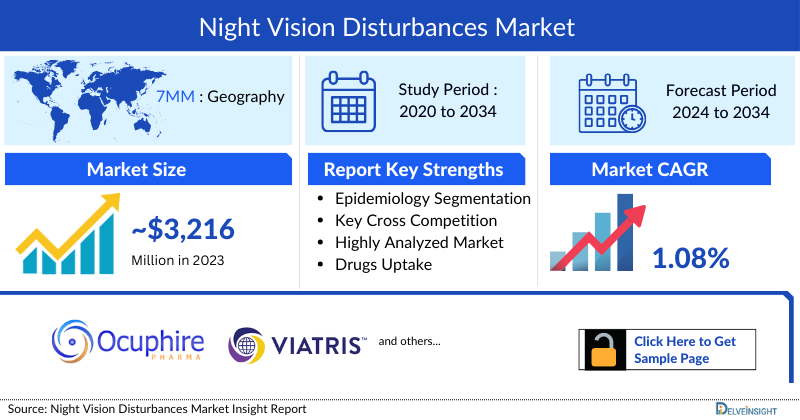
DelveInsight’s “Night Vision Disturbance – Market Insights, Epidemiology, and Market Forecast – 2034” report delivers an in-depth understanding of the Night Vision Disturbance, historical and forecasted epidemiology as well as the Night Vision Disturbance market trends in the United States, EU4 and the UK (Germany, France, Italy, Spain) and the United Kingdom, and Japan.
The Night Vision Disturbance Treatment Market Report provides current treatment practices, emerging drugs, and market share of the individual therapies, current and forecasted 7MM Night Vision Disturbance market size from 2020 to 2034. The Report also covers current Night Vision Disturbance treatment practice, market drivers, market barriers, SWOT analysis, reimbursement and market access, and unmet medical needs to curate the best of the opportunities and assess the underlying potential of the market.
|
Study Period |
2020 to 2034 |
|
Forecast Period |
2024-2034 |
|
Geographies Covered |
|
|
Night Vision Disturbance Market |
|
|
Night Vision Disturbance Market Size |
USD 1754 Million in 2023 (US among in the 7MM) |
|
Night Vision Disturbance Companies |
|
Night Vision Disturbance Treatment Market: Overview and Algorithm
Night Vision Disturbance refers to the impairment or disruption of one's ability to see clearly in low-light or nighttime conditions, often experienced by individuals using night vision technology or devices. It can result from various factors, such as bright light sources, glare, and insufficient contrast, leading to reduced visibility and potential safety hazards. NVD mitigation strategies may include adjusting device settings, employing anti-glare measures, or developing advanced technology to enhance nighttime vision without causing discomfort or visual impairment.
Night Vision Disturbance Diagnosis
The process of diagnosing night vision disturbance typically entails an ocular examination to eliminate any underlying ocular conditions, such as cataracts or retinal issues. Additionally, specialized assessments, such as contrast sensitivity testing, may be conducted to evaluate the precise nature and extent of the impairment. The recommended course of action for early symptoms is observation because the patient's cerebral processing and adaptability are at work. The subjective questionnaire, which involves asking patients about their symptoms and rating them on a scale, is the assessment technique used the most frequently for night vision impairments.
Currently, all available tests and examination methods for NVD are symptomatic. To date, no established gold standard clinical test exists to quantify NVD accurately. Since NVD is a multifactorial disease with diverse associated issues, establishing a definitive treatment regimen remains a challenge, and standardization of treatment approaches remains a distant objective. There is also absence of curative diagnosis and guidelines leading to underdiagnoses.
Further details related to diagnosis are provided in the report…
Night Vision Disturbance Treatment
Currently, no approved treatment modalities exist for patients afflicted with NVD, and observation remains the primary course of action. Patients are often advised to utilize night-vision glasses or anti-glare mirrors while driving, although these options do not provide a curative effect and is correlated with diminished quality of life, accidental injuries, and social isolation which creates an alarming burden of this indication. Using off-label eye drops may result in daytime redness due to preservatives, and can lead to potential side effects such as ocular surface damage, eye irritation, and tear film instability. Furthermore, the high dosing frequency of these eye drops (three to four times daily) often results in poor compliance. Therefore, developing a preservative-free eye drop with long-lasting daytime effects is imperative.

Night Vision Disturbance Epidemiology
As the market is derived using a patient-based model, the Night Vision Disturbance epidemiology chapter in the report provides historical as well as forecasted epidemiology segmented by Total Diagnosed Prevalent Cases of Night Vision Disturbance, in the 7MM covering, the United States, EU4 countries (Germany, France, Italy, and Spain), United Kingdom, and Japan from 2020 to 2034.
- In the assessment done by DelveInsight, the estimated total diagnosed prevalent cases of Night Vision Disturbance in the 7MM were nearly 55 million in 2023.
- The highest total diagnosed prevalent cases of Night Vision Disturbance were accounted by the US in 2023 (44%), which are expected to show a rise in the future.
- Among the European countries, Germany had the highest diagnosed prevalent cases of Night Vision Disturbance with ~6 million cases, followed by France, which had diagnosed prevalent population of ~4 million in 2023. On the other hand, Spain had the lowest prevalent population (~3 million cases).
- Japan had nearly 9 million total diagnosed prevalent cases of Night Vision Disturbance in 2023, accounting for approximately 16% in 7MM.
Unlock comprehensive insights! Click Here to Purchase the Full Epidemiology Report @ Night Vision Disturbance Prevalence
Night Vision Disturbance Drug Chapters
The drug chapter segment of the Night Vision Disturbance treatment market report encloses a detailed analysis of Night Vision Disturbance off-label drugs and late-stage (Phase-III and Phase-II) Night Vision Disturbance pipeline drugs analysis. It also helps to understand the Night Vision Disturbance clinical trials details, expressive pharmacological action, agreements and collaborations, approval and patent details, advantages and disadvantages of each included drug, and the latest Night Vision Disturbance news and press releases.
Night Vision Disturbance Emerging Drugs
- Phentolamine Ophthalmic Solution 0.75% (Nyxol): Ocuphire Pharma/Viatris
Nyxol is a novel ophthalmic treatment for multiple front-of-the-eye disorders, including NVD and presbyopia. It is a proprietary ophthalmic formulation of phentolamine mesylate, an alpha-1 and alpha-2 inhibitor that has been approved previously as an injectable for other indications, allowing a more efficient development pathway for approval. Nyxol has demonstrated a differentiated product profile by moderately reducing pupil size (which leads to improved night and day vision), significantly lowering intraocular pressure, and convenient once-daily dosing. In September 2023, RYZUMVI (phentolamine ophthalmic solution) became a FDA-approved medicine to treat pharmacologically-induced mydriasis - dilation of the pupil of the eye caused by eye drops. Approval was supported by positive results in the MIRA-2 and MIRA-3 clinical trials. Ocuphire has a partnership with Viatris, Inc. to develop and commercialize phentolamine ophthalmic solution 0.75%.
In January 2024, Ocuphire Pharma, Inc. reported that it has secured an agreement with the US Food and Drug Administration (FDA) under a Special Protocol Assessment (SPA). This agreement covers the clinical trial protocol and planned statistical analysis for the LYNX-2 Phase III trial, aimed at evaluating phentolamine ophthalmic solution for the treatment of decreased visual acuity under dim (mesopic) light conditions.
The SPA agreement with the FDA provides a clear regulatory pathway for phentolamine ophthalmic solution in patients experiencing poor night vision after keratorefractive surgery.
Based on the agreement with the FDA, Ocuphire initiated the LYNX-2 Phase III trial in April 2024. The trial aims to assess the safety and efficacy of 0.75% Phentolamine Ophthalmic Solution in improving mesopic low contrast visual acuity in subjects with post-refractive surgery visual disturbances. The expected primary completion date is set for September 2025.
|
Drug |
MoA |
RoA |
Company |
Phase |
|
Nyxol |
Nonselective alpha-adrenergic antagonist |
Topical eye drop |
Ocuphire Pharma/Viatris. |
III |
|
NVK031 |
XXX |
Topical |
Vyluma |
XXX |

Night Vision Disturbance Market Outlook
Currently, there is no definitive cure for Night Vision Disturbance. Ophthalmologists typically conduct an assessment of NVD by examining the patient's eyes and testing their vision. Early symptoms are best managed through observation, as the patient's neural processing and adaptation mechanisms come into play.
Night Vision Disturbance treatment aims to mitigate symptoms and risk factors through diet modifications, pharmacological interventions, and invasive procedures as needed. Off-label usage of miotics, such as pilocarpine, carbachol, and aceclidine, and adrenergic agonists, such as brimonidine tartrate to reduce night vision symptoms in ophthalmology is significant.
- Supportive care options (miotics and adrenergic agonists) are major revenue generators in the current treatment landscape.
- The United States accounted for the highest Night Vision Disturbance Market Size approximately 55% of the total market size in 7MM in 2023, in comparison to the other major markets i.e., EU4 countries (Germany, France, Italy, and Spain), and the United Kingdom, and Japan.
- Among the EU countries, Germany had the highest Night Vision Disturbance market size with nearly USD 283 million each in 2023, while Spain had the lowest Night Vision Disturbance market size with USD ~149 million in 2023.
- The Night Vision Disturbance Market Size in Japan was estimated to be about USD 434 million in 2023.
- With the expected launch of upcoming Night Vision Disturbance Therapies, such as Phentolamine Ophthalmic Solution 0.75% (Nyxol), among others, the total Night Vision Disturbance Market Size is expected to show change in the upcoming years.
Night Vision Disturbance Drugs Uptake
This section focuses on the uptake rate of potential Night Vision Disturbance drugs expected to launch in the market during 2020–2034. For example, Phentolamine Ophthalmic Solution 0.75% in the US is expected to be launched with a peak share of 10%. Phentolamine Ophthalmic Solution 0.75%is anticipated to take 7 years to peak with a medium uptake.
Further detailed analysis of emerging therapies drug uptake in the report…
Night Vision Disturbance Pipeline Development Activities
The Night Vision Disturbance therapeutics market report provides insights into different therapeutic candidates in Phase III, Phase II, and Phase I stage. It also analyzes key Night Vision Disturbance Companies involved in developing targeted therapeutics.
Pipeline Development Activities
The Night Vision Disturbance therapeutics market report covers information on collaborations, acquisitions and mergers, licensing, and patent details for Night Vision Disturbance emerging therapies.
Take Your Research to the Next Level! Click Here to Get Access to the Full Pipeline Report @ Night Vision Disturbance Treatment Drugs
KOL Views
To keep up with current Night Vision Disturbance market trends, we take KOLs and SMEs’ opinions working in the domain through primary research to fill the data gaps and validate the secondary research. Industry Experts were contacted for insights on Night Vision Disturbance evolving treatment landscape, patient reliance on conventional therapies, patient therapy switching acceptability, and drug uptake along with challenges related to accessibility, including KOL from Keck School of Medicine of the University of Southern California, Los Angeles; Department of Ophthalmology, University Medical Centre Hamburg-Eppendorf, Hamburg, Germany; Nouvelle Clinique de l'Union, Saint Jean, France; Section of Ophthalmology, University of Palermo, Italy; Department of Ophthalmology, Tajimi Municipal Hospital, Tajimi, Japan; and others.
Delveinsight’s analysts connected with 50+ KOLs to gather insights; however, interviews were conducted with 15+ KOLs in the 7MM. Their opinion helps understand and validate current and emerging therapies, treatment patterns, or Night Vision Disturbance market trends. This will support the clients in potential upcoming novel treatments by identifying the overall scenario of the market and the unmet needs.
Night Vision Disturbance Drugs Market: Qualitative Analysis
We perform Qualitative and market Intelligence analysis using various approaches, such as SWOT and Conjoint Analysis. In the SWOT analysis, strengths, weaknesses, opportunities, and threats in terms of disease diagnosis, patient awareness, patient burden, competitive landscape, cost-effectiveness, and geographical accessibility of therapies are provided. These pointers are based on the Analyst’s discretion and assessment of the patient burden, cost analysis, and existing and evolving treatment landscape.
Conjoint Analysis analyzes multiple approved and emerging therapies based on relevant attributes such as safety, efficacy, frequency of administration, route of administration, and order of entry. Scoring is given based on these parameters to analyze the effectiveness of therapy.
Further, the therapies’ safety is evaluated wherein the acceptability, tolerability, and adverse events are majorly observed, and it sets a clear understanding of the side effects posed by the drug in the trials. In addition, the scoring is also based on the route of administration, order of entry and designation, probability of success, and the addressable patient pool for each therapy. According to these parameters, the final weightage score and the ranking of the emerging therapies are decided.
Night Vision Disturbance Therapeutics Market Access and Reimbursement
The high cost of therapies for the treatment is a major factor restraining the growth of the global drug market. Because of the high cost, the economic burden is increasing, leading the patient to escape from proper treatment. The Night Vision Disturbance therapeutics market report further provides detailed insights on the country-wise accessibility and reimbursement scenarios, cost-effectiveness scenario of approved therapies, programs making accessibility easier and out-of-pocket costs more affordable, insights on patients insured under federal or state government prescription drug programs, etc.
Night Vision Disturbance Therapeutics Market Report Scope
- The Night Vision Disturbance therapeutics market report covers a segment of key events, an executive summary, descriptive overview, explaining its causes, signs and symptoms, and currently available therapies.
- Comprehensive insight has been provided into the epidemiology segments and forecasts, the future growth potential of diagnosis rate, disease progression, and treatment guidelines.
- Additionally, an all-inclusive account of the current and emerging therapies and the elaborative profiles of late-stage and prominent therapies will impact the current treatment landscape.
- A detailed review of the Night Vision Disturbance therapeutics market, historical and forecasted Night Vision Disturbance treatment market size, Night Vision Disturbance drugs market share by therapies, detailed assumptions, and rationale behind the approach is included in the report covering the 7MM drug outreach.
- The Night Vision Disturbance therapeutics market report provides an edge while developing business strategies, by understanding trends, through SWOT analysis and expert insights/KOL views, patient journey, and treatment preferences that help shape and drive the 7MM Night Vision Disturbance drugs market.
Night Vision Disturbance Therapeutics Market Report Insights
- Patient-based Night Vision Disturbance Market Forecasting
- Therapeutic Approaches
- Night Vision Disturbance Pipeline Analysis
- Night Vision Disturbance Market Size and Trends
- Existing and Future Night Vision Disturbance Drugs Market Opportunity
Night Vision Disturbance Therapeutics Market Report Key Strengths
- 11 years Night Vision Disturbance Market Forecast
- The 7MM Coverage
- Night Vision Disturbance Epidemiology Segmentation
- Key Cross Competition
- Conjoint Analysis
- Night Vision Disturbance Drugs Uptake
- Key Night Vision Disturbance Market Forecast Assumptions
Night Vision Disturbance Therapeutics Market Report Assessment
- Current Night Vision Disturbance Treatment Market Practices
- Night Vision Disturbance Unmet Needs
- Night Vision Disturbance Pipeline Drugs Analysis Profiles
- Night Vision Disturbance Drugs Market Attractiveness
- Qualitative Analysis (SWOT and Conjoint Analysis)
Key Questions
Night Vision Disturbance Treatment Market Insights
- What was the Night Vision Disturbance drugs market share (%) distribution in 2020 and how it would look like in 2034?
- What would be the Night Vision Disturbance total market size as well as market size by therapies across the 7MM during the forecast period (2024–2034)?
- What are the key findings pertaining to the market across the 7MM and which country will have the largest Night Vision Disturbance market size during the forecast period (2024–2034)?
- At what CAGR, the Night Vision Disturbance drugs market is expected to grow at the 7MM level during the forecast period (2024–2034)?
- What would be the Night Vision Disturbance market outlook across the 7MM during the forecast period (2024–2034)?
- What would be the Night Vision Disturbance market growth till 2034 and what will be the resultant market size in the year 2034?
- How would the market drivers, barriers, and future opportunities affect the market dynamics and subsequent analysis of the associated trends?
Night Vision Disturbance Epidemiology Insights
- What is the disease risk, burden, and unmet needs of Night Vision Disturbance?
- What is the historical Night Vision Disturbance patient population in the United States, EU5 (Germany, France, Italy, Spain, and the UK), and Japan?
- What would be the forecasted patient population of Night Vision Disturbance at the 7MM level?
- What will be the growth opportunities across the 7MM with respect to the patient population pertaining to Night Vision Disturbance?
- Out of the above-mentioned countries, which country would have the highest prevalent population of Night Vision Disturbance during the forecast period (2024–2034)?
- At what CAGR the population is expected to grow across the 7MM during the forecast period (2024–2034)?
Current Night Vision Disturbance Treatment Market Scenario, Marketed Drugs, and Emerging Therapies
- What are the current options for the treatment of Night Vision Disturbance along with the approved therapy?
- What are the current treatment guidelines for the treatment of Night Vision Disturbance in the US, Europe, And Japan?
- What are the Night Vision Disturbance marketed drugs and their MOA, regulatory milestones, product development activities, advantages, disadvantages, safety, and efficacy, etc.?
- How many companies are developing therapies for the treatment of Night Vision Disturbance?
- How many emerging therapies are in the mid-stage and late stages of development for the treatment of Night Vision Disturbance?
- What are the key collaborations (Industry–Industry, Industry-Academia), Mergers and acquisitions, licensing activities related to the Night Vision Disturbance therapies?
- What are the recent therapies, targets, mechanisms of action and technologies developed to overcome the limitation of existing therapies?
- What are the clinical studies going on for Night Vision Disturbance and their status?
- What are the key designations that have been granted for the emerging therapies for Night Vision Disturbance?
- What are the 7MM historical and forecasted market of Night Vision Disturbance?
Reasons to Buy
- The Night Vision Disturbance therapeutics market report will help in developing business strategies by understanding the latest trends and changing treatment dynamics driving the Night Vision Disturbance Market.
- Insights on patient burden/disease Night Vision Disturbance Prevalence, evolution in diagnosis, and factors contributing to the change in the epidemiology of the disease during the forecast years.
- To understand the existing Night Vision Disturbance Drugs Market opportunity in varying geographies and the growth potential over the coming years.
- Distribution of historical and current patient share based on real-world prescription data along with reported sales of approved products in the US, EU4 (Germany, France, Italy, and Spain), the United Kingdom, and Japan.
- Identification of strong upcoming players in the Night Vision Disturbance Drugs Market will help in devising strategies that will help in getting ahead of competitors.
- Detailed analysis and potential of current and emerging therapies under the conjoint analysis section to provide visibility around leading emerging drugs.
- Highlights of Access and Reimbursement policies of approved therapies, barriers to accessibility of off-label expensive therapies, and patient assistance programs.
- To understand the perspective of Key Opinion Leaders around the accessibility, acceptability, and compliance-related challenges of existing treatment to overcome barriers in future.
- Detailed insights on the unmet need of the existing Night Vision Disturbance Drugs Market so that the upcoming players can strengthen their development and launch strategy.
Stay Updated with us for Recent Articles
-pipeline.png&w=256&q=75)