Nonmelanoma Skin Cancer Pipeline Insight
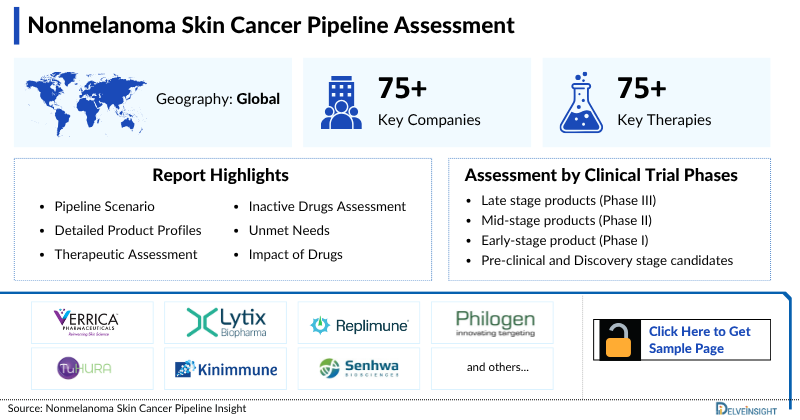
DelveInsight’s, “Nonmelanoma Skin Cancer Pipeline Insight, 2026” report provides comprehensive insights about 75+ companies and 75+ pipeline drugs in Nonmelanoma Skin Cancer pipeline landscape. It covers the pipeline drug profiles, including clinical and nonclinical stage products. It also covers the therapeutics assessment by product type, stage, route of administration, and molecule type. It further highlights the inactive pipeline products in this space.
Geography Covered
- Global coverage
Nonmelanoma Skin Cancer Understanding
Nonmelanoma Skin Cancer Overview
Nonmelanoma skin cancer (NMSC) is the most common type of skin cancer worldwide and includes several malignancies arising from epidermal keratinocytes, primarily basal cell carcinoma (BCC) and squamous cell carcinoma (SCC). BCC is the most prevalent subtype, accounting for approximately 75% of NMSC cases and is characterized by slow growth and a low risk of metastasis. SCC is the second most common subtype and has a greater potential for local invasion and metastasis. Less common forms of NMSC include Merkel cell carcinoma, dermatofibrosarcoma protuberans, and adnexal carcinomas. The incidence of NMSC continues to increase globally, largely due to cumulative ultraviolet radiation exposure and an aging population, posing a growing healthcare burden.
The development of nonmelanoma skin is primarily driven by chronic exposure to ultraviolet (UV) radiation from sunlight, which induces DNA damage in skin cells. Additional risk factors include fair skin, increasing age, immunosuppression, exposure to ionizing radiation or carcinogenic chemicals such as arsenic, and certain genetic disorders that impair DNA repair mechanisms. These factors contribute to the accumulation of genetic mutations that promote the development of basal cell carcinoma and squamous cell carcinoma, the most common forms of NMSC.
The pathophysiology of nonmelanoma skin cancer is primarily driven by cumulative ultraviolet (UV) radiation-induced DNA damage in epidermal keratinocytes. Repeated UV exposure leads to mutations in key tumor suppressor genes and signaling pathways, resulting in uncontrolled cellular proliferation, impaired DNA repair, and resistance to apoptosis. Over time, these genetic alterations promote the development and progression of basal cell carcinoma and squamous cell carcinoma, the two major forms of NMSC.
Diagnosis of nonmelanoma skin cancer is primarily based on clinical examination of suspicious skin lesions, followed by histopathological confirmation through biopsy. Dermatologic assessment helps differentiate between basal cell carcinoma, squamous cell carcinoma, and other skin conditions, while tissue analysis remains the gold standard for establishing the diagnosis and guiding treatment decisions.
Treatment of nonmelanoma skin cancer depends on the tumor type, size, and location, with surgical excision and Mohs micrographic surgery serving as the primary treatment options for most cases. Additional approaches, including curettage and electrodessication, cryotherapy, radiotherapy, photodynamic therapy, and topical agents, may be used for selected lesions. Early detection and appropriate treatment are associated with high cure rates and favorable clinical outcomes.
"Nonmelanoma Skin Cancer Pipeline Insight, 2026" report by DelveInsight outlays comprehensive insights of present scenario and growth prospects across the indication. A detailed picture of the Nonmelanoma Skin Cancer pipeline landscape is provided which includes the disease overview and Nonmelanoma Skin Cancer treatment guidelines.
The assessment part of the report embraces, in depth Nonmelanoma Skin Cancer commercial assessment and clinical assessment of the pipeline products under development. In the report, detailed description of the drug is given which includes mechanism of action of the drug, clinical studies, NDA approvals (if any), and product development activities comprising the technology, Nonmelanoma Skin Cancer collaborations, licensing, mergers and acquisition, funding, designations and other product related details.
Nonmelanoma Skin Cancer Pipeline Report Highlights
The Nonmelanoma Skin Cancer companies and academics are working to assess challenges and seek opportunities that could influence Nonmelanoma Skin Cancer R&D. The therapies under development are focused on novel approaches to treat/improve Nonmelanoma Skin Cancer.
Nonmelanoma Skin Cancer Emerging Drugs Analysis
This segment of the Nonmelanoma Skin Cancer report encloses its detailed analysis of various drugs in different stages of clinical development, including phase II, I, preclinical and Discovery. It also helps to understand clinical trial details, expressive pharmacological action, agreements and collaborations, and the latest news and press releases.
Nonmelanoma Skin Cancer Emerging Drugs
IFx-2.0: TuHURA Biosciences
IFx-2.0 is an investigational innate immune agonist developed for the treatment of multiple cancers, including basal cell carcinoma. According to the company, IFx-2.0 utilizes its proprietary Immune Fx™ platform to make tumor cells appear like bacteria to the immune system by inducing the expression of the highly immunogenic bacterial protein Emm55 on the tumor cell surface. This triggers activation of the innate immune response, promotes uptake of tumor cells by dendritic cells, and enhances presentation of tumor neoantigens to T cells. Through this mechanism, IFx-2.0 is designed to stimulate a robust tumor-specific immune response and overcome resistance to immune checkpoint inhibitors. Currently, the drug is being evaluated in the Phase III stage of its development for the treatment of Nonmelanoma Skin Cancer.
RP1: Replimune Group Inc.
RP1 (vusolimogene oderparepvec) is an investigational oncolytic immunotherapy developed by Replimune Group Inc. for the treatment of non-melanoma skin cancers and other solid tumors. According to the company, RP1 is a genetically engineered herpes simplex virus type 1 (HSV-1) designed to selectively infect and destroy tumor cells while stimulating a systemic anti-tumor immune response. The therapy expresses GM-CSF and the fusogenic protein GALV-GP R−, which enhance tumor cell killing, promote the release of tumor antigens, and activate immune cells. Through direct oncolysis and immune activation, RP1 is intended to improve recognition and elimination of cancer cells throughout the body. Currently, the drug is being evaluated in the Phase II stage of its development for the treatment of Nonmelanoma Skin Cancer.
AIV001: AiViva BioPharma
AIV001 is an investigational intradermally administered therapy developed by AiViva BioPharma for the treatment of basal cell carcinoma and other non-melanoma skin cancers. According to the company, AIV001 is a proprietary prolonged-release formulation of axitinib, a multi-kinase inhibitor designed to provide sustained local drug exposure following injection into the lesion. The drug inhibits multiple signaling pathways, including vascular endothelial growth factor receptor (VEGFR)-mediated pathways, thereby reducing angiogenesis, abnormal cell proliferation, inflammation, and fibrosis. Through its localized and prolonged activity, AIV001 is intended to suppress tumor growth while minimizing systemic exposure. Currently, the drug is being evaluated in the Phase I/II stage of its development for the treatment of Nonmelanoma Skin Cancer.
Silmitasertib (CX-4945): Senhwa Biosciences, Inc.
Silmitasertib (CX-4945) is a first-in-class, orally administered small-molecule inhibitor developed by Senhwa Biosciences, Inc. for the treatment of advanced basal cell carcinoma (BCC). Silmitasertib selectively inhibits Casein Kinase 2 (CK2), a key regulator of the Hedgehog signaling pathway that promotes the stability and activity of GLI transcription factors involved in BCC growth. By blocking CK2-mediated signaling, the drug is designed to suppress Hedgehog pathway activity, inhibit tumor cell proliferation, and potentially overcome resistance to Smoothened inhibitors used in BCC treatment. Currently, the drug is being evaluated in the Phase I stage of its development for the treatment of Nonmelanoma Skin Cancer.
Further product details are provided in the report……..
Nonmelanoma Skin Cancer Drug Therapeutic Assessment
This segment of the report provides insights about the different Nonmelanoma Skin Cancer drugs segregated based on following parameters that define the scope of the report, such as:
Major Nonmelanoma Skin Cancer Players in Nonmelanoma Skin Cancer
There are approx. 75+ key companies which are developing the therapies Nonmelanoma Skin Cancer. The companies which have their Nonmelanoma Skin Cancer drug candidates in the most advanced stage, i.e. Phase III include, TuHURA Biosciences and others.
Nonmelanoma Skin Cancer Clinical Trial Phases
DelveInsight’s report covers around 75+ products under different phases of clinical development like
- Late stage products (Phase III)
- Mid-stage products (Phase II)
- Early-stage product (Phase I) along with the details of
- Pre-clinical and Discovery stage candidates
- Discontinued & Inactive candidates
Nonmelanoma Skin Cancer Drug Route of Administration
Nonmelanoma Skin Cancer pipeline report provides the therapeutic assessment of the pipeline drugs by the Route of Administration. Products have been categorized under various ROAs such as
- Intra-articular
- Intraocular
- Intrathecal
- Intravenous
- Ophthalmic
- Oral
- Parenteral
- Subcutaneous
- Topical
- Transdermal
Nonmelanoma Skin Cancer Product Molecule Type
Products have been categorized under various Molecule types such as
- Oligonucleotide
- Peptide
- Small molecule
Nonmelanoma Skin Cancer Product Type
Drugs have been categorized under various product types like Mono, Combination and Mono/Combination.
Nonmelanoma Skin Cancer Clinical Trial Activities
The Nonmelanoma Skin Cancer pipeline report provides insights into different Nonmelanoma Skin Cancer clinical trials within report provides insights into different therapeutic candidates in phase II, I, preclinical and discovery stage. It also analyses Nonmelanoma Skin Cancer therapeutic drugs key players involved in developing key drugs.
Nonmelanoma Skin Cancer Pipeline Development Activities
The Nonmelanoma Skin Cancer clinical Trial analysis report covers the detailed information of collaborations, acquisition and merger, licensing along with a thorough therapeutic assessment of emerging Nonmelanoma Skin Cancer drugs.
Nonmelanoma Skin Cancer Pipeline Report Insights
- Nonmelanoma Skin Cancer Pipeline Analysis
- Nonmelanoma Skin Cancer Therapeutic Assessment
- Nonmelanoma Skin CancerUnmet Needs
- Impact of Nonmelanoma Skin Cancer Drugs
Nonmelanoma Skin Cancer Pipeline Report Assessment
- Nonmelanoma Skin Cancer Pipeline Product Profiles
- Nonmelanoma Skin Cancer Therapeutic Assessment
- Nonmelanoma Skin Cancer Pipeline Assessment
- Nonmelanoma Skin Cancer Inactive drugs assessment
- Nonmelanoma Skin Cancer Market Unmet Needs
Key Questions Answered In The Nonmelanoma Skin Cancer Pipeline Report:
- Current Treatment Scenario and Emerging Therapies:
- How many companies are developing Nonmelanoma Skin Cancer drugs?
- How many Nonmelanoma Skin Cancer drugs are developed by each company?
- How many emerging drugs are in mid-stage, and late-stage of development for the treatment of Nonmelanoma Skin Cancer?
- What are the key collaborations (Industry–Industry, Industry–Academia), Mergers and acquisitions, licensing activities related to the Nonmelanoma Skin Cancer therapeutics?
- What are the recent trends, drug types and novel technologies developed to overcome the limitation of existing therapies?
- What are the clinical studies going on for Nonmelanoma Skin Cancer and their status?
- What are the key designations that have been granted to the emerging drugs?
Nonmelanoma Skin Cancer Key Players
- Verrica Pharmaceuticals/Lytix Biopharma ASA
- Replimune, Inc.
- Philogen S.p.A.
- TuHURA Biosciences
- Kinimmune
- Senhwa Biosciences, Inc.
- AiViva BioPharma
- Sol-Gel Technologies Ltd.
- EMD Serono Research & Development Institute, Inc.
Nonmelanoma Skin Cancer Key Products
- VP-315
- RP1
- NidlegyTM
- IFx-2.0
- KIN-101
- Silmitasertib
- AIV001
- SGT-610
- tuvusertib