Nrg1 Fusion Cancer Pipeline Insight
DelveInsight’s, “NRG1 Fusion Cancer Pipeline Insight, 2026” report provides comprehensive insights about 3+ companies and 3+ pipeline drugs in NRG1 Fusion Cancer pipeline landscape. It covers the pipeline drug profiles, including clinical and nonclinical stage products. It also covers the therapeutics assessment by product type, stage, route of administration, and molecule type. It further highlights the inactive pipeline products in this space.
Geography Covered
- Global coverage
NRG1 Fusion Cancer Understanding
NRG1 Fusion Cancer Overview
NRG1 fusion-positive cancer is a rare molecular subtype of solid tumors driven by gene fusions involving the NRG1. These fusions activate the HER3–HER2 signaling pathway, promoting uncontrolled tumor growth and survival across multiple cancer types, including Non-small cell lung cancer, Pancreatic ductal adenocarcinoma, and other epithelial malignancies.
Although NRG1 fusions occur in less than 1% of most solid tumors, they represent an actionable oncogenic driver that can be identified through comprehensive genomic profiling. The emergence of targeted therapies directed against HER2/HER3 signaling has significantly advanced treatment options for this rare patient population, with ongoing research focused on improving response durability and expanding therapeutic strategies.
NRG1 fusion-positive cancer is driven by chromosomal rearrangements involving the NRG1, which generate fusion proteins that retain the NRG1 EGF-like domain. This domain constitutively binds to the HER3 (ERBB3) receptor, promoting its dimerization with HER2 (ERBB2) and persistent activation of downstream signaling pathways, primarily PI3K/AKT/mTOR and MAPK/ERK. Continuous activation of these pathways enhances tumor cell proliferation, survival, invasion, and metastasis while inhibiting apoptosis. Because tumor growth is largely dependent on HER2–HER3 signaling, NRG1 fusion-positive cancers are particularly susceptible to therapies targeting HER2, HER3, or both.
Treatment of NRG1 fusion-positive cancer depends on the tumor type, disease stage, and prior therapies, but targeted inhibition of the HER2–HER3 signaling pathway has become the cornerstone for advanced NRG1 fusion-positive cancers. The bispecific antibody Zenocutuzumab is the first approved targeted therapy for patients with unresectable or metastatic solid tumors harboring an NRG1 fusion, regardless of tumor origin. Other investigational approaches include HER3-targeted monoclonal antibodies, HER2 tyrosine kinase inhibitors, and combination regimens designed to overcome resistance. Conventional treatments such as surgery, chemotherapy, radiotherapy, and immunotherapy continue to play an important role depending on the primary cancer type and clinical setting, often in conjunction with biomarker-directed therapies.
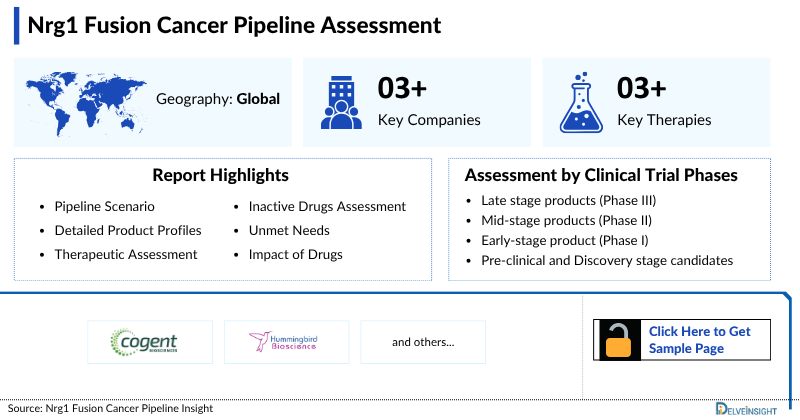
"NRG1 Fusion Cancer Pipeline Insight, 2026" report by DelveInsight outlays comprehensive insights of present scenario and growth prospects across the indication. A detailed picture of the NRG1 Fusion Cancer pipeline landscape is provided which includes the disease overview and NRG1 Fusion Cancer treatment guidelines. The assessment part of the report embraces, in depth NRG1 Fusion Cancer commercial assessment and clinical assessment of the pipeline products under development. In the report, detailed description of the drug is given which includes mechanism of action of the drug, clinical studies, NDA approvals (if any), and product development activities comprising the technology, NRG1 Fusion Cancer collaborations, licensing, mergers and acquisition, funding, designations and other product related details.
NRG1 Fusion Cancer Pipeline Report Highlights
The companies and academics are working to assess challenges and seek opportunities that could influence NRG1 Fusion Cancer R&D. The therapies under development are focused on novel approaches to treat/improve NRG1 Fusion Cancer.
NRG1 Fusion Cancer Emerging Drugs Analysis
This segment of the NRG1 Fusion Cancer report encloses its detailed analysis of various drugs in different stages of clinical development, including Phase III, II, I, Preclinical and Discovery. It also helps to understand clinical trial details, expressive pharmacological action, agreements and collaborations, and the latest news and press releases.
NRG1 Fusion Cancer Emerging Drugs
CGT4255: Cogent Biosciences, Inc.
CGT4255 is an investigational, orally administered, selective HER2 (ERBB2) tyrosine kinase inhibitor designed to inhibit HER2-driven signaling while sparing EGFR, with the goal of improving tolerability and central nervous system (CNS) penetration. It is currently being evaluated in a Phase I/Ib trial for patients with advanced solid tumors harboring ERBB2 genetic alterations, HER2 overexpression, or NRG1 gene fusions. Because NRG1 fusion-positive tumors signal through HER2/HER3 heterodimers, CGT4255 is being explored as a potential targeted therapy for this molecular subset, although its safety, optimal dose, and preliminary antitumor activity are still under clinical investigation.
Further product details are provided in the report……..
NRG1 Fusion Cancer: Therapeutic Assessment
This segment of the report provides insights about the different NRG1 Fusion Cancer drugs segregated based on following parameters that define the scope of the report, such as:
Major NRG1 Fusion Cancer Players in NRG1 Fusion Cancer
There are approx. 3+ key companies which are developing the therapies for NRG1 Fusion Cancer. The companies which have their NRG1 Fusion Cancer drug candidates in the early stage, i.e. Phase I include, Cogent Biosciences, Inc.
NRG1 Fusion Cancer Cinical Trial Phases
DelveInsight’s report covers around 3+ products under different phases of clinical development like
- Late stage products (Phase III)
- Mid-stage products (Phase II)
- Early-stage product (Phase I) along with the details of
- Pre-clinical and Discovery stage candidates
- Discontinued & Inactive candidates
NRG1 Fusion Cancer Drug Route of Administration
NRG1 Fusion Cancer pipeline report provides the therapeutic assessment of the pipeline drugs by the Route of Administration. Products have been categorized under various ROAs such as
- Oral
- Intravenous
- Subcutaneous
- Parenteral
- Topical
NRG1 Fusion Cancer Product Molecule Type
Products have been categorized under various Molecule types such as
- Recombinant fusion proteins
- Small molecule
- Monoclonal antibody
- Peptide
- Polymer
- Gene therapy
NRG1 Fusion Cancer Product Type
Drugs have been categorized under various product types like Mono, Combination and Mono/Combination.
NRG1 Fusion Cancer Clinical Trial Activities
The NRG1 Fusion Cancer Pipeline report provides insights into different NRG1 Fusion Cancer Clinical Trials within Phase III, II, I, preclinical and discovery stage. It also analyses NRG1 Fusion Cancer therapeutic drugs key players involved in developing key drugs.
NRG1 Fusion Cancer Pipeline Development Activities
The NRG1 Fusion Cancer Clinical Trial Analysis report covers the detailed information of collaborations, acquisition and merger, licensing along with a thorough therapeutic assessment of emerging NRG1 Fusion Cancer drugs.
NRG1 Fusion Cancer Report Insights
- NRG1 Fusion Cancer Pipeline Analysis
- NRG1 Fusion Cancer Therapeutic Assessment
- NRG1 Fusion Cancer Unmet Needs
- Impact of NRG1 Fusion Cancer Drugs
NRG1 Fusion Cancer Report Assessment
- NRG1 Fusion Cancer Pipeline Product Profiles
- NRG1 Fusion CancerTherapeutic Assessment
- NRG1 Fusion CancerPipeline Assessment
- NRG1 Fusion CancerInactive drugs assessment
- NRG1 Fusion Cancer Market Unmet Needs
Key Questions Answered in the NRG1 Fusion Cancer Pipeline Report
- Current Treatment Scenario and Emerging Therapies:
- How many companies are developing NRG1 Fusion Cancer drugs?
- How many NRG1 Fusion Cancer drugs are developed by each company?
- How many emerging drugs are in mid-stage, and late-stage of development for the treatment of NRG1 Fusion Cancer?
- What are the key collaborations (Industry–Industry, Industry–Academia), Mergers and acquisitions, licensing activities related to the NRG1 Fusion Cancer therapeutics?
- What are the recent trends, drug types and novel technologies developed to overcome the limitation of existing therapies?
- What are the clinical studies going on for NRG1 Fusion Cancer and their status?
- What are the key designations that have been granted to the emerging drugs?
NRG1 Fusion Cancer Key Players
- Cogent Biosciences, Inc.
- Hummingbird Bioscience
NRG1 Fusion Cancer Key Products
- CGT4255
- HMBD-001

