
OCS-02 Market Summary
Key Factors Driving OCS-02 Growth
1. Market Positioning and Patient Opportunity
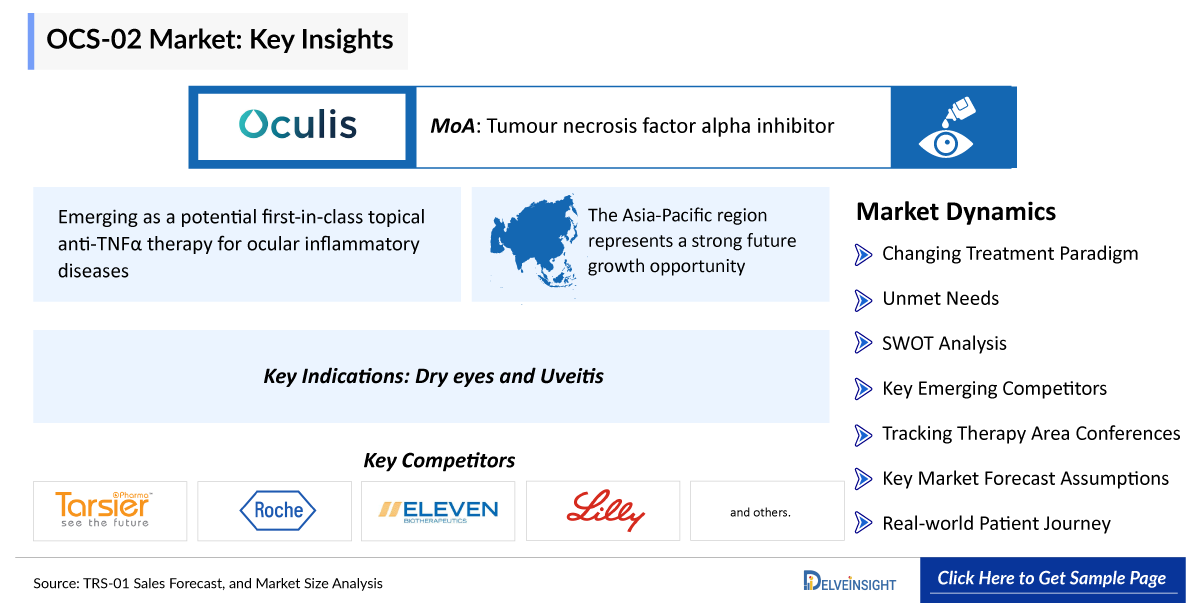
• OCS-02 is emerging as a potential first-in-class topical anti-TNFα therapy for ocular inflammatory diseases, addressing a significant unmet need.
• The drug is being positioned to capture patients who are inadequately controlled on corticosteroids or systemic immunosuppressant.
• Rising prevalence of chronic ocular inflammation and dry eye–related inflammatory conditions is expanding the addressable patient pool.
• Strong scientific rationale and differentiated mechanism support growing interest among ophthalmologists and uveitis specialists.
2. Expansion Across Key Indications
• Dry Eye Disease (DED): OCS-02 has been evaluated as a novel anti-inflammatory approach targeting TNFα, aiming to address the inflammatory component of moderate-to-severe DED beyond symptomatic relief.
• Non-infectious Anterior Uveitis (NIAU): The drug’s development focus has increasingly shifted toward uveitis, where there is a clear need for steroid-sparing topical therapies.
• Other Ocular Inflammatory Disorders: Pipeline positioning suggests potential expansion into additional anterior segment inflammatory indications, pending clinical validation.
• OCS-02’s topical delivery differentiates it from systemic biologics used off-label in severe ocular inflammation.
3. Geographic Development Strategy
• OCS-02 is being developed with a global clinical strategy, including trials conducted across North America and Europe.
• The Asia-Pacific region represents a strong future growth opportunity due to rising diagnosis rates of inflammatory eye diseases and improving access to specialty ophthalmology care.
• Oculis is building a development footprint designed to support future global regulatory filings and commercialization partnerships.
4. Regulatory and Clinical Milestones
• OCS-02 is progressing through mid-stage clinical development, with regulatory interactions focused on defining endpoints relevant to inflammatory ocular disease.
• Advancement into later-stage trials could significantly improve its regulatory and commercial outlook, particularly in uveitis.
• Success in securing orphan or special regulatory designations in niche ocular indications could enhance development efficiency and market exclusivity.
5. Clinical Momentum in Ocular Inflammation
• Non-infectious anterior uveitis represents a key value driver, as current treatment options rely heavily on chronic steroid use.
• OCS-02’s potential to reduce steroid exposure while maintaining disease control supports strong future uptake assumptions.
• Increasing awareness of steroid-related complications is driving demand for targeted, localized anti-inflammatory therapies.
6. Competitive Differentiation and Market Trends
• Topical biologic approach: OCS-02 stands out as a locally administered anti-TNFα therapy, avoiding systemic immunosuppression.
• Steroid-sparing potential improves long-term safety and physician confidence.
• Fits well with broader ophthalmology trends favoring precision anti-inflammatory treatments and chronic disease management.
• Growing emphasis on real-world outcomes and long-term safety is expected to support adoption if clinical benefits are confirmed.
OCS-02 Recent Developments
• In June 2024, Oculis announced positive topline results from its Phase IIb RELIEF trial with licaminlimab, a novel anti-TNFα biologic eye drop with an established dual anti-inflammatory and anti-apoptotic mechanism of action in patients with dry eye disease (DED).
• The Phase IIb RELIEF trial is a multi-center, randomized, double-masked, vehicle-controlled trial evaluating the efficacy and safety of licaminlimab in subjects with signs of DED. The trial also evaluated the efficacy and safety of licaminlimab in a subpopulation of subjects with a TNFR1-related genotype as prespecified in the protocol. One hundred and twenty-two (122) patients were randomized 1:1 to either licaminlimab (n=62) or vehicle (n=60) across 4 sites for a 6-week treatment period and a 2-week follow up. A total of 23 patients carried a specific TNFR1-related genotype. Patients were evaluated for efficacy endpoints at baseline, Day 15 and Day 43. The prespecified investigational efficacy measures in this trial included multiple signs of DED that are accepted by the FDA as efficacy endpoints.
“OCS-02 Sales Forecast, and Market Size Analysis – 2034” report provides comprehensive insights of OCS-02 for potential indication like Dry eyes and Uveitis in the 7MM. A detailed picture of OCS-02’s existing usage in anticipated entry and performance in potential indications in the 7MM, i.e., the United States, EU4 (Germany, France, Italy, and Spain) and the United Kingdom, and Japan for the study period 2020 –2034 is provided in this report along with a detailed description of the OCS-02 for potential indications. The OCS-02 market report provides insights about OCS-02’s sales forecast, mechanism of action (MoA), dosage and administration, as well as research and development including regulatory milestones, along with other developmental activities. Further, it also consists of historical and current OCS-02 performance, future market assessments inclusive of the OCS-02 market forecast analysis for potential indications in the 7MM, SWOT, analysts’ views, comprehensive overview of market competitors, and brief about other emerging therapies in respective indications. It also provides analysis of OCS-02 sales forecasts, along with factors driving its market.
OCS-02 Drug Summary
OCS-02, also known as licaminlimab, is an investigational topical ophthalmic solution developed by Oculis for treating dry eye disease (DED), particularly severe cases with persistent ocular discomfort. This single-chain antibody fragment (scFv, molecular weight 26.7 kDa) specifically binds and neutralizes human tumor necrosis factor alpha (TNFα), exerting a dual mechanism of anti-inflammation and anti-necrosis to penetrate ocular surface tissues, reduce corneal inflammation, and alleviate symptoms unlike larger full-length monoclonal antibodies. Phase II (NCT05896670) trials, including a randomized study showing significant improvement in global ocular discomfort scores (–7.9 vs. –3.6 for vehicle at day 29, p=0.041) and the 2024 RELIEF Phase IIb trial demonstrating benefits on DED signs especially in specific genotypes, support its advancement with no major safety signals and minimal systemic exposure. The report provides OCS-02’s sales, growth barriers and drivers, post usage and approvals in multiple indications.
Scope of the OCS-02 Market Report
The report provides insights into:
• A comprehensive product overview including the OCS-02 MoA, description, dosage and administration, research and development activities in potential indication like Dry eyes and Uveitis.
• Elaborated details on OCS-02 regulatory milestones and other development activities have been provided in OCS-02 market report.
• The report also highlights OCS-02‘s cost estimates and regional variations, reported and estimated sales performance, research and development activities in potential indications across the United States, Europe, and Japan.
• The OCS-02 market report also covers the patents information, generic entry and impact on cost cut.
• The OCS-02 market report contains current and forecasted OCS-02 sales for potential indications till 2034.
• Comprehensive coverage of the late-stage emerging therapies for respective indications.
• The OCS-02 market report also features the SWOT analysis with analyst views for OCS-02 in potential indications.
Methodology
The OCS-02 market report is built using data and information sourced primarily from internal databases, primary and secondary research and in-house analysis by DelveInsight’s team of industry experts. Information and data from the secondary sources have been obtained from various printable and nonprintable sources like search engines, news websites, global regulatory authorities websites, trade journals, white papers, magazines, books, trade associations, industry associations, industry portals and access to available databases.
OCS-02 Analytical Perspective by DelveInsight
• In-depth OCS-02 Market Assessment
This OCS-02 sales market forecast report provides a detailed market assessment of OCS-02 for potential indication like Dry eyes and Uveitis in the seven major markets, i.e., the United States, EU4 (Germany, France, Italy, and Spain) and the United Kingdom, and Japan. This segment of the report provides current and forecasted OCS-02 sales data uptil 2034.
• OCS-02 Clinical Assessment
The OCS-02 market report provides the clinical trials information of OCS-02 for potential indications covering trial interventions, trial conditions, trial status, start and completion dates.
OCS-02 Competitive Landscape
The report provides Insights on competitors and marketed products within the domain, along with a summary of emerging products and their respective launch dates, posing significant competition in the market.
OCS-02 Market Potential & Revenue Forecast
• Projected market size for the OCS-02 and its key indications
• Estimated OCS-02 sales potential (OCS-02 peak sales forecasts)
• OCS-02 Pricing strategies and reimbursement landscape
OCS-02 Competitive Intelligence
• Number of competing drugs in development (pipeline analysis)
• OCS-02 Market positioning compared to existing treatments
• OCS-02 Strengths & weaknesses relative to competitors
OCS-02 Regulatory & Commercial Milestones
• OCS-02 Key regulatory approvals & expected launch timelines
• Commercial partnerships, licensing deals, and M&A activity
OCS-02 Clinical Differentiation
• OCS-02 Efficacy & safety advantages over existing drugs
• OCS-02 Unique selling points
OCS-02 Market Report Highlights
• In the coming years, the OCS-02 market scenario is set to change due to strong adoption, increased prescriptions and broader uptake in multiple immunological indications; which would expand the size of the market.
• The OCS-02 companies are developing therapies that focus on novel approaches to treat/improve the disease condition, assess challenges, and seek opportunities that could influence OCS-02’s dominance.
• Other emerging products for corneal disorders are expected to give tough market competition to OCS-02 and launch of late-stage emerging therapies in the near future will significantly impact the market.
• A detailed description of regulatory milestones, and developmental activities, provide the current development scenario of OCS-02 in potential indications.
• Analyse OCS-02 cost, pricing trends and market positioning to support strategic decision-making in the immunology landscape.
• Our in-depth analysis of the forecasted OCS-02 sales data uptil 2034 will support the clients in decision-making process regarding their therapeutic portfolio by identifying the overall scenario of OCS-02 in potential indications.
Key Questions
• What is the class of therapy, route of administration and mechanism of action of OCS-02? How strong is OCS-02’s clinical and commercial performance?
• What is OCS-02’s clinical trial status in each individual indications such as Dry eyes and Uveitis and study completion date?
• What are the key collaborations, mergers and acquisitions, licensing and other activities related to the OCS-02 Manufacturers?
• What are the key designations that have been granted to OCS-02 for potential indications? How are they going to impact OCS-02’s penetration in various geographies?
• What is the current and forecasted OCS-02 market scenario for potential indications? What are the key assumptions behind the forecast?
• What are the current and forecasted sales of OCS-02 in the seven major countries, including the United States, Europe (Germany, France, Italy, Spain) and the United Kingdom, and Japan?
• What are the other emerging products available and how are these giving competition to OCS-02 for potential indications?
• Which are the late-stage emerging therapies under development for the treatment of potential indications?
• How cost-effective is OCS-02? What is the duration of therapy and what are the geographical variations in cost per patient?