
Ocular Motility Disturbance Market
- The Ocular Motility Disturbance Market Size is anticipates to grow with a significant CAGR during the study period (2022-2036).
- The key Ocular Motility Disturbance companies actively involved in the Neuroleptic Malignant Syndrome Treatment include - Abbott Laboratories, Alcon Vision LLC, AbbVie Inc. (via Allergan), Novartis AG, Roche Holding AG, Johnson & Johnson, Carl Zeiss Meditec AG, Essilor International S.A., Topcon Corporation, Nidek Co., Ltd., and others.
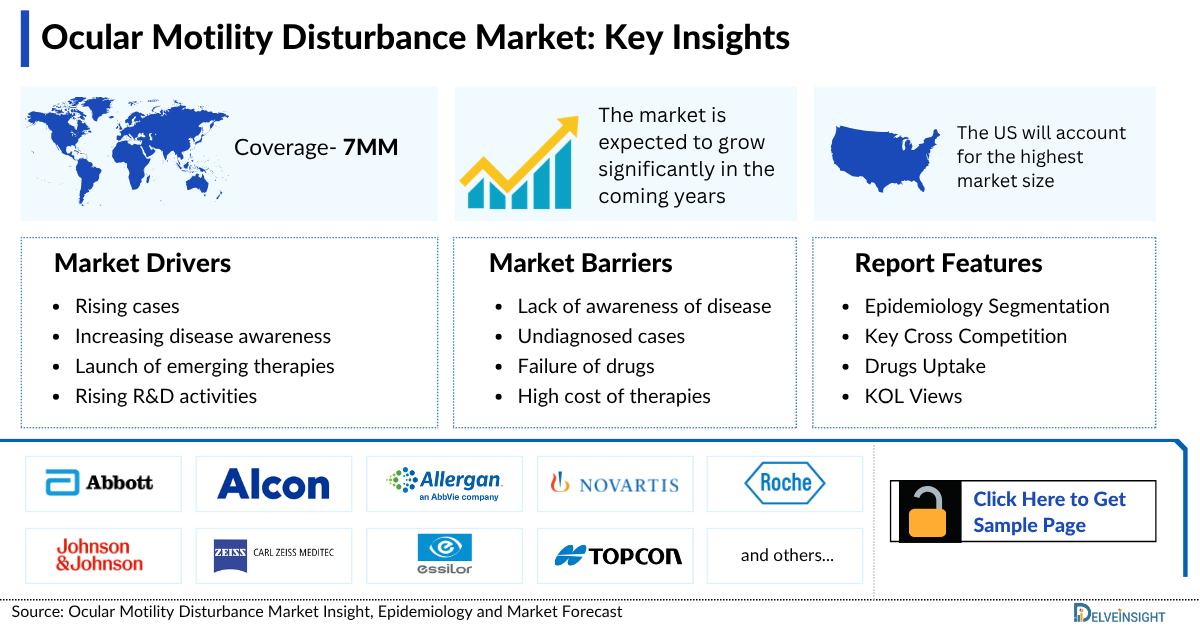
Request a sample to unlock the CAGR for "Ocular Motility Disturbance Market Forecast"
Key Factors Driving The Ocular Motility Disturbance Market:
- Rising prevalence of neurological and ophthalmic disorders: Conditions such as stroke, Parkinson’s disease, multiple sclerosis, thyroid eye disease, and myasthenia gravis are increasing the patient pool requiring diagnosis and treatment for ocular motility issues.
- Growing aging population: Higher incidence of age-related eye movement disorders, including diplopia and nerve palsies, is contributing to sustained market demand.
- Advancements in diagnostic imaging and eye-tracking technologies: Innovations such as infrared oculography, digital strabismus assessment tools, and AI-assisted vision diagnostics are improving detection accuracy and clinical adoption.
- Increasing awareness and early intervention practices: Greater recognition of ocular motility disorders by neurologists, ophthalmologists, and pediatric specialists is driving timely diagnosis and expanding treatment utilization.
- Expanding therapeutic pipeline and device innovation: Development of targeted therapies, botulinum toxin applications, corrective prism lenses, and surgical advancements are boosting the market landscape.
DelveInsight's "Ocular Motility Disturbance Market Insights, Epidemiology, and Market Forecast-2036" report delivers an in-depth understanding of the Ocular Motility Disturbance, historical and forecasted epidemiology as well as the Ocular Motility Disturbance therapeutics market trends in the United States, EU5 (Germany, Spain, Italy, France, and United Kingdom) and Japan.
The Ocular Motility Disturbance market report provides current treatment practices, emerging drugs, Ocular Motility Disturbance market share of the individual therapies, current and forecasted Ocular Motility Disturbance market Size from 2022 to 2036 segmented by seven major markets. The Report also covers current Ocular Motility Disturbance treatment practice/algorithm, market drivers, market barriers and unmet medical needs to curate the best of the opportunities and assesses the underlying potential of the Ocular Motility Disturbance market.
|
Study Period |
2022 to 2036 |
|
Forecast Period |
2026-2036 |
|
Geographies Covered |
|
|
Ocular Motility Disturbance Market |
|
|
Ocular Motility Disturbances Market Size | |
|
Ocular Motility Disturbance Companies |
Abbott Laboratories, Alcon Vision LLC, AbbVie Inc. (via Allergan), Novartis AG, Roche Holding AG, Johnson & Johnson, Carl Zeiss Meditec AG, Essilor International S.A., Topcon Corporation, Nidek Co., Ltd., and others |
|
Ocular Motility Disturbance Epidemiology Segmentation |
|
Ocular Motility Disturbance Disease Understanding
Ocular motility disturbance refers to abnormalities in the movement, coordination, or alignment of the eyes, resulting from dysfunction of the extraocular muscles, cranial nerves, brainstem, cerebellum, or other neurological pathways that control eye movements. Common manifestations include strabismus, diplopia (double vision), nystagmus, impaired gaze, and difficulty with smooth pursuit or saccadic movements. These disturbances may be congenital or acquired and can be associated with conditions such as cranial nerve palsies, thyroid eye disease, myasthenia gravis, stroke, traumatic brain injury, multiple sclerosis, and other neurological or orbital disorders. Symptoms can interfere with reading, depth perception, balance, driving, and other daily activities.
Ocular Motility Disturbance Diagnosis
Diagnosis of ocular motility disturbances involves a comprehensive ophthalmic and neurological assessment to determine the type, severity, and underlying cause of abnormal eye movements. Clinicians typically evaluate ocular alignment, extraocular muscle function, binocular vision, visual acuity, pupil responses, and eye movements in different directions of gaze. Tests such as cover and uncover testing, prism measurements, Hess or Lancaster testing, and assessments of saccades and smooth pursuit may be used to characterize the disturbance. Depending on the suspected cause, additional investigations—including blood tests, orbital imaging, CT or MRI scans, and neurological examinations—may be performed to identify structural, muscular, vascular, or neurological abnormalities.
Ocular Motility Disturbance Treatment
Treatment of ocular motility disturbances depends on the underlying etiology, severity of symptoms, and degree of functional impairment. Management may include observation for transient conditions, corrective eyeglasses or prism lenses to reduce diplopia, and treatment of underlying diseases such as thyroid eye disease, myasthenia gravis, or neurological disorders. In selected patients, botulinum toxin injections may be used to temporarily alter extraocular muscle activity, while strabismus surgery can reposition or adjust extraocular muscles to improve ocular alignment. Vision therapy or targeted eye-movement exercises may also be considered in specific conditions. The growing use of specialized diagnostic technologies and advances in surgical and nonsurgical interventions continue to support more individualized management of ocular motility disorders.
Ocular Motility Disturbance Epidemiology
The Ocular Motility Disturbance epidemiology section provides insights about the historical and current Ocular Motility Disturbance patient pool and forecasted trends for individual seven major countries. It helps to recognize the causes of current and forecasted trends by exploring numerous studies and views of key opinion leaders. This part of the Ocular Motility Disturbance market report also provides the diagnosed patient pool and their trends along with assumptions undertaken.
Key Findings
The disease epidemiology covered in the report provides historical as well as forecasted Ocular Motility Disturbance epidemiology scenario in the 7MM covering the United States, EU5 countries (Germany, Spain, Italy, France, and the United Kingdom), and Japan from 2022 to 2036.
Ocular Motility Disturbance Drug Chapters
The drug chapter segment of the Ocular Motility Disturbance report encloses the detailed analysis of Ocular Motility Disturbance marketed drugs and late-stage (Phase-III and Phase-II) Ocular Motility Disturbance pipeline drugs. It also helps to understand the Ocular Motility Disturbance clinical trial details, expressive pharmacological action, agreements and collaborations, approval and patent details, advantages and disadvantages of each included drug and the latest news and press releases.
Ocular Motility Disturbance Emerging Drugs
Botulinum Toxin Type A
Botulinum toxin A is the most clinically established pharmacological approach relevant to ocular motility disorders. It produces temporary chemodenervation of injected extraocular muscles by inhibiting acetylcholine release, thereby weakening the targeted muscle and potentially improving ocular alignment. Its use is being further evaluated as an alternative or adjunct to strabismus surgery, particularly in selected pediatric and adult patients. A U.S.-registered Phase III trial, ETS4 (NCT07470164), is planned to compare botulinum toxin A with bilateral medial rectus recession in patients with esotropia greater than 10 and up to 30 prism diopters; the study is estimated to begin in January 2027 and enroll 244 participants.
Key Developments in the Ocular Motility Disturbance Market
- In September 2026, Sling Therapeutics raised $123 million to advance its late-stage clinical program for an oral therapy for thyroid eye disease. TED can cause orbital inflammation, eye bulging, and double vision (diplopia), making it relevant to ocular motility disturbances.
- In June 2026, the U.S. FDA approved Lumvoa (teprotumumab-like IGF-1R-targeted therapy) from Viridian Therapeutics for TED.
Ocular Motility Disturbance Market Outlook
The Ocular Motility Disturbance market outlook of the report helps to build a detailed comprehension of the historic, current, and forecasted Ocular Motility Disturbance market trends by analyzing the impact of current Ocular Motility Disturbance therapies on the market, unmet needs, drivers and barriers, and demand for better technology.
This segment gives a thorough detail of Ocular Motility Disturbance market trend of each marketed drug and late-stage pipeline therapy by evaluating their impact based on the annual cost of therapy, inclusion and exclusion criteria's, mechanism of action, compliance rate, growing need of the market, increasing patient pool, covered patient segment, expected launch year, competition with other therapies, brand value, their impact on the market and view of the key opinion leaders. The calculated Ocular Motility Disturbance market data are presented with relevant tables and graphs to give a clear view of the market at first sight.
According to DelveInsight, the Ocular Motility Disturbance market in 7MM is expected to witness a major change in the study period 2022-2036.
Ocular Motility Disturbance Drugs Uptake
This section focuses on the rate of uptake of the potential Ocular Motility Disturbance drugs recently launched in the Ocular Motility Disturbance market or expected to get launched in the market during the study period 2022-2036. The analysis covers Ocular Motility Disturbance market uptake by drugs; patient uptake by therapies; and sales of each drug.
Ocular Motility Disturbance Drugs Uptake helps in understanding the drugs with the most rapid uptake, reasons behind the maximal use of new drugs, and allow the comparison of the drugs on the basis of Ocular Motility Disturbance market share and size which again will be useful in investigating factors important in market uptake and in making financial and regulatory decisions.
Ocular Motility Disturbance Pipeline Development Activities
The Ocular Motility Disturbance pipeline report provides insights into different Ocular Motility Disturbance clinical trials within Phase II, and Phase III stage. It also analyses Ocular Motility Disturbance key players involved in developing targeted therapeutics.
Ocular Motility Disturbance Pipeline Development Activities
The Ocular Motility Disturbance clinical trials analysis report covers the detailed information of collaborations, acquisition, and merger, licensing, patent details, and other information for Ocular Motility Disturbance emerging therapies.
Reimbursement Scenario in Ocular Motility Disturbance
Approaching reimbursement proactively can have a positive impact both during the late stages of product development and well after product launch. In a report, we take reimbursement into consideration to identify economically attractive indications and market opportunities. When working with finite resources, the ability to select the markets with the fewest reimbursement barriers can be a critical business and price strategy.
KOL- Views on the Ocular Motility Disturbance Report
To keep up with current Ocular Motility Disturbance market trends, we take KOLs and SMEs ' opinion working in the Ocular Motility Disturbance domain through primary research to fill the data gaps and validate our secondary research. Their opinion helps to understand and validate current and emerging therapies treatment patterns or Ocular Motility Disturbance market trends. This will support the clients in potential upcoming novel treatment by identifying the overall scenario of the market and the unmet needs.
Ocular Motility Disturbance Competitive Intelligence Analysis
We perform Competitive and Market Intelligence analysis of the Ocular Motility Disturbance Market by using various Competitive Intelligence tools that include - SWOT analysis, PESTLE analysis, Porter's five forces, BCG Matrix, Market entry strategies etc. The inclusion of the analysis entirely depends upon the data availability.
Scope of the Ocular Motility Disturbance Market Report
- The Ocular Motility Disturbance Therapeutics Market Report covers a segment of key events, an executive summary, a descriptive overview, explaining their causes, signs and symptoms, pathogenesis, and currently available treatments.
- Comprehensive insight has been provided into the epidemiology segments and forecasts, the future growth potential of the diagnosis rate, and disease progression along Ocular Motility Disturbance Treatment guidelines.
- Additionally, an all-inclusive account of both the current and emerging treatments, along with the elaborative profiles of late-stage and prominent therapies, will have an impact on the current Ocular Motility Disturbance Treatment landscape.
- A detailed review of the Ocular Motility Disturbance Therapeutics Market, historical and forecasted Ocular Motility Disturbance Treatment Market Size, Ocular Motility Disturbance Drugs Market Share by therapies, detailed assumptions, and rationale behind our approach is included in the report, covering the 7MM drug outreach.
- The Ocular Motility Disturbance Therapeutics Market Report provides an edge while developing business strategies by understanding trends through SWOT analysis and expert insights/KOL views, patient journey, and treatment preferences that help in shaping and driving the 7MM Ocular Motility Disturbance Drugs Market.
Ocular Motility Disturbance Market Report Insights
- Ocular Motility Disturbance Patient Population Forecast
- Ocular Motility Disturbance Therapeutics Market Size
- Ocular Motility Disturbance Pipeline Drugs Analysis
- Ocular Motility Disturbance Market Size and Trends
- Ocular Motility Disturbance Therapeutics Market Opportunity (Current and Forecasted)
Ocular Motility Disturbance Market Report Key Strengths
- Epidemiology-based (Epi-based) Bottom-up Forecasting
- Artificial Intelligence (AI) - enabled Market Research Report
- 11-year forecast
- Ocular Motility Disturbance Market Outlook (North America, Europe, Asia-Pacific)
- Patient Burden Trends (by geography)
- Ocular Motility Disturbance Treatment Addressable Market (TAM)
- Ocular Motility Disturbance Competitive Landscape
- Ocular Motility Disturbance Major Companies Insights
- Ocular Motility Disturbance Price Trends and Analogue Assessment
- Ocular Motility Disturbance Therapies Drug Adoption/Uptake
- Ocular Motility Disturbance Therapies Peak Patient Share Analysis
Ocular Motility Disturbance Market Report Assessment
- Ocular Motility Disturbance Current Treatment Practices
- Ocular Motility Disturbance Unmet Needs
- Ocular Motility Disturbance Clinical Development Analysis
- Ocular Motility Disturbance Emerging Drugs Product Profiles
- Ocular Motility Disturbance Market Attractiveness
- Ocular Motility Disturbance Qualitative Analysis (SWOT and Attribute analysis)
Key Questions Answered in the Ocular Motility Disturbance Treatment Market Report
Ocular Motility Disturbance Therapeutics Market Insights
- What was the Ocular Motility Disturbance Treatment Market Size, the Ocular Motility Disturbance Market Size by therapies, Ocular Motility Disturbance Drugs Market Share (%) distribution in 2025, and what would it look like by 2036? What are the contributing factors for this growth?
- What are the anticipated pricing variations among different geographies for the emerging therapies in the future?
- What can be the future treatment paradigm of Ocular Motility Disturbance?
- What are the disease risks, burdens, and unmet needs of Ocular Motility Disturbance?
- What will be the growth opportunities across the 7MM concerning the patient population with Ocular Motility Disturbance?
- Who is the major future competitor in the market, and how will the competitors affect their market share?
- What are the current options for the treatment of Ocular Motility Disturbance? What are the current guidelines for treating Ocular Motility Disturbance in the US, Europe, and Japan?
Reasons to Buy the Ocular Motility Disturbance Therapeutics Market Report
- The Ocular Motility Disturbance Therapeutics Market Report will help in developing business strategies by understanding the latest trends and changing treatment dynamics driving the Ocular Motility Disturbance Drugs Market.
- Bottom up forecasting builds from the affected population to product forecasts, delivering a robust, data driven approach ideal for new therapies and novel classes.
- Insights on patient burden/disease Ocular Motility Disturbance Prevalence, evolution in diagnosis, and factors contributing to the change in the epidemiology of the disease during the forecast years.
- Understand the existing Ocular Motility Disturbance Drugs Market opportunities in varying geographies and the growth potential over the coming years.
- Identifying strong upcoming players in the Ocular Motility Disturbance Drugs Market will help devise strategies to help get ahead of competitors.
- Detailed analysis, ranking of class-wise potential current, and emerging therapies under the attribute analysis section to provide visibility around leading classes.
- To understand KOLs’ perspectives on the accessibility, acceptability, and compliance-related challenges of existing treatment to overcome barriers in the future.
- Detailed insights on the unmet needs of the existing Ocular Motility Disturbance Drugs Market so that the upcoming players can strengthen their development and launch strategy.
- This Artificial Intelligence (AI) enabled report summarize and simplify complex datasets with in the report into clear, actionable insights for stakeholders, investors, and healthcare providers, enabling faster, data driven decisions.

