
Oligometastatic Disease Market
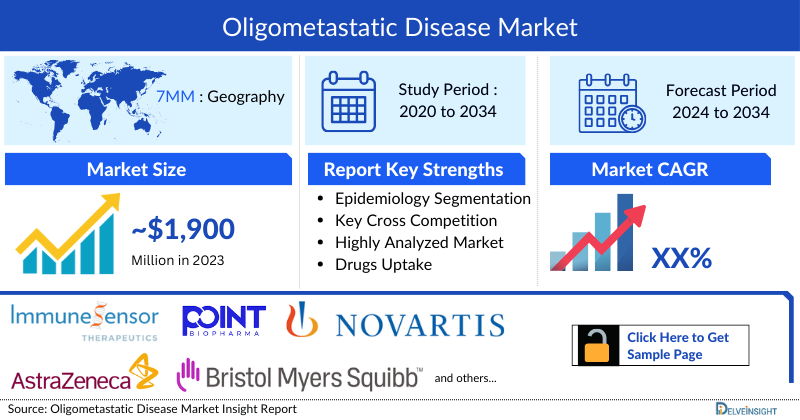
- According to DelveInsight’s patient-based forecasting model, the oligometastatic disease market size in the 7MM was around USD 1,900 million in 2023, which is expected to significantly increase over the forecast period (2024-2034), owing to an increase in the cases and the launch of new therapies.
- The oligometastatic disease refers to a transitional state between localized and widespread disease. It typically involves one to five distant sites beyond the primary tumor.
- In 2023, the United States accounted for the highest number of oligometastatic disease cases with approximately 40% cases found in the 7MM.
- Major types of oligometastatic cancers include oligometastatic breast cancer, oligometastatic prostate cancer, oligometastatic prostate cancer, oligometastatic colorectal cancer, oligometastatic renal cell cancer, oligometastatic non-small cell lung cancer.
- There were around 30,000 cases of oligorecurrent cases in the United States in 2023 and the highest number of oligorecurrent cases were observed in non-small cell lung cancer.
- The key Oligometastatic Disease companies in the market who are in different phases of developing Oligometastatic Disease Therapies are - ImmuneSensor Therapeutics, POINT Biopharma, Novartis Pharmaceuticals, AstraZeneca PLC, Bristol-Myers Squibb Company, and others.
- The accurate diagnosis of the oligometastatic disease relies on advanced imaging techniques, such as positron emission tomography-computed tomography (PET-CT) and magnetic resonance imaging (MRI), to identify and localize metastatic lesions.
- Oligometastatic prostate cancer is treated with systemic therapies, like radiation therapy or hormone therapy. Using radiation therapy gives patients a much longer break from hormone therapy.
- Oligometastatic non-small cell lung cancer patients often see long-term benefits from using radiation therapy or surgery after some immunotherapy or chemotherapy.
- Oligometastatic kidney cancer can be treated with stereotactic body radiation (SBRT) and other forms of radiation.
- Oligometastatic colorectal cancer occurs when colorectal cancer spreads to other sites in the body. If oligometastatic colorectal cancer is limited to the liver, it is treated most effectively with SBRT, radiofrequency ablation, and surgery.
- Currently, there are no approved drugs for the treatment of oligometastatic disease. Few oligometastatic disease therapies are being investigated for the treatment of oligometastatic disease. Some of the key players involved in the development are ImmuneSensor Therapeutics (IMSA101), POINT Biopharma (PNT2002), and Novartis Pharmaceuticals (PLUVICTO).
- Understanding the long-term outcomes and survival of patients with oligometastatic disease is currently limited. Longitudinal studies are needed to assess the durability of local treatment responses, evaluate patterns of disease recurrence, and identify prognostic factors that influence survival and quality of life. Additionally, studies focusing on survivorship and the late effects of treatment will help optimize post-treatment care and support strategies for the patient.
Request for sample page to Unlock Oligometastatic Disease CAGR @ Oligometastatic Disease Treatment Market Report
Oligometastatic Disease Market Report Summary
- The oligometastatic disease market report offers extensive knowledge regarding the epidemiology segments and predictions, presenting a deep understanding of the potential future growth in diagnosis rates, disease progression, and treatment guidelines. It provides comprehensive insights into these aspects, enabling a thorough assessment of the subject matter.
- Additionally, an all-inclusive account of the current management techniques and emerging therapies and the elaborative profiles of late-stage (Phase II) and prominent therapies that would impact the current treatment landscape and result in an overall market shift has been provided in the report.
- The report also encompasses a comprehensive analysis of the oligometastatic disease market, providing an in-depth examination of its historical and projected market size (2020–2034). It also includes the market share of therapies, detailed assumptions, and the underlying rationale for our methodology. The report also includes drug outreach coverage in the 7MM region.
- The oligometastatic disease market report includes qualitative insights that provide an edge while developing business strategies, by understanding trends, through SWOT analysis and expert insights/KOL views, including experts from various hospitals and prominent universities, patient journey, and treatment preferences that help shape and drive the 7MM oligometastatic disease market.
The table given below further depicts the key segments provided in the report:
|
Study Period |
2020–2034 |
|
Forecast Period |
2024–2034 |
|
Geographies Covered |
US, EU4 (Germany, France, Italy, and Spain) and the UK, and Japan |
|
Oligometastatic disease Epidemiology |
Segmented by:
|
|
Oligometastatic disease Market |
Segmented by:
|
|
Oligometastatic disease Market Analysis |
|
Oligometastatic Disease Treatment Market
Oligometastatic Disease Overview
Oligometastatic disease is a type of metastasis in which cancer cells from the primary tumor spread throughout the body and create a few metastatic tumors in one or two additional locations. For instance, cancer cells can migrate from the colon to the liver or from the breast to develop one or two new tumors in the brain.
The oligometastatic disease is characterized by limited metastatic spread, typically involving one to five distant sites beyond the primary tumor.The concept challenges the traditional view of cancer as a uniformly progressive and systemic disease, suggesting that some patients may benefit from aggressive local treatment to control or eradicate metastatic lesions.
Oligometastatic Disease Diagnosis
To identify oligometastatic patients accurately, using modern imaging techniques, such as PET and brain MRI, is essential to detect the presence of occult metastases that are not visible with conventional imaging techniques. MRI is superior to CT in detecting brain metastases, often detecting lesions not visible on CT. PET/CT imaging is associated with better survival outcomes because metastases detected with PET/CT, which are not visible on standard CT, result in stage migration. These more advanced imaging tests can detect occult metastases in patients initially considered oligometastatic, thus preventing the application of aggressive local therapy in patients unlikely to benefit from treatment.
Further details related to country-based variations are provided in the report…
Oligometastatic Disease Market Treatment
There has been growing evidence, suggesting that patients with few and slowly progressive distant lesions of small size may benefit from various local ablation techniques. These techniques have already been established as standard-of-care modalities in some cancers like non-small-cell lung cancer, colorectal cancer, renal cell carcinomas, and sarcomas.
Surgical resection has been the method of choice; however, recent studies have helped establish stereotactic (ablative) body radiotherapy (SABR/SBRT) as a viable, non-invasive treatment option for many patients.
Although these local interventions have been proven to be highly effective, several other clinical variables are needed to be taken into account, including patient-related factors (general health status, patient preferences, and socioeconomic background) and disease-related factors (primary tumor site, growth kinetics, synchronous, or metachronous metastases) before allocating such intervention to any patient.
Further details related to treatment and management are provided in the report…
Oligometastatic Disease Epidemiology
The Oligometastatic Disease epidemiology chapter in the report provides historical as well as forecasted epidemiology segmented by Total Oligometastatic Disease Cases, Oligometastatic Disease Cases by Major Cancer Indications, Type-Specific Cases of Oligometastatic Disease, Total Oligorecurrent Cases, and Oligorecurrent Cases by Major Cancer Indications in the United States, EU4 (Germany, France, Italy, Spain) and the United Kingdom, and Japan from 2020 to 2034.
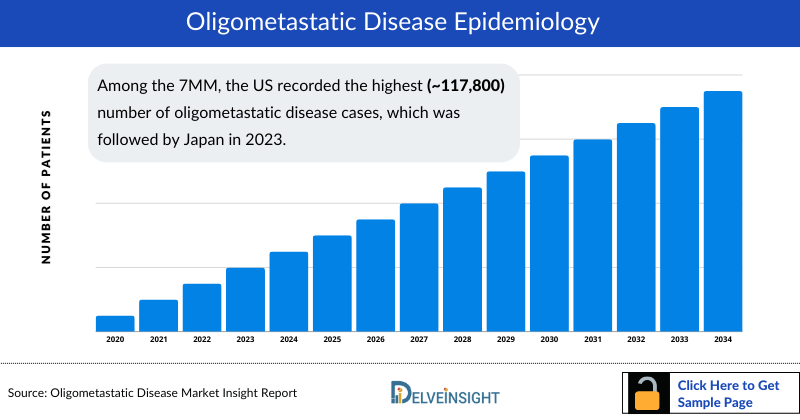
- Among the 7MM, the US recorded the highest (~117,800) number of oligometastatic disease cases, which was followed by Japan in 2023.
- The major cancer types in which oligometastasis is observed includes breast cancer, non-small cell lung cancer, hormone naive prostate cancer, castration resistant prostate cancer, head and neck cancer, colorectal cancer, pancreatic cancer, renal cell cancer. In 2023, highest number of oligometastasis were observed in non-small cell lung cancer in United States.
- As per DelveInsight’s analysis, in 2023, there were approximately 70% cases of metachronous oligometastatic disease, which was followed by synchronous oligometastatic disease in the US.
- Among EU4 and UK, Germany accounted for the highest number of cases in 2023, followed by the UK and France, respectively.
Further details related to epidemiology will be provided in the report…
Oligometastatic Disease Market
Various key players are leading the treatment landscape of oligometastatic disease, such as Eli Lilly and Company/ POINT Biopharma, ImmuneSensor Therapeutics, and Novartis Pharmaceuticals. The details of the country-wise and therapy-wise market size have been provided below.
- In 2023, the United States accounted for the largest Oligometastatic disease market size among the 7MM, making ~50% of the total Oligometastatic disease market size of the 7MM.
- There are limited number of Oligometastatic disease therapies in pipeline which may get launched during the forecast period and hence, currently available systemic therapies are expected to maintain dominant position by 2034.
- ImmuneSensor Therapeutics’ IMSA101 is expected to capture a significant Oligometastatic disease market size of oligometastatic disease during the forecast period.
- Among EU4 and the UK, Germany is anticipated to cover the largest Oligometastatic disease market size, while the smallest Oligometastatic disease market size is expected to be covered by Spain.
Oligometastatic Disease Drug Chapters
The Oligometastatic Disease drug section report provides an in-depth evaluation of mid-stage pipeline drugs (Phase II) related to oligometastatic disease drug market.
The Oligometastatic Disease drug chapters section provides valuable information on various aspects related to Oligometastatic Disease clinical trials of disease, such as the pharmacological mechanisms of the drugs involved, designations, approval status, patent information, and a comprehensive analysis of the pros and cons associated with each drug. Furthermore, it presents the most recent news updates and press releases on drugs targeting oligometastatic disease.
Emerging Oligometastatic Disease Therapies
IMSA101: ImmuneSensor Therapeutics
IMSA101 is an intra-tumoral adminsitred, novel small molecule analog of cyclic guanosine monophosphate–adenosine monophosphate (cGAMP), designed with a unique defense-sensing mechanism that increases antitumor immunity to ultimately stimulate cytokines to turn “cold” tumors to “hot,” IMSA101 holds first-in-class potential for treating solid tumors. It is currently being investigated in Phase II clinical trial for the treatment of oligometastatic disease.
PNT2002 (177Lu-PNT2002): POINT Biopharma/Eli Lilly and Company
177Lu-PNT2002 is a prostate-specific membrane antigen (PSMA)-targeted lutetium 177-based radioligand therapy. It is currently being investigated under a Phase II trial to test whether 177-Lutetium-PSMA given before stereotactic body radiotherapy (SBRT) works to improve cancer control rate in patients with 1-5 prostate cancer tumors that have come back after prior treatment (oligorecurrent).
Note: Detailed assessment will be provided in the final report of Oligometastatic Disease…
Know more in detail about the drugs and therapies @ Oligometastatic disease Clinical Trials
Oligometastatic Disease Market Outlook
No drug-based treatments are available for oligometastatic disease, with the current treatment paradigm being reliant on locally-ablative treatments like radiotherapy and surgery, which have shown noticeable benefits in retrospective and small-scale studies. Several Phase II trials have shown that definitive local therapy in the form of stereotactic body radiotherapy (SBRT) or surgery in combination with standard-of-care (SoC) systemic therapy can benefit selected oligometastatic patients by prolonging progression-free survival (PFS) or overall survival (OS).
In the absence of data from Phase III oligometastatic disease clinical trials, the foundation of contemporary cancer care continues to be interdisciplinary discussion and decision-making in the form of multidisciplinary tumor boards, which make case-by-case recommendations based on the latest research and best practices. It has been demonstrated that routine use of multidisciplinary tumor boards for cancer patients improves clinical outcomes, increases adherence to SoC, and results in more well-rounded treatment recommendations.
The key Oligometastatic Disease companies in the market who are in different phases of developing Oligometastatic Disease Therapies are - ImmuneSensor Therapeutics, POINT Biopharma, Novartis Pharmaceuticals, AstraZeneca PLC, Bristol-Myers Squibb Company, and others.
The oligometastatic disease pipeline possesses few drugs that are expected to be launched during the forecast period (2024–2034). Both of the emerging oligometastatic disease therapies, IMSA101 (ImmuneSensor Therapeutics) and PNT2002 (POINT Biopharma) are in Phase II clinical stage.
KOL Views
To stay abreast of the latest trends in the oligometastatic disease market, we conduct primary research by seeking the opinions of Key Opinion Leaders (KOLs) and Subject Matter Experts (SMEs) who work in the relevant field. This helps us fill any gaps in data and validate our secondary research.
We have reached out to industry experts to gather insights on various aspects of oligometastatic disease, including the evolving treatment landscape, patients’ reliance on conventional therapies, their acceptance of therapy switching, drug uptake, and challenges related to accessibility. The experts we contacted included medical/scientific writers, professors, and researchers from prestigious universities in the US, Europe, the UK, and Japan.
Our team of analysts at Delveinsight connected with more than 10 KOLs across the 7MM. We contacted institutions such as the Dana Farber Cancer Institute, Royal Marsden Hospital, Kitasato University School of Medicine, etc., among others. By obtaining the opinions of these experts, we gained a better understanding of the current and emerging treatment patterns in the oligometastatic disease market, which will assist our clients in analyzing the overall epidemiology and market scenario.
|
Product |
Company |
RoA |
MoA |
|
IMSA101 |
ImmuneSensor Therapeutics |
Intratumoral |
STING agonist |
|
PNT2002 (177Lu-PNT2002 |
POINT Biopharma |
Intravenous |
PSMA-Targeted therapy |
The opinion of experts from various regions has been provided below:
Oligometastatic Disease Qualitative Analysis
We perform Qualitative and Market Intelligence analysis using various approaches, such as SWOT analysis and Conjoint Analysis. In the SWOT analysis, strengths, weaknesses, opportunities, and threats in terms of disease diagnosis, patient awareness, patient burden, competitive landscape, cost-effectiveness, and geographical accessibility of therapies are provided. These pointers are based on the Analyst’s discretion and assessment of the patient burden, cost analysis, and existing and evolving treatment landscape.
Conjoint Analysis analyzes multiple approved and emerging oligometastatic disease therapies based on relevant attributes such as safety, efficacy, frequency of administration, designation, route of administration, and order of entry. Scoring is given based on these parameters to analyze the effectiveness of therapy.
In efficacy, the trial’s primary and secondary outcome measures are evaluated; for instance, in trials for oligometastatic disease, one of the most important primary endpoints was progression-free rate. Based on this, the overall efficacy is evaluated.
Further, the therapies’ safety is evaluated wherein the acceptability, tolerability, and adverse events are majorly observed, and it sets a clear understanding of the side effects posed by the oligometastatic disease drug in clinical trials. In addition, the scoring is also based on the route of administration, order of entry and designation, probability of success, and the addressable patient pool for each therapy. According to these parameters, the final weightage score and the ranking of the emerging oligometastatic disease therapies are decided.
Oligometastatic Disease Market Access and Reimbursement
Because newly authorized oligometastatic disease drugs are often expensive, some patients escape receiving proper treatment or use off-label, less expensive prescriptions. Reimbursement plays a critical role in how innovative treatments can enter the oligometastatic disease market. The cost of the medicine, compared to the benefit it provides to patients who are being treated, sometimes determines whether or not it will be reimbursed. Regulatory status, target population size, the setting of treatment, unmet needs, the number of incremental benefit claims, and prices can all affect market access and reimbursement possibilities.
The Oligometastatic disease market report further provides detailed insights on the country-wise accessibility and reimbursement scenarios, cost-effectiveness scenario of approved therapies, programs making accessibility easier and out-of-pocket costs more affordable, insights on patients insured under federal or state government prescription drug programs, etc.
Oligometastatic Disease Market Report Insights
- Oligometastatic disease Patient Population
- Oligometastatic disease Therapeutic Approaches
- Oligometastatic Disease Market Size
- Oligometastatic disease Market Trends
- Existing Oligometastatic disease Market Opportunity
Oligometastatic Disease Treatment Market Report Key Strengths
- Eleven-year Forecast
- The 7MM Coverage
- Oligometastatic Disease Epidemiology Segmentation
- Key Cross Competition
Oligometastatic Disease Market Report Assessment
- Current Treatment Practices
- Oligometastatic disease Reimbursements
- Oligometastatic disease Market Attractiveness
- Qualitative Analysis (SWOT, Conjoint Analysis)
Key Questions
- Would there be any changes observed in the treatment approach for oligometastatic disease over the forecast period?
- Will there be any new drug included in oligometastatic disease management recommendations?
- Would research and development advancements pave the way for future tests and therapies for oligometastatic disease?
- Would the diagnostic testing space change significantly and lead to a positive shift in the treatment landscape of oligometastatic disease?
- What kind of uptake will the new therapies witness in coming years in oligometastatic disease patients?