Ophthalmic Surgical Devices Market Summary
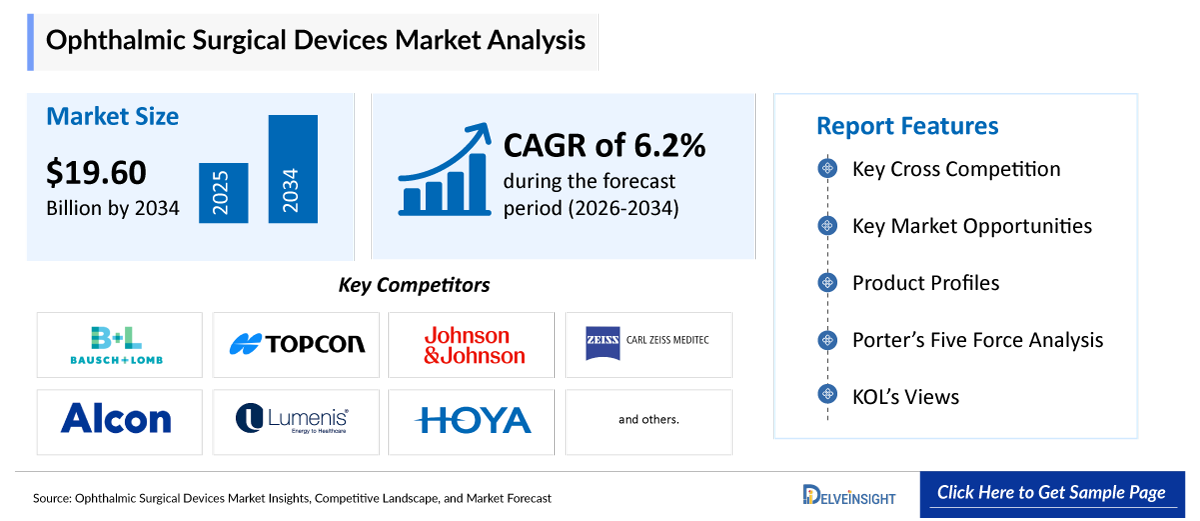
● The Ophthalmic Surgical Devices market is estimated at USD 11.40 billion in 2025 and is projected to reach USD 19.60 billion by 2034. Growth is anchored in the rising global prevalence of cataract, glaucoma, and retinal disorders, an aging population, expanding cataract surgical volumes, and continuous technological advancement in phacoemulsification, femtosecond laser, and robotic-assisted surgical platforms.
● The global Ophthalmic Surgical Devices market is growing at a CAGR of 6.2% during the forecast period from 2026 to 2034.
● By device type, the ophthalmic surgical implants segment dominated the Ophthalmic Surgical Devices market with a 38% share in 2025.
● By surgical procedure, the cataract surgery segment dominated the Ophthalmic Surgical Devices market with a 42% share in 2025.
● By technology, the ultrasound-based devices segment dominated the Ophthalmic Surgical Devices market with a 36% share in 2025.
● By end-users, the hospitals segment dominated the Ophthalmic Surgical Devices market with a 54% share in 2025.
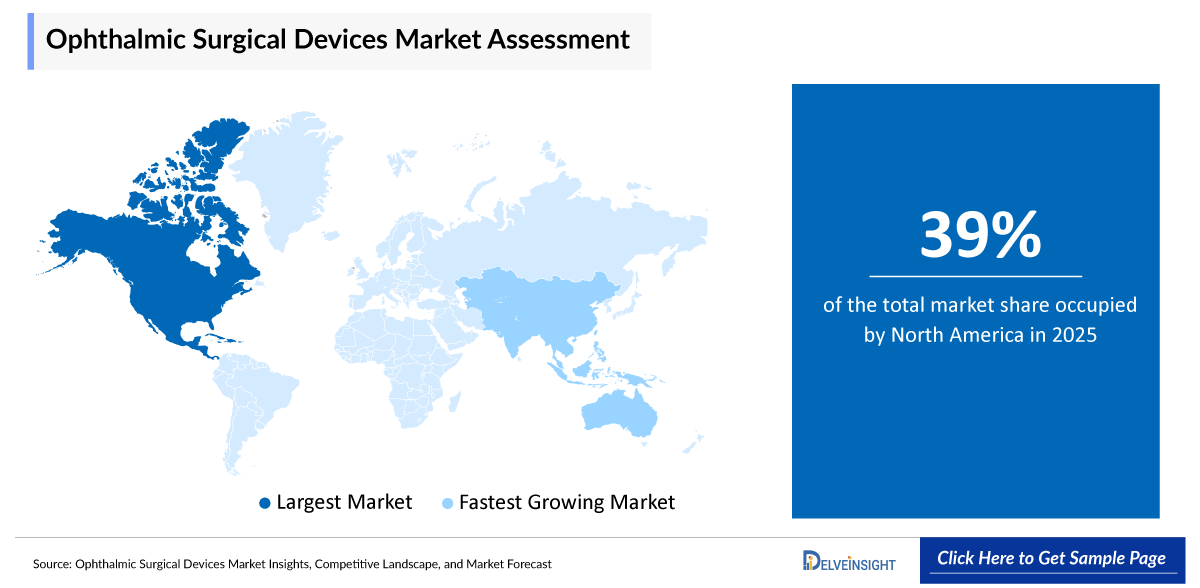
● North America dominated the global Ophthalmic Surgical Devices market revenue with a 39% share in 2025, representing the highest regional market share globally.
An ophthalmic surgical device is an instrument, system, implant, or accessory used by ophthalmic surgeons to diagnose intraoperatively, correct, or treat structural and functional disorders of the eye, spanning cataract, glaucoma, retinal and vitreous, corneal, and refractive conditions. Because most of these conditions are progressive and irreversible if untreated, and because eye surgery volumes rise steeply with age, hospitals, ambulatory surgical centers, and specialty eye clinics rely on a broad ecosystem of ophthalmic surgical systems, instruments, implants, visualization systems, and consumables to deliver safe, reproducible outcomes. The market is organized by device type across ophthalmic surgical systems (phacoemulsification, vitrectomy, and laser platforms), ophthalmic surgical instruments, ophthalmic surgical implants (led by intraocular lenses), ophthalmic visualization systems, and surgical accessories and consumables; by surgical procedure across cataract, glaucoma, retinal and vitreous, corneal, and refractive surgery; by technology across laser-based, ultrasound-based, microincisional, conventional, and computer-assisted or robotic-assisted devices; and by end-user, led by hospitals. Driven by rising cataract and glaucoma prevalence, an aging global population, the shift of procedures to ambulatory surgical centers, and rapid adoption of femtosecond laser-assisted and robotic-assisted surgical platforms, ophthalmic surgical devices have become essential infrastructure underpinning the global restoration and preservation of sight.
Ophthalmic Surgical Devices Market Key Growth Drivers
• The rising global burden of cataract and other age-related eye disorders is driving demand, with an estimated 28 million cataract surgeries performed annually worldwide and cataract remaining a leading cause of reversible blindness.
• Rapid adoption of premium, technologically advanced surgical platforms, including femtosecond laser-assisted cataract surgery, multifocal and extended depth-of-focus intraocular lenses, and robotic-assisted systems such as Alcon's UNITY platform and LENSAR's ALLY Robotic Cataract Laser Treatment System, is expanding average procedure value.
• The rising global prevalence of glaucoma, projected by public-health researchers to affect over 110 million people by 2040, is expanding demand for micro-invasive glaucoma surgery (MIGS) devices and glaucoma implants.
• The shift of cataract, refractive, and minor ophthalmic procedures toward ambulatory surgical centers is increasing procedure throughput and driving replacement demand for compact, high-efficiency surgical systems.
• Active strategic consolidation among device manufacturers, including Alcon's 2025 acquisitions of LENSAR, Aurion Biotech, and LumiThera, is broadening surgical portfolios and accelerating technology diffusion.
• Growing government and private investment in eye-care infrastructure across Asia-Pacific and other emerging markets is expanding surgical capacity and access to modern ophthalmic devices.
• The convergence of rising disease burden, technology adoption, outpatient migration, and industry consolidation is expected to sustain steady mid-single-digit-to-high-single-digit growth in the market through 2034.
Key Companies in Ophthalmic Surgical Devices Market
The competitive landscape is led by the following active manufacturers:
• Bausch & Lomb Incorporated
• Topcon Corporation
• Johnson & Johnson
• Carl Zeiss AG
• Alcon Inc.
• Lumenis Ltd.
• Hoya Corporation
• Ellex Medical Laser Ltd.
• STAAR Surgical Company
• Ziemer Ophthalmic Systems AG
Factors Contributing to the Growth of the Ophthalmic Surgical Devices Market
Market Drivers
Rising Global Burden of Cataract and Age-Related Eye Disorders
The most powerful driver of the Ophthalmic Surgical Devices market is the sheer scale of the global cataract burden. Cataract remains one of the leading causes of reversible blindness worldwide, affecting an estimated 94 million people, and an estimated 28 million cataract surgeries are performed each year globally, a volume that keeps rising as populations age. Every cataract procedure requires a phacoemulsification system, surgical instruments, an intraocular lens, and associated visualization and consumable products, giving cataract surgery outsized influence over overall device demand. Beyond cataract, the aging of the global population is increasing the incidence of glaucoma, retinal and vitreous disease, and corneal disorders, each of which requires dedicated surgical systems, implants, or instruments. As life expectancy rises and cataract surgical rates increase in underserved regions, demand for ophthalmic surgical devices expands directly, anchoring market growth through 2034.
Increasing Adoption of Premium and Technologically Advanced Surgical Platforms
A structural shift toward premium, technology-enabled surgery is expanding average device revenue per procedure. Femtosecond laser-assisted cataract surgery, multifocal and extended depth-of-focus intraocular lenses, and advanced phacoemulsification platforms with intraoperative aberrometry and thermal-management features are gaining adoption among surgeons seeking better refractive outcomes and shorter recovery times. Robotic-assisted and computer-guided platforms, including LENSAR's ALLY Robotic Cataract Laser Treatment System and Alcon's UNITY Vitreoretinal Cataract System, are extending automation into both anterior- and posterior-segment surgery. As patients increasingly seek premium refractive outcomes and reimbursement models evolve to support advanced technology fees, surgeons and surgical centers upgrade to next-generation systems, sustaining replacement and upgrade demand across the forecast period.
Market Restraints
Despite strong momentum, the Ophthalmic Surgical Devices market faces material constraints. The high capital cost of advanced phacoemulsification, femtosecond laser, and robotic-assisted platforms is a significant barrier, particularly for smaller surgical centers and providers in price-sensitive and emerging markets, and slows equipment upgrade cycles. Reimbursement for premium technologies, including femtosecond laser-assisted surgery and presbyopia-correcting intraocular lenses, remains inconsistent across geographies, limiting adoption to patients able to pay out of pocket for advanced-technology fees. A shortage of trained ophthalmic surgeons and support staff in many regions constrains surgical volume growth even where equipment is available. Stringent regulatory requirements for device approval and post-market surveillance lengthen product development timelines and raise compliance costs, while pricing pressure from group purchasing organizations and value-based procurement in mature markets compresses manufacturer margins. Together, these capital, reimbursement, workforce, and regulatory barriers temper the pace of growth, even as the underlying drivers of rising disease prevalence, technology adoption, and outpatient migration remain firmly intact.
Ophthalmic Surgical Devices Market Segment Analysis
The ophthalmic surgical devices market by device type (ophthalmic surgical systems [phacoemulsification systems, vitrectomy systems, ophthalmic laser systems, femtosecond laser systems, excimer laser systems], ophthalmic surgical instruments [forceps, scissors, speculums, cannulas and probes, others], ophthalmic surgical implants [intraocular lenses (iols), glaucoma implants, corneal implants, others], ophthalmic visualization systems [operating microscopes, ophthalmic visualization systems, wide-field visualization systems], and ophthalmic surgical accessories & consumables), surgical procedure (cataract surgery, glaucoma surgery, retinal & vitreous surgery, corneal surgery, refractive surgery, others), technology (laser-based devices, ultrasound-based devices, microincisional/micro-invasive devices, conventional surgical devices, computer-assisted/robotic-assisted devices, other), end-users (hospitals, ambulatory surgical centers, others), and geography (North America, Europe, Asia-Pacific, and Rest of World).
By Device Type
Dominant Subsegment: Ophthalmic Surgical Implants.
The ophthalmic surgical implants segment, led by intraocular lenses (IOLs), accounted for 38% of the Ophthalmic Surgical Devices market in 2025. Intraocular lenses are implanted in nearly every cataract procedure performed worldwide, and the segment's leadership reflects the sheer volume of cataract surgery combined with the rising mix of premium multifocal, extended depth-of-focus, and toric lenses that carry higher average selling prices than standard monofocal IOLs. Glaucoma implants and corneal implants add incremental scale as MIGS and corneal transplantation procedures expand. Ophthalmic surgical systems, particularly phacoemulsification and femtosecond laser platforms, represent the fastest-growing device type as surgeons upgrade to automated and laser-assisted capital equipment, and ophthalmic visualization systems and surgical accessories and consumables provide steady, recurring revenue tied to procedure volume. While capital equipment adoption is accelerating, the recurring, high-volume, premium-mix nature of intraocular lens implantation secures the ophthalmic surgical implants segment's leadership across the forecast period.
By Surgical Procedure
Dominant Subsegment: Cataract Surgery.
The cataract surgery segment accounted for 42% of the Ophthalmic Surgical Devices market in 2025. Cataract surgery is the leading surgical procedure because it is among the most frequently performed surgical procedures in medicine, with an estimated 28 million procedures conducted each year globally, and because each procedure requires a dedicated bundle of phacoemulsification systems, instruments, intraocular lenses, viscoelastic devices, and visualization equipment. The aging global population, rising cataract prevalence, and expanding surgical capacity in emerging markets continue to enlarge the treated patient pool. Retinal and vitreous surgery and glaucoma surgery are growing quickly as MIGS adoption expands and retinal disease prevalence rises with diabetes and age-related macular degeneration, while refractive and corneal surgery post steady growth from rising myopia prevalence and demand for vision-correction alternatives. Nonetheless, the sheer procedure volume and universal device requirement of cataract surgery secure its leadership across the forecast period.
Ophthalmic Surgical Devices Market Region Analysis
Dominant Region: North America
North America accounted for 39% of the global Ophthalmic Surgical Devices market revenue in 2025, representing the highest regional market share globally. The region's dominance reflects advanced healthcare infrastructure, favorable reimbursement for cataract and glaucoma surgery, high per-capita cataract surgical volumes, and the concentrated presence of leading device manufacturers including Alcon, Johnson & Johnson, and Bausch & Lomb, all of which are headquartered or maintain major operations in the United States. North America hosts the largest concentration of ambulatory surgical centers performing high-volume cataract and refractive procedures, and surgeons benefit from early access to premium technologies such as femtosecond laser-assisted cataract surgery and robotic-assisted platforms. Strong reimbursement for standard-of-care procedures, a well-established regulatory pathway through the FDA, and continued capital investment in next-generation surgical systems anchor the region's continued leadership across the forecast period.
Fastest Growing Region: Asia-Pacific
Asia-Pacific is the fastest-growing region in the Ophthalmic Surgical Devices market. The region's elevated CAGR is driven by rising cataract and glaucoma prevalence, rapid expansion of eye-care infrastructure, and growing healthcare investment across China, Japan, India, South Korea, and Australia. China is expanding its network of dedicated eye hospitals and cataract surgical capacity, India leverages high-volume, low-cost surgical models to address a large cataract-surgery backlog, and Japan is adopting premium femtosecond laser and advanced-technology intraocular lens platforms. Government blindness-prevention programs, expanding health insurance coverage, and rising disposable income are accelerating adoption of modern surgical devices, while international manufacturers scale regional distribution and local manufacturing partnerships. The combination of high disease burden, large underserved patient populations, and infrastructure build-out positions Asia-Pacific as the principal source of incremental growth over the forecast period.
Regional Commentary
North America
North America accounted for 39% of the global Ophthalmic Surgical Devices market revenue in 2025. The United States dominates on the strength of its advanced surgical infrastructure, favorable reimbursement, high cataract surgical volumes, and the concentrated presence of leading manufacturers, while continued expansion of ambulatory surgical centers and adoption of premium laser and robotic-assisted platforms reinforce its leadership.
Europe
Europe is a large and advanced regional market, supported by universal healthcare coverage, established regulatory frameworks under the EU Medical Device Regulation, and a strong base of ophthalmic device manufacturers including Carl Zeiss AG and Ziemer Ophthalmic Systems AG. Growing adoption of femtosecond laser-assisted cataract surgery and MIGS devices across Germany, France, the United Kingdom, Italy, and Spain reinforces the region's role as both a major consumption market and a manufacturing hub.
Asia-Pacific
Asia-Pacific is the fastest-growing region, propelled by rising cataract and glaucoma prevalence, rapid eye-care infrastructure build-out, and growing healthcare investment across China, Japan, India, South Korea, and Australia. China's expanding eye-hospital network, India's high-volume cataract-surgery model, and Japan's adoption of premium surgical technologies are accelerating regional device demand.
Rest of World
The Rest of the World region, spanning Latin America, the Middle East, and Africa, is an emerging growth frontier. Expanding eye-care and healthcare infrastructure, rising demand for cataract and glaucoma surgery, and international partnerships and blindness-prevention programs are gradually broadening access to modern ophthalmic surgical devices, while local assembly and distribution partnerships support the build-out of regional capacity.
Ophthalmic Surgical Devices Market Competitive Landscape
The Ophthalmic Surgical Devices market is classified as Moderately Consolidated. A group of large, diversified players with broad surgical and implant portfolios, including Alcon, Johnson & Johnson, Carl Zeiss AG, and Bausch & Lomb Incorporated, anchors the top tier through global distribution, deep clinical relationships, and continuous product innovation, while specialized providers such as Topcon Corporation, Lumenis Ltd., Hoya Corporation, Ellex Medical Laser Ltd., STAAR Surgical Company, and Ziemer Ophthalmic Systems AG compete through focused technology leadership in visualization, laser, and refractive-lens platforms, increasing competition in fast-growing premium and MIGS segments.
The competitive landscape can be evaluated across the following dimensions:
• Market concentration: Moderately consolidated, with diversified global leaders anchoring the top tier and a competitive field of technology-focused specialists in laser, visualization, and implant niches.
• Leading players: Alcon, Johnson & Johnson, Carl Zeiss AG, and Bausch & Lomb Incorporated anchor the top tier through broad surgical and implant portfolios and global distribution networks.
• Geographic reach: Leaders operate global, regionally distributed distribution and service networks essential for supporting capital equipment installations and consumable supply worldwide.
• Product portfolio strength: Top players offer end-to-end portfolios spanning phacoemulsification and laser systems, intraocular lenses, visualization systems, and surgical accessories and consumables.
• Technology access: Ownership of femtosecond laser, robotic-assisted, and premium intraocular lens technology, including Alcon's UNITY and LENSAR platforms, is a decisive competitive advantage.
• Strategic partnerships: Tie-ups with academic eye institutes, group purchasing organizations, and regional distributors extend market reach and clinical validation.
• M&A activity: Active consolidation, including Alcon's 2025 acquisitions of LENSAR and a majority interest in Aurion Biotech, and its agreement to acquire LumiThera, reflects continued portfolio broadening.
• Manufacturing capabilities: Precision optics manufacturing, cleanroom lens production, and automated laser-system assembly are key competitive moats.
• Innovation focus: Femtosecond laser-assisted surgery, premium intraocular lens design, MIGS devices, robotic-assisted platforms, and wide-field visualization systems.
Ophthalmic Surgical Devices Market Recent Developmental Activities
In April 2026, Alcon Inc. launched Clareon TruPlus, an enhanced monofocal and toric intraocular lens designed to deliver increased depth of focus without sacrificing distance-vision clarity, at the American Society of Cataract and Refractive Surgery annual meeting. Strategic significance: Broadens Alcon's Clareon intraocular lens franchise and reinforces its leadership in premium cataract technology.
In January 2026, Alcon Inc. terminated its definitive merger agreement to acquire STAAR Surgical Company after STAAR stockholders did not approve the transaction, leaving STAAR to continue as an independent, publicly traded company. Strategic significance: Preserves STAAR Surgical's position as an independent competitor in phakic intraocular lenses while Alcon maintains its existing refractive and cataract portfolio.
Ophthalmic Surgical Devices Market Segmentation
Ophthalmic Surgical Devices Market by Device Type
• Ophthalmic Surgical Systems
▪ Phacoemulsification Systems
▪ Vitrectomy Systems
▪ Ophthalmic Laser Systems
▪ Femtosecond Laser Systems
▪ Excimer Laser Systems
• Ophthalmic Surgical Instruments
▪ Forceps
▪ Scissors
▪ Speculums
▪ Cannulas and Probes
▪ Others
• Ophthalmic Surgical Implants
▪ Intraocular Lenses (IOLs)
▪ Glaucoma Implants
▪ Corneal Implants
▪ Others
• Ophthalmic Visualization Systems
▪ Operating Microscopes
▪ Ophthalmic Visualization Systems
▪ Wide-Field Visualization Systems
• Ophthalmic Surgical Accessories & Consumables
Ophthalmic Surgical Devices Market by Surgical Procedures
• Cataract Surgery
• Glaucoma Surgery
• Retinal & Vitreous Surgery
• Corneal Surgery
• Refractive Surgery
• Others
Ophthalmic Surgical Devices Market by Technology
• Laser-based Devices
• Ultrasound-based Devices
• Microincisional/Micro-invasive Devices
• Conventional Surgical Devices
• Computer-assisted/Robotic-assisted Devices
• Other
Ophthalmic Surgical Devices Market by End-Users
• Hospitals
• Ambulatory Surgical Centers
• Others
Ophthalmic Surgical Devices Market by Geography
• North America Ophthalmic Surgical Devices Market
▪ United States Ophthalmic Surgical Devices Market Size in USD million (2023-2034)
▪ Canada Ophthalmic Surgical Devices Market Size in USD million (2023-2034)
▪ Mexico Ophthalmic Surgical Devices Market Size in USD million (2023-2034)
• Europe Ophthalmic Surgical Devices Market
▪ Germany Ophthalmic Surgical Devices Market Size in USD million (2023-2034)
▪ United Kingdom Ophthalmic Surgical Devices Market Size in USD million (2023-2034)
▪ France Ophthalmic Surgical Devices Market Size in USD million (2023-2034)
▪ Italy Ophthalmic Surgical Devices Market Size in USD million (2023-2034)
▪ Spain Ophthalmic Surgical Devices Market Size in USD million (2023-2034)
▪ Rest of Europe Ophthalmic Surgical Devices Market Size in USD million (2023-2034)
• Asia-Pacific Ophthalmic Surgical Devices Market
▪ China Ophthalmic Surgical Devices Market Size in USD million (2023-2034)
▪ Japan Ophthalmic Surgical Devices Market Size in USD million (2023-2034)
▪ India Ophthalmic Surgical Devices Market Size in USD million (2023-2034)
▪ Australia Ophthalmic Surgical Devices Market Size in USD million (2023-2034)
▪ South Korea Ophthalmic Surgical Devices Market Size in USD million (2023-2034)
▪ Rest of Asia-Pacific Ophthalmic Surgical Devices Market Size in USD million (2023-2034)
• Rest of the World (RoW) Ophthalmic Surgical Devices Market
▪ Middle East Ophthalmic Surgical Devices Market Size in USD million (2023-2034)
▪ Africa Ophthalmic Surgical Devices Market Size in USD million (2023-2034)
▪ South America Ophthalmic Surgical Devices Market Size in USD million (2023-2034)
Key Takeaways from the Ophthalmic Surgical Devices Market Report Study
• Market size analysis for the current Ophthalmic Surgical Devices market size (2025), and market forecast for 9 years (2026 to 2034).
• Top key product/technology developments, mergers, acquisitions, partnerships, and joint ventures that happened over the last 3 years.
• Key companies dominating the global Ophthalmic Surgical Devices market.
• Various opportunities available for competitors in the Ophthalmic Surgical Devices market space.
• What are the top-performing segments in 2025? How will these segments perform in 2034?
• Which are the top-performing regions and countries in the current Ophthalmic Surgical Devices market scenario?
• Which are the regions and countries where companies should concentrate their opportunities for Ophthalmic Surgical Devices market growth in the future?
Target audience who can benefit from this Ophthalmic Surgical Devices market report study
• Ophthalmic Surgical Devices product providers
• Research organizations and consulting companies
• Ophthalmic Surgical Devices -related organizations, associations, forums, and other alliances
• Government and corporate offices
• Start-up companies, venture capitalists, and private equity firms
• Distributors and traders dealing in Ophthalmic Surgical Devices
• Various end-users who want to know more about the Ophthalmic Surgical Devices market and the latest technological developments in the Ophthalmic Surgical Devices market.