Organ-on-Chip Market Summary
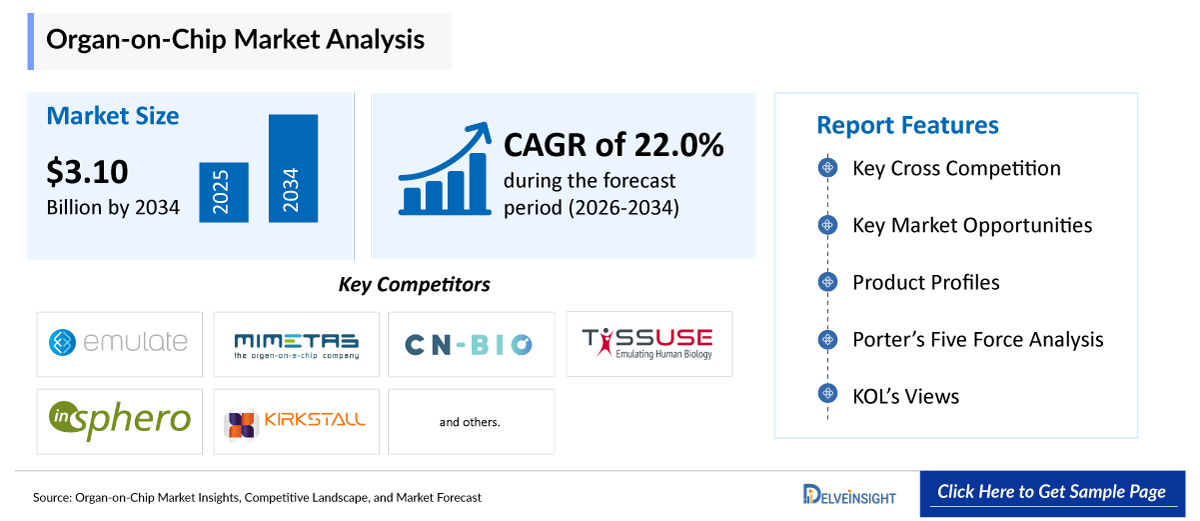
- The Organ-on-Chip market size is estimated at USD 0.52 billion in 2025 and is projected to reach USD 3.10 billion by 2034. Growth is anchored in the accelerating shift away from animal testing toward human-relevant microphysiological systems, expanding pharmaceutical adoption of predictive preclinical models, and supportive regulatory momentum from the FDA and other global agencies.
- The global Organ-on-Chip market is growing at a CAGR of 22.0% during the forecast period from 2026 to 2034.
- By product type, the products segment (devices and consumables & accessories) dominated the Organ-on-Chip market with a 64% share in 2025.
- By organ type, the liver-on-a-chip segment dominated the Organ-on-Chip market with a 29% share in 2025.
- By application, the drug discovery & development segment dominated the Organ-on-Chip market with a 41% share in 2025.
- By end-users, the pharmaceutical & biotechnology companies segment dominated the Organ-on-Chip market with a 57% share in 2025.
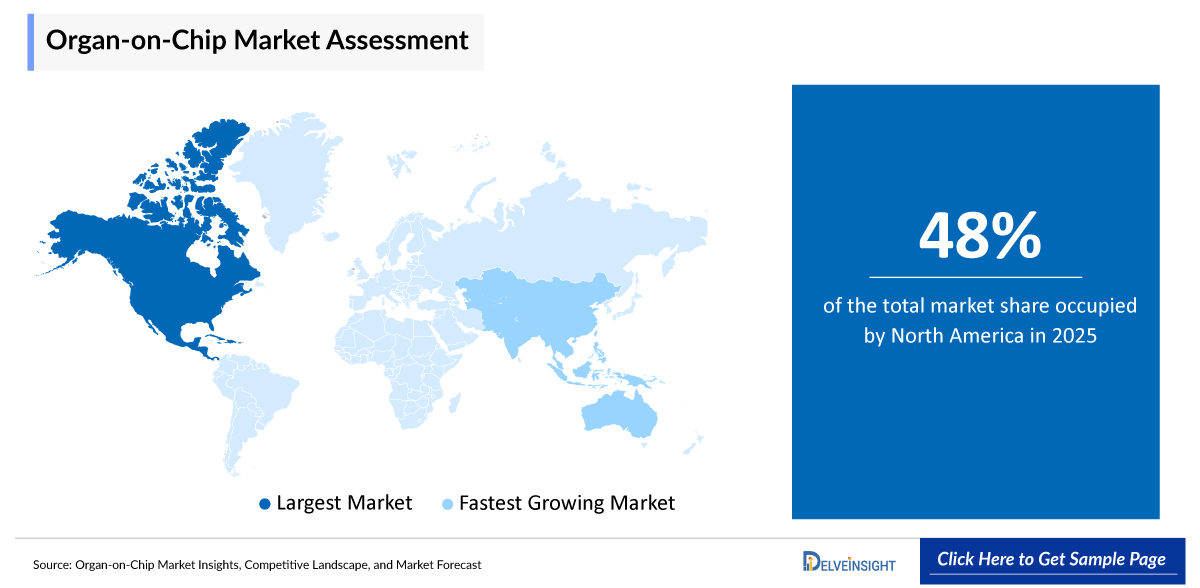
- North America dominated the global Organ-on-Chip market revenue with a 48% share in 2025, representing the highest regional market share globally.
An organ-on-chip (OoC) is a microengineered, microfluidic cell-culture device lined with living human cells that reproduces the structure, mechanical forces, and physiological responses of a specific human organ or organ interface on a miniature platform. Because these systems combine human-derived cells, biomaterials, and precisely controlled fluid flow, they generate more human-relevant, predictive data on drug efficacy, toxicity, and disease mechanisms than conventional two-dimensional cell culture or animal models, while supporting the global movement to reduce, refine, and replace animal testing.
The market is organized by product type across products, comprising devices and consumables & accessories, and services; by organ type, including liver, lung, heart, kidney, and other organs such as skin, gut, and multi-organ (body-on-a-chip) systems; by application across drug discovery & development, drug toxicity testing, disease modeling, personalized medicine, pharmacokinetic/pharmacodynamic studies, and others; and by end-users, led by pharmaceutical and biotechnology companies, academic and research institutes, contract research organizations, and others. Driven by accelerating regulatory endorsement of new approach methodologies (NAMs), rising pharmaceutical outsourcing of predictive toxicology, and deepening big-pharma partnerships, organ-on-chip platforms have moved from academic proof-of-concept toward becoming an established pillar of the modern human-relevant drug development toolkit.
Organ-on-Chip Market Key Growth Drivers
- The FDA's April 2025 roadmap to phase out animal-testing requirements for preclinical safety and toxicity studies over the next three to five years is directly accelerating pharmaceutical adoption of organ-chip and other new approach methodologies (NAMs).
- The NIH's mid-2025 policy requiring new funding announcements involving animal models to incorporate human-focused approaches, including organ chips, is expanding research-grade demand across academic and translational programs.
- Emulate's Liver-Chip becoming the first organ-chip accepted into the FDA's Innovative Science and Technology Approaches for New Drugs (ISTAND) program is establishing a regulatory qualification pathway that is expected to accelerate broader agency acceptance of chip-based data.
- Deepening strategic partnerships between organ-chip developers and large pharmaceutical companies, including Emulate's collaborations with Roche, AstraZeneca, Merck, and Janssen, and Hesperos' partnerships with Bayer Consumer Health and Psilera, are embedding chip-based testing into sponsor drug-safety workflows.
- The rising global burden of chronic and complex diseases, including cardiovascular disorders, cancer, and neurodegenerative conditions, is expanding demand for physiologically relevant disease-modeling and toxicity-testing platforms.
- Growing regulatory momentum outside the United States, including the United Kingdom's November 2025 moves to reduce reliance on animal testing, is broadening the addressable geography for organ-chip adoption.
- Formation of industry coalitions such as the Industry Alliance for Microphysiological Systems (IAMPS), launched in February 2025 by MIMETAS, TissUse, InSphero, and other founding members, is standardizing validation practices and strengthening buyer confidence in the technology.
- The convergence of regulatory endorsement, big-pharma partnership activity, disease burden, and cross-industry standardization is expected to sustain strong double-digit growth in the market through 2034.
Key Companies in Organ-on-Chip Market
The competitive landscape is led by the following active manufacturers:
- Emulate, Inc.
- MIMETAS
- CN Bio
- TissUse GmbH
- InSphero AG
- Kirkstall Ltd.
- Nortis Inc.
- Hesperos, Inc.
- AxoSim
- Altis Biosystems, and others
For illustrative purposes, only the top 10 companies are listed in the Table of Contents. The report may include analysis and references to additional companies relevant to the market assessment.
Organ-on-Chip Market Size
The following snapshot summarizes the principal report metrics for the Organ-on-Chip market.
|
Report Metrics |
Details |
|
2025 Market Size |
USD 0.52 billion |
|
2034 Projected Market Size |
USD 3.10 billion |
|
Growth Rate (2026-2034) |
22.0% CAGR |
|
Largest Market |
North America |
|
Fastest Growing Market |
Asia-Pacific |
|
Market Structure |
Fragmented |
All market values are expressed in USD and represent DelveInsight estimates synthesized from primary and secondary research.
Factors Contributing to the Growth of the Organ-on-Chip Market
Organ-on-Chip Market Drivers
- Accelerating Regulatory Endorsement of Non-Animal Testing Methods: The single most powerful driver of the Organ-on-Chip market is the accelerating regulatory shift away from animal testing toward validated new approach methodologies. In April 2025, the U.S. FDA announced a strategic roadmap to make animal testing the exception, rather than the norm, for preclinical safety and toxicity studies within three to five years, positioning organ-chip technology alongside organoids, computational modeling, and artificial intelligence as core replacement tools. The NIH reinforced this direction the same year by requiring new funding announcements involving animal models to incorporate human-focused approaches. Emulate's Liver-Chip has become the first organ-chip technology accepted into the FDA's ISTAND program, a qualification pathway for tools that fall outside existing frameworks, giving sponsors a clearer route to regulatory-grade use of chip-derived data. As these frameworks mature and expand to additional organ systems and disease contexts, pharmaceutical sponsors are expected to steadily increase organ-chip adoption across the drug development pipeline, anchoring market growth through 2034.
- Deepening Big-Pharma and Strategic Partnerships: A structural wave of partnership activity between organ-chip developers and large pharmaceutical companies is embedding the technology into mainstream drug-safety and efficacy workflows. Emulate has established strategic collaborations with Roche, AstraZeneca, Merck, and Janssen spanning safety prediction, disease mechanisms, and patient-derived cell models, while Hesperos has partnered with Bayer Consumer Health on a human-on-a-chip model of stress-induced cognitive dysfunction and with Psilera to advance preclinical modeling of a neuropsychiatric drug candidate for frontotemporal dementia. CN Bio and Altis Biosystems have jointly developed a next-generation human gut/liver in vitro model to support advanced ADME studies. These sponsor-embedded collaborations validate organ-chip technology at the point of pharmaceutical decision-making, generate recurring revenue for platform providers, and create durable reference programs that accelerate adoption by additional sponsors across the forecast period.
- Rising Global Burden of Chronic and Complex Diseases: The growing global burden of chronic and complex diseases, including cardiovascular disorders, cancer, metabolic disease, and neurodegenerative conditions, is expanding demand for physiologically relevant disease-modeling and toxicity-testing tools. Traditional animal models and static two-dimensional cell cultures often fail to predict human-specific disease mechanisms or drug responses, particularly for complex, multifactorial conditions. Organ-on-chip platforms that incorporate patient-derived or induced pluripotent stem cell-derived tissue allow researchers to model disease progression and drug response with greater physiological fidelity. As disease prevalence rises and precision medicine approaches gain adoption, the volume and sophistication of disease-modeling programs utilizing organ-chip technology is expected to expand steadily through the forecast period.
- Expanding Pharmaceutical Outsourcing of Predictive Toxicology: Pharmaceutical and biotechnology sponsors are increasingly outsourcing complex, human-relevant toxicology and efficacy testing to specialized organ-chip providers and contract research organizations rather than building in-house microphysiological systems capability. Operating organ-chip platforms requires specialized microfluidics engineering, cell biology, and data-analytics expertise that many sponsors, particularly smaller biotech companies, do not possess internally. Specialized providers such as Emulate, MIMETAS, CN Bio, and TissUse offer end-to-end chip design, tissue engineering, assay development, and data interpretation services, allowing sponsors to access predictive toxicology capability without significant capital investment. As outsourcing intensity rises alongside expanding biotech pipelines, the addressable market for organ-chip products and services grows correspondingly.
- Growing International Regulatory Alignment: Regulatory momentum toward reducing animal testing is broadening beyond the United States. In November 2025, the United Kingdom advanced regulatory changes aimed at reducing reliance on animal testing in favor of human-relevant alternatives, mirroring the FDA's roadmap. The European Medicines Agency and national regulators across Europe continue to expand acceptance of microphysiological systems data within broader efforts to align with the 3Rs principle of replacement, reduction, and refinement in animal research. As additional jurisdictions formalize pathways for non-animal test data, global pharmaceutical sponsors gain confidence to standardize organ-chip use across multi-region development programs, expanding the addressable market beyond North America and Europe.
- Industry Standardization and Cross-Sector Collaboration: The formation of dedicated industry coalitions is accelerating standardization and buyer confidence in microphysiological systems technology. In February 2025, MIMETAS, TissUse, InSphero, and six other founding organizations launched the Industry Alliance for Microphysiological Systems (IAMPS), the first industry association dedicated to advancing organ-chip and organoid technologies as predictive, ethical, and scalable alternatives to traditional models. Coordinated efforts on validation protocols, terminology, and best practices reduce technical fragmentation across the fast-growing but historically dispersed vendor landscape, making it easier for pharmaceutical sponsors and contract research organizations to evaluate and adopt chip-based platforms with confidence, supporting market expansion through the forecast period.
- Expanding Personalized Medicine and Novel Application Areas: Organ-on-chip platforms incorporating patient-derived cells are increasingly used to model individual variability in drug response, supporting the growth of personalized and precision medicine programs. Beyond traditional pharmaceutical applications, organ-chip technology is also expanding into novel research domains: Emulate's organ-chip payload flew aboard NASA's Artemis II lunar mission in April 2026 as part of the AVATAR investigation studying the effects of deep-space radiation and microgravity on human tissue, illustrating the platform's growing credibility and visibility beyond conventional drug development. As personalized medicine adoption grows and novel use cases continue to emerge, demand for flexible, patient-relevant organ-chip platforms is expected to expand across the forecast period.
Organ-on-Chip Market Restraints
Despite strong momentum, the Organ-on-Chip market faces material constraints. The high cost of organ-chip devices, instrumentation, and consumables, combined with the specialized microfluidics engineering and cell-biology expertise required to operate them, limits adoption among smaller academic laboratories and budget-constrained research institutes. The absence of fully harmonized regulatory qualification pathways beyond early programs such as the FDA's ISTAND initiative creates uncertainty for sponsors seeking to rely on chip-derived data for regulatory submissions, slowing broader adoption. Technical challenges around inter-laboratory reproducibility, standardization of cell sourcing, and long-term validation against clinical outcomes remain active areas of development. Competition from alternative new approach methodologies, including organoids, computational and AI-driven modeling, and advanced 2D/3D co-culture systems, creates a fragmented and rapidly evolving competitive landscape. A shortage of professionals trained across microfluidics, tissue engineering, and translational biology constrains the pace of scale-up, while low-throughput manufacturing at many specialized providers limits the volume of chips that can be supplied to large pharmaceutical customers. Together, these cost, regulatory, technical, and workforce barriers temper the pace of growth, even as the underlying drivers of regulatory endorsement, disease burden, and pharmaceutical outsourcing remain firmly intact.
Organ-on-Chip Market Segment Analysis
The organ-on-chip market by product type (products {devices and consumables & accessories} and services), organ type (liver-on-a-chip, lung-on-a-chip, heart-on-a-chip, kidney-on-a-chip, and others), application (drug discovery & development, drug toxicity testing, disease modeling, personalized medicine, pharmacokinetic/pharmacodynamic studies, and others), end-users (pharmaceutical & biotechnology companies, academic & research institutes, contract research organizations, and others), and geography (North America, Europe, Asia-Pacific, and Rest of World).
By Product Type
Dominant Subsegment: Products (Devices and Consumables & Accessories).
The products segment accounted for 64% of the Organ-on-Chip market in 2025. Products are the leading category because organ-chip adoption fundamentally requires recurring purchases of physical devices, microfluidic chips, and consumables such as membranes, scaffolds, and reagents to run each new experiment or screening campaign. Devices and platforms, including chip cartridges, culture plates, and supporting instrumentation such as pumps and perfusion controllers, form the durable hardware backbone that laboratories invest in first, while consumables and accessories generate steady repeat revenue tied to experimental throughput. Leading providers including Emulate, MIMETAS, and CN Bio sell modular, plug-and-play systems compatible with standard laboratory equipment, lowering the barrier for pharmaceutical and academic customers to adopt the hardware. While the services segment, spanning contract assay development, custom tissue modeling, and data interpretation, is growing quickly as sponsors seek turnkey solutions without in-house expertise, the recurring nature and higher unit economics of device and consumable sales secure the products segment's leadership across the forecast period.
By Organ Type
Dominant Subsegment: Liver-on-a-Chip.
The liver-on-a-chip segment accounted for 29% of the Organ-on-Chip market in 2025. Liver-on-a-chip is the leading organ type because hepatotoxicity remains the single most common cause of drug candidate failure and post-market withdrawal, making liver models the earliest and most extensively validated application of the technology. Emulate's Liver-Chip, the first organ-chip accepted into the FDA's ISTAND program for drug-induced liver injury evaluation, exemplifies the regulatory traction that liver models have achieved relative to other organ systems. Kirkstall's Quasi Vivo perfusion platform and CN Bio's liver-focused systems further reinforce the segment's breadth of validated commercial offerings. Lung-on-a-chip and heart-on-a-chip are expanding quickly, driven by respiratory disease research and cardiotoxicity screening, respectively, and kidney-on-a-chip is gaining traction in nephrotoxicity testing led by providers such as Nortis. Nonetheless, the depth of validation data, regulatory precedent, and breadth of commercial liver-chip offerings secure the segment's leadership across the forecast period.
By Application
Dominant Subsegment: Drug Discovery & Development.
The drug discovery & development segment accounted for 41% of the Organ-on-Chip market in 2025. Drug discovery and development is the leading application because organ-chip technology's core value proposition, generating more human-relevant, predictive data earlier in the pipeline, delivers the greatest return when applied to compound screening, lead optimization, and early efficacy assessment, where reducing late-stage attrition has outsized economic impact for sponsors. Pharmaceutical companies increasingly deploy organ-chip platforms alongside traditional assays to de-risk candidates before committing to costly animal studies and clinical trials. Drug toxicity testing is a closely related and fast-growing application, propelled directly by the FDA's roadmap to reduce animal testing, while disease modeling and personalized medicine are expanding as patient-derived cell sourcing matures. Pharmacokinetic/pharmacodynamic studies benefit from multi-organ chip systems that model absorption, distribution, metabolism, and excretion. While toxicity testing is growing rapidly, the breadth and centrality of drug discovery workflows secure this segment's leadership across the forecast period.
By End-Users
Dominant Subsegment: Pharmaceutical & Biotechnology Companies.
The pharmaceutical & biotechnology companies segment accounted for 57% of the Organ-on-Chip market in 2025. Pharmaceutical and biotechnology companies are the leading end-user group because they bear direct commercial responsibility for reducing drug candidate attrition and are the primary beneficiaries of the cost and time savings organ-chip technology can deliver across discovery and preclinical development. Strategic collaborations such as Emulate's partnerships with Roche, AstraZeneca, Merck, and Janssen, and Hesperos' work with Bayer Consumer Health, illustrate the depth of big-pharma engagement with the technology. Academic and research institutes represent the second-largest end-user group, using organ-chip platforms for fundamental disease-mechanism research often in collaboration with industry, while contract research organizations are expanding chip-based service offerings to meet sponsor outsourcing demand. As pharmaceutical sponsors continue to embed organ-chip technology into standard preclinical workflows, this segment is expected to retain its leadership across the forecast period.
Organ-on-Chip Market Region Analysis
Dominant Region: North America
North America accounted for 48% of the global Organ-on-Chip market revenue in 2025, representing the highest regional market share globally. The region's dominance reflects a dense concentration of organ-chip technology developers, including Emulate, Nortis, Hesperos, AxoSim, and Altis Biosystems, a mature pharmaceutical R&D ecosystem, and clear regulatory tailwinds from the FDA's 2025 roadmap to reduce animal testing and the NIH's human-focused research funding requirements. The United States hosts the largest concentration of organ-chip commercial and academic research activity, anchored by Emulate's ISTAND-accepted Liver-Chip program and its strategic partnerships with major pharmaceutical companies. Strong venture and grant funding, exemplified by recent financing rounds at Altis Biosystems and AxoSim, continues to support platform development and commercialization. Robust research infrastructure, regulatory clarity, and proximity to leading pharmaceutical sponsors anchor the region's continued leadership across the forecast period.
Fastest Growing Region: Asia-Pacific
Asia-Pacific is the fastest-growing region in the Organ-on-Chip market. The region's elevated CAGR is driven by rapidly expanding biopharmaceutical R&D investment, government-backed life-sciences initiatives, and a growing base of contract research organizations across China, Japan, India, South Korea, and Australia. China is scaling domestic microphysiological systems research and manufacturing capacity, Japan is integrating organ-chip platforms into its regenerative-medicine and drug-safety ecosystem, and India is emerging as a lower-cost hub for chip-based contract research services. Growing academic-industry collaboration, rising chronic disease burden, and expanding local biotechnology funding are accelerating adoption, while regional providers increasingly partner with established Western developers to access validated platforms. The combination of R&D investment, cost-competitive services capacity, and expanding pharmaceutical outsourcing positions Asia-Pacific as the principal source of incremental growth over the forecast period.
Organ-on-Chip Market Regional Commentary
North America
North America accounted for 48% of the global Organ-on-Chip market revenue in 2025. The United States dominates on the strength of its concentration of organ-chip developers, mature pharmaceutical R&D base, and clear regulatory momentum from the FDA and NIH, while strong venture funding and deepening big-pharma partnerships reinforce its leadership.
Europe
Europe is a large and technically advanced regional market, supported by pioneering developers including MIMETAS, TissUse, InSphero, and Kirkstall, a strong academic microfluidics research base, and growing regulatory alignment with the 3Rs principle. The February 2025 launch of the Industry Alliance for Microphysiological Systems, founded predominantly by European companies, and the United Kingdom's November 2025 regulatory moves to reduce animal testing reinforce the region's role as a hub for organ-chip innovation and standardization across Germany, the United Kingdom, France, Italy, and Spain.
Asia-Pacific
Asia-Pacific is the fastest-growing region, propelled by expanding biopharmaceutical R&D investment, government life-sciences initiatives, and a growing contract research organization base across China, Japan, India, South Korea, and Australia. Rising local funding and academic-industry collaboration are accelerating regional organ-chip adoption and clinical-translation activity.
Rest of World
The Rest of World region, spanning Latin America, the Middle East, and Africa, is an emerging growth frontier. Expanding biomedical research infrastructure, growing interest in ethical and cost-effective alternatives to animal testing, and international academic partnerships are gradually broadening access, while local capacity for organ-chip research remains nascent relative to North America, Europe, and Asia-Pacific.
Organ-on-Chip Market Competitive Landscape
The Organ-on-Chip market is classified as Fragmented. A group of well-funded, first-mover platform developers, including Emulate, MIMETAS, CN Bio, and TissUse, anchors the top tier through broad organ-model portfolios, regulatory traction, and big-pharma partnerships, while specialized providers such as InSphero, Kirkstall, Nortis, Hesperos, AxoSim, and Altis Biosystems compete through organ-specific expertise, academic collaborations, and niche application focus, sustaining intense innovation-driven competition across the vendor landscape.
The competitive landscape can be evaluated across the following dimensions:
- Market concentration: Fragmented, with a handful of broad-portfolio platform leaders and a large field of organ-specific specialized providers.
- Leading players: Emulate, MIMETAS, CN Bio, and TissUse anchor the top tier through multi-organ portfolios and regulatory and pharma-partnership traction.
- Regulatory positioning: Emulate's Liver-Chip acceptance into the FDA's ISTAND program is a decisive competitive advantage, establishing a precedent that other developers are working to replicate for additional organ systems.
- Product portfolio strength: Top players offer modular, plug-and-play organ-chip systems spanning liver, lung, heart, kidney, gut, and neural models, compatible with standard laboratory equipment.
- Strategic partnerships: Tie-ups with pharmaceutical sponsors, such as Emulate's collaborations with Roche, AstraZeneca, Merck, and Janssen, and Hesperos' partnerships with Bayer Consumer Health and Psilera, extend commercial reach and validate technology.
- Industry collaboration: Founding participation in the Industry Alliance for Microphysiological Systems (IAMPS) by MIMETAS, TissUse, InSphero, and others is shaping shared validation standards across the sector.
- Funding activity: Active venture and grant funding, including recent rounds at Altis Biosystems and AxoSim, continues to support platform development and commercialization among specialized providers.
- Technology focus: Multi-organ (body-on-a-chip) integration, patient-derived and iPSC-based cell sourcing, and automated, high-throughput chip manufacturing are key competitive differentiators.
- Innovation focus: Regulatory-grade validation studies, novel application domains such as space biomedicine, and standardized cross-laboratory protocols define the next phase of competition.
Organ-on-Chip Market Recent Developmental Activities
- In April 2026, Emulate, Inc. launched its organ-chip technology, containing astronaut-derived cells, aboard NASA's Artemis II lunar mission as part of the AVATAR investigation studying the effects of deep-space radiation and microgravity on human tissue.
- In April 2025, Emulate, Inc. welcomed the FDA's newly announced roadmap to reduce reliance on animal testing and applauded the agency's embrace of organ-chip technologies as validated new approach methodologies.
- In 2025, Emulate, Inc. had its Liver-Chip accepted into the FDA's Innovative Science and Technology Approaches for New Drugs (ISTAND) program for a context-of-use claim focused on identifying drug-induced liver injury, the first organ-chip technology admitted to the program.
- In October 2025, Hesperos, Inc. and Bayer Consumer Health developed the first Human-on-a-Chip model of stress-induced cognitive dysfunction.
- In July 2025, Hesperos, Inc. demonstrated the first digital twin of human disease built using its organ-on-a-chip platform.
- In June 2025, Hesperos, Inc. and Psilera announced a collaboration to advance preclinical modeling of drug candidate PSIL-006 for frontotemporal dementia using Hesperos' human-on-a-chip platform.
- In February 2025, MIMETAS became a founding member, alongside TissUse, InSphero, and six other companies, of the Industry Alliance for Microphysiological Systems (IAMPS), the first industry association dedicated to advancing organ-chip and organoid technologies.
- In April 2025, Altis Biosystems closed a Series A-II financing round to continue development of its gut-on-a-chip technology.
- In 2024, CN Bio partnered with Altis Biosystems to develop a next-generation human gut/liver in vitro model for advanced ADME studies.
- In November 2025, United Kingdom regulators advanced measures to reduce reliance on animal testing in favor of validated human-relevant alternatives, including organ-chip technology.
Organ-on-Chip Market Segmentation
- Organ-on-Chip Market by Product Type
- Products
- Devices
- Consumables & Accessories
- Services
- Organ-on-Chip Market by Organ Type
- Liver-on-a-Chip
- Lung-on-a-Chip
- Heart-on-a-Chip
- Kidney-on-a-Chip
- Others
- Organ-on-Chip Market by Application
- Drug Discovery & Development
- Drug Toxicity Testing
- Disease Modeling
- Personalized Medicine
- Pharmacokinetic/Pharmacodynamic Studies
- Others
- Organ-on-Chip Market by End-Users
- Pharmaceutical & Biotechnology Companies
- Academic & Research Institutes
- Contract Research Organizations
- Others
Organ-on-Chip Market Assessment by Geography
- North America Organ-on-Chip Market Assessment
- United States Organ-on-Chip Market Size in USD million (2023-2034)
- Canada Organ-on-Chip Market Size in USD million (2023-2034)
- Mexico Organ-on-Chip Market Size in USD million (2023-2034)
- Europe Organ-on-Chip Market Assessment
- Germany Organ-on-Chip Market Size in USD million (2023-2034)
- United Kingdom Organ-on-Chip Market Size in USD million (2023-2034)
- France Organ-on-Chip Market Size in USD million (2023-2034)
- Italy Organ-on-Chip Market Size in USD million (2023-2034)
- Spain Organ-on-Chip Market Size in USD million (2023-2034)
- Rest of Europe Organ-on-Chip Market Size in USD million (2023-2034)
- Asia-Pacific Organ-on-Chip Market Assessment
- China Organ-on-Chip Market Size in USD million (2023-2034)
- Japan Organ-on-Chip Market Size in USD million (2023-2034)
- India Organ-on-Chip Market Size in USD million (2023-2034)
- Australia Organ-on-Chip Market Size in USD million (2023-2034)
- South Korea Organ-on-Chip Market Size in USD million (2023-2034)
- Rest of Asia-Pacific Organ-on-Chip Market Size in USD million (2023-2034)
- Rest of the World (RoW) Organ-on-Chip Market Assessment
- Middle East Organ-on-Chip Market Size in USD million (2023-2034)
- Africa Organ-on-Chip Market Size in USD million (2023-2034)
- South America Organ-on-Chip Market Size in USD million (2023-2034)
Organ-on-Chip Market Recent Industry Trends and Milestones (2023-2026):
|
Category |
Key Developments |
|
Organ-on-Chip Market Product Approval |
Regulatory momentum is expanding commercial adoption. The FDA released a roadmap in April 2025 to make animal testing the exception for preclinical safety studies within three to five years, the NIH aligned its funding requirements accordingly, and Emulate's Liver-Chip became the first organ-chip accepted into the FDA's ISTAND program. The United Kingdom advanced similar measures in November 2025. Each development creates durable, recurring demand for regulatory-grade organ-chip platforms. |
|
Organ-on-Chip Market Expansion |
Developers broadened commercial reach through pharma partnerships. Emulate deepened collaborations with Roche, AstraZeneca, Merck, and Janssen; Hesperos partnered with Bayer Consumer Health and Psilera; and CN Bio partnered with Altis Biosystems on a combined gut/liver model. These sponsor-embedded collaborations validate the technology and generate recurring commercial revenue. |
|
Organ-on-Chip Market Investment |
Cross-industry coordination accelerated sharply. In February 2025, MIMETAS, TissUse, InSphero, AlveoliX, BiomimX, Chiron, Dynamic42, NETRI, and React4Life launched the Industry Alliance for Microphysiological Systems (IAMPS), the first dedicated industry association for organ-chip and organoid technologies, to advance shared validation standards. |
|
Company Strategy |
Emulate, Inc.: Regulatory-pathway leadership through ISTAND acceptance and novel space-biomedicine applications. MIMETAS: Industry standardization leadership through IAMPS. CN Bio: Multi-organ ADME model expansion through the Altis Biosystems partnership. TissUse and InSphero: Multi-organ systems and 3D microtissue platforms reinforced through IAMPS founding membership. Hesperos, Inc.: Neurological and consumer-health application expansion through Bayer and Psilera partnerships. Kirkstall Ltd., Nortis Inc., AxoSim, and Altis Biosystems: Organ-specific platform specialization in perfusion systems, kidney/vascular models, neural models, and gut-on-a-chip technology, respectively. |
|
Emerging Technologies |
Multi-organ (body-on-a-chip) integration is the leading edge of innovation, alongside patient-derived and induced pluripotent stem cell-based tissue sourcing that supports personalized medicine applications. Digital-twin approaches combining computational modeling with physical organ-chip data, as demonstrated by Hesperos, and novel application domains such as space biomedicine, as demonstrated by Emulate's Artemis II payload, are expanding the technology's reach. Automated, higher-throughput chip manufacturing and standardized validation protocols developed through IAMPS are addressing reproducibility and scale-up constraints. |
Organ-on-Chip Market Startup Funding and Investment Trends
Investment in the Organ-on-Chip ecosystem has concentrated on regulatory-grade validation programs, multi-organ platform development, and specialized organ-focused technology. The following companies illustrate recent funding and investment activity and technology focus.
|
Company |
Total Funding |
Funding Stage |
Main Offering |
Core Technology |
|
Altis Biosystems |
USD ~7.5 million |
Series A / Grant |
Gut-on-a-chip platform |
Intestinal microphysiological systems |
|
Request for unlocking the report of the @ Organ-on-Chip Market Insights | ||||
Capital continues to flow toward providers advancing regulatory-grade validation and expanding organ-model breadth. Altis Biosystems closed a Series A-II round in April 2025 to continue development of its intestinal modeling platform, while AxoSim and MIMETAS have raised venture and growth-stage funding to scale neural and multi-organ platform capabilities, respectively. Emerging providers continue to attract grant and early-stage capital as the FDA and NIH's 2025 policy shifts create durable demand signals for validated non-animal testing platforms. Collectively, these investments signal conviction that regulatory qualification, multi-organ integration, and specialized organ-focused expertise will define the next phase of competitive advantage in the global Organ-on-Chip market.
Key Takeaways from the Organ-on-Chip Market Report Study
- Market size analysis for the current organ-on-chip market size (2025), and market forecast for 9 years (2026 to 2034).
- Top key product/technology developments, mergers, acquisitions, partnerships, and joint ventures that happened over the last 3 years.
- Key companies dominating the global organ-on-chip market.
- Various opportunities available for competitors in the organ-on-chip market space.
- What are the top-performing segments in 2025? How will these segments perform in 2034?
- Which are the top-performing regions and countries in the current organ-on-chip market scenario?
- Which are the regions and countries where companies should concentrate their opportunities for organ-on-chip market growth in the future?
Target audience who can benefit from this organ-on-chip market report study
- Organ-on-Chip product providers
- Research organizations and consulting companies
- Neurodegenerative disease therapeutics-related organizations, associations, forums, and other alliances
- Government and corporate offices
- Start-up companies, venture capitalists, and private equity firms
- Distributors and traders dealing in organ-on-chip
- Various end-users who want to know more about the organ-on-chip market and the latest technological developments in the organ-on-chip market.

