Orphan Drugs Market
Orphan Drugs Market by Drug Type (Small Molecule and Biologics), Route of Administration (Oral and Parenteral), Indication (Oncology, Hematology, Ophthalmology, Neurology, and Others), Distribution Channel (Hospital and Retail Pharmacies and Online Pharmacies), and Geography (North America, Europe, Asia-Pacific, and Rest of the World) is expected to grow at a steady CAGR forecast till 2032 owing to the growing prevalence of genetic disorders and rare disease globally, increased government incentives, increasing R&D activities, and increase in product development activities among the key market players
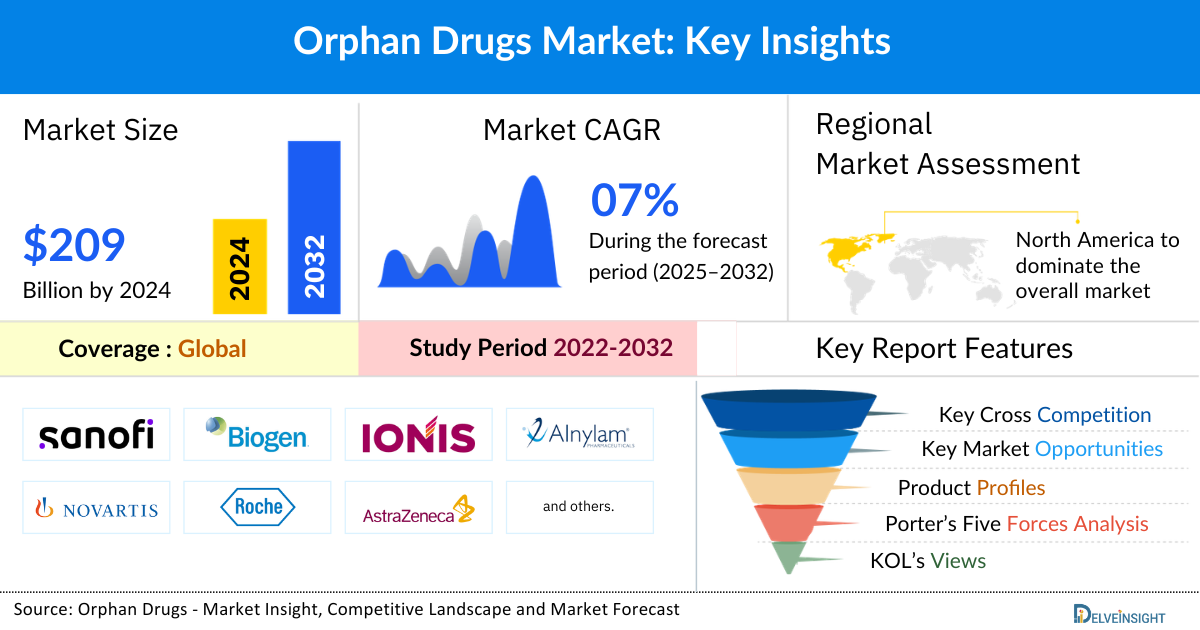
The global orphan drugs market was valued at USD 208.61 billion in 2024, growing at a CAGR of 6.98% during the forecast period from 2025 to 2032 to reach USD 357.26 billion by 2032. The orphan drugs market is experiencing robust growth, driven by the rising global prevalence of genetic disorders and rare diseases, alongside a high unmet medical need. Many rare diseases still lack effective treatments, creating a significant market opportunity. Favorable government policies and regulatory incentives, such as market exclusivity and accelerated approval pathways, are further fueling the development of orphan drugs. These policies reduce development barriers and make the market more attractive to pharmaceutical companies. Additionally, increased R&D investment and a growing number of product launches by key industry players, particularly in biotechnology, gene therapy, and precision medicine, are driving innovation and market expansion. These factors are expected to continue contributing to the positive growth of the orphan drugs market during the forecast period from 2025 to 2032.
Request for unlocking the report of the @ Orphan Drugs Market
Orphan Drugs Market Dynamics:
According to the data provided by the World Economic Forum (2023), an estimated 400 to 475 million people were living with a rare disease across the globe, with one in 20 individuals affected at some point in their lives.
Additionally, as per the data from the European Union (2024), in 2023, over 36 million individuals in the EU were living with a rare disease. Rare diseases are often severe and lack effective treatments, creating a strong demand for targeted therapies. To address this, global regulatory bodies like the U.S. FDA and EMA offer incentives such as market exclusivity, tax credits, and fast-track approvals through policies like the Orphan Drug Act. These benefits make rare disease drug development attractive to pharmaceutical companies, despite the small patient populations. As a result, investment and innovation in this area are increasing, significantly boosting the overall market for orphan drugs.
As per statistics from the Haemophilia Society UK (2024), in 2023, approximately one in 2,000 individuals in the United Kingdom were living with bleeding disorders, including hemophilia and von Willebrand disease. These disorders often require highly specialized and costly treatments, including clotting factor replacement therapies, gene therapies, and novel non-factor treatments designed to prevent or control bleeding episodes. Given the severity and life-threatening nature of uncontrolled bleeding, there is a high demand for effective and innovative therapies that can improve patient outcomes and quality of life.
Similarly, data from the Spinal Muscular Atrophy Foundation (2023), reported that Spinal Muscular Atrophy (SMA), a genetic neuromuscular disorder, affected 10,000 to 25,000 children and adults in the United States. Moreover, 1 in 6,000 to 1 in 10,000 children were born with SMA in the U.S. each year. SMA is a rare genetic neuromuscular disorder that primarily affects infants and children, leading to progressive muscle weakness and, in severe cases, early death if left untreated. The high unmet medical need, combined with recent scientific breakthroughs in gene therapy and antisense oligonucleotide (ASO) treatments, has positioned SMA as a key driver within the orphan drug landscape.
Moreover, favorable government policies and regulatory incentives, such as market exclusivity and tax credits from agencies like the FDA and EMA, are encouraging pharmaceutical companies to invest in rare disease R&D. Alongside this, rising R&D efforts and new product launches by key players are driving strong growth in the orphan drugs market. For example, in October 2023, BioMarin Pharmaceutical Inc. announced FDA approval of the supplemental New Drug Application (sNDA) for VOXZOGO® (vosoritide), a treatment aimed at increasing linear growth in pediatric patients with achondroplasia. This approval, granted under accelerated approval based on improved annualized growth velocity, also includes orphan drug designation for the treatment of hypochondroplasia.
However, the high costs associated with orphan drugs, and small patient population, and the complex clinical trial design, among others are some of the key constraints that may limit the growth of the orphan drugs market.
Orphan Drugs Market Segment Analysis:
Orphan Drugs Market by Drug Type (Small Molecule and Biologics), Route of Administration (Oral and Parenteral), Indication (Oncology, Hematology, Ophthalmology, Neurology, and Others), Distribution Channel (Hospital and Retail Pharmacies and Online Pharmacies), and Geography (North America, Europe, Asia-Pacific, and Rest of the World)
In the drug type segment of the orphan drugs market, the biologics category is estimated to account for the largest market share in 2024. This can be attributed to the growing prevalence of rare and genetic diseases and the increasing demand for biological drugs due to their advantages. As per the data from Rare Disease International (2022), in 2022, it was estimated that 300 million people were affected by rare diseases globally, and approximately 72% of these conditions were from genetic origin. Furthermore, the future prediction estimated that 1 in 17 individuals worldwide will be affected by a rare condition at some point in their lives.
Biologics offer significant advantages in the treatment of rare diseases, providing better options for complex conditions that were previously difficult to manage with traditional small-molecule drugs, such as rare cancers, autoimmune disorders, and genetic diseases. For many rare and complex diseases such as rare cancers, genetic disorders (e.g., hemophilia, muscular dystrophy), and neurological diseases there is a significant unmet medical need for effective therapies. Biologics are increasingly filling this gap by offering breakthrough treatments that provide relief or even cures for previously untreatable conditions.
Streamlined regulatory pathways like fast track and accelerated approvals, along with incentives from the Orphan Drug Act, are boosting the development of biologics for rare diseases. These measures are driving demand and encouraging key players to innovate targeted therapies in the orphan drug market. For example, in March 2024, Cabaletta Bio, Inc. received an FDA Orphan Drug Designation for CABA-201, a 4-1BB-containing CD19-CAR T cell investigational therapy, for the treatment of systemic sclerosis (SSc). Similarly, in June 2024, Be Biopharma, Inc. was granted FDA Orphan Drug Designation for BE-101, an engineered B cell medicine being developed to treat Hemophilia B.
Thus, the factors mentioned are likely to boost the market segment and thereby increasing the overall market of orphan drugs during the forecast period.
North America is expected to dominate the overall orphan drugs market:
North America is projected to maintain its position as the dominant region in the orphan drugs market in 2024, driven by several key factors. The growing prevalence of genetic disorders and rare diseases in the region is creating a substantial demand for orphan drugs. Additionally, the region's dominance in the market is attributed to supportive government policies, particularly the Orphan Drug Act of 1983, which offered incentives like tax credits, grants, and market exclusivity. Advancements in biotechnology, increased R&D investments, and frequent product launches by major pharmaceutical firms are also said to be accelerating market growth and expanding treatment options for rare diseases with high unmet needs.
According to data published by the Centers for Disease Control and Prevention (CDC) in May 2024, approximately 35,000 people were suffering from cystic fibrosis in 2024 in the United States.
According to the Rare Disease Day Organization (2023), an estimated 30 million Americans were affected by rare diseases, with approximately 80% of these conditions having a genetic origin. Diseases such as spinal muscular atrophy (SMA), hemophilia, sickle cell anemia, and Duchenne muscular dystrophy (DMD) underscore the critical need for advanced treatments.
According to data from the BDSRA Foundation (2024), in 2023, it was estimated that two to four infants per 100,000 of the total population in the United States were affected by Batten disease. Similarly, data from the Government of Canada (2025), indicated that Batten disease, a rare and inherited genetic disorder, affects between 1 and 35 births per 500,000 babies born in Canada.
Thus, this high prevalence of rare conditions, such as genetic disorders, rare cancers, and autoimmune diseases, fuels the demand for orphan drugs. As a result, drug developers are increasingly focusing on rare disease treatments, viewing them as a high-reward market despite the small patient base. Furthermore, advancements in genomics and personalized medicine have accelerated the identification of rare disease mechanisms, enabling the development of targeted therapies.
Moreover, the key players in the region are intensifying their focus on R&D activities to develop advanced treatments, which is expected to significantly drive the growth of the orphan drugs market. The rising number of product development initiatives in the region further supports this expansion. For example, in January 2025, Rigel Pharmaceuticals, Inc., a commercial-stage biotechnology company specializing in hematologic disorders and cancer, announced that the U.S. Food and Drug Administration (FDA) granted Orphan Drug Designation (ODD) to R289 for the treatment of myelodysplastic syndromes (MDS). Similarly, Tempest Therapeutics, Inc., a clinical-stage biotechnology company, received FDA Orphan Drug Designation for amezalpat (TPST-1120), a selective PPAR⍺ antagonist, for the treatment of hepatocellular carcinoma (HCC).
These advancements in orphan drug development underscore the growing commitment to addressing rare diseases, contributing to the market's ongoing growth during the forecasted period.
Orphan Drugs Market Key Players:
Some of the key market players operating in the orphan drugs market include Sanofi, Biogen, Ionis Pharmaceuticals, Inc., Novartis AG, Alnylam Pharmaceuticals, Inc., F. Hoffmann-La Roche Ltd., AstraZeneca, Gilead Sciences, Inc., Johnson & Johnson Services, Inc., Mitsubishi Tanabe Pharma Corporation, BioMarin Pharmaceutical Inc., Vertex Pharmaceuticals Incorporated, Ultragenyx Pharmaceutical Inc., Kyowa Kirin Co., Ltd., Catalyst Pharmaceuticals, Inc., Chugai Pharmaceutical Co., Ltd., Sarepta Therapeutics, Inc., Astellas Pharma Inc., Pfizer Inc., Novo Nordisk A/S, and others.
Recent Developmental Activities in the Orphan Drugs Market:
- In March 2026, Meiji Seika Pharma Co., Ltd. reported that its selective PDE4 inhibitor morcamilast (development code ME3183; proposed international nonproprietary name) has received orphan medicinal product status from the European Commission for the treatment of palmoplantar pustulosis (PPP).
- In February 2026, Soligenix reported that the European Medicines Agency’s Committee for Orphan Medicinal Products had given a favorable recommendation to grant orphan drug status to dusquetide, the active compound in SGX945, for treating Behçet’s Disease. The decision follows a review of newly published Phase 2a results showing both biological activity and a positive safety profile.
- In February 2026, AbbVie obtained FDA orphan-drug status for its neuroendocrine carcinoma therapy, strengthening the company’s strategic foothold in treatments for rare diseases.
- In January 2026, Veloxis Pharmaceuticals, Inc. reported that the U.S. Food and Drug Administration (FDA) had granted Orphan Drug Designation to pegrizeprument (VEL-101), its new investigational maintenance immunosuppressant aimed at preventing acute rejection in solid-organ transplant patients, specifically for use in preventing organ rejection in individuals undergoing liver transplantation.
- In January 2026, Opna Bio reported that the U.S. Food and Drug Administration had granted Orphan Drug Designation to OPN-2853, its small-molecule inhibitor targeting BET proteins, for the treatment of myelofibrosis.
- In January 2026, Lantern Pharma Inc. reported that the U.S. Food and Drug Administration (FDA) had awarded Orphan Drug Designation to its drug candidate LP-284 for treating soft tissue sarcomas.
- In January 2026, Rein Therapeutics said it had been granted orphan drug status by the European Medicines Agency for LTI-03, its leading investigational therapy designed to help maintain lung function in people with idiopathic pulmonary fibrosis.
- In January 2025, Johnson & Johnson announced that its Nipocalimab Biologics License Application (BLA) received Priority Review designation from the U.S. Food and Drug Administration (FDA) for the treatment of antibody-positive generalized myasthenia gravis (gMG) patients. The drug had previously been granted Orphan Drug Designation by both the FDA and European Medicines Agency (EMA).
- In January 2025, NMD Pharma A/S revealed that the FDA has granted Orphan Drug Designation (ODD) to NMD670, a novel oral small-molecule inhibitor targeting the skeletal muscle-specific chloride ion channel ClC-1, for the treatment of Charcot-Marie-Tooth disease (CMT).
- In January 2025, Elicera Therapeutics AB (publ), a clinical-stage cell and gene therapy company, announced that its drug candidate ELC-100 has received Orphan Drug Designation from the FDA for the treatment of pancreatic neuroendocrine tumors. This designation provides substantial regulatory benefits during the continued development and potential marketing approval of the treatment.
- In January 2025, KalVista Pharmaceuticals, Inc. reported that Japan’s Ministry of Health, Labour and Welfare (MHLW) granted Sebetralstat Orphan Drug Designation for the on-demand treatment of hereditary angioedema (HAE) attacks in adults and adolescents aged 12 years and older.
- In October 2024, Astellas Pharma Inc. received FDA approval for VYLOYTM (zolbetuximab-clzb), a first-line treatment for HER2-negative gastric or gastroesophageal junction adenocarcinoma.
Key Takeaways from the Orphan Drugs Market Report Study
- Market size analysis for current orphan drugs market size (2024), and market forecast for 8 years (2025 to 2032)
- Top key product/technology developments, mergers, acquisitions, partnerships, and joint ventures happened over the last 3 years.
- Key companies dominating the orphan drugs market.
- Various opportunities available for the other competitors in the orphan drugs market space.
- What are the top-performing segments in 2024? How these segments will perform in 2032?
- Which are the top-performing regions and countries in the current orphan drugs market scenario?
- Which are the regions and countries where companies should have concentrated on opportunities for orphan drugs market growth in the coming future?
Target Audience Who Can be benefited from this Orphan Drugs Market Report Study
- Orphan drug product providers
- Research organizations and consulting companies
- Orphan drugs related organizations, associations, forums, and other alliances
- Government and corporate offices
- Start-up companies, venture capitalists, and private equity firms
- Distributors and traders dealing in orphan drugs
- Various end-users who want to know more about the orphan drugs market and the latest technological developments in the orphan drugs market.
Frequently Asked Questions for the Orphan Drugs Market:
1. What are orphan drugs?
- Orphan drugs are pharmaceutical products that are specifically developed to treat rare diseases, often referred to as orphan diseases, which affect a small percentage of the population. These diseases are typically defined as those that affect fewer than 200,000 individuals in a given country (such as the United States) or a similar low prevalence threshold in other regions. Orphan drugs are crucial because they address unmet medical needs for conditions that may otherwise have limited or no treatment options.
2. What is the market for orphan drugs?
- The global orphan drugs market was valued at USD 208.61 billion in 2024, growing at a CAGR of 6.98% during the forecast period from 2025 to 2032 to reach USD 357.26 billion by 2032.
3. What are the drivers for the orphan drugs market?
- The orphan drugs market is experiencing robust growth, driven by the rising global prevalence of genetic disorders and rare diseases, alongside a high unmet medical need. Many rare diseases still lack effective treatments, creating a significant market opportunity. Favorable government policies and regulatory incentives, such as market exclusivity and accelerated approval pathways, are further fueling the development of orphan drugs. These policies reduce development barriers and make the market more attractive to pharmaceutical companies. Additionally, increased R&D investment and a growing number of product launches by key industry players, particularly in biotechnology, gene therapy, and precision medicine, are driving innovation and market expansion. These factors are expected to continue contributing to the positive growth of the orphan drugs market during the forecast period from 2025 to 2032.
4. Who are the key players operating in the orphan drugs market?
- Some of the key market players operating in the orphan drugs market include Sanofi, Biogen, Ionis Pharmaceuticals, Inc., Novartis AG, Alnylam Pharmaceuticals, Inc., F. Hoffmann-La Roche Ltd., AstraZeneca, Gilead Sciences, Inc., Johnson & Johnson Services, Inc., Mitsubishi Tanabe Pharma Corporation, BioMarin Pharmaceutical Inc., Vertex Pharmaceuticals Incorporated, Ultragenyx Pharmaceutical Inc., Kyowa Kirin Co., Ltd., Catalyst Pharmaceuticals, Inc., Chugai Pharmaceutical Co., Ltd., Sarepta Therapeutics, Inc., Astellas Pharma Inc., Pfizer Inc., Novo Nordisk A/S, and others.
5. Which region has the highest share in the orphan drugs market?
- North America is projected to maintain its position as the dominant region in the orphan drugs market in 2024, driven by several key factors. The growing prevalence of genetic disorders and rare diseases in the region is creating a substantial demand for orphan drugs. Additionally, the region's dominance in the market is attributed to supportive government policies, particularly the Orphan Drug Act of 1983, which offered incentives like tax credits, grants, and market exclusivity. Advancements in biotechnology, increased R&D investments, and frequent product launches by major pharmaceutical firms are also said to be accelerating market growth and expanding treatment options for rare diseases with high unmet needs.

