%20market.png&w=256&q=75)
Osteogenesis Imperfecta Market Summary
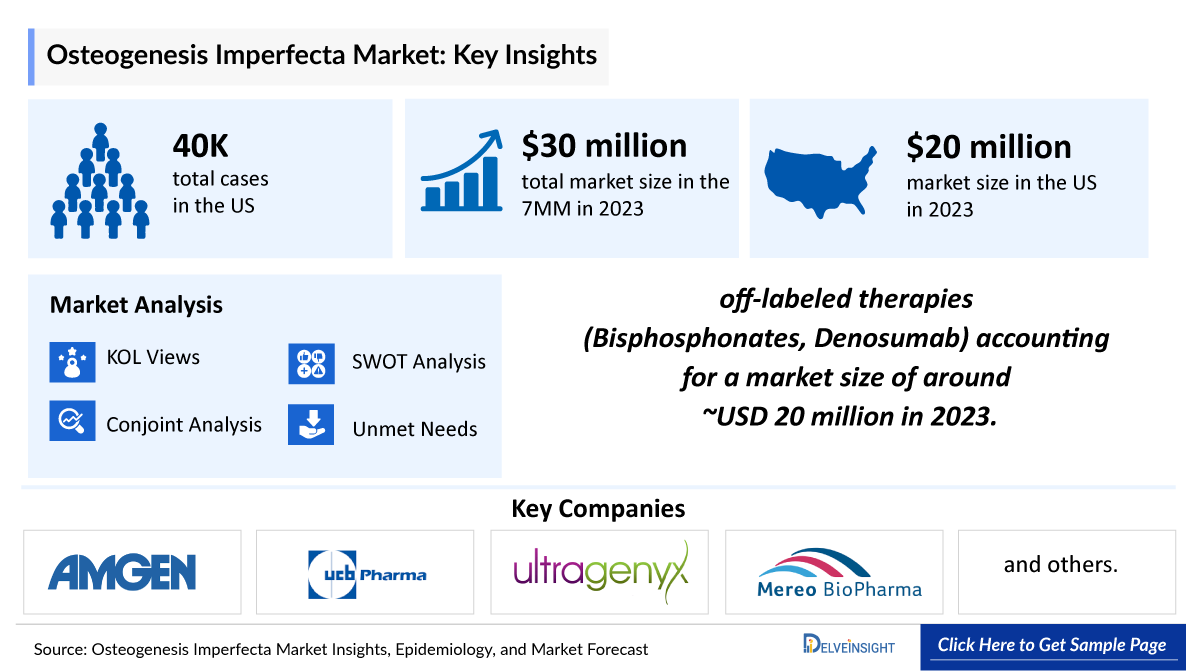
- The Osteogenesis Imperfecta market size was valued ~USD 30 million in 2023 and is anticipated to grow with a significant CAGR during the study period (2020-2034).
- The United States accounts for the largest Osteogenesis Imperfecta market size ~USD 20 million of Osteogenesis Imperfecta, in comparison to EU4 (Germany, Spain, Italy, France), the United Kingdom, and Japan.
- The Osteogenesis Imperfecta market is anticipated to witness a substantial positive shift owing to better uptake of existing drugs, the expected market launch of therapies, and raised awareness.
- The Osteogenesis Imperfecta companies developing therapies include - Amgen, UCB, Ultragenyx Pharmaceuticals, Mereo BioPharma, and others.
Osteogenesis Imperfecta Market & Epidemiology Insights
- Osteogenesis Imperfecta is a group of genetic disorders that mainly affect the development of bones. People with this condition have bones that break easily, often from little or no trauma.
- There are currently no US FDA or Europe-approved treatments for osteogenesis imperfecta. Treatment is directed toward preventing or controlling the symptoms.
- There are at least 19 recognized forms of osteogenesis imperfecta, designated type I through type XIX. Several types are distinguished by their signs and symptoms, although their characteristic features overlap.
- In 2023, there were about 72,400 prevalent cases of osteogenesis imperfecta across the 7MM.
- In 2023, the US accounted for ~55% of all prevalent cases of Osteogenesis Imperfecta, while the EU4 and the UK combined for ~35%, and Japan contributed only ~10% in the 7MM.
- Osteogenesis Imperfecta pipeline is not so robust but possesses potential drugs i.e. EVENITY (romosozumab) and Setrusumab (UX143).
-
EVENITY MoA is sclerostin inhibitor, and the drug is currently in phase III stage of development for treating bond-related disease.
- Osteogenesis imperfecta incidence varies globally, affecting approximately 1 in 10,000 to 20,000 births, with types ranging from mild to severe.
- Setrusumab Vs romosozumab target different pathways for Osteogenesis Imperfecta treatment, with Setrusumab focusing on bone formation and Romosozumab inhibiting sclerostin.
- In the 7MM, Setrusumab (UX143) is expected to garner the largest market revenue in the forecasted period.
- In April 2024, Ultragenyx Pharmaceutical announced that enrollment is complete for the Phase III Orbit and Cosmic studies of setrusumab (UX143) in Osteogenesis Imperfecta. The Orbit study has randomized 158 patients aged 5–25 years, while the cosmic study has enrolled 66 patients aged 2–7 years.
Request a sample to unlock the CAGR for "Osteogenesis Imperfecta Market Forecast"
Key Factors Driving Osteogenesis Imperfecta Market
-
Rising Prevalence and Diagnosis of Osteogenesis Imperfecta: Improved genetic testing, awareness, and early diagnosis of Osteogenesis Imperfecta are increasing patient identification, driving demand for targeted therapies and supportive care.
-
Advancements in Therapeutic Development: Novel treatments such as bone-targeted therapies, gene therapy candidates, and anabolic agents are progressing in the pipeline, fueling market growth by offering disease-modifying potential.
-
Growing Focus on Pediatric and Adult Care: Since Osteogenesis Imperfecta manifests early in life but requires lifelong management, increasing emphasis on long-term treatment strategies and improved quality of life drives sustained demand.
-
Expansion of Orphan Drug Incentives and Regulatory Support: Orphan drug designations, accelerated approvals, and government incentives are encouraging investment in rare disease therapies, increasing R&D activity in the Osteogenesis Imperfecta market.
-
Rising Awareness and Support Programs: Patient advocacy, educational campaigns, and better access to specialized care and diagnostic centers are improving disease management, thereby expanding market opportunities.
DelveInsight's “Osteogenesis Imperfecta Market Insights, Epidemiology and Market Forecast – 2034” report delivers an in-depth understanding of Osteogenesis Imperfecta, historical and forecasted epidemiology as well as the Osteogenesis Imperfecta therapeutics market trends in the United States, EU4 (Germany, Spain, Italy, and France) and the United Kingdom, and Japan.
Osteogenesis Imperfecta market report provides real-world prescription pattern analysis, emerging drugs, market share of individual therapies, and historical and forecasted 7MM Osteogenesis Imperfecta market size from 2020 to 2034. The report also covers current Osteogenesis Imperfecta treatment practices/algorithms and unmet medical needs to curate the best opportunities and assess the market’s underlying potential.
Scope of the Osteogenesis Imperfecta Market | |
|
Study Period |
2020 to 2034 |
|
Forecast Period |
2024-2034 |
|
Geographies Covered |
|
|
Osteogenesis Imperfecta Market |
|
|
Osteogenesis Imperfecta Market Size | |
|
Osteogenesis Imperfecta Companies |
Cosmo Pharmaceuticals, RedHill Biopharma, and others |
|
Osteogenesis Imperfecta Epidemiology Segmentation |
|
Osteogenesis Imperfecta Disease Understanding
Osteogenesis Imperfecta Overview
Osteogenesis imperfecta (OI), commonly referred to as brittle bone disease, is a genetic disorder primarily characterized by fragile bones that break easily, often with little or no trauma. This condition stems from abnormalities in the synthesis or processing of type I collagen, a crucial protein for bone strength and structure. The severity of Osteogenesis Imperfecta varies widely, with at least 19 recognized types, ranging from mild forms that may only cause a few fractures in a lifetime to severe types that can lead to multiple fractures even before birth. Other clinical manifestations include blue sclerae, short stature, hearing loss, and dental issues such as dentinogenesis imperfecta. The condition is inherited in various patterns, predominantly autosomal dominant, and its clinical presentation can significantly impact the quality of life for affected individuals.
Osteogenesis Imperfecta Diagnosis
Diagnosis of osteogenesis imperfecta typically involves a combination of clinical evaluation, family history assessment, and genetic testing. Healthcare providers look for characteristic signs such as frequent bone fractures, blue sclerae, and other skeletal deformities. Imaging studies like X-rays can reveal bone density and structural abnormalities. Genetic testing can confirm the diagnosis by identifying mutations in the COL1A1 or COL1A2 genes, which are responsible for most cases of Osteogenesis Imperfecta. The diagnosis may also involve ruling out other conditions that could mimic Osteogenesis Imperfecta symptoms. Early diagnosis is crucial for managing the condition effectively and preventing complications associated with bone fragility.
Further details related to country-based variations in diagnosis are provided in the report...
Osteogenesis Imperfecta Treatment
Treatment for osteogenesis imperfecta focuses on preventing fractures and managing symptoms, as there is currently no cure for the condition. Bisphosphonates are commonly prescribed to strengthen bones and reduce fracture risk. Other interventions may include physical therapy, orthopedic surgery, and the use of assistive devices to enhance mobility and independence. In severe cases, surgical procedures like rodding may be performed to stabilize long bones and prevent deformities.
Osteogenesis Imperfecta Epidemiology
The Osteogenesis Imperfecta epidemiology chapter in the report provides historical as well as forecasted in the 7MM covering the United States, EU4 countries (Germany, France, Italy, and Spain), the United Kingdom, and Japan from 2024 to 2034. The Osteogenesis Imperfecta epidemiology is segmented with detailed insights into Prevalent Cases, Diagnosed Cases, Gene-specific, Type-specific Cases of Osteogenesis Imperfecta.
Key Findings from Osteogenesis Imperfecta Epidemiological Analyses and Forecast
- In 2023, the prevalent population of Osteogenesis Imperfecta in the United States was found to be ~40.000 cases which, as per DelveInsight’s estimates, is expected to increase in the forecasted period.
- In the US, there were ~20,000 prevalent cases of COL1A1 gene mutation, ~7,000 cases of COL1A2 gene mutation, and cases of other mutations were ~800 in 2023.
- Germany had the highest prevalence of Osteogenesis Imperfecta among the EU4 and the UK, accounting for ~25% of cases, followed by the France with ~20%, in 2023.
- Osteogenesis imperfecta prevalence is estimated at 6 to 7 per 100,000 individuals worldwide, with varying severity across different genetic mutations.
- In 7MM, According to the analysis, in 2023, Japan's contribution to the total treated cases of Osteogenesis Imperfecta stood at a modest ~10%.
Osteogenesis Imperfecta Epidemiology Segmentation
- Prevalent Cases of Osteogenesis Imperfecta
- Diagnosed Cases of Osteogenesis Imperfecta
- Gene-specific Cases of Osteogenesis Imperfecta
- Type-specific Cases of Osteogenesis Imperfecta
- Total Treated Cases of Osteogenesis Imperfecta
Osteogenesis Imperfecta Drugs Analysis
The drug chapter segment of the Osteogenesis Imperfecta market report encloses a detailed analysis of Osteogenesis Imperfecta drugs market and late-stage (Phase III and Phase II) Osteogenesis Imperfecta pipeline drugs. It also deep dives into the Osteogenesis Imperfecta pivotal clinical trial details, recent and expected market approvals, patent details, the latest news, and recent deals and collaborations.
Osteogenesis Imperfecta Emerging Drugs
EVENITY (romosozumab): Amgen/UCB
Romosozumab-aqqg is a humanized monoclonal antibody (IgG2) produced in a mammalian cell line (Chinese hamster ovary) by recombinant DNA technology that binds to and inhibits sclerostin. EVENITY increases bone formation and, to a lesser extent, decreases bone resorption. Animal studies showed that romosozumab-aqqg stimulates new bone formation on trabecular and cortical bone surfaces by stimulating osteoblastic activity, resulting in increases in trabecular and cortical bone mass and improvements in bone structure and strength. It is approved by the FDA for the treatment of osteoporosis in postmenopausal women at high-risk for fracture.
Currently, it is being investigated in Phase III for the treatment of osteogenesis imperfecta in pediatric patients.
Setrusumab (UX143): Ultragenyx Pharmaceuticals/Mereo BioPharma
UX143 is an investigational, fully human monoclonal antibody that inhibits sclerostin, a protein that acts on a key bone-signaling pathway and inhibits the activity of bone-forming cells. By selectively binding to and inhibiting sclerostin, UX143 is designed to increase bone formation and density, increase the production of collagen, and increase bone mineral density and strength. Sclerostin inhibition also reduces excessive bone resorption, further improving bone density.
Currently, it is being investigated in Phase III for the treatment of osteogenesis imperfecta in pediatric patients.
Osteogenesis Imperfecta Market Outlook
Key players, such as Ultragenyx Pharmaceuticals, Mereo BioPharma, Amgen, UCB and others are evaluating their lead candidates in different stages of clinical development, respectively. They aim to investigate their products for the treatment of Osteogenesis Imperfecta.
Key findings from Osteogenesis Imperfecta Market Report
- The osteogenesis imperfecta market size in US was ~USD 20 million in 2023.
- Among the EU4 and the UK, Germany accounted for the highest market size of ~USD 2 million in 2023.
- The treatment mostly comprises off-labeled therapies (Bisphosphonates, Denosumab) accounting for a market size of around ~USD 20 million in 2023.
- Among the emerging therapies, Setrusumab (UX143) is expected to garner the largest market revenue.
Osteogenesis Imperfecta Competitive Landscape
The Osteogenesis Imperfecta (OI) market features a moderately competitive mix of multinational pharmaceutical companies, specialized biotechs, and emerging innovators working on both current treatment options and next‑generation therapies. Established companies like Amgen Inc., Novartis AG, Pfizer Inc., Eli Lilly and Company, Merck & Co., Inc., Sanofi S.A., and Bristol‑Myers Squibb are active in this space with bone‑strengthening agents and supportive care products, while Ultragenyx Pharmaceutical Inc. and Mereo BioPharma Group plc lead efforts on novel targeted biologics such as sclerostin inhibitors for increasing bone density. Smaller players and biotech firms are also contributing through innovative approaches, including cell therapies and gene‑focused research.
Competitive strategies include R&D investment in disease‑modifying agents, strategic partnerships and licensing agreements, and expanding global distribution, all aimed at enhancing patient outcomes and capturing share in a growing rare disease segment. Overall, the landscape is shaped by innovation, regulatory incentives (like orphan drug designations), and collaboration across industry and research institutions.
Key Osteogenesis Imperfecta Companies
The Key Osteogenesis Imperfecta companies actively involved in the Osteogenesis Imperfecta treatment landscape include -
- Amgen
- UCB
- Ultragenyx Pharmaceuticals
- Mereo BioPharma, and others
Osteogenesis Imperfecta Drugs Uptake
This section focuses on the uptake rate of potential Osteogenesis Imperfecta drugs expected to be launched in the Osteogenesis Imperfecta market during 2024–2034, which depends on the competitive landscape, safety, and efficacy data along with order of entry. It is important to understand that the key players evaluating their novel therapies in the pivotal and confirmatory trials should remain vigilant when selecting appropriate comparators to stand the greatest chance of a positive opinion from regulatory bodies, leading to approval, smooth launch, and rapid uptake.
Further detailed analysis of emerging therapies drug uptake in the report…
Osteogenesis Imperfecta Clinical Trial Activities
The Osteogenesis Imperfecta pipeline report provides insights into different Osteogenesis Imperfecta clinical trials within Phase III and Phase II stages. It also analyzes Osteogenesis Imperfecta key players involved in developing targeted therapeutics.
Osteogenesis Imperfecta Pipeline Development Activities
The Osteogenesis Imperfecta clinical trials analysis report covers information on collaborations, acquisitions and mergers, licensing, and patent details for Osteogenesis Imperfecta emerging therapies.
Latest KOL Views on Osteogenesis Imperfecta Market Report
To keep up with the real-world scenario in current and emerging market trends, we take opinions from Key Industry leaders working in the domain through primary research to fill the data gaps and validate our secondary research. Industry Experts were contacted for insights on the evolving treatment landscape, patient reliance on conventional therapies, patient therapy switching acceptability, and drug uptake along with challenges related to accessibility.
DelveInsight’s analysts connected with 15+ KOLs to gather insights; however, interviews were conducted with 9+ KOLs in the 7MM. Centers such as Johns Hopkins University, Pediatric Orthopedic and Spine Surgeon, etc., were contacted. Their opinion helps understand and validate current and emerging treatment patterns of Osteogenesis Imperfecta. This will support the clients in potential upcoming novel treatments by identifying the overall scenario of the market and the unmet needs.
Osteogenesis Imperfecta Report Qualitative Analysis
We perform Qualitative and market Intelligence analysis using various approaches, such as SWOT analysis and Conjoint Analysis. In the SWOT analysis, strengths, weaknesses, opportunities, and threats in terms of gaps in disease diagnosis, patient awareness, physician acceptability, competitive landscape, cost-effectiveness, and geographical accessibility of therapies are provided.
Conjoint Analysis analyzes multiple approved and emerging therapies based on relevant attributes such as safety, efficacy, frequency of administration, route of administration, and order of entry. Scoring is given based on these parameters to analyze the effectiveness of therapy.
In efficacy, the trial’s primary and secondary outcome measures are evaluated; one of the most important primary outcome measures is annualized rate of all radiographically-confirmed fractures, including morphometric vertebral fractures during the active-controlled period.
Further, the therapies’ safety is evaluated wherein the acceptability, tolerability, and adverse events are majorly observed, and it sets a clear understanding of the side effects posed by the drug in the trials. In addition, the scoring is also based on the probability of success, and the addressable patient pool for each therapy. According to these parameters, the final weightage score and the ranking of the emerging therapies are decided.
Osteogenesis Imperfecta Market Access and Reimbursement
The report further provides detailed insights on the country-wise accessibility and reimbursement scenarios, cost-effectiveness scenario of currently used therapies, programs making accessibility easier and out-of-pocket costs more affordable, insights on patients insured under federal or state government prescription drug programs, etc.
Scope of the Osteogenesis Imperfecta Market Report
- The report covers a segment of key events, an executive summary, descriptive overview of Osteogenesis Imperfecta, explaining its causes, signs and symptoms, pathogenesis, and currently available therapies.
- Comprehensive insight has been provided into the epidemiology segments and forecasts, the future growth potential of diagnosis rate, and disease progression along with country specific treatment guidelines.
- Additionally, an all-inclusive account of both the current and emerging therapies, along with the elaborative profiles of late-stage and prominent therapies, will have an impact on the current treatment landscape.
- A detailed review of the Osteogenesis Imperfecta market, historical and forecasted market size, market share by therapies, detailed assumptions, and rationale behind our approach is included in the report, covering the 7MM drug outreach.
- The report provides an edge while developing business strategies, by understanding trends, through SWOT analysis and expert insights/KOL views, patient journey, and treatment preferences that help in shaping and driving the 7MM Osteogenesis Imperfecta market.
Osteogenesis Imperfecta Market Report Insights
- Osteogenesis Imperfecta Patient Population
- Osteogenesis Imperfecta Therapeutic Approaches
- Osteogenesis Imperfecta Pipeline Analysis
- Osteogenesis Imperfecta Market Size and Trends
- Existing and future Market Opportunity
- Osteogenesis Imperfecta Drugs Market
Osteogenesis Imperfecta Market Report Key Strengths
- Eleven Years Forecast
- 7MM Coverage
- Osteogenesis Imperfecta Epidemiology Segmentation
- Inclusion of Country specific treatment guidelines
- KOL’s feedback on approved and emerging therapies
- Key Cross Competition
- Conjoint analysis
- Osteogenesis Imperfecta Drugs Uptake
- Key Osteogenesis Imperfecta Market Forecast Assumptions
Osteogenesis Imperfecta Market Report Assessment
- Current Osteogenesis Imperfecta Treatment Practices
- Osteogenesis Imperfecta Unmet Needs
- Osteogenesis Imperfecta Pipeline Product Profiles
- Osteogenesis Imperfecta Market Attractiveness
- Qualitative Analysis (SWOT and Conjoint Analysis)
- Osteogenesis Imperfecta Market Drivers
- Osteogenesis Imperfecta Market Barriers
FAQs Regarding the Osteogenesis Imperfecta Market Report:
- What is the growth rate of the 7MM Osteogenesis Imperfecta treatment market?
- What was the Osteogenesis Imperfecta total market size, the market size by therapies, market share (%) distribution in 2020, and what would it look like in 2034? What are the contributing factors/key catalysts for this growth?
- Is there any unexplored patient setting that can open the window for growth in the future?
- What are the pricing variations among different geographies for approved and off-label therapies?
- How would the market drivers, barriers, and future opportunities affect the market dynamics and subsequent analysis of the associated trends? Although multiple expert guidelines recommend testing for targetable mutations before therapy initiation, why do barriers to testing remain high?
- What are the current and emerging options for the treatment of Osteogenesis Imperfecta?
- How many Osteogenesis Imperfecta companies are developing therapies for the treatment of Osteogenesis Imperfecta?
- What are the recent novel therapies, targets, mechanisms of action, and technologies developed to overcome the limitations of existing therapies?
- Patient/physician acceptability in terms of preferred treatment options as per real-world scenarios?
- What are the country-specific accessibility issues of expensive, recently Osteogenesis Imperfecta capproved therapies?
Reasons to buy Osteogenesis Imperfecta Market Forecast Report
- The Osteogenesis Imperfecta market report will help in developing business strategies by understanding the latest trends and changing treatment dynamics driving the Osteogenesis Imperfecta Market.
- Insights on patient burden/disease prevalence, evolution in diagnosis, and factors contributing to the change in the epidemiology of the disease during the forecast years
- Understand the existing Osteogenesis Imperfecta market opportunities in varying geographies and the growth potential over the coming years.
- Distribution of historical and current patient share based on real-world prescription data along with reported sales of approved products in the US, EU4 (Germany, France, Italy, and Spain), the United Kingdom, and Japan.
- Identifying strong upcoming Osteogenesis Imperfecta companies in the Osteogenesis Imperfecta market will help devise strategies to help get ahead of competitors.
- Detailed analysis and ranking of class-wise potential current and emerging therapies under the conjoint analysis section to provide visibility around leading classes.
- Highlights of access and reimbursement policies of approved therapies, barriers to accessibility of expensive off-label therapies, and patient assistance programs.
- To understand Key Opinion Leaders’ perspectives around the accessibility, acceptability, and compliance-related challenges of existing treatment to overcome barriers in the future.
- Detailed insights on the unmet needs of the existing market so that the upcoming players can strengthen their development and launch strategy.