
overactive bladder pipeline insight
DelveInsight’s, “Overactive Bladder Pipeline Insight, 2026” report provides comprehensive insights about 11+ companies and 12+ pipeline drugs in Overactive Bladder pipeline landscape. It covers the pipeline drug profiles, including clinical and nonclinical stage products. It also 2026 the therapeutics assessment by product type, stage, route of administration, and molecule type. It further highlights the inactive pipeline products in this space.
Geography Covered
- Global coverage
Overactive Bladder Understanding
Overactive Bladder Overview
Overactive bladder (OAB) is a common symptom syndrome characterized by urinary urgency, usually accompanied by increased daytime urinary frequency and nocturia, with or without urgency urinary incontinence, in the absence of urinary tract infection or other obvious pathological conditions. Rather than representing a single disease entity, OAB encompasses a spectrum of storage symptoms that can substantially impair daily functioning, emotional well-being, sleep quality, work productivity, and overall quality of life. The condition affects both men and women across all age groups, although its prevalence increases with advancing age. Population-based studies estimate that OAB affects approximately 10–20% of adults worldwide, making it a significant public health concern.
The pathophysiology of OAB is complex and multifactorial, involving abnormalities in bladder sensory signaling, detrusor muscle activity, urothelial function, and central and peripheral nervous system regulation. Historically, OAB was primarily attributed to detrusor overactivity; however, accumulating evidence indicates that many patients with OAB do not exhibit detrusor overactivity on urodynamic testing. Contemporary research suggests that altered afferent nerve signaling from the urothelium and suburothelium, changes in bladder mechanosensation, autonomic nervous system dysfunction, metabolic disorders, hormonal changes, and chronic inflammation may all contribute to symptom development. Consequently, OAB is increasingly recognized as a heterogeneous syndrome with multiple underlying biological mechanisms rather than a single pathophysiological disorder.
The diagnosis of OAB is largely clinical and is based on symptom assessment after excluding urinary tract infection, bladder outlet obstruction, urinary stones, malignancy, and other identifiable causes of lower urinary tract symptoms. Patient evaluation typically includes a detailed medical history, physical examination, urinalysis, voiding diaries, and symptom questionnaires, while urodynamic studies are reserved for selected patients with complex presentations or those who fail initial therapy. Because OAB symptoms overlap with several other urological and neurological disorders, careful differential diagnosis is essential to ensure appropriate management.
Current management of OAB follows a stepwise approach that combines behavioral interventions, pharmacological therapy, and advanced treatment options for refractory cases. First-line management includes lifestyle modifications, bladder training, pelvic floor muscle exercises, and fluid management. Pharmacological treatment primarily consists of antimuscarinic agents and β3-adrenoceptor agonists, which improve bladder storage function by reducing involuntary detrusor contractions or enhancing bladder relaxation. Patients with persistent symptoms despite conservative and medical therapy may benefit from minimally invasive interventions such as intradetrusor botulinum toxin injections, sacral neuromodulation, or percutaneous tibial nerve stimulation. Ongoing advances in the understanding of OAB pathophysiology are facilitating the development of more personalized therapeutic strategies aimed at improving long-term symptom control and patient outcomes.
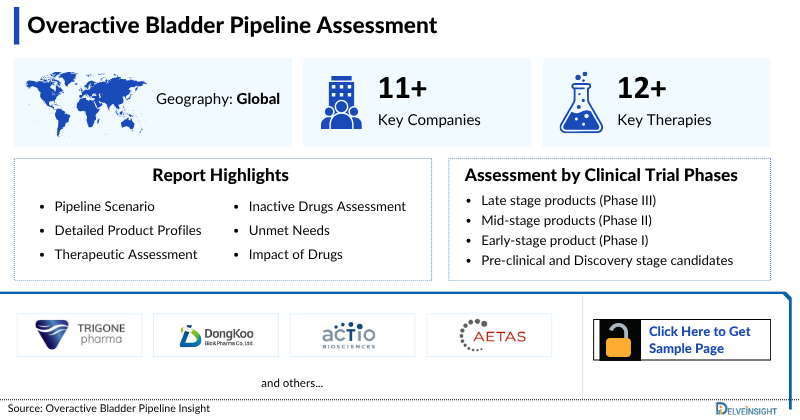
"Overactive Bladder Pipeline Insight, 2026" report by DelveInsight outlays comprehensive insights of present scenario and growth prospects across the indication. A detailed picture of the Overactive Bladder pipeline landscape is provided which includes the disease overview and Overactive Bladder treatment guidelines. The assessment part of the report embraces, in depth Overactive Bladder commercial assessment and clinical assessment of the pipeline products under development. In the report, detailed description of the drug is given which includes mechanism of action of the drug, clinical studies, NDA approvals (if any), and product development activities comprising the technology, Overactive Bladder collaborations, licensing, mergers and acquisition, funding, designations and other product related details.
Overactive Bladder Pipeline Report Highlights
- The companies and academics are working to assess challenges and seek opportunities that could influence Overactive Bladder R&D. The therapies under development are focused on novel approaches to treat/improve Overactive Bladder.
Overactive Bladder Emerging Drugs Analysis
This segment of the Overactive Bladder report encloses its detailed analysis of various drugs in different stages of clinical development, including phase II, I, preclinical and Discovery. It also helps to understand clinical trial details, expressive pharmacological action, agreements and collaborations, and the latest news and press releases.
Overactive Bladder Emerging Drugs
TRG-200: Trigone Pharma
TRG-200 is an investigational intravesical sustained-release formulation being developed by Trigone Pharma for the treatment of refractory overactive bladder. The therapy utilizes Trigone Pharma's proprietary localized drug delivery platform, in which a Carbopol-based gel matrix containing oxybutynin is instilled directly into the bladder via a urethral catheter. This approach is designed to provide prolonged local release of oxybutynin over an extended period while minimizing systemic drug exposure and reducing the anticholinergic adverse effects commonly associated with oral oxybutynin. TRG-200 is currently being evaluated in a Phase II open-label clinical trial investigating two dose levels (150 mg and 300 mg) administered as monthly intravesical instillations to assess its safety, tolerability, pharmacokinetics, and preliminary efficacy in patients with refractory OAB.
DKB17001: DongKoo Bio & Pharma
DKB17001 is an investigational oral fixed-dose combination therapy being developed by DongKoo Bio & Pharma for the treatment of patients with overactive bladder. DKB-17001 is a fixed dose combination of mirabegron and tamsulosin hydrochloride and is an incrementally modified drug. Mirabegron acts by targeting beta adrenergic receptor and tamsulosin hydrochloride acts by targets alpha-1 adrenergic receptor. The candidate has completed preclinical studies and a Phase I drug–drug interaction (DDI) study, with additional pharmacokinetic evaluation and late-stage clinical development planned in South Korea.
Further product details are provided in the report……..
Overactive Bladder Drug Therapeutic Assessment
This segment of the report provides insights about the different Overactive Bladder drugs segregated based on following parameters that define the scope of the report, such as:
Major Overactive Bladder Players in Overactive Bladder
There are approx. 11+ key companies which are developing the therapies for Overactive Bladder. The companies which have their Overactive Bladder drug candidates in the most advanced stage, i.e. phase II include, Trigone Pharma.
Overactive Bladder Clinical Trial Phases
DelveInsight’s report covers around 12+ products under different phases of clinical development like
- Late stage products (Phase III)
- Mid-stage products (Phase II)
- Early-stage product (Phase I) along with the details of
- Pre-clinical and Discovery stage candidates
- Discontinued & Inactive candidates
Overactive Bladder Drug Route of Administration
Overactive Bladder pipeline report provides the therapeutic assessment of the pipeline drugs by the Route of Administration. Products have been categorized under various ROAs such as
- Oral
- Intravenous
- Subcutaneous
- Parenteral
- Topical
Overactive Bladder Product Molecule Type
Products have been categorized under various Molecule types such as
- Recombinant fusion proteins
- Small molecule
- Monoclonal antibody
- Peptide
- Polymer
- Gene therapy
Overactive Bladder Product Type
Drugs have been categorized under various product types like Mono, Combination and Mono/Combination.
Overactive Bladder Clinical Trial Activities
The Overactive Bladder Pipeline report provides insights into different Overactive Bladder Clinical Trial within phase II, I, preclinical and discovery stage. It also analyses Overactive Bladder therapeutic drugs key players involved in developing key drugs.
Overactive Bladder Pipeline Development Activities
The Overactive Bladder Clinical Trial Analysis report covers the detailed information of collaborations, acquisition and merger, licensing along with a thorough therapeutic assessment of emerging Overactive Bladder drugs.
Overactive Bladder Report Insights
- Overactive Bladder Pipeline Analysis
- Overactive Bladder Therapeutic Assessment
- Overactive Bladder Unmet Needs
- Impact of Overactive Bladder Drugs
Overactive Bladder Report Assessment
- Overactive Bladder Pipeline Product Profiles
- Overactive Bladder Therapeutic Assessment
- Overactive Bladder Pipeline Assessment
- Overactive Bladder Inactive drugs assessment
- Overactive Bladder Market Unmet Needs
Key Questions Answered in the Overactive Bladder Pipeline Report
- Current Treatment Scenario and Emerging Therapies:
- How many companies are developing Overactive Bladder drugs?
- How many Overactive Bladder drugs are developed by each company?
- How many emerging drugs are in mid-stage, and late-stage of development for the treatment of Overactive Bladder?
- What are the key collaborations (Industry–Industry, Industry–Academia), Mergers and acquisitions, licensing activities related to the Overactive Bladder therapeutics?
- What are the recent trends, drug types and novel technologies developed to overcome the limitation of existing therapies?
- What are the clinical studies going on for Overactive Bladder and their status?
- What are the key designations that have been granted to the emerging drugs?
Overactive Bladder Key Players
- Trigone Pharma
- DongKoo Bio & Pharma
- Actio Biosciences
- Aetas Pharma
Overactive Bladder Key Products
- TRG-200
- DKB17001
- ABS 0871
- AK14
-market.png&w=256&q=75)
-market.png&w=256&q=75)