
Parkinson’s disease Pipeline Summary
- According to DelveInsight’s analysis, the Parkinson’s Disease Pipeline is witnessing robust growth, driven by a deeper understanding of the disease's underlying pathophysiology and an urgent need for disease-modifying therapies.
- The leading Parkinson's Disease Companies, such as Roche, Prothena Biosciences, Biohaven Pharmaceuticals, Neuraly Inc, FAScinate Therapeutics, Cerevance, Hillhurst Biopharmaceuticals, Inc., Endurance Bio, Enterin Inc., Jazz Pharmaceuticals plc, Mthera Pharma Co., Ltd., TrueBinding, IRLAB, Annovis Bio Inc, Neuron23, Forest Hills Lab, Ventyx Biosciences, HanAll Biopharma, Lundbeck, Sanofi, ABL Bio, Contera Pharma, Eli Lilly and Company, Asceneuron SA, Allyx Therapeutics, Inc., Ventus Therapeutics, and others.
Request for Unlocking the Sample Page of the "Parkinson's Disease Pipeline"
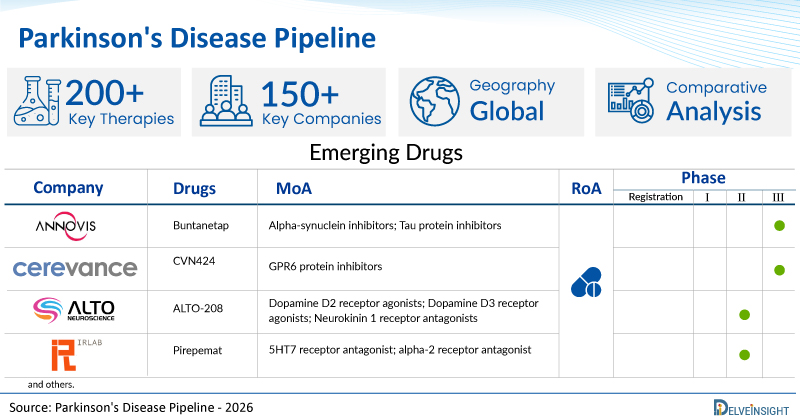
DelveInsight’s, “Parkinson’s Disease Pipeline Insight, 2026” report provides comprehensive insights about 150+ companies and 200+ pipeline drugs in Parkinson’s Disease pipeline landscape. It covers the pipeline drug profiles, including clinical and nonclinical stage products. It also covers the therapeutics assessment by product type, stage, route of administration, and molecule type. It further highlights the inactive pipeline products in this space.
Geography Covered
- Global coverage
Parkinson’s Disease Understanding
Parkinson’s Disease Overview
Parkinson’s disease is a chronic, progressive neurodegenerative disorder that primarily affects movement and coordination. It results from the gradual loss of dopamine-producing neurons in the brain, leading to characteristic motor and non-motor symptoms. The disease typically develops in older adults and progresses slowly, with symptoms worsening over time. Although not curable, available treatments can effectively manage symptoms and improve quality of life.
Parkinson’s disease is caused by a combination of genetic and environmental factors that lead to progressive neuronal damage. Advancing age is the strongest risk factor, while inherited mutations in genes such as SNCA, LRRK2, PARK2, PINK1, and DJ-1 contribute to familial forms of the disease. Environmental exposures, including pesticides, heavy metals, and other neurotoxins, are also implicated in increasing disease risk.
The disease is characterized by degeneration of dopamine-producing neurons in the substantia nigra pars compacta, resulting in reduced dopamine levels in the nigrostriatal pathway. This dopamine deficiency disrupts basal ganglia circuits responsible for motor control. Additionally, abnormal aggregation of misfolded α-synuclein protein leads to the formation of Lewy bodies, contributing to neuronal dysfunction, inflammation, and progressive neurodegeneration.
Parkinson’s disease presents with hallmark motor symptoms such as resting tremor, bradykinesia, muscular rigidity, and postural instability. Non-motor manifestations are common and include depression, anxiety, cognitive impairment, sleep disturbances, autonomic dysfunction (e.g., constipation, orthostatic hypotension), fatigue, and loss of smell, often preceding motor symptoms.
Diagnosis is primarily clinical, based on the presence of characteristic motor features and their progression over time, supported by a positive response to dopaminergic therapy. Neuroimaging, such as dopamine transporter (DAT) single-photon emission computed tomography (SPECT), may be used to support the diagnosis or differentiate Parkinson’s disease from other movement disorders, while routine imaging is mainly used to exclude secondary causes.
Management focuses on symptomatic control, as no curative therapy currently exists. Pharmacologic treatment includes levodopa combined with carbidopa, dopamine agonists, MAO-B inhibitors, and COMT inhibitors to enhance dopaminergic activity. In advanced disease, deep brain stimulation or continuous infusion therapies may be considered. Non-pharmacological approaches, including physiotherapy, occupational therapy, speech therapy, and psychosocial support, play an essential role in improving functional ability and quality of life.
"Parkinson’s Disease Pipeline Insight, 2026" report by DelveInsight outlays comprehensive insights of present scenario and growth prospects across the indication. A detailed picture of the Parkinson’s Disease pipeline landscape is provided which includes the disease overview and Parkinson’s Disease treatment guidelines. The assessment part of the report embraces, in depth Parkinson’s Disease commercial assessment and clinical assessment of the pipeline products under development. In the Parkinson’s disease Pipeline Report, a detailed description of the drug is given which includes mechanism of action of the drug, Parkinson’s disease Clinical Studies, NDA approvals (if any), and product development activities comprising the technology, Parkinson’s Disease collaborations, licensing, mergers and acquisition, funding, designations and other product related details.
Parkinson’s Disease Pipeline Report Highlights
- The Parkinson’s disease Companies and academics are working to assess challenges and seek opportunities that could influence Parkinson’s Disease R&D. The therapies under development are focused on novel approaches to treat/improve Parkinson’s Disease.
Parkinson’s Disease Emerging Drugs Analysis
This segment of the Parkinson’s Disease Pipeline report encloses its detailed analysis of various drugs in different stages of clinical development, including phase II, I, preclinical and Discovery. It also helps to understand Parkinson’s disease Clinical Trial details, expressive pharmacological action, agreements and collaborations, and the latest news and press releases.
Parkinson’s Disease Emerging Drugs
-
Prasinezumab: Roche/Prothena Biosciences
Prasinezumab is an investigational monoclonal antibody designed to bind aggregated alpha-synuclein and thereby reduce neuronal toxicity. By reducing the build-up of alpha-synuclein protein in the brain, prasinezumab can potentially prevent further accumulation and spreading between cells, which may slow progression of the disease. The safety database for prasinezumab consists of data from more than 900 Parkinson’s disease study participants that have been treated with the investigational medicine, of which more than 750 remain in open label treatment with over 500 treated for 1.5-5 years. The drug is currently in Phase III of its clinical development for the treatment of patients with Parkinson's disease.
-
Buntanetap: Annovis Bio
Buntanetap targets neurodegeneration by inhibiting the formation of multiple neurotoxic proteins, including amyloid beta, tau, alpha-synuclein, and TDP43. By improving synaptic transmission, axonal transport, and reducing neuroinflammation, Buntanetap aims to reverse neurodegeneration in AD, PD, and other neurodegenerative diseases, thereby aiming to restore brain function and improve the quality of life for patients. The drug is currently in Phase III stage of its clinical development for the treatment of patients with Parkinson's disease.
-
NEU 411: Neuron23
NEU‑411 is an orally available, brain-penetrant small-molecule inhibitor of the kinase LRRK2, being developed by Neuron23, Inc. for Parkinson’s disease. It is designed for the subset of patients with LRRK2-driven PD whether through LRRK2 mutations or predictive SNPs where over activity of LRRK2 is believed to contribute to disease progression. Currently, the drug is in the Phase II stage of its clinical trial for the treatment of Parkinson’s disease.
-
VTX3232: Ventyx Biosciences
VTX3232 is an oral, brain-penetrant inhibitor of the NLRP3 inflammasome, developed to target neuroinflammation in Parkinson’s disease by reducing harmful signaling from microglial activation. It crosses the blood–brain barrier, maintains plasma and cerebrospinal fluid concentrations above the inhibitory threshold for NLRP3, and thereby aims to not only ease motor/non-motor symptoms but modify underlying disease progression. Currently, the drug is in Phase II stage of its clinical trial for the treatment of Parkinson’s disease
-
ANPD001: Aspen Neuroscience
ANPD001, developed by Aspen Neuroscience, is an investigational autologous cell-therapy for Parkinson’s disease that uses a patient’s own skin cells reprogrammed into induced pluripotent stem cells (iPSCs), then differentiated into dopaminergic neuronal precursor cells (DANPCs) for implantation. Currently, the drug is in Phase I/II stage of its clinical trial for the treatment of Parkinson’s disease
-
Lu AF28996: Lundbeck
Lu AF28996 is an investigational small-molecule therapy developed by H. Lundbeck A/S for the treatment of Parkinson’s disease. It is designed as a dual dopamine D1 and D2 receptor agonist, providing concerted stimulation of both receptor subtypes to restore dopaminergic signaling and improve motor control in patients with Parkinson’s disease. This mechanism of action aims to compensate for dopamine deficiency in the nigrostriatal pathway, thereby alleviating motor symptoms such as bradykinesia and rigidity. Lu AF28996 is formulated for oral administration, typically delivered as a capsule taken once daily.
Currently, the drug is in Phase I stage of its clinical trial for the treatment of Parkinson’s disease
Parkinson’s Disease Therapeutic Assessment
This segment of the Parkinson’s disease pipeline report provides insights about the different Parkinson’s Disease drugs segregated based on following parameters that define the scope of the report, such as:
Major Players in Parkinson’s Disease
- There are approx. 150+ key companies which are developing the therapies for Parkinson’s Disease. The Parkinson’s disease Companies which have their Parkinson’s Disease drug candidates in the most advanced stage, i.e. phase III include, Roche, Prothena Biosciences, and others.
Parkinson’s Disease Phases
DelveInsight’s Parkinson’s disease Pipeline Report covers around 200+ products under different phases of clinical development like
- Late stage products (Phase III)
- Mid-stage products (Phase II)
- Early-stage product (Phase I) along with the details of
- Pre-clinical and Discovery stage candidates
- Discontinued & Inactive candidates
Parkinson’s Disease Route of Administration
Parkinson’s Disease pipeline report provides the therapeutic assessment of the pipeline drugs by the Route of Administration. Products have been categorized under various ROAs such as
- Oral
- Intravenous
- Subcutaneous
- Parenteral
- Topical
Parkinson’s Disease Molecule Type
Parkinson’s disease Products have been categorized under various Molecule types such as
- Recombinant fusion proteins
- Small molecule
- Monoclonal antibody
- Peptide
- Polymer
- Gene therapy
Parkinson’s Disease Product Type
Parkinson’s disease Drugs have been categorized under various product types like Mono, Combination and Mono/Combination.
Parkinson’s Disease Clinical Trial Activities
The Parkinson’s Disease Pipeline report provides insights into different Parkinson’s Disease clinical trials within phase II, I, preclinical and discovery stage. It also analyses Parkinson’s Disease therapeutic drugs involved in developing key drugs.
Parkinson’s Disease Pipeline Development Activities
The Parkinson’s Disease pipeline report analysis covers the detailed information of collaborations, acquisition and merger, licensing along with a thorough therapeutic assessment of emerging Parkinson’s Disease drugs.
Parkinson’s Disease Pipeline Report Insights
- Parkinson’s Disease Pipeline Analysis
- Parkinson’s Disease Therapeutic Assessment
- Parkinson’s Disease Unmet Needs
- Impact of Parkinson’s Disease Drugs
Parkinson’s Disease Pipeline Report Assessment
- Parkinson’s Disease Pipeline Product Profiles
- Parkinson’s Disease Therapeutic Assessment
- Parkinson’s Disease Pipeline Assessment
- Parkinson’s Disease Inactive drugs assessment
- Parkinson’s Disease Market Unmet Needs
Key Questions Answered In The Parkinson’s Disease Pipeline Report:
Current Parkinson’s Disease Treatment Scenario and Emerging Therapies:
- How many companies are developing Parkinson’s Disease drugs?
- How many Parkinson’s Disease drugs are developed by each company?
- How many emerging drugs are in mid-stage, and late-stage of development for the treatment of Parkinson’s Disease?
- What are the key collaborations (Industry–Industry, Industry–Academia), Mergers and acquisitions, licensing activities related to the Parkinson’s Disease therapeutics?
- What are the recent trends, drug types and novel technologies developed to overcome the limitation of existing therapies?
- What are the clinical studies going on for Parkinson’s Disease and their status?
- What are the key designations that have been granted to the emerging drugs?
Parkinson’s Disease Companies
- Roche
- Prothena Biosciences
- Biohaven Pharmaceuticals
- Neuraly Inc
- FAScinate Therapeutics
- Cerevance
- Hillhurst Biopharmaceuticals, Inc.
- Endurance Bio
- Enterin Inc.
- Jazz Pharmaceuticals plc
- Mthera Pharma Co., Ltd.
- TrueBinding
- IRLAB
- Annovis Bio Inc
- Neuron23
- Forest Hills Lab
- Ventyx Biosciences
- HanAll Biopharma
- Lundbeck
- Sanofi
- ABL Bio
- Contera Pharma
- Eli Lilly and Company
- Asceneuron SA
- Allyx Therapeutics, Inc.
- Ventus Therapeutics
Parkinson’s Disease Pipeline Report Key Products
- Prasinezumab
- Buntanetap
- NLY01
- CVN424
- Mesdopetam
- BHV-8000
- KM-819
- HBI-002
- T-168
- ENT-01
- JZP385
- MT101-5
- TB006
- NEU 411
- FHL-301
- VTX3232
- ATH-399A
- Lu AF28996
- ABL301
- CP-012
- LY4006896
- ASN51
- ASN90
- ALX-001
- VENT-02
Stay updated with us for Recent Articles
- The Future of Parkinson’s Disease Treatment: Unlocking the Potential of Cell and Gene Therapy
- Analyzing the Potential of AAV2-GDNF Gene Therapy in Parkinson's Disease Treatment: Insights from Phase Ib Trial Data
- Analyzing ABBV-951 for Parkinson’s Disease: A Promise in Addressing Motor Fluctuations and Enhancing Quality of Life
- Risvodetinib: A Promising Breakthrough in Parkinson’s Disease Treatment
- Target Engagement of UB-312 in Parkinson's Disease Patients: Insights from CSF Analysis
- Advancing Parkinson's Disease Treatment: P2B001 Offers Promising Safety Profile in Early PD Patients
- What Lies Ahead For Parkinson’s Disease Psychosis Treatment Market?
- Most Promising Therapies in the Parkinson’s Disease Treatment Market
- Evaluation of Rapidly Evolving Parkinson’s Disease Therapeutic Market
- Cell and Gene Therapy in Parkinson’s Disease Market Infographics
- New DelveInsight Blogs


