
Parkinson's Disease Related Dementia Market Summary
- The Parkinson’s Disease-related Dementia Market Size is expected to maintain steady growth from 2025 to 2034, driven by rising disease recognition, increasing prevalence in aging populations, greater clinical awareness, and continued R&D into targeted therapies for this progressive neurodegenerative condition.
- The leading Parkinsons Disease Related Dementia Companies developing therapies include - Anavex Life Sciences, Roche, AbbVie, Novartis, Pfizer, UCB Pharma, and others.
Parkinsons Disease Related Dementia Market & Epidemiology Forecast
- EXELON PATCH (rivastigmine) is the only FDA approved medication for the treatment of mild to moderate PD dementia. It inhibits both butyrylcholinesterase and acetylcholinesterase, unlike donepezil, which selectively inhibits acetylcholinesterase, and is available as transdermal patch. Its generic versions are available from manufacturers like Alvogen, Amneal, and Mylan.
- The drug pipeline for Parkinsons Disease Related Dementia remains limited, with ANAVEX 2-73 (blarcamesine) by Anavex Life Sciences standing out as a key investigational candidate. This underscores the urgent need for therapies that move beyond symptomatic management to directly address the complex neurodegenerative processes driving the disease.
- According to Parkinson’s Foundation (2024), over 10 million people worldwide are living with Parkinson’s disease, a condition that increases with age, though an estimated 4% of people are diagnosed before age 50. Additionally, men are 1.5 times more likely to develop Parkinson's disease than women.
- About 70% of Parkinson’s disease patients eventually develop dementia, highlighting the significant cognitive burden associated with the progression of the disease.
- Market growth is driven by the development of novel agents targeting the neurodegenerative processes and cognitive decline associated with Parkinson’s disease dementia. While current treatment relies largely on symptomatic management and off-label cognitive enhancers, innovation is spurred by limited therapeutic efficacy, high disease burden, and the absence of approved disease-specific therapies.
Request for unlocking the Sample Page of the "Parkinsons Disease Related Dementia Market Insights"
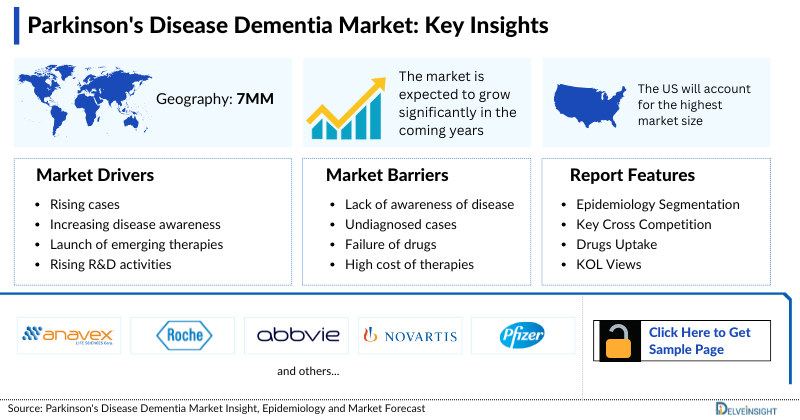
Key Factors Driving the Parkinsons Disease Related Dementia Market
- Rising Prevalence of Parkinson’s Disease and Aging Population: The steady increase in Parkinson’s disease cases, particularly among individuals aged 60 and above, is significantly contributing to the growing burden of Parkinson’s Disease–Related Dementia (PDD). As global life expectancy rises, the number of patients progressing to cognitive impairment continues to expand.
- Advancements in Diagnostic Tools and Early Identification: Improved clinical assessment methods, neuroimaging advancements, and biomarker research are enabling earlier and more accurate diagnosis of PDD. This helps improve treatment initiation and increases the demand for effective therapeutic options.
- Growing Therapeutic Pipeline and Research Investments: Multiple pharmaceutical companies are investigating novel candidates, including disease-modifying therapies, cholinesterase inhibitors, and drugs targeting α-synuclein pathology. Increased R&D funding and active clinical trials are propelling innovation in this domain.
- Rising Awareness and Improved Clinical Understanding: Enhanced understanding of disease progression, differentiation between Parkinson’s dementia and other cognitive disorders, and structured clinical guidelines are supporting better patient management and driving treatment uptake.
- Increasing Demand for Effective Symptomatic and Neuroprotective Therapies: Current treatment options provide limited symptomatic relief, creating a substantial unmet medical need. This gap is accelerating the demand for advanced therapies that can slow cognitive decline, improve memory, and enhance behavioral outcomes.
- Supportive Healthcare Infrastructure and Policy Initiatives: Improved access to neurologists, memory-care services, and supportive reimbursement policies in major markets are facilitating earlier intervention and expanding the overall market potential.
DelveInsight’s comprehensive report titled “Parkinsons Disease Related Dementia Market Insights, Epidemiology, and Market Forecast – 2034” offers a detailed analysis of Parkinsons Disease Related Dementia. The report presents historical and projected epidemiological data covering total prevalent cases of Parkinson’s disease, Total Diagnosed Prevalent Cases of Parkinsons Disease Related Dementia, gender-specific cases of Parkinsons Disease Related Dementia, age-specific cases of Parkinsons Disease Related Dementia, severity-specific cases of Parkinsons Disease Related Dementia and total treated cases of Parkinsons Disease Related Dementia. In addition to epidemiology, the market report encompasses various aspects related to the patient population. These aspects include the diagnosis process, prescription patterns, physician perspectives, market accessibility, treatment options, and prospective developments in the market across seven major markets: the United States, EU4 (Germany, France, Italy, and Spain), the United Kingdom, and Japan, spanning from 2020 to 2034.
The Parkinsons Disease Related Dementia Treatment Market Report analyzes the existing treatment practices and unmet medical requirements in Parkinsons Disease Related Dementia. It evaluates the market potential and identifies potential business prospects for enhancing therapies or interventions. This valuable information enables stakeholders to make well-informed decisions regarding product development and strategic planning for the market.
Scope of the Parkinsons Disease Related Dementia Market | |
|
Study Period |
2020 to 2034 |
|
Forecast Period |
2025-2034 |
|
Geographies Covered |
|
|
Parkinsons Disease Related Dementia Market |
|
|
Parkinsons Disease Related Dementia Market Size | |
|
Parkinsons Disease Related Dementia Companies |
Anavex Life Sciences, Roche, AbbVie, Novartis, Pfizer, UCB Pharma, and others |
|
Parkinsons Disease Related Dementia Epidemiology Segmentation |
|
Parkinsons Disease Related Dementia Disease Understanding
Parkinsons Disease Related Dementia Overview
Parkinsons Disease Related Dementia is a progressive decline in cognitive function that occurs at least a year after a Parkinson’s diagnosis. While the disease initially affects movement causing tremors, stiffness, and slowed motion—it can later impair memory, attention, judgment, and planning as brain changes spread. The primary brain changes in Parkinson’s disease and Parkinson’s disease dementia involve abnormal microscopic deposits primarily made of alpha-synuclein, a common brain protein with an unclear normal function. These deposits, known as “Lewy bodies,” were named after Dr. Frederick H. Lewy, who identified them in the early 1900s while working in Dr. Alois Alzheimer’s lab.
Parkinsons Disease Related Dementia Diagnosis
There is no definitive test or combination of tests that can confirm Parkinsons Disease Related Dementia with certainty. Diagnosis is typically based on clinical criteria. When dementia develops at least one year or often several years after the onset of motor symptoms such as tremors or movement changes associated with Parkinson’s disease, the condition is classified as Parkinson’s disease dementia. Diagnosis involves a detailed assessment of symptom onset, medical and family history, medications, and may include lab tests, imaging, and neuropsychological evaluations. This helps differentiate Parkinsons Disease Related Dementia from similar conditions like Lewy body dementia.
Parkinsons Disease Related Dementia Treatment Algorithm
There are currently no treatments available to slow or halt the progression of brain cell damage in Parkinson’s disease dementia. Management primarily focuses on symptom relief, with medication plans tailored to each individual. Cholinesterase inhibitors, commonly used in Alzheimer’s, may help address cognitive decline, hallucinations, and behavioral issues. Carbidopa-levodopa can improve motor symptoms, but may worsen confusion or hallucinations in some patients.
Other supportive treatments include SSRIs for managing depression and clonazepam or melatonin for REM sleep behavior disorder. Deep brain stimulation (DBS) is not recommended for Parkinson’s disease dementia due to limited evidence on safety and efficacy, although early studies suggest potential future use pending further research.
Parkinsons Disease Related Dementia Epidemiology
The Parkinsons Disease Related Dementia epidemiology section of the market report offers information on the patient populations, including historical and projected trends for each of the seven major markets. Examining key opinion leader views from physicians or clinical experts can assist in identifying the reasons behind historical and projected trends. The diagnosed patient pool, their trends, and the underlying assumptions are all included in this section of the report. This section also presents the data with relevant tables and graphs, offering a clear and concise view of the prevalence of Parkinsons Disease Related Dementia. Additionally, the report discloses the assumptions made during the analysis, ensuring data interpretation and presentation transparency. This Parkinsons Disease Related Dementia Epidemiological data is valuable for understanding the disease burden and its impact on the Parkinsons Disease Related Dementia Patient Population across various regions.
Key Findings from the Parkinsons Disease Related Dementia Epidemiological Analysis
- According to Parkinson’s Foundation (2024), nearly one million people in the US are living with Parkinson's disease, a number expected to rise to 1.2 million by 2030. Parkinson's is the second-most common neurodegenerative disease after Alzheimer's, with nearly 90,000 new diagnoses each year in the US.
- A study by Gallagher et al. (2024) showed that dementia develops less frequently and later in Parkinson's disease than previously reported. At 10 years, dementia probability was 9-15%, rising to 27% at 10 years, 50% at 15 years, and 74% at 20 years, suggesting a slower progression than earlier studies indicated.
- As per the study by Bock et al. (2022), the prevalence of PD-MCI ranges from 20% to 40% depending on the population studied. The incidence of PD-dementia increases with duration of disease, with estimates growing from 3% to 30% of individuals followed for 5 years or less to over 80% after 20 years.
- The epidemiology of Parkinsons Disease Related Dementia is expected to change during the forecast period (2025-2034).
Parkinsons Disease Related Dementia Drug Analysis
Emerging Parkinsons Disease Related Dementia Drugs
The Parkinsons Disease Related Dementia market is expected to evolve gradually, driven by the limited number of emerging therapies currently in development. Key players such as ANAVEX2-73 (blarcamesine) by Anavex Life Sciences, among others are showing active commitment to addressing this unmet need, with ongoing efforts to advance novel treatment options for this complex condition.
-
ANAVEX2-73 (blarcamesine): Anavex Life Sciences
ANAVEX2-73 (blarcamesine) is an oral small-molecule activator of the sigma-1 receptor (SIGMAR1), which data suggests is pivotal to restoring neural cell homeostasis and promoting neuroplasticity.
In March 2023, a Phase II extension study demonstrated the clinical benefits of ANAVEX2-73 in Parkinson’s disease dementia (PDD) both primary and secondary objectives. The data from these studies suggest that ANAVEX2-73 is well-tolerated and shows promising effects in disease-modifying models of Parkinson’s. ANAVEX2-73 demonstrated significant motor recovery, neurophysiological improvement, and reduced microglial activation key Parkinson’s biomarkers without dystonia or abnormal behaviors in animal studies.
Note: Detailed emerging therapies assessment will be provided in the final report.
Parkinsons Disease Related Dementia Market Outlook
The Parkinsons Disease Related Dementia therapeutics market is projected to grow steadily during the forecast period (2025–2034), driven by a rising prevalence among hemodialysis patients along with increasing awareness, technological advancements, and the anticipated launch of novel therapies targeting this high-risk, underserved population. With ongoing research and continued commitment, there is growing optimism for more effective treatments and potentially a cure for Parkinsons Disease Related Dementia, a life-threatening and underserved condition. According to DelveInsight, the Parkinsons Disease Related Dementia market in the 7MM is expected to change significantly during the forecast period 2025–2034.
Key Findings
This section includes a glimpse of the Bladder cancer market in 7MM.
The United States: Bladder Cancer Market Outlook
This section provides the total Bladder cancer market size and market size by therapies in the United States.
EU-5 Countries: Bladder Cancer Market Outlook
The total Bladder cancer market size and market size by therapies in Germany, France, Italy, Spain, and the United Kingdom is provided in this section.
Japan Bladder Cancer Market Outlook
The total Bladder cancer market size and market size by therapies in Japan is also mentioned.
Parkinsons Disease Related Dementia Competitive Landscape
The Parkinson’s Disease‑Related Dementia market is increasingly active, with a mix of established pharmaceutical giants, biotech innovators, and emerging technology players competing across symptomatic treatments, diagnostics, and early‑stage neuroprotective candidates. The market is growing steadily due to rising Parkinson’s prevalence and greater focus on cognitive complications of the disease.
Key Parkinsons Disease Related Dementia Companies In The Treatment Market
Major Parkinsons Disease Related Dementia pharmaceutical companies with current products or active R&D in Parkinsons Disease Related Dementia and related cognitive/behavioral symptoms include:
- Anavex Life Sciences
- Roche
- AbbVie
- Novartis
- Pfizer
- UCB Pharma, and others
Parkinsons Disease Related Dementia Market Segmentation
DelveInsight’s ‘Parkinsons Disease Related Dementia Market Insights, Epidemiology, and Market Forecast – 2034’ report provides a detailed outlook of the current and future Parkinsons Disease Related Dementia market, segmented within countries, by therapies, and by classes. Further, the market of each region is then segmented by each therapy to provide a detailed view of the current and future market share of all therapies.
Parkinsons Disease Related Dementia Market Size by Countries
The Parkinsons Disease Related Dementia market size is assessed separately for various countries, including the United States, EU4 (Germany, France, Italy, and Spain), the UK, and Japan. In 2024, the United States held a significant share of the overall 7MM (Seven Major Markets) Parkinsons Disease Related Dementia market, primarily attributed to the country’s higher incidence of the condition and the elevated cost of the available treatments. This dominance is projected to persist, especially with the potential introduction of new products.
Parkinsons Disease Related Dementia Market Size by Therapies
Parkinsons Disease Related Dementia Market Size by Therapies is categorized into current and emerging markets for the study period 2020–2034.
Note: Detailed market segment assessment will be provided in the final report...
Parkinsons Disease Related Dementia Drugs Uptake
This section focuses on the rate of uptake of the potential Parkinsons Disease Related Dementia drugs recently launched in the Parkinsons Disease Related Dementia treatment market or expected to get launched in the market during the study period 2020-2034. The analysis covers Parkinsons Disease Related Dementia market uptake by drugs; patient uptake by therapies; and sales of each drug.
Parkinsons Disease Related Dementia Drugs Uptake helps in understanding the drugs with the most rapid uptake, reasons behind the maximal use of new drugs, and allow the comparison of the drugs on the basis of Parkinsons Disease Related Dementia market share and size which again will be useful in investigating factors important in market uptake and in making financial and regulatory decisions.
Parkinsons Disease Related Dementia Pipeline Activities
The Parkinsons Disease Related Dementia pipeline report provides insights into Parkinsons Disease Related Dementia Clinical Trials within Phase II, and Phase III stage. It also analyses Parkinsons Disease Related Dementia key players involved in developing targeted therapeutics.
Parkinsons Disease Related Dementia Clinical Trials Activities
The Parkinsons Disease Related Dementia clinical trials analysis report covers the detailed information of collaborations, acquisition, and merger, licensing, patent details, and other information for Parkinsons Disease Related Dementia emerging therapies.
Note: Detailed assessment of drug uptake and attribute analysis will be provided in the full report on Parkinson ’s disease related dementia...
Parkinsons Disease Related Dementia Market Access and Reimbursement
DelveInsight’s ‘Parkinsons Disease Related Dementia Market Insights, Epidemiology, and Market Forecast – 2034’ report provides a descriptive overview of the market access and reimbursement scenario of Parkinsons Disease Related Dementia. This section includes a detailed analysis of the country-wise healthcare system for each therapy, enlightening the market access, reimbursement policies, and health technology assessments.
Latest KOL Views on Parkinsons Disease Related Dementia
To keep up with current Parkinsons Disease Related Dementia market trends and fill gaps in secondary findings, we interview KOLs and SMEs’ working in the Parkinsons Disease Related Dementia domain. Their opinion helps understand and validate current and emerging therapies and treatment patterns or Parkinsons Disease Related Dementia market trends. This will support the clients in potential upcoming novel treatments by identifying the overall scenario of the market and the Parkinsons Disease Related Dementia unmet needs.
Parkinsons Disease Related Dementia KOL Insights
DelveInsight’s analysts connected with 50+ KOLs to gather insights; however, interviews were conducted with 15+ KOLs in the 7MM. These KOLs were from organizations, institutes, and hospitals, such as University of California, US, University Hospital Schleswig-Holstein, Kiel University, Germany, University of Barcelona, Barcelona, Spain, ellvitge-Idibell University Hospital, Barcelona, Spain, Institute of Psychiatry, Psychology and Neuroscience (IoPPN), King's College London, UK, and Fukuoka University, Japan, among others.
“Dementia and broader cognitive decline are frequent in Parkinson's disease and represent a major concern for both patients and caregivers. Cognitive symptoms may appear at any stage of the disease. While the occurrence and intensity of Parkinson’s disease dementia (PDD) tend to rise with disease duration, differences in underlying brain pathology and neurotransmitter imbalances lead to significant variability in how early and how quickly cognitive decline progresses.”
“Initiating treatment early in Parkinson’s disease dementia, along with identifying biomarkers for its early stages and creating therapies that address both cognitive and motor symptoms, may enhance long-term patient outcomes and potentially delay the progression of the disease.
“The cognitive pattern seen in Parkinson’s disease dementia often differs from that of Alzheimer’s disease. In Parkinson’s disease dementia, deficits are more pronounced in areas such as attention, executive function, and visuospatial skills, while problems with memory formation and language are typically less prominent compared to those observed in Alzheimer’s disease.”
Note: Detailed assessment of KOL Views will be provided in the full report on Parkinsons Disease Related Dementia...
Parkinsons Disease Related Dementia Competitive Intelligence Analysis
We conduct a Competitive and Market Intelligence analysis of the Parkinsons Disease Related Dementia Market, utilizing various Competitive Intelligence tools such as SWOT analysis and Market entry strategies. The inclusion of these analyses is contingent upon data availability, ensuring a comprehensive and well-informed assessment of the market landscape and competitive dynamics.
Scope of the Parkinsons Disease Related Dementia Market Report
- The Parkinsons Disease Related Dementia treatment market report covers the descriptive overview of Parkinsons Disease Related Dementia, explaining its causes, signs and symptoms, pathophysiology, diagnosis and currently available Parkinsons Disease Related Dementia therapies
- Comprehensive insight has been provided into the Parkinsons Disease Related Dementia epidemiology and treatment in the 7MM
- Additionally, an all-inclusive account of both the current and emerging therapies for Parkinsons Disease Related Dementia is provided, along with the assessment of new therapies, which will have an impact on the current treatment landscape
- A detailed review of the Parkinsons Disease Related Dementia treatment market; historical and forecasted is included in the report, covering drug outreach in the 7MM
- The Parkinsons Disease Related Dementia treatment market report provides an edge while developing business strategies, by understanding trends shaping and driving the global Parkinsons Disease Related Dementia market
Parkinsons Disease Related Dementia Market Report Insights
- Patient-based Parkinsons Disease Related Dementia Market Forecasting
- Patient-based Parkinsons Disease Related Dementia Therapeutic Approaches
- Parkinsons Disease Related Dementia Pipeline Analysis
- Parkinsons Disease Related Dementia Market Size and Trends
- Parkinsons Disease Related Dementia Market Opportunities
- Impact of Upcoming Parkinsons Disease Related Dementia Therapies
Parkinsons Disease Related Dementia Market Report Key Strengths
- 10 Years Parkinsons Disease Related Dementia Market Forecast
- The 7MM Coverage
- Parkinsons Disease Related Dementia Epidemiology Segmentation
- Key Cross Competition
- Highly Analyzed Parkinsons Disease Related Dementia Market
- Parkinsons Disease Related Dementia Drugs Uptake
Parkinsons Disease Related Dementia Market Report Assessment
- Parkinsons Disease Related Dementia Current Treatment Practices
- Patient-based Parkinsons Disease Related Dementia Unmet Needs
- Parkinsons Disease Related Dementia Pipeline Product Profiles
- Parkinsons Disease Related Dementia Market Attractiveness
- Patient-based Parkinsons Disease Related Dementia Market Drivers
- Patient-based Parkinsons Disease Related Dementia Market Barriers
Key Questions Answered in the Parkinsons Disease Related Dementia Market Report:
- How common is Parkinsons Disease Related Dementia?
- What are the key findings of Parkinsons Disease Related Dementia epidemiology across the 7MM, and which country will have the highest number of patients during the study period (2020–2034)?
- What are the currently available treatments for Parkinsons Disease Related Dementia?
- What are the disease risk, burden, and unmet needs of Parkinsons Disease Related Dementia?
- At what CAGR is the Parkinsons Disease Related Dementia market and its epidemiology is expected to grow in the 7MM during the forecast period (2025–2034)?
- How would the unmet needs impact the Parkinsons Disease Related Dementia market dynamics and subsequently influence the analysis of the related trends?
- What would be the forecasted patient pool of Parkinsons Disease Related Dementia in the 7MM covering the United States, EU4 (Germany, France, Italy, and Spain), the UK, and Japan?
- Among EU4 and the UK, which country will have the highest number of patients during the forecast period (2025–2034)?
- How many companies are currently developing therapies for the treatment of Parkinsons Disease Related Dementia?
Reasons to Buy the Parkinsons Disease Related Dementia Market Forecast Report
- The Parkinsons Disease Related Dementia Therapeutics Market Report will help in developing business strategies by understanding the latest trends and changing treatment dynamics driving the Parkinsons Disease Related Dementia DrugsMarket.
- Insights on patient burden/disease Parkinsons Disease Related Dementia Prevalence, evolution in diagnosis, and factors contributing to the change in the epidemiology of the disease during the forecast years.
- To understand the existing market opportunity in varying geographies and the growth potential over the coming years.
- Distribution of historical and current patient share based on real-world prescription data along with reported Parkinsons Disease Related Dementia Sales of current treatment in the US, EU4 (Germany, France, Italy, and Spain), the United Kingdom, and Japan.
- Identification of strong upcoming players in the Parkinsons Disease Related Dementia Drugs Market will help in devising strategies that will help in getting ahead of competitors.
- Detailed analysis and ranking of class-wise potential current and emerging therapies under the conjoint analysis section to provide visibility around leading classes.
- Highlights of Access and Reimbursement policies of approved therapies, barriers to accessibility of off-label expensive therapies, and patient assistance programs.
- To understand the perspective of Key Opinion Leaders around the accessibility, acceptability, and compliance-related challenges of existing treatment to overcome barriers in the future.
- Detailed insights on the unmet needs of the existing Parkinsons Disease Related Dementia Drugs Market so that the upcoming players can strengthen their development and launch strategy.
Stay updated with us for Recent Articles @ New DelveInsight Blogs