
Patient Lateral Transfer Market Summary
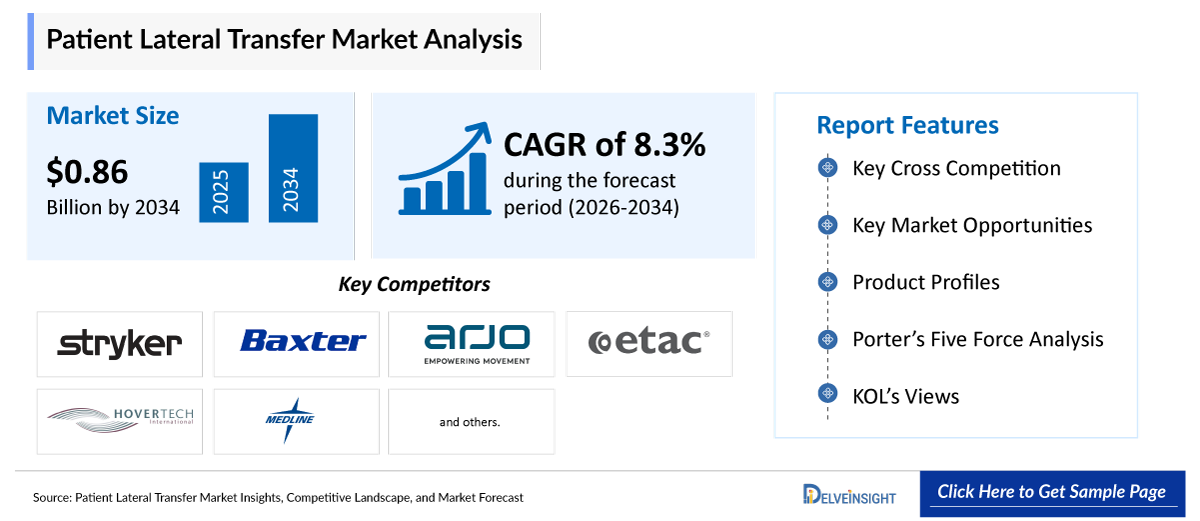
- The global patient lateral transfer market size was valued at USD 0.42 billion in 2025 and is projected to reach USD 0.86 billion by 2034.
- The market is expected to expand at a CAGR of 8.3% during the forecast period 2026-2034, supported by the regulatory and institutional focus on safe patient handling, the rising incidence of caregiver musculoskeletal injury, the growing prevalence of obesity and the aging population, and the shift from manual handling to air-assisted and mechanical transfer.
- By product, the air-assisted transfer devices segment dominated the patient lateral transfer market with a 42% share in 2025.
- By usability, the single-patient-use segment dominated the patient lateral transfer market with a 54% share in 2025.
- By application, the operating room and imaging segment dominated the patient lateral transfer market with a 38% share in 2025.
- By end-user, the hospitals segment dominated the patient lateral transfer market with a 68% share in 2025.
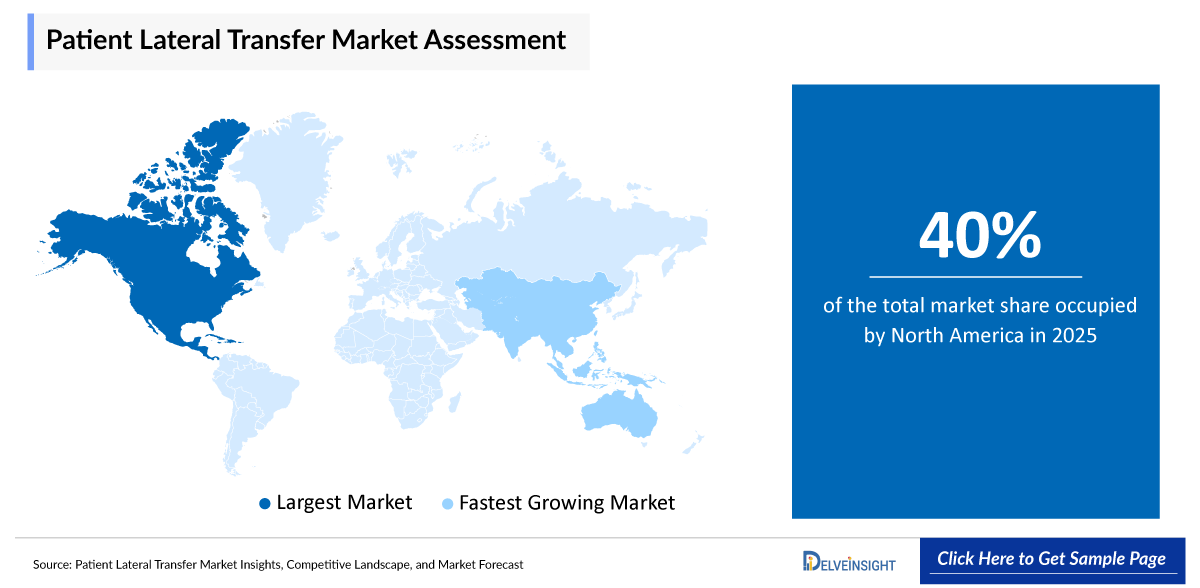
- North America accounted for the largest share of the patient lateral transfer market at 40% in 2025, while Asia-Pacific is anticipated to register the fastest growth through 2034.
Patient lateral transfer refers to the devices and systems used to move a patient horizontally between two surfaces, such as a bed, stretcher, operating room table, or imaging surface, safely and with reduced physical strain on caregivers. The scope encompasses air-assisted transfer devices, in which a cushion of air beneath an inflatable mattress reduces the friction and the force required to move the patient, slide sheets and tubes that reduce friction for short transfers, rigid and roller transfer boards that bridge the gap between surfaces, and mechanical and accessory aids. Leading products include the HoverMatt air transfer system from HoverTech, the Stryker Glide, the AirPal system now part of Arjo, and the slide sheets and transfer boards of Baxter through Hillrom, together with the offerings of Etac, Medline, and specialist safe patient handling companies. Air-assisted systems reduce the force required to move a patient substantially, enabling fewer caregivers to transfer patients safely, and the contemporary market is defined by the shift from manual handling to air-assisted and mechanical transfer, driven by the imperative to protect caregivers and patients.
Patient Lateral Transfer Market Key Growth Drivers
- Regulatory and institutional focus on safe patient handling, with the Association of periOperative Registered Nurses recommending mechanical or air-assisted devices for the lateral transfer of patients who cannot assist and above a defined weight threshold.
- Rising incidence of caregiver musculoskeletal injury, with healthcare worker injury and illness rates double the rate of private industry as a whole.
- Growing prevalence of obesity and the aging population, which increases the number of dependent and higher-weight patients requiring assisted transfer.
- Shift from manual handling to air-assisted and mechanical transfer, with air-assisted systems reducing the force required to move a patient by 80 to 90 percent.
- Nursing and caregiver workforce shortages that increase the need for devices that allow fewer staff to transfer patients safely.
- Adoption of safe patient handling and mobility programs by hospitals to reduce injury, workers' compensation costs, and staff turnover.
- Use of transfer devices across the operating room, imaging, and inpatient departments for a wide range of handling tasks.
Key Companies in Patient Lateral Transfer Market
The leading participants in the patient lateral transfer market include the following:
- Stryker Corporation
- Baxter International Inc.
- Arjo AB
- Etac AB
- HoverTech International
- Medline Industries, LP
- Handicare Group AB
- Sizewise Rentals, LLC
- Prism Medical UK Ltd
- McAuley Medical, Inc., and others
For illustrative purposes, only the top 10 companies are listed in the Table of Contents. The report may include analysis and references to additional companies relevant to the market assessment.
Patient Lateral Transfer Market Size
The following table summarizes the headline market metrics for the global patient lateral transfer market across the base year and the forecast horizon.
|
Report Metrics |
Details |
|
2025 Market Size |
USD 0.42 billion |
|
2034 Projected Market Size |
USD 0.86 billion |
|
Growth Rate (2026-2034) |
8.3% CAGR |
|
Largest Market |
North America (40% share in 2025) |
|
Fastest Growing Market |
Asia-Pacific |
|
Market Structure |
Moderately Consolidated |
All market values are expressed in USD and represent DelveInsight estimates synthesized from primary and secondary research.
Factors Contributing to the Growth of the Patient Lateral Transfer Market
Patient Lateral Transfer Market Drivers
- Regulatory and Institutional Focus on Safe Patient Handling: The foundational driver of the patient lateral transfer market is the regulatory and institutional focus on safe patient handling, which increasingly requires the use of mechanical and air-assisted devices for lateral transfer. Manual patient handling causes musculoskeletal injury to caregivers and puts patients at risk of falls, skin tears, and injury, and organizations including the Association of periOperative Registered Nurses, the Occupational Safety and Health Administration, and the National Institute for Occupational Safety and Health have established guidelines and standards that emphasize the use of assistive devices. The Association of periOperative Registered Nurses recommends mechanical devices for the lateral transfer of a patient who cannot assist, and its ergonomic guidance indicates that mechanical or air-assisted devices should be used when a patient weighs above a defined threshold, effectively making assistive technology a standard of care rather than an optional extra. The Occupational Safety and Health Administration enforces worker safety under the General Duty Clause in healthcare, which is recognized as a high injury risk industry, and state safe patient handling laws require programs and equipment. The National Institute for Occupational Safety and Health has determined that safe patient handling programs should seek to eliminate manual lifting wherever possible. As guidelines, standards, and laws increasingly require the use of mechanical and air-assisted transfer devices, hospitals adopt these devices to comply and to protect caregivers and patients. The regulatory and institutional focus on safe patient handling sustains demand for patient lateral transfer devices across the forecast period and anchors the growth of the market.
- Rising Incidence of Caregiver Musculoskeletal Injury: The rising incidence of musculoskeletal injury among caregivers is a powerful driver, since these injuries impose a large human and financial cost that transfer devices are designed to prevent. Healthcare workers experience high rates of musculoskeletal injury from the manual lifting, transferring, and repositioning of patients, and injury and illness rates in healthcare are double the rate of private industry as a whole. These injuries, concentrated in the back and shoulders, cause pain, disability, lost work, and turnover, and they generate substantial direct and indirect workers' compensation costs for healthcare facilities. Lateral transfer is a particularly hazardous task, since it requires multiple caregivers to move a patient between surfaces and imposes high spinal loading and hand force, and studies show that air-assisted devices substantially reduce the hand force, spinal loading, and muscle activity required for lateral transfer. By reducing the force required to move a patient and enabling fewer caregivers to perform transfers safely, air-assisted and mechanical devices reduce the incidence and cost of caregiver injury, improving staff safety, satisfaction, and retention. As healthcare facilities confront the human and financial cost of caregiver injury and seek to reduce it, they adopt the transfer devices that prevent injury. The rising incidence and cost of caregiver musculoskeletal injury sustain demand for patient lateral transfer devices across the forecast period.
- Growing Prevalence of Obesity and the Aging Population: The growing prevalence of obesity and the aging of the population increase the number of dependent and higher-weight patients requiring assisted transfer, driving demand for lateral transfer devices. The rising prevalence of obesity increases the average weight of patients and the number of bariatric patients, and the manual transfer of higher-weight patients is more hazardous and requires more caregivers, making mechanical and air-assisted devices necessary. Guidance indicates that mechanical or air-assisted devices should be used above a defined patient weight, and air-assisted systems can transfer patients of substantial weight with as few as two caregivers, making them essential for the safe handling of heavier patients. The aging of the population increases the number of dependent, frail, and immobile patients who cannot assist in their own transfer and who require assisted lateral transfer, and the growth of the elderly population increases the volume of care and the number of patients requiring handling. The combination of rising patient weight and an aging, more dependent population increases the number and the difficulty of lateral transfers and the necessity of mechanical and air-assisted devices. As obesity and the aging population increase the number of dependent and higher-weight patients, demand for the transfer devices that safely handle them grows. The growing prevalence of obesity and the aging of the population sustain demand for patient lateral transfer devices across the forecast period.
- Shift from Manual Handling to Air-Assisted and Mechanical Transfer: The shift from manual handling to air-assisted and mechanical transfer is a defining driver that concentrates demand in air-assisted devices. Manual lateral transfer, using only caregivers and basic aids, is hazardous, labor-intensive, and increasingly unacceptable under safe patient handling guidelines, and healthcare facilities are shifting toward air-assisted and mechanical devices that reduce the force and the number of caregivers required. Air-assisted transfer systems use a cushion of air beneath an inflatable mattress to reduce the force required to move a patient by 80 to 90 percent, enabling caregivers to transfer patients safely without lifting or straining, and they reduce skin shear and bruising and improve patient comfort. The efficacy, safety, and efficiency of air-assisted systems, which enable fewer caregivers to perform transfers and reduce injury, drive the shift away from manual handling, and the availability of reusable and single-patient-use air transfer mattresses expands adoption across departments. The expiration of the original patents on air transfer technology has broadened the market and increased the availability and adoption of air-assisted systems. As healthcare facilities shift from manual handling to air-assisted and mechanical transfer to improve safety and efficiency and to comply with guidelines, demand concentrates in air-assisted devices. The shift from manual handling to air-assisted and mechanical transfer sustains demand and reinforces the leadership of the air-assisted devices segment across the forecast period.
- Nursing and Caregiver Workforce Shortages: Nursing and caregiver workforce shortages increase the need for transfer devices that allow fewer staff to move patients safely, driving the adoption of air-assisted and mechanical systems. Healthcare faces persistent shortages of nurses and caregivers, and the reduced availability of staff means that manual transfers, which require multiple caregivers, are difficult to perform safely, and caregivers often transfer and position patients with too few staff, increasing the risk of injury. Air-assisted and mechanical transfer devices reduce the number of caregivers required to perform a lateral transfer, enabling as few as two caregivers to transfer even heavy patients safely, and they reduce the physical demand on the available staff. By allowing fewer staff to perform transfers safely and by reducing the injuries that further deplete the workforce, transfer devices help facilities manage the constraints of workforce shortages. The shortage of staff, the difficulty of performing manual transfers with too few caregivers, and the imperative to protect the available workforce from injury drive the adoption of devices that reduce the staffing and physical demand of transfers. As workforce shortages persist and as facilities seek to perform transfers safely with fewer staff, they adopt air-assisted and mechanical transfer devices. Nursing and caregiver workforce shortages sustain demand for patient lateral transfer devices across the forecast period.
- Adoption of Safe Patient Handling and Mobility Programs: The adoption of safe patient handling and mobility programs by hospitals drives the systematic deployment of transfer devices across facilities. Hospitals increasingly implement safe patient handling and mobility programs that establish policies, training, and equipment to eliminate manual lifting and to protect caregivers and patients, and these programs deploy air-assisted, mechanical, and accessory transfer devices across departments. Safe patient handling programs are driven by the imperative to reduce caregiver injury and cost, to comply with guidelines and laws, and to improve patient safety and satisfaction, and they systematically equip facilities with the devices required for safe transfer and repositioning. The programs deploy transfer devices in the operating room, imaging, emergency, and inpatient departments, and they establish the training and procedures for their use, driving the sustained adoption of devices. The value of a comprehensive program in reducing injury, cost, and turnover and in improving safety drives the adoption of safe patient handling and mobility programs, and the programs drive the deployment of transfer devices. As hospitals adopt safe patient handling and mobility programs to reduce injury and improve safety, demand for the transfer devices they deploy grows. The adoption of safe patient handling and mobility programs sustains demand for patient lateral transfer devices across the forecast period.
- Use Across the Operating Room, Imaging, and Inpatient Departments: The use of transfer devices across the operating room, imaging, and inpatient departments for a wide range of handling tasks drives broad and recurring demand. Lateral transfer is performed in every hospital unit, and transfer devices are used to move patients between beds, stretchers, operating room tables, and imaging surfaces throughout the facility. In the operating room, the lateral transfer of patients under anesthesia between the stretcher and the operating table is a frequent and hazardous task for which air-assisted devices are recommended, and many air transfer mattresses are radiolucent and safe for imaging and radiology procedures, enabling their use in diagnostic imaging. Air-assisted and mechanical devices are multifunctional, supporting lateral transfer, repositioning, boosting, and turning across departments, and a single device can be used for multiple handling tasks throughout the facility, including radiology, diagnostic imaging, and ancillary departments. The breadth of use across departments and tasks drives broad and recurring demand for transfer devices, and the single-patient-use model drives recurring consumption. As transfer devices are used across the operating room, imaging, and inpatient departments for a wide range of tasks, demand for them is broad and sustained. The use of transfer devices across departments and tasks sustains demand for patient lateral transfer devices across the forecast period.
Patient Lateral Transfer Market Restraints
The patient lateral transfer market faces several interrelated restraints that temper its growth. The foremost is budget constraints and the cost of devices and programs, since air-assisted systems, air supply units, and comprehensive safe patient handling programs require investment in equipment, single-patient-use consumables, and training, and facilities with constrained budgets may delay or limit adoption despite the long-term savings in injury cost. The absence in some jurisdictions of a single mandatory safe patient handling standard means that adoption depends on guidelines, state laws, and institutional commitment rather than a uniform requirement, and inconsistent enforcement slows adoption.
Training, change management, and adherence are critical and challenging, since the benefit of transfer devices depends on their consistent and correct use, and inadequate training, understaffing, and time pressure can lead caregivers to revert to manual handling, undermining the value of the devices. The requirement for air supply units, storage, cleaning, and maintenance of reusable devices adds operational burden, and the ongoing cost of single-patient-use consumables adds recurring expense. The crowded and competitive market, following the expiration of the original patents, exerts price pressure and can commoditize products. The variability of reimbursement and the indirect and long-term nature of the return on investment, realized through reduced injury and turnover rather than direct revenue, can make the financial case less immediate for some facilities. In lower-resource settings, the cost of devices and the reliance on manual handling constrain adoption. Together, these factors moderate the pace and scope of adoption and require vendors to demonstrate safety, efficacy, ease of use, and clear return on investment to sustain growth.
Patient Lateral Transfer Market Segment Analysis
The global patient lateral transfer market is segmented by product (air-assisted transfer devices, slide sheets and tubes, transfer boards, mechanical and accessory aids), by usability (single patient use and reusable), by application (operating room and imaging, inpatient and emergency care, long-term care, and others), by end-users (hospitals, ambulatory surgical centers, long term care facilities, and others), and by geography (North America, Europe, Asia-Pacific, and the Rest of the World).
By Product
Dominant Subsegment: Air-Assisted Transfer Devices.
The air-assisted transfer devices category is expected to dominate the market. The air-assisted transfer devices segment accounted for a 42% share of the patient lateral transfer market in 2025. Air-assisted transfer devices, which use a cushion of air beneath an inflatable mattress to reduce the friction and the force required to move a patient, are the leading product category because they provide the greatest reduction in force and injury risk and are recommended by safe patient handling guidelines. The dominance of the segment reflects the efficacy of air-assisted systems in reducing the force required to move a patient by 80 to 90 percent, their recommendation for lateral transfer of dependent and higher-weight patients, and their multifunctional use across transfer, repositioning, boosting, and turning. Air-assisted systems, including the HoverMatt, the Stryker Glide, the AirPal system, and other air transfer mattresses, enable caregivers to transfer patients safely with fewer staff and less strain, reduce skin shear and injury, and are used across the operating room, imaging, and inpatient departments. The availability of reusable and single-patient-use air transfer mattresses, the recommendation of air-assisted devices by guidelines, and their efficacy and versatility drive the segment. While slide sheets and tubes, transfer boards, and mechanical and accessory aids are important product categories, the efficacy, versatility, and guideline support of air-assisted devices sustain the leadership of the air-assisted transfer devices segment across the forecast period.
By Usability
Dominant Subsegment: Single-Patient-Use.
The single-patient-use category is expected to dominate the market. The single-patient-use segment accounted for a 54% share of the patient lateral transfer market in 2025. Single-patient-use transfer devices, which are dedicated to one patient and discarded after use, are the leading usability category because they reduce the risk of cross-contamination and hospital-acquired infection, follow the patient through the episode of care, and generate recurring consumption. The dominance of the segment reflects the infection control benefit of single-patient-use devices, the convenience of a device dedicated to and following the patient, and the recurring revenue and consumption they generate. Single-patient-use air transfer mattresses and slide sheets eliminate the need to clean and reprocess devices between patients, reduce the risk of transmitting infection, and can follow the patient from admission through the departments of the facility; they are widely adopted in infection-conscious environments. The infection control imperative, the convenience of a dedicated device, and the recurring consumption drive the single-patient-use segment, and the model aligns with the priorities of modern infection prevention. While reusable devices remain important for their lower per-use cost and sustainability, the infection control benefit, convenience, and recurring consumption of single-patient-use devices sustain the leadership of the single-patient-use segment across the forecast period.
By Application
Dominant Subsegment: Operating Room and Imaging.
The operating room and imaging category is expected to dominate the market. The operating room and imaging segment accounted for a 38% share of the patient lateral transfer market in 2025. The operating room and imaging application is the leading application because it involves the frequent lateral transfer of dependent and anesthetized patients between stretchers, operating tables, and imaging surfaces, for which air-assisted and mechanical devices are strongly recommended. The dominance of the segment reflects the frequency and hazard of lateral transfer in the operating room and imaging, the recommendation of air-assisted devices for the transfer of anesthetized and dependent patients, and the radiolucent design of many air transfer mattresses that enables their use in imaging. In the operating room, the transfer of patients under anesthesia between the stretcher and the operating table is frequent and hazardous, requiring multiple caregivers, and air-assisted devices are recommended to reduce injury. In imaging, radiolucent transfer mattresses enable the safe transfer and positioning of patients for radiology and diagnostic procedures. The frequency and hazard of transfer in these settings, the vulnerability of anesthetized and dependent patients, and the recommendation of assistive devices drive the application. While inpatient units, emergency departments, and long-term care are significant applications, the frequency, hazard, and guideline support of transfer in the operating room and imaging sustain the leadership of the operating room and imaging segment across the forecast period.
By End-User
Dominant Subsegment: Hospitals.
The hospitals category is expected to dominate the market. The hospitals segment accounted for a 68% share of the patient lateral transfer market in 2025. Hospitals, including acute care hospitals, surgical centers, and academic medical centers, are the principal users of patient lateral transfer devices because they perform the large majority of patient transfers across the operating room, imaging, emergency, and inpatient departments and implement safe patient handling programs, which concentrates market value in this segment. The dominance of the segment reflects the volume and frequency of patient transfer in hospitals, the implementation of safe patient handling and mobility programs by hospitals, and the deployment of air-assisted, mechanical, and accessory transfer devices across hospital departments. Hospitals perform frequent lateral transfers of dependent, anesthetized, and higher-weight patients; they face the regulatory and cost imperative to protect caregivers, and they deploy transfer devices systematically through safe patient handling programs. The concentration of surgery, imaging, and acute care, the frequency of transfer, and the implementation of programs in hospitals drive the segment. While long-term care facilities, ambulatory surgical centers, and home care are growing end-users, the volume of transfer, the implementation of programs, and the depth of deployment in hospitals sustain the leadership of the hospitals segment across the forecast period, and it shapes the direction of the market.
Patient Lateral Transfer Market Region Analysis
Dominant Region: North America
North America accounted for a 40% share of the global patient lateral transfer market in 2025, representing the highest regional market share globally. The leadership of the region reflects the rigor of safe patient handling guidelines and laws, the high awareness of caregiver injury, the concentration of the leading vendors, and the advanced adoption of air-assisted and mechanical transfer. The United States is the largest national market, supported by the guidelines of the Association of periOperative Registered Nurses, the Occupational Safety and Health Administration, and the National Institute for Occupational Safety and Health, state safe patient handling laws, the high awareness and cost of caregiver musculoskeletal injury, and the advanced adoption of air-assisted transfer and safe patient handling programs. The regulatory and institutional focus on safe patient handling, the high cost of workers' compensation for caregiver injury, and the prevalence of obesity drive the adoption of transfer devices, and the leading vendors, including the medical technology and safe patient handling companies, operate extensively in the region. The rigor of guidelines and laws, the awareness of injury and cost, the concentration of vendors, and the advanced adoption of air-assisted transfer reinforce the leadership of the region. The combination of regulatory rigor, injury awareness, vendor presence, and adoption maturity sustains the position of North America as the largest regional market across the forecast period.
Fastest Growing Region: Asia-Pacific
Asia-Pacific is projected to register the fastest compound annual growth rate through 2034. The region is expanding and modernizing its healthcare infrastructure, increasing awareness of safe patient handling, and adopting air-assisted and mechanical transfer, which drives the growth of the market. China, Japan, and India are the principal national markets, supported by the construction and modernization of hospitals, the aging of the population, the rising prevalence of obesity, the growth of surgical and imaging volumes, and the increasing awareness of caregiver safety and safe patient handling. The modernization of hospitals, the growth of surgery and imaging, and the increasing adoption of safe patient handling practices and devices enlarge the demand for transfer devices. As hospitals build and modernize, as surgical and imaging volumes grow, and as awareness of caregiver safety increases, the region increases its adoption of transfer devices from a growing base, and the scale of healthcare expansion and the aging of large populations create substantial long-term demand. The combination of hospital modernization, growing surgical and imaging volumes, aging populations, and rising awareness of safe patient handling positions Asia-Pacific as the fastest-growing regional market, and it attracts investment and commercial focus from the leading global vendors seeking presence in high-growth national markets.
Patient Lateral Transfer Market Regional Commentary
North America
North America leads the market, supported by the rigor of safe patient handling guidelines and laws, the high awareness and cost of caregiver injury, the concentration of the leading vendors, and the advanced adoption of air-assisted and mechanical transfer. The United States dominates the region through the guidelines of the Association of periOperative Registered Nurses, the Occupational Safety and Health Administration, and the National Institute for Occupational Safety and Health, state safe patient handling laws, and the advanced adoption of air-assisted transfer and safe patient handling programs. The imperative to reduce caregiver injury and cost sustains demand.
Europe
Europe is a substantial market shaped by strong occupational health and safe patient handling regulation, the adoption of air-assisted and mechanical transfer, and the presence of vendors including Arjo, Etac, Handicare, and Prism Medical. Germany, the United Kingdom, France, Italy, and Spain are the principal national markets, supported by manual handling regulations, the adoption of safe patient handling practices, and the aging of the population. Demand is sustained by occupational safety requirements and the focus on caregiver and patient safety.
Asia-Pacific
Asia-Pacific is the fastest-growing region, driven by the construction and modernization of hospitals, the aging of the population, the growth of surgical and imaging volumes, and the rising awareness of safe patient handling across China, Japan, and India. Healthcare expansion, aging populations, and the increasing adoption of transfer devices sustain demand, and the region attracts commercial focus from the leading global vendors.
Rest of World
The Rest of World, spanning Latin America, the Middle East, and Africa, represents an emerging opportunity as healthcare infrastructure expands and as awareness of safe patient handling grows. Growth is supported by the modernization of hospitals, the growth of surgical and imaging volumes, and the increasing adoption of transfer devices, though adoption varies by market and manual handling remains prevalent in lower-resource settings. Vendors pursue these markets through devices suited to modernizing hospitals.
Patient Lateral Transfer Market Competitive Landscape
The global patient lateral transfer market is classified as Moderately Consolidated. A group of medical technology and safe patient handling companies holds a substantial share of the market through comprehensive portfolios and installed bases, while specialist air transfer and patient handling vendors compete on differentiated products, and the expiration of the original air transfer patents has broadened the field. Competition centers on the efficacy and safety of transfer, the breadth of the product portfolio across air-assisted, slide, board, and mechanical devices, the infection control of single-patient-use devices, the integration with safe patient handling programs, and price; acquisitions, product launches, and the crowded competitive field intensify the contest.
The competitive landscape is evaluated across the following dimensions:
- Market concentration: Moderately consolidated, with a group of medical technology and safe patient handling companies holding a substantial share, alongside specialist air transfer and patient handling vendors in a field broadened by the expiration of the original patents.
- Leading players: Stryker, Baxter through Hillrom, and Arjo lead among the medical technology companies; HoverTech leads in air transfer with the HoverMatt, and Etac, Medline, Handicare, Sizewise, Prism Medical, and McAuley Medical contest air transfer, slide, and patient handling categories.
- Geographic reach: The leading medical technology companies operate global commercial and service organizations, and specialist air transfer and patient handling vendors serve defined markets, with strong presence in North America and Europe.
- Product portfolio strength: Competitive advantage rests on the breadth across air-assisted transfer, slide sheets and tubes, transfer boards, and mechanical and accessory aids, and on the efficacy, safety, and infection control of the devices.
- Pipeline strength: Development is concentrated in air-assisted transfer, single-patient-use and infection control, multifunctional devices, and integration with safe patient handling programs.
- Strategic partnerships: Collaboration spans integration with beds, stretchers, and lifts, distribution partnerships, and alliances with safe patient handling programs and training.
- M&A activity: Consolidation has shaped the field, exemplified by the acquisition of AirPal by Arjo and the acquisition of Hillrom, with its patient handling portfolio, by Baxter, alongside continued consolidation of patient handling assets.
- Innovation focus: Innovation is shifting toward more effective and versatile air-assisted transfer, single-patient-use and infection control, multifunctional devices for transfer, repositioning, and turning, and integration with safe patient handling programs.
- Regulatory standing: Alignment with the guidelines of the Association of periOperative Registered Nurses, the Occupational Safety and Health Administration, and the National Institute for Occupational Safety and Health, and with state safe patient handling laws, and clearance and conformity as medical devices, are decisive competitive credentials and a principal axis of competition among the leaders.
Patient Lateral Transfer Market Recent Developmental Activities
- In 2021, Baxter International Inc. completed its acquisition of Hillrom, whose portfolio includes patient handling, repositioning, and transfer products alongside beds and connected care. Strategic significance: the acquisition brought a leading patient handling and mobility portfolio into a major medical technology company and reinforced the integration of transfer and mobility with the care environment.
- In 2024 and 2025, Arjo AB advanced its patient handling and safe patient handling portfolio, including the air-assisted transfer technology of the AirPal system that it acquired, and its mechanical lifts and slings. Strategic significance: the developments reinforced the position of a leading safe patient handling company across air-assisted and mechanical transfer.
- In 2024 and 2025, HoverTech International advanced the HoverMatt air transfer system and its single-patient-use and reusable air transfer mattresses and slings, reducing the force required to move a patient by 80 to 90 percent. Strategic significance: the developments reinforced the position of a leading air transfer vendor and advanced multifunctional air-assisted handling.
- In 2024 and 2025, Etac AB advanced its air-assisted transfer portfolio, including the HoverMatt reusable and single-patient-use mattresses and the HoverMatt PROS air sling for transfer, turning, and lifting. Strategic significance: the developments reinforced the position of a leading patient handling vendor across air-assisted transfer, repositioning, and lifting.
- In 2024 and 2025, Stryker Corporation advanced its patient handling portfolio, including the Stryker Glide air-assisted transfer system and its transfer and mobility products. Strategic significance: the developments reinforced the position of a major medical technology company in air-assisted transfer and patient handling.
- In 2024 and 2025, Medline Industries, LP advanced its distribution and portfolio of transfer devices, including single-patient-use air transfer mattresses, expanding access to air-assisted transfer. Strategic significance: the developments reinforced the role of a major distributor in expanding access to transfer devices across facilities.
- In 2024 and 2025, the Association of periOperative Registered Nurses maintained and promoted its ergonomic guidance recommending mechanical and air-assisted devices for the lateral transfer of patients who cannot assist and above a defined weight threshold. Strategic significance: the guidance sustained the standard of care for lateral transfer and reinforced the adoption of assistive devices.
- In 2024 and 2025, hospitals expanded the implementation of safe patient handling and mobility programs, deploying air-assisted, slide, and mechanical transfer devices across the operating room, imaging, and inpatient departments. Strategic significance: the expansion of programs drove the systematic deployment of transfer devices and reinforced the sustained adoption of the market.
- In 2024 and 2025, the single-patient-use segment expanded as facilities adopted single-patient-use air transfer mattresses and slide sheets to reduce cross-contamination and hospital-acquired infections. Strategic significance: the expansion of single-patient-use devices reinforced the infection control imperative and the recurring consumption of the market.
- In 2024 and 2025, specialist vendors including Sizewise Rentals, LLC, Prism Medical UK Ltd, and McAuley Medical, Inc. advanced their air-assisted and mechanical transfer and patient handling solutions and their rental and service models. Strategic significance: the developments reinforced the competitive field of specialist patient handling vendors, broadened by the expiration of the original patents.
- In 2024 and 2025, the industry advanced multifunctional devices that combine lateral transfer with repositioning, boosting, and turning, and that integrate with beds, stretchers, and lifts. Strategic significance: the advancement of multifunctional devices increased the value and versatility of transfer devices across handling tasks.
- In 2024 and 2025, the leading vendors advanced air-assisted transfer, single-patient-use and infection control, multifunctional handling, and integration with safe patient handling programs across the patient lateral transfer market. Strategic significance: the convergence of the leaders on air-assisted transfer, infection control, multifunctional handling, and program integration confirmed these as the defining axes of competition and signaled a market advancing toward safer, more versatile, and program-integrated patient handling.
Patient Lateral Transfer Market Segmentation
- Patient Lateral Transfer Market Assessment by Product
- Air-Assisted Transfer Devices
- Slide Sheets and Tubes
- Transfer Boards
- Mechanical and Accessory Aids
- Patient Lateral Transfer Market Assessment by Usability
- Single-Patient-Use
- Reusable
- Patient Lateral Transfer Market Assessment by Application
- Operating Room and Imaging
- Inpatient and Emergency Care
- Long-Term Care
- Others
- Patient Lateral Transfer Market Assessment by End-User
- Hospitals
- Ambulatory Surgical Centers
- Long-Term Care Facilities
- Others
Patient Lateral Transfer Market Assessment by Geography
- North America Patient Lateral Transfer Market Assessment
- United States Patient Lateral Transfer Market Size in USD million (2023-2034)
- Canada Patient Lateral Transfer Market Size in USD million (2023-2034)
- Mexico Patient Lateral Transfer Market Size in USD million (2023-2034)
- Europe Patient Lateral Transfer Market Assessment
- Germany Patient Lateral Transfer Market Size in USD million (2023-2034)
- United Kingdom Patient Lateral Transfer Market Size in USD million (2023-2034)
- France Patient Lateral Transfer Market Size in USD million (2023-2034)
- Italy Patient Lateral Transfer Market Size in USD million (2023-2034)
- Spain Patient Lateral Transfer Market Size in USD million (2023-2034)
- Rest of Europe Patient Lateral Transfer Market Size in USD million (2023-2034)
- Asia-Pacific Patient Lateral Transfer Market Assessment
- China Patient Lateral Transfer Market Size in USD million (2023-2034)
- Japan Patient Lateral Transfer Market Size in USD million (2023-2034)
- India Patient Lateral Transfer Market Size in USD million (2023-2034)
- Australia Patient Lateral Transfer Market Size in USD million (2023-2034)
- South Korea Patient Lateral Transfer Market Size in USD million (2023-2034)
- Rest of Asia-Pacific Patient Lateral Transfer Market Size in USD million (2023-2034)
- Rest of the World Patient Lateral Transfer Market Assessment
- Middle East Patient Lateral Transfer Market Size in USD million (2023-2034)
- Africa Patient Lateral Transfer Market Size in USD million (2023-2034)
- South America Patient Lateral Transfer Market Size in USD million (2023-2034)
Patient Lateral Transfer Market Recent Industry Trends and Milestones (2023-2026):
|
Category |
Key Developments |
|
Patient Lateral Transfer Market Product Advancement |
The period was defined by the advancement of air-assisted, single-patient-use, and multifunctional transfer devices. HoverTech advanced the HoverMatt air transfer system, Etac advanced its air-assisted transfer and sling portfolio, Stryker advanced the Glide system, Arjo advanced its air-assisted and mechanical portfolio, and Baxter advanced its Hillrom patient handling products. Vendors advanced single-patient-use devices for infection control and multifunctional devices for transfer, repositioning, and turning. Together, these advances concentrated competition in air-assisted, infection-conscious, and versatile patient handling. |
|
Patient Lateral Transfer Market Product Expansion |
Product expansion advanced along three axes. The first is air-assisted transfer, as vendors advanced air transfer mattresses and slings that reduce the force required to move a patient by 80 to 90 percent. The second is single-patient-use and infection control, as vendors expanded disposable air transfer mattresses and slide sheets to reduce cross-contamination. The third is multifunctional and integrated handling, as vendors advanced devices combining transfer, repositioning, boosting, and turning and integrating with beds, stretchers, and lifts. Vendors also expanded reusable, rental, and service models. |
|
Patient Lateral Transfer Market Investment |
Investment was shaped by consolidation and the shift to air-assisted and single-patient-use transfer. Baxter acquired Hillrom with its patient handling portfolio, Arjo acquired AirPal air transfer technology, and vendors invested in air-assisted, single-patient-use, and multifunctional devices and in safe patient handling programs. The expiration of the original air transfer patents broadened the field and increased investment by specialist vendors. Investment also flowed into infection control, integration with the care environment, and rental and service models. |
|
Company Strategy |
The unifying strategic theme is the delivery of effective, infection-conscious, and versatile patient handling integrated with safe patient handling programs. Stryker, Baxter, and Arjo are advancing broad patient handling portfolios, HoverTech and Etac are advancing air transfer, and Medline, Handicare, Sizewise, Prism Medical, and McAuley Medical are competing across air-assisted, slide, and mechanical devices and rental and service. Across the field, strategy centers on air-assisted transfer, single-patient-use infection control, multifunctional handling, and program integration. |
|
Emerging Technologies |
The defining emerging technologies are air-assisted transfer systems that reduce the force required to move patients and enable fewer caregivers to transfer safely; single-patient-use devices that reduce cross-contamination and hospital-acquired infection; multifunctional devices that combine lateral transfer with repositioning, boosting, turning, and lifting; and radiolucent transfer mattresses that enable transfer and positioning in imaging. Supporting these are integration with beds, stretchers, and ceiling and mobile lifts, breathable and pressure-relieving designs, and safe patient handling program integration and training. Across these, the trajectory is toward patient handling that is safer, more versatile, and infection-conscious, improving caregiver safety, patient comfort, and the efficiency of transfer across the facility. |
Patient Lateral Transfer Market Startup Funding and Investment Trends
Investment in the patient lateral transfer field has concentrated on technologies and models that make patient handling safer, more infection-conscious, and more versatile, namely air-assisted transfer, single-patient-use and infection control, multifunctional handling, and rental and service models. Because the market is moderately consolidated among medical technology and safe patient handling companies and broadened by the expiration of the original patents, innovators pursue differentiated air-assisted, infection control, or multifunctional technologies that serve defined needs or that a larger company can absorb. The table below summarizes representative companies advancing the next generation of patient handling.
|
Company |
Total Funding |
Funding Stage |
Main Product/Offering |
Core Technology |
|
HoverTech International |
Privately held |
Commercial stage |
HoverMatt air transfer system |
Air-assisted lateral transfer |
|
SPH Medical |
Privately held |
Commercial stage |
Air transfer and positioning system |
Air-assisted transfer and safe patient handling |
|
Request for unlocking the report of the @ Patient Lateral Transfer Market Insights | ||||
Capital formation in this field is shaped by the presence of medical technology and safe patient handling companies with comprehensive portfolios and installed bases, so investors and acquirers have favored companies that introduce differentiated air-assisted transfer, single-patient-use infection control, or multifunctional handling that serves defined needs or that a larger company can absorb. Air-assisted transfer is a clear thesis, providing the greatest reduction in force and injury and recommended by guidelines. Single-patient-use and infection control constitute a second thesis, addressing the infection prevention imperative, and multifunctional handling a third, combining transfer with repositioning and turning. The archetypal outcome is acquisition by a medical technology or safe patient handling company seeking to add capability, exemplified by the acquisition of air transfer technology by the leading companies, or growth as a specialist vendor or rental and service provider. The principal risks are the comprehensive portfolios and installed bases of the leaders, the crowded and competitive field following patent expiration, the price pressure of a commoditizing market, and the dependence on institutional commitment and safe patient handling programs.
Key Takeaways from the Patient Lateral Transfer Market Report Study
- Market size analysis for the current patient lateral transfer market size (2025), and market forecast for 9 years (2026 to 2034).
- Top key product and technology developments, mergers, acquisitions, partnerships, and joint ventures that happened over the last 3 years.
- Key companies dominating the global patient lateral transfer market.
- Various opportunities available for competitors in the patient lateral transfer market space.
- What are the top-performing segments in 2025? How will these segments perform in 2034?
- Which are the top-performing regions and countries in the current patient lateral transfer market scenario?
- Which are the regions and countries where companies should concentrate their opportunities for patient lateral transfer market growth in the future?
Target audience who can benefit from this patient lateral transfer market report study
- Patient lateral transfer, patient handling, and medical device providers
- Research organizations and consulting companies
- Patient handling and safe patient handling-related organizations, associations, forums, and other alliances
- Government and corporate offices
- Start-up companies, venture capitalists, and private equity firms
- Distributors and traders dealing in patient lateral transfer devices
- Various end-users who want to know more about the patient lateral transfer market and the latest technological developments in the patient lateral transfer market.

