Patient Monitoring Devices Market Summary
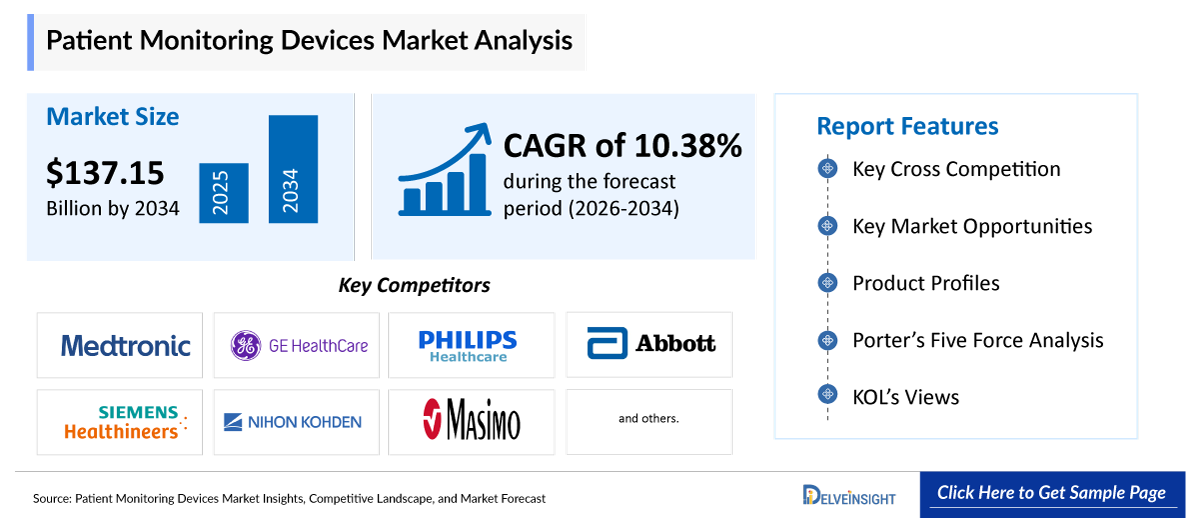
- The Patient Monitoring Devices market size is estimated at USD 56.4 billion in 2025 and is projected to reach USD 137.15 billion by 2034. Growth is anchored in the rising global burden of chronic and cardiovascular disease, rapid adoption of AI-enabled and wireless monitoring platforms, and the accelerating shift of continuous monitoring from acute hospital settings into ambulatory and home care.
- The global Patient Monitoring Devices market is growing at a CAGR of 10.38% during the forecast period from 2026 to 2034.
- By type of devices, the blood glucose monitoring systems segment dominated the Patient Monitoring Devices market with a 26% share in 2025.
- By application, the cardiology segment dominated the Patient Monitoring Devices market with a 38% share in 2025.
- By end-user, the hospitals & clinics segment dominated the Patient Monitoring Devices market with a 46% share in 2025.
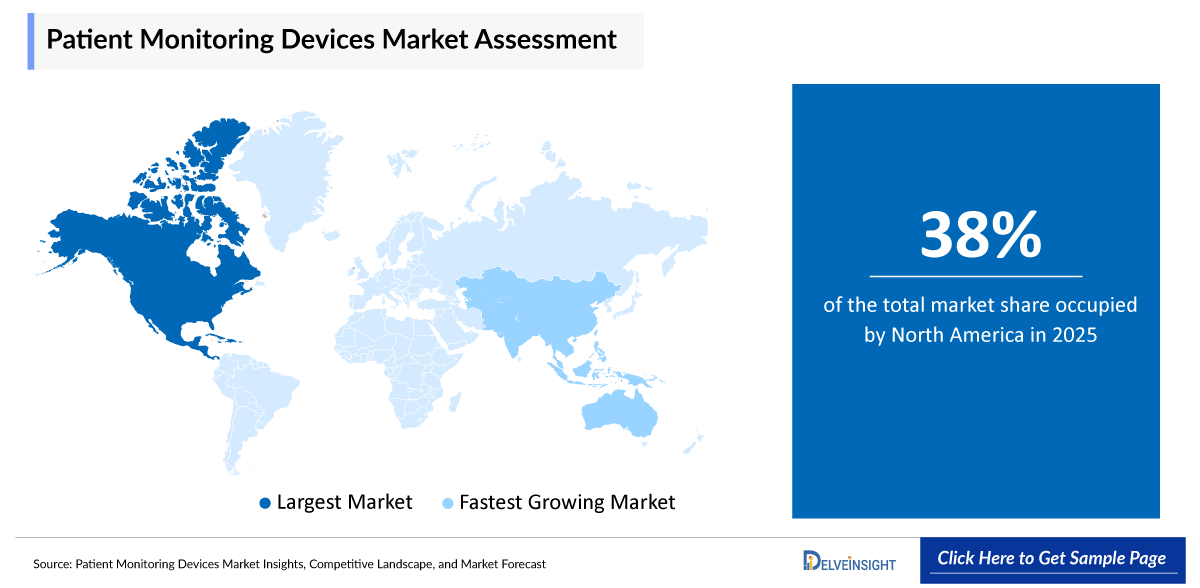
- North America dominated the global Patient Monitoring Devices market revenue with a 43% share in 2025, representing the highest regional market share globally.
A patient monitoring device is a diagnostic or therapeutic support instrument that continuously or intermittently measures, records, and transmits a patient's physiological parameters, including cardiac activity, neurological status, respiratory function, hemodynamic status, and blood glucose levels, to support clinical decision-making and early detection of deterioration. Because acutely and chronically ill patients require uninterrupted surveillance across the care continuum, hospitals, ambulatory surgical centers, and home care providers rely on a broad ecosystem of neuromonitoring, cardiac monitoring, respiratory monitoring, hemodynamic monitoring, blood glucose monitoring, and multi-parameter monitoring devices. The market is organized by type of devices across neuromonitoring, cardiac monitoring, respiratory monitoring, hemodynamic monitoring, blood glucose monitoring systems, multi-parameter monitoring devices, and others; by application across cardiology, neurology, respiratory, and other clinical specialties; and by end-user across hospitals and clinics, ambulatory surgical centers, home care settings, and others. Driven by the rising global prevalence of cardiovascular disease, diabetes, and respiratory disorders, the rapid integration of artificial intelligence, wireless connectivity, and cloud-based analytics into monitoring platforms, and the accelerating adoption of remote patient monitoring and home-based care models, patient monitoring devices have become essential infrastructure underpinning continuous, data-driven patient care.
Patient Monitoring Devices Market Key Growth Drivers
- The rising global burden of chronic disease is expanding demand for continuous monitoring, with more than half of U.S. adults living with hypertension and global diabetes prevalence projected to rise sharply through 2050.
- The growing geriatric population is increasing the volume of patients requiring cardiac, respiratory, and multi-parameter surveillance across hospital, ambulatory, and home care settings.
- Rapid advancement of wearable sensors, wireless connectivity, and AI-powered analytics is improving the accuracy, portability, and predictive capability of monitoring devices, exemplified by GE HealthCare's Carevance monitor and Masimo's wearable Radius VSM platform.
- Accelerating adoption of remote patient monitoring and telehealth, reinforced by favorable reimbursement policies and government digital-health initiatives, is extending continuous monitoring beyond the hospital.
- A structural shift toward home healthcare and self-monitoring is expanding consumer demand for blood pressure monitors, pulse oximeters, and continuous glucose monitors.
- Rising healthcare expenditure and expanding hospital infrastructure, particularly across Asia-Pacific, are increasing the installed base of multi-parameter and bedside monitoring systems.
- Sustained new-product launches, FDA clearances, and strategic partnerships among leading medical technology companies are broadening monitoring capability and intensifying competitive innovation.
Key Companies in Patient Monitoring Devices Market
The competitive landscape is led by the following active device manufacturers:
- Medtronic
- GE Healthcare
- Philips Healthcare
- Abbott Laboratories
- Siemens Healthineers
- Nihon Kohden Corporation
- Masimo Corporation
- Omron Healthcare Co., Ltd.
- Smiths Medical
- Hillrom, and others
For illustrative purposes, only the top 10 companies are listed in the Table of Contents. The report may include analysis and references to additional companies relevant to the market assessment.
Patient Monitoring Devices Market Size
The following snapshot summarizes the principal report metrics for the Patient Monitoring Devices market.
|
Report Metrics |
Details |
|
2025 Market Size |
USD 56.4 billion |
|
2034 Projected Market Size |
USD 137.15 billion |
|
Growth Rate (2026-2034) |
10.38% CAGR |
|
Largest Market |
North America |
|
Fastest Growing Market |
Asia-Pacific |
|
Market Structure |
Moderately Consolidated |
All market values are expressed in USD and represent DelveInsight estimates synthesized from primary and secondary research.
Factors Contributing to the Growth of the Patient Monitoring Devices Market
Patient Monitoring Devices Market Drivers
- Rising Global Burden of Chronic and Cardiovascular Disease: The most powerful driver of the Patient Monitoring Devices market is the escalating global burden of cardiovascular disease, diabetes, and respiratory disorders, which require continuous or frequent physiological surveillance. Hypertension alone affects roughly half of U.S. adults and remains the leading modifiable risk factor for cardiovascular events worldwide, while global diabetes prevalence continues to climb steeply. New clinical guidance from bodies such as the American Heart Association and American College of Cardiology in 2025 has further emphasized earlier detection and closer at-home blood pressure tracking. As chronic disease prevalence rises across both developed and emerging economies, demand for cardiac, hemodynamic, respiratory, and glucose monitoring devices expands directly, anchoring market growth through 2034.
- Growing Geriatric Population and Rising Hospitalization Needs: The expanding global geriatric population is increasing the volume of patients who require continuous vital-sign and multi-parameter surveillance, both during hospitalization and in post-acute and home settings. Older patients are disproportionately affected by cardiovascular disease, neurological disorders, and respiratory illness, and are more likely to experience clinical deterioration that benefits from early, continuous detection. As life expectancy rises and healthcare systems prioritize proactive geriatric care, hospitals and home care providers are expanding their installed base of bedside, wearable, and multi-parameter monitors to manage this growing patient population, sustaining demand for monitoring devices across the forecast period.
- Technological Advancement in Wearables, Wireless Connectivity, and AI Analytics: Rapid innovation in sensor miniaturization, wireless connectivity, and AI-powered analytics is transforming what patient monitoring devices can do and where they can be used. GE HealthCare's Carevance patient monitor, which received CE mark in October 2025 and introduced a Cardiac Output Insights application, and Masimo's Radius VSM wearable monitor, which received FDA clearance for opioid-induced respiratory depression detection in 2026, illustrate how AI-enabled, wireless platforms are shifting monitoring away from tethered bedside equipment. Nihon Kohden's AlarmSense analytics solution, launched in October 2025 to combat alarm fatigue, further shows how software-driven intelligence is becoming a core differentiator. As device makers embed predictive algorithms, cloud connectivity, and electronic health record integration into their platforms, monitoring capability, accuracy, and clinical value continue to rise, driving adoption and replacement demand.
- Expansion of Remote Patient Monitoring and Telehealth Adoption: The global shift toward telehealth and remote patient monitoring, accelerated in the years following the COVID-19 pandemic, continues to expand the addressable market for connected monitoring devices. Favorable reimbursement policies in the United States and Europe, combined with hospital-at-home programs and enterprise monitoring platforms such as Philips' expanding IntelliVue and enterprise monitoring ecosystem, are enabling continuous tracking of patients outside traditional hospital walls. As health systems seek to reduce readmissions, manage staffing shortages, and extend clinical oversight into the home, remote and wireless monitoring adoption is expected to outpace traditional hospital-based monitoring growth through the forecast period.
- Favorable Reimbursement Policies and Government Digital-Health Initiatives: Supportive reimbursement frameworks and public health initiatives are encouraging broader adoption of patient monitoring devices, particularly in developed markets. Government-backed screening campaigns, such as Omron Healthcare's continued support of May Measurement Month hypertension screening across roughly 120 countries, and reimbursement pathways for remote physiologic monitoring, are lowering the cost barrier to adoption for both providers and patients. As more governments formalize digital-health and preventive-care reimbursement structures, demand for monitoring devices used in both clinical and home settings is expected to strengthen further.
- Growing Home Healthcare and Self-Monitoring Trends: Rising consumer awareness of preventive health and self-management is driving strong growth in home-use monitoring devices, including blood pressure monitors, pulse oximeters, and continuous glucose monitors. Omron Healthcare, which has sold more than 350 million home blood-pressure devices worldwide, continues to expand AI-powered AFib detection features into its consumer product line, while wearable ECG patches and smart monitoring platforms are increasingly used to manage chronic conditions from home. This structural shift toward home-based, patient-driven monitoring reduces reliance on frequent clinical visits and is expected to be among the fastest-growing demand channels through 2034.
- Strategic Investment and Portfolio Expansion by Leading Medical Technology Companies: Continued strategic investment, portfolio consolidation, and new product introductions among leading medical technology companies are reinforcing market growth. Notably, Medtronic's patient monitoring and respiratory interventions business drew acquisition interest from Siemens Healthineers, GE HealthCare, and ICU Medical before the company elected to retain and reinvest in the segment, which delivered double-digit growth within its Acute Care & Monitoring portfolio in fiscal 2026. ICU Medical's USD 2.4 billion acquisition of Smiths Medical and Baxter International's acquisition of Hillrom have further consolidated ownership of monitoring portfolios among diversified medical technology companies, expanding their scale, distribution reach, and capacity for continued product innovation.
Patient Monitoring Devices Market Restraints
Despite strong momentum, the Patient Monitoring Devices market faces material constraints. The relatively high upfront cost of advanced multi-parameter, hemodynamic, and neuromonitoring systems limits adoption among smaller hospitals, ambulatory centers, and providers in price-sensitive emerging markets. Data privacy, cybersecurity, and interoperability concerns complicate the integration of wireless and cloud-connected monitoring devices with hospital IT infrastructure and electronic health records, slowing deployment in some health systems. Alarm fatigue and false-positive alerts remain a persistent clinical challenge, as nurses can spend a substantial share of their shifts responding to signals that require no intervention, prompting the need for continued investment in smarter alarm-management software. Reimbursement for remote and home-based monitoring remains uneven across geographies, and stringent, evolving regulatory requirements around device accuracy, cybersecurity, and clinical validation lengthen approval timelines and raise development costs. A shortage of trained biomedical and clinical informatics personnel in some regions further constrains the pace of large-scale monitoring system deployment. Together, these cost, interoperability, regulatory, and workforce barriers temper the pace of growth, even as the underlying drivers of chronic disease burden, technological innovation, and home-care expansion remain firmly intact.
Patient Monitoring Devices Market Segment Analysis
The patient monitoring devices by market by type of devices (neuromonitoring devices, cardiac monitoring devices, respiratory monitoring devices, hemodynamic monitoring devices, blood glucose monitoring systems, multi-parameter monitoring devices, and others), application (cardiology, neurology, respiratory, and others), end-users (hospitals & clinics, ambulatory surgical centers, home care settings, and others), and geography (North America, Europe, Asia-Pacific, and Rest of World).
By Type of Devices
Dominant Subsegment: Blood Glucose Monitoring Systems.
Dominant: Blood Glucose Monitoring Systems ~ 26%
The blood glucose monitoring systems segment accounted for 26% of the Patient Monitoring Devices market in 2025. Blood glucose monitoring systems are the leading device type because the global diabetic population continues to expand steeply, requiring frequent to continuous glucose tracking through both point-of-care meters and wearable continuous glucose monitors. The commercial success and rapid iteration of continuous glucose monitoring platforms, combined with the shift of diabetes management from clinical settings into daily home use, has made this segment the workhorse of the home-monitoring channel. Cardiac monitoring devices represent a close and fast-growing category, propelled by the rising prevalence of arrhythmias and cardiovascular disease and by wearable ECG innovation, while multi-parameter monitoring devices remain the standard of care in hospital wards and intensive care units. While cardiac and multi-parameter monitoring devices are growing rapidly on the back of hospital modernization and AI-enabled analytics, the sheer volume, frequency, and consumer accessibility of glucose monitoring secure the segment's leadership across the forecast period.
By Application
Dominant Subsegment: Cardiology.
Dominant: Cardiology ~ 38%
The cardiology segment accounted for 38% of the Patient Monitoring Devices market in 2025. Cardiology is the leading application because cardiovascular disease remains the leading cause of morbidity and mortality worldwide, driving high-volume, recurring demand for ECG monitors, cardiac telemetry, hemodynamic monitors, and wearable cardiac patches across hospitals, ambulatory centers, and the home. New clinical guidelines emphasizing earlier detection of hypertension and atrial fibrillation, together with the rapid rollout of AI-powered AFib-detection features by companies such as Omron Healthcare and Masimo, are reinforcing sustained demand for cardiology-focused monitoring. Neurology is the fastest-growing application as neuromonitoring adoption expands into stroke care, epilepsy management, and intraoperative monitoring, while respiratory monitoring benefits from the ongoing burden of chronic respiratory disease. Nonetheless, the breadth, recurrence, and clinical urgency of cardiovascular monitoring keep cardiology the dominant application through the forecast period.
By End-User
Dominant Subsegment: Hospitals & Clinics.
Dominant: Hospitals & Clinics ~ 46%
The hospitals & clinics segment accounted for 46% of the Patient Monitoring Devices market in 2025. Hospitals and clinics remain the leading end-user because acute and intensive care settings require the highest density of continuous, multi-parameter physiological surveillance, spanning general wards, operating rooms, and intensive care units, and because capital equipment purchases and enterprise monitoring platform upgrades are concentrated in this channel. Enterprise monitoring platform deployments, such as Philips' expanding IntelliVue ecosystem and GE HealthCare's Portrait and Carevance platforms, continue to anchor hospital demand. Home care settings represent the fastest-growing end-user channel as remote patient monitoring, hospital-at-home programs, and consumer self-monitoring devices expand rapidly, while ambulatory surgical centers sustain steady demand for perioperative monitoring. Nonetheless, the scale, complexity, and criticality of hospital-based monitoring secure the hospitals & clinics segment's clear leadership across the forecast period.
Patient Monitoring Devices Market Region Analysis
Dominant Region: North America
North America accounted for 43% of the global Patient Monitoring Devices market revenue in 2025, representing the highest regional market share globally. The region's dominance reflects a high prevalence of chronic disease, widespread adoption of advanced healthcare technologies, mature telehealth and reimbursement infrastructure, and the concentrated presence of leading monitoring device manufacturers including Medtronic, GE HealthCare, Abbott, and Masimo. The United States leads on the strength of favorable reimbursement for remote physiologic monitoring, extensive hospital modernization investment, and rapid clinical adoption of wearable and AI-enabled monitoring platforms, exemplified by the FDA clearance of new wearable cardiac and respiratory monitoring devices throughout 2025 and 2026. Strong regulatory clarity, deep capital markets, and sustained new product launches anchor the region's continued leadership across the forecast period.
Fastest Growing Region: Asia-Pacific
Asia-Pacific is the fastest-growing region in the Patient Monitoring Devices market. The region's elevated CAGR is driven by a large and aging patient population, rising chronic disease incidence, rapid hospital infrastructure expansion, and growing healthcare expenditure across China, Japan, India, South Korea, and Australia. China is expanding hospital-grade monitoring capacity as part of broader healthcare modernization, Japan continues to lead in precision monitoring technology through manufacturers such as Nihon Kohden, and India is emerging as a high-volume, cost-sensitive market for home blood pressure and glucose monitoring devices. Government investment in digital health infrastructure, expanding insurance coverage, and rising consumer awareness of preventive care are accelerating adoption, positioning Asia-Pacific as the principal source of incremental market growth over the forecast period.
Patient Monitoring Devices Market Regional Commentary
North America
North America accounted for 43% of the global Patient Monitoring Devices market revenue in 2025. The United States dominates on the strength of its chronic disease burden, mature reimbursement and telehealth infrastructure, and the concentrated presence of leading manufacturers, while continued FDA clearances for wearable and AI-enabled monitoring devices reinforce the region's leadership.
Europe
Europe is a large and technologically advanced regional market, supported by strong national healthcare systems, established CE-mark regulatory pathways, and growing adoption of digital health and remote monitoring initiatives. Recent developments, including Philips' FDA and CE-cleared monitoring innovations and its expanding enterprise monitoring deployments across major European health systems, reinforce the region's role as a center of clinical monitoring innovation across Germany, France, the United Kingdom, Italy, and Spain.
Asia-Pacific
Asia-Pacific is the fastest-growing region, propelled by a large aging population, rising cardiovascular and diabetes prevalence, and rapid hospital infrastructure build-out across China, Japan, India, South Korea, and Australia. Japan's precision-monitoring leadership through Nihon Kohden, China's hospital modernization programs, and India's fast-growing home-monitoring consumer base are accelerating regional adoption and manufacturing investment.
Rest of World
The Rest of World region, spanning Latin America, the Middle East, and Africa, is an emerging growth frontier. Expanding hospital infrastructure, rising prevalence of chronic and cardiovascular disease, and growing government investment in healthcare access are gradually broadening adoption of patient monitoring devices, while international partnerships and distribution expansion by global manufacturers support the build-out of regional monitoring capacity.
Patient Monitoring Devices Market Competitive Landscape
The Patient Monitoring Devices market is classified as Moderately Consolidated. A group of large, diversified medical technology companies with broad monitoring portfolios and global distribution, including Medtronic, GE Healthcare, Philips Healthcare, and Abbott Laboratories, anchors the top tier, while specialized providers such as Masimo, Nihon Kohden, Siemens Healthineers, Omron Healthcare, Smiths Medical, and Hillrom compete through differentiated sensor technology, home-monitoring platforms, and clinical partnerships, increasing competition across the fastest-growing device categories.
The competitive landscape can be evaluated across the following dimensions:
- Market concentration: Moderately consolidated, with diversified, multi-segment medical technology leaders competing alongside specialized monitoring-technology providers.
- Leading players: Medtronic, GE Healthcare, Philips Healthcare, and Abbott Laboratories anchor the top tier through broad monitoring portfolios and global installed bases.
- Geographic reach: Leaders operate global, multi-region distribution and service networks essential for hospital and home-monitoring deployments across developed and emerging markets.
- Product portfolio strength: Top players offer end-to-end monitoring across neuromonitoring, cardiac, respiratory, hemodynamic, glucose, and multi-parameter categories, spanning hospital, ambulatory, and home settings.
- Technology partnerships: Strategic collaborations, such as the renewed multi-year Philips-Masimo partnership integrating advanced sensing parameters into Philips' IntelliVue monitors, extend technology reach and accelerate innovation.
- M&A and consolidation activity: Active consolidation, including ICU Medical's USD 2.4 billion acquisition of Smiths Medical and Baxter International's acquisition of Hillrom, has concentrated monitoring portfolios among diversified medical technology companies.
- Innovation focus: AI-powered predictive analytics, wireless and wearable monitoring, alarm-management software, and integration with electronic health records are key competitive differentiators.
- Regulatory track record: Sustained FDA clearances and CE mark approvals for new monitoring platforms, sensors, and AI-enabled features are a decisive advantage in winning provider contracts.
Patient Monitoring Devices Market Recent Developmental Activities
- In October 2025, GE HealthCare received CE mark for its Carevance patient monitor, introducing a new Cardiac Output Insights application and expanding accessible, clinically reliable monitoring for European customers. Strategic significance: Strengthens GE HealthCare's hospital monitoring portfolio and reinforces its position as an integrated patient care solutions leader.
- In October 2025, Nihon Kohden launched AlarmSense, a data-driven analytics solution designed to intelligently streamline hospital alarm response and combat alarm fatigue among clinical teams. Strategic significance: Extends Nihon Kohden's software and analytics capability beyond hardware monitoring, addressing a persistent clinical workflow challenge.
- In September 2025, Philips and Masimo announced a renewed multi-year strategic partnership to accelerate integration of Masimo's monitoring technologies, including SET pulse oximetry and Radius PPG, into Philips' multi-parameter patient monitors through 2026 and beyond. Strategic significance: Deepens two of the market's leading companies' collaboration on next-generation AI-based monitoring technology.
- In June 2026, Masimo received FDA 510(k) clearance for an opioid-induced respiratory depression detection feature integrated into its wearable Radius VSM patient monitor. Strategic significance: Expands Masimo's wearable monitoring capability into a high-priority patient-safety application.
- In July 2026, Philips received FDA 510(k) clearance for its next-generation reusable SpO2 clip sensor, reporting improved accuracy and reduced skin-tone-related measurement variability. Strategic significance: Strengthens Philips' core pulse-oximetry sensor portfolio and supports its broader platform-based patient monitoring strategy.
- In June 2026, Philips was selected by University Health in San Antonio to deploy its enterprise patient monitoring platform system-wide, supporting standardization as patient volumes grow. Strategic significance: Demonstrates continued enterprise-scale hospital adoption of Philips' monitoring ecosystem.
- In fiscal 2026, Medtronic reported that its Acute Care & Monitoring business within the Medical Surgical portfolio grew at a low-double-digit rate, after the company elected in 2024 to retain and reinvest in its patient monitoring and respiratory interventions segment rather than divest it. Strategic significance: Reinforces Medtronic's continued commitment to and investment in the monitoring business following acquisition interest from rival medical technology companies.
- In August 2025, Omron Healthcare issued a national call-to-action promoting routine at-home blood pressure monitoring in response to new American Heart Association and American College of Cardiology guidelines, building on its AI-powered AFib-detection blood pressure monitor line. Strategic significance: Reinforces Omron's leadership in the home blood-pressure monitoring channel amid new clinical guidance favoring earlier detection.
- In 2022, ICU Medical completed its USD 2.4 billion acquisition of Smiths Medical, adding infusion, vascular access, and patient monitoring hardware to its critical-care portfolio. Strategic significance: Consolidated Smiths Medical's monitoring and critical-care assets under a larger, diversified infusion and monitoring technology platform.
- In 2021, Baxter International completed its acquisition of Hillrom, bringing the Welch Allyn patient monitoring and vital-signs brand into Baxter's connected care portfolio. Strategic significance: Expanded Baxter's presence in professional vital-signs and patient monitoring equipment, particularly in the U.S. blood pressure monitoring segment.
Patient Monitoring Devices Market Segmentation
- Patient Monitoring Devices Market by Product
- Neuromonitoring Devices
- Cardiac Monitoring Devices
- Respiratory Monitoring Devices
- Hemodynamic Monitoring Devices
- Blood Glucose Monitoring Systems
- Multi-parameter Monitoring Devices
- Others
- Patient Monitoring Devices Market by Application
- Cardiology
- Neurology
- Respiratory
- Others
- Patient Monitoring Devices Market by End User
- Hospitals & Clinics
- Ambulatory Surgical Centers
- Home Care Settings
- Others
Patient Monitoring Devices Market Assessment by Geography
- North America Patient Monitoring Devices Market
- United States Patient Monitoring Devices Market Size in USD million (2023-2034)
- Canada Patient Monitoring Devices Market Size in USD million (2023-2034)
- Mexico Patient Monitoring Devices Market Size in USD million (2023-2034)
- Europe Patient Monitoring Devices Market
- Germany Patient Monitoring Devices Market Size in USD million (2023-2034)
- United Kingdom Patient Monitoring Devices Market Size in USD million (2023-2034)
- France Patient Monitoring Devices Market Size in USD million (2023-2034)
- Italy Patient Monitoring Devices Market Size in USD million (2023-2034)
- Spain Patient Monitoring Devices Market Size in USD million (2023-2034)
- Rest of Europe Patient Monitoring Devices Market Size in USD million (2023-2034)
- Asia-Pacific Patient Monitoring Devices Market
- China Patient Monitoring Devices Market Size in USD million (2023-2034)
- Japan Patient Monitoring Devices Market Size in USD million (2023-2034)
- India Patient Monitoring Devices Market Size in USD million (2023-2034)
- Australia Patient Monitoring Devices Market Size in USD million (2023-2034)
- South Korea Patient Monitoring Devices Market Size in USD million (2023-2034)
- Rest of Asia-Pacific Patient Monitoring Devices Market Size in USD million (2023-2034)
- Rest of the World (RoW) Patient Monitoring Devices Market
- Middle East Patient Monitoring Devices Market Size in USD million (2023-2034)
- Africa Patient Monitoring Devices Market Size in USD million (2023-2034)
- South America Patient Monitoring Devices Market Size in USD million (2023-2034)
Patient Monitoring Devices Market Recent Industry Trends and Milestones (2023-2026):
|
Category |
Key Developments |
|
Patient Monitoring Devices Market Product Approval |
Regulatory momentum is expanding commercial adoption. Masimo received FDA 510(k) clearance in June 2026 for opioid-induced respiratory depression detection on its wearable Radius VSM monitor, and Philips received FDA 510(k) clearance in July 2026 for its next-generation reusable SpO₂ clip sensor. Omron Healthcare secured FDA de novo authorization for upper-arm blood pressure monitors with AI-powered AFib detection. Each clearance creates durable demand for compliant, next-generation monitoring hardware and software across hospital and home channels. |
|
Patient Monitoring Devices Market Expansion |
Manufacturers broadened capacity and capability across the value chain. GE HealthCare launched its Carevance patient monitor and Carestation 850 anaesthesiology device, Nihon Kohden launched its AlarmSense alarm-management analytics platform, and Philips introduced its IntelliVue Patient Monitor 6000 Series alongside an expanding enterprise monitoring platform. Wireless, wearable, and AI-enabled monitoring expanded across hospital and home channels, addressing staffing shortages and alarm fatigue. |
|
Patient Monitoring Devices Market Investment |
Capital and consolidation activity remained significant. ICU Medical's 2022 acquisition of Smiths Medical for USD 2.4 billion and Baxter International's 2021 acquisition of Hillrom concentrated monitoring portfolios among diversified medical technology companies. Medtronic drew acquisition interest from Siemens Healthineers, GE HealthCare, and ICU Medical for its patient monitoring and respiratory interventions business before electing to retain and reinvest in the segment in 2024, which subsequently delivered double-digit growth. |
|
Company Strategy |
Medtronic: Retained and reinvested in its Acute Care & Monitoring business, delivering double-digit segment growth. GE Healthcare: Expanded hospital monitoring through Carevance and Portrait platforms. Philips Healthcare: Deepened its Masimo partnership and enterprise monitoring platform deployments. Abbott Laboratories: Leverages continuous glucose monitoring and cardiac diagnostics leadership. Siemens Healthineers: Pursued strategic interest in expanding monitoring capabilities. Nihon Kohden Corporation: Advanced alarm-management analytics through AlarmSense. Masimo Corporation: Expanded wearable, AI-enabled monitoring through Radius VSM. Omron Healthcare Co., Ltd.: Reinforced home blood-pressure monitoring leadership with AI-powered AFib detection. Smiths Medical and Hillrom: Integrated into ICU Medical's and Baxter's broader critical-care and connected-care portfolios, respectively. |
|
Emerging Technologies |
AI-powered predictive analytics and alarm-management software are the leading edge of innovation, supported by wearable, wireless, and cloud-connected monitoring platforms that extend surveillance from the hospital into the home. Continuous glucose monitoring and wearable cardiac sensing continue to scale rapidly, while integration with electronic health records and remote patient monitoring reimbursement pathways is accelerating adoption. Sustainability and workflow-efficiency initiatives, including reusable sensor technology and reduced-alarm-burden software, are expanding across leading manufacturers' portfolios. |
Patient Monitoring Devices Market Startup Funding and Investment Trends
Investment in the Patient Monitoring Devices ecosystem has concentrated on AI-enabled analytics, wearable and wireless monitoring platforms, and strategic consolidation among diversified medical technology companies. Capital continues to flow toward providers that combine large installed hospital bases with expanding home-monitoring and software capabilities.
|
Company |
Total Funding |
Funding Stage |
Main Offering |
Core Technology |
|
Sibel Health |
Series C |
US$30 Million |
Anne One Platform |
Wireless wearable biosensors for continuous vital sign monitoring with an AI-enabled remote patient monitoring platform. |
|
Request for unlocking the report of the @ Patient Monitoring Devices Market Insights | ||||
ICU Medical's USD 2.4 billion acquisition of Smiths Medical and Baxter International's acquisition of Hillrom underscore the strategic value of established monitoring hardware portfolios, while Medtronic's decision to retain and reinvest in its Acute Care & Monitoring business, after drawing acquisition interest from Siemens Healthineers, GE HealthCare, and ICU Medical, highlights the segment's renewed strategic importance. Emerging innovation is concentrated in AI-powered predictive analytics, wearable cardiac and respiratory sensing, and alarm-management software, with companies such as Masimo, Nihon Kohden, and GE HealthCare expanding dedicated platforms in these areas. Collectively, these investments signal conviction that wireless connectivity, AI-driven clinical decision support, and home-monitoring expansion will define the next phase of competitive advantage in the global Patient Monitoring Devices market.
Key Takeaways from the Patient Monitoring Devices Market Report Study
- Market size analysis for the current patient monitoring devices market size (2025), and market forecast for 9 years (2026 to 2034).
- Top key product/technology developments, mergers, acquisitions, partnerships, and joint ventures that happened over the last 3 years.
- Key companies dominating the global patient monitoring devices market.
- Various opportunities available for competitors in the patient monitoring devices market space.
- What are the top-performing segments in 2025? How will these segments perform in 2034?
- Which are the top-performing regions and countries in the current patient monitoring devices market scenario?
- Which are the regions and countries where companies should concentrate their opportunities for patient monitoring devices market growth in the future?
Target audience who can benefit from this patient monitoring devices market report study
- Patient monitoring devices product providers
- Research organizations and consulting companies
- Patient monitoring devices-related organizations, associations, forums, and other alliances.
- Government and corporate offices
- Start-up companies, venture capitalists, and private equity firms
- Distributors and traders dealing in patient monitoring devices
- Various end-users who want to know more about the patient monitoring devices market and the latest technological developments in the patient monitoring devices market.

