
Patisiran Market Summary
Key Factors Driving Patisiran Growth
1. Market Share Gains and New Patient Starts
• Patisiran (ONPATTRO®) has established itself as a leading RNA interference (RNAi) therapeutic in the treatment of hereditary transthyretin-mediated (hATTR) amyloidosis with polyneuropathy, helping capture a significant share of the small pool of eligible patients within this ultra-rare disease segment since its initial approval in 2018.
• Steady new patient starts are driven by increasing diagnosis rates for hATTR amyloidosis and greater physician awareness around TTR-targeted therapies, especially in key markets such as North America and Europe where specialty care centers are active.
• Alnylam’s broader RNAi portfolio and targeted education efforts have helped reinforce ONPATTRO’s position among clinicians treating amyloid neuropathy, supporting continued adoption within a niche but medically critical segment.
2. Expansion Across Key Indications
• Hereditary ATTR Amyloidosis with Polyneuropathy: ONPATTRO’s primary approved indication remains treatment of the polyneuropathy associated with hATTR amyloidosis in adults, where it helps reduce pathogenic transthyretin (TTR) protein levels through mRNA silencing.
• Beyond this core indication, patisiran has been under clinical investigation for ATTR amyloidosis with cardiomyopathy, with positive Phase III APOLLO-B data suggesting clinical benefits and supportive biomarker effects — although regulatory expansion of this indication is currently on hold.
• Long-term extension data have shown sustained slowing of disease progression in familial amyloid polyneuropathy (FAP), emphasizing the importance of early treatment initiation and expanded therapeutic impact over years.
3. Geographic Expansion
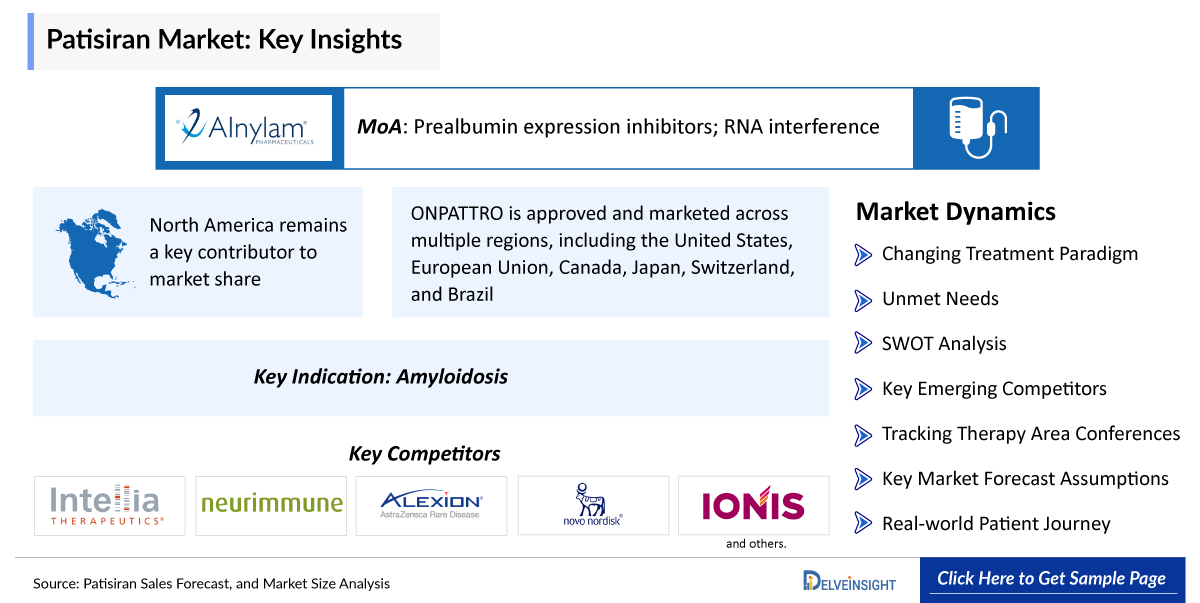
• ONPATTRO is approved and marketed across multiple regions, including the United States, European Union, Canada, Japan, Switzerland and Brazil, expanding access for patients through established regulatory frameworks and reimbursements.
• North America remains a key contributor to market share due to advanced diagnosis infrastructure and specialist networks, while Europe and Asia-Pacific show growing uptake as healthcare systems improve access to rare disease treatments.
• Market forecasts suggest further growth potential in emerging regions with expanding healthcare coverage and diagnostic capabilities for amyloidosis and other rare genetic diseases.
4. New Indication Approvals
• The core indication for patisiran—hATTR amyloidosis with polyneuropathy in adults—has been maintained since its original approval, reflecting sustained clinical use and regulatory support.
• Attempts to expand the label to include treatment for ATTR amyloidosis cardiomyopathy met regulatory challenges; in 2023 the U.S. FDA issued a Complete Response Letter (CRL) citing insufficient evidence of clinical meaningfulness for this additional use, and the application was discontinued in its then-submitted form.
• Despite this setback, ongoing research and the APOLLO-B trial continue to generate data that may inform future submission strategies or alternative therapeutic approaches.
5. Strong Volume Momentum
• Volume growth for patisiran is underpinned by continuous patient initiations and long-term use among treated individuals with hATTR amyloidosis, supported by real-world and extension study data demonstrating slowed disease progression over several years.
• Maintenance therapy through regular intravenous infusions every three weeks means sustained prescription volumes as new diagnoses enter care pathways and existing patients continue long-term treatment.
• Analysts project moderate but steady growth in the broader amyloidosis therapeutics market through 2033 and beyond, with RNAi therapies like patisiran contributing meaningfully to overall segment expansion.
6. Competitive Differentiation and Market Trends
• Patisiran’s RNAi mechanism targeting TTR mRNA differentiates it from other treatment modalities by acting at the genetic expression level, reducing pathogenic protein production more directly than some traditional symptomatic therapies.
• Broad trends favoring precision medicine and targeted therapies support the adoption of RNA-based drugs in rare disease treatment landscapes, where molecular pathophysiology guides therapy selection.
• The evolving regulatory landscape for rare diseases and increasing payer recognition of long-term disease-modifying potential enhance confidence among healthcare systems and clinicians in supporting RNAi therapeutics such as Patisiran.
Patisiran Recent Developments
• FDA Complete Response Letter on Expanded Indication (2023): The US FDA issued a Complete Response Letter for patisiran’s supplemental NDA seeking approval for the cardiomyopathy indication, stating that evidence did not meet the threshold for clinical meaningfulness. As a result, Alnylam discontinued this expansion effort in its then-submitted form, though ONPATTRO’s core indication remains unaffected.
• Positive APOLLO-B Data Presentations: Additional data from the APOLLO-B Phase III study — including sustained treatment effects at 18-24 months on functional outcomes and quality of life measures — have been presented at scientific congresses, underlining ongoing interest in patisiran’s potential beyond its current label.
“Patisiran Sales Forecast, and Market Size Analysis – 2034” report provides comprehensive insights of Patisiran for approved indication like Amyloidosis in the 7MM. A detailed picture of Patisiran’s existing usage in anticipated entry and performance in approved indications in the 7MM, i.e., the United States, EU4 (Germany, France, Italy, and Spain) and the United Kingdom, and Japan for the study period 2020 –2034 is provided in this report along with a detailed description of the Patisiran for approved indications. The Patisiran market report provides insights about Patisiran’s sales forecast, mechanism of action (MoA), dosage and administration, as well as research and development including regulatory milestones, along with other developmental activities. Further, it also consists of historical and current Patisiran performance, future market assessments inclusive of the Patisiran market forecast analysis for approved indications in the 7MM, SWOT, analysts’ views, comprehensive overview of market competitors, and brief about other emerging therapies in respective indications. It also provides analysis of Patisiran sales forecasts, along with factors driving its market.
Patisiran Drug Summary
Patisiran (Onpattro) is a lipid nanoparticle-formulated small interfering RNA (siRNA) approved for the treatment of polyneuropathy associated with hereditary transthyretin-mediated (hATTR) amyloidosis in adults, a rare autosomal dominant disorder caused by TTR gene mutations leading to misfolded transthyretin protein that forms amyloid deposits in peripheral nerves, autonomic nerves, heart, and other tissues, resulting in progressive sensorimotor neuropathy, autonomic dysfunction, and cardiomyopathy. Administered as a 0.3 mg/kg intravenous infusion every 3 weeks following premedication with dexamethasone, retinoids, acetaminophen, and an H1/H2 antagonist to mitigate infusion-related reactions, patisiran targets wild-type and mutant transthyretin mRNA in hepatocytes via RNA interference: the siRNA is taken up by ApoE-opsonized lipid nanoparticles through receptor-mediated endocytosis, processed by Dicer to form the RNA-induced silencing complex (RISC), which cleaves complementary TTR mRNA to reduce serum transthyretin protein levels by ~80-90% within 2-3 weeks, halting new amyloid formation, stabilizing neuropathy (as shown in the APOLLO trial with mNIS+7 improvement), improving quality of life, and potentially benefiting cardiac amyloidosis. The report provides Patisiran’s sales, growth barriers and drivers, post usage and approvals in multiple indications.
Scope of the Patisiran Market Report
The report provides insights into:
• A comprehensive product overview including the Patisiran MoA, description, dosage and administration, research and development activities in approved indication like Amyloidosis.
• Elaborated details on Patisiran regulatory milestones and other development activities have been provided in Patisiran market report.
• The report also highlights Patisiran‘s cost estimates and regional variations, reported and estimated sales performance, research and development activities in approved indications across the United States, Europe, and Japan.
• The Patisiran market report also covers the patents information, generic entry and impact on cost cut.
• The Patisiran market report contains current and forecasted Patisiran sales for approved indications till 2034.
• Comprehensive coverage of the late-stage emerging therapies for respective indications.
• The Patisiran market report also features the SWOT analysis with analyst views for Patisiran in approved indications.
Methodology
The Patisiran market report is built using data and information sourced primarily from internal databases, primary and secondary research and in-house analysis by DelveInsight’s team of industry experts. Information and data from the secondary sources have been obtained from various printable and nonprintable sources like search engines, news websites, global regulatory authorities websites, trade journals, white papers, magazines, books, trade associations, industry associations, industry portals and access to available databases.
Patisiran Analytical Perspective by DelveInsight
• In-depth Patisiran Market Assessment
This Patisiran sales market forecast report provides a detailed market assessment of Patisiran for approved indication like Amyloidosis in the seven major markets, i.e., the United States, EU4 (Germany, France, Italy, and Spain) and the United Kingdom, and Japan. This segment of the report provides current and forecasted Patisiran sales data uptil 2034.
• Patisiran Clinical Assessment
The Patisiran market report provides the clinical trials information of Patisiran for approved indications covering trial interventions, trial conditions, trial status, start and completion dates.
Patisiran Competitive Landscape
The report provides Insights on competitors and marketed products within the domain, along with a summary of emerging products and their respective launch dates, posing significant competition in the market.
Patisiran Market Potential & Revenue Forecast
• Projected market size for the Patisiran and its key indications
• Estimated Patisiran sales potential (Patisiran peak sales forecasts)
• Patisiran Pricing strategies and reimbursement landscape
Patisiran Competitive Intelligence
• Number of competing drugs in development (pipeline analysis)
• Patisiran Market positioning compared to existing treatments
• Patisiran Strengths & weaknesses relative to competitors
Patisiran Regulatory & Commercial Milestones
• Patisiran Key regulatory approvals & expected launch timelines
• Commercial partnerships, licensing deals, and M&A activity
Patisiran Clinical Differentiation
• Patisiran Efficacy & safety advantages over existing drugs
• Patisiran Unique selling points
Patisiran Market Report Highlights
• In the coming years, the Patisiran market scenario is set to change due to strong adoption, increased prescriptions and broader uptake in multiple immunological indications; which would expand the size of the market.
• The Patisiran companies are developing therapies that focus on novel approaches to treat/improve the disease condition, assess challenges, and seek opportunities that could influence Patisiran’s dominance.
• Other emerging products for Amyloidosis are expected to give tough market competition to Patisiran and launch of late-stage emerging therapies in the near future will significantly impact the market.
• A detailed description of regulatory milestones, and developmental activities, provide the current development scenario of Patisiran in approved indications.
• Analyse Patisiran cost, pricing trends and market positioning to support strategic decision-making in the immunology landscape.
• Our in-depth analysis of the forecasted Patisiran sales data uptil 2034 will support the clients in decision-making process regarding their therapeutic portfolio by identifying the overall scenario of Patisiran in approved indications.
Key Questions
• What is the class of therapy, route of administration and mechanism of action of Patisiran? How strong is Patisiran’s clinical and commercial performance?
• What is Patisiran’s clinical trial status in each individual indications such as Amyloidosis and study completion date?
• What are the key collaborations, mergers and acquisitions, licensing and other activities related to the Patisiran Manufacturers?
• What are the key designations that have been granted to Patisiran for approved indications? How are they going to impact Patisiran’s penetration in various geographies?
• What is the current and forecasted Patisiran market scenario for approved indications? What are the key assumptions behind the forecast?
• What are the current and forecasted sales of Patisiran in the seven major countries, including the United States, Europe (Germany, France, Italy, Spain) and the United Kingdom, and Japan?
• What are the other emerging products available and how are these giving competition to Patisiran for approved indications?
• Which are the late-stage emerging therapies under development for the treatment of approved indications?
• How cost-effective is Patisiran? What is the duration of therapy and what are the geographical variations in cost per patient?

