
peripheral artery disease and stenosis treatment devices market
Peripheral Artery Disease And Stenosis Treatment Devices Market By Product Type (Angioplasty And Drug-Coated Balloons, Angioplasty Stents, Plaque Modification Devices, Hemodynamic Flow Alteration Devices, Peripheral Guidewires), End-User (Hospitals, Ambulatory Surgical Centers, And Specialty Clinics), and geography is expected to grow at a steady CAGR forecast till 2030 owing to the rising prevalence of peripheral artery disease and arteriosclerosis across the globe.
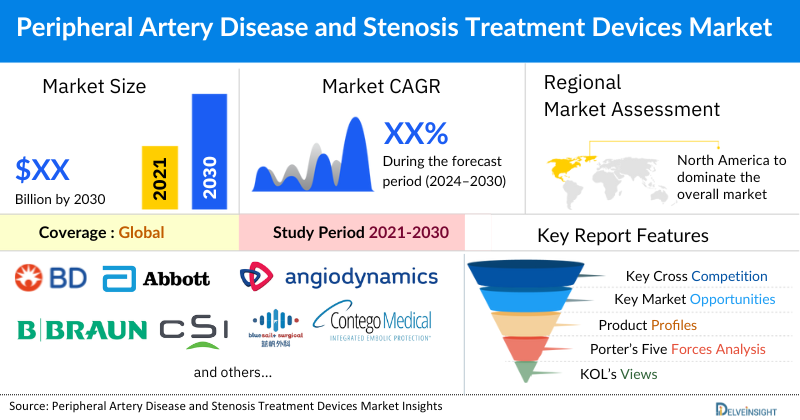
The global peripheral artery disease and stenosis treatment devices market was valued at USD XX million in 2023, growing at a CAGR of XX% during the forecast period from 2024 to 2030 to reach USD XX million by 2030. The demand for peripheral artery disease and stenosis treatment devices is primarily being boosted owing to the escalating burden of the geriatric population and the rising population associated with stenosis-related PAD and arteriosclerosis across the globe. Furthermore, the rising prevalence of various risk factors such as obesity, diabetes, and high blood pressure coupled with increasing product launches are creating a positive market growth, thereby contributing to the overall growth of the peripheral artery disease and stenosis treatment devices market during the forecast period from 2024-2030.
Peripheral Artery Disease And Stenosis Treatment Devices Market Dynamics:
According to the Global Burden of Disease 2019, there were 56.4 million prevalent cases of Peripheral Artery Disease (PAD) among those aged 40–70, worldwide in 2019. As per the Canadian Journal of Cardiology article, the global prevalence of PAD was 5.6%, with higher prevalence estimates in high-income countries than in low-income countries. Moreover, based on a recent research study published in 2023, 113,443,017 people lived with PAD and 10,504,092 new cases occurred in 2019.
Based on a research study, it was also reported that 75% of acute myocardial infarctions occur from plaque rupture, and the highest incidence of plaque rupture was observed in men over 45 years; whereas, in women, the incidence increases beyond age 50 years.
A community-based cross-sectional research study from Northern Kerala, India, published in the year 2018 in the Indian Heart Journal, stated that there was a steady increase in the prevalence of the disease between the age prevalence of 60- 64 years and 75 to 79 years groups, being 21.13% and 38.19% in the year 2018 respectively.
Furthermore, the increasing geriatric population prone to various cardiovascular disorders involving stenosis cases, among others is further accelerating the demand for PAD and stenosis treatment devices. According to the data provided by the WHO (2022), in 2020, about one billion people across the world were over the age of 60. The elderly population aged 60 and above is expected to double in number representing about 2.1 billion people by 2050. Also, people in the age group of 80 and above are estimated to triple between 2020 and 2050 to reach 426 million. PAD prevalence among the elderly is similar or higher in women compared with men mainly because women form the major section of the elderly population.
However, the high cost of different devices, and the adverse events related to various treatments, among others may restrict the growth of the overall market for peripheral artery disease and stenosis treatment devices during the forecast period.
Peripheral Artery Disease And Stenosis Treatment Devices Market Segment Analysis:
Peripheral artery disease and stenosis treatment devices Market by Product Type (Angioplasty And Drug-Coated Balloons, Angioplasty Stents, Plaque Modification Devices, Hemodynamic Flow Alteration Devices, Peripheral Guidewires), End-User (Hospitals, Ambulatory Surgical Centers, And Specialty Clinics), And Geography (North America, Europe, Asia-Pacific, and Rest of the World).
In the product type segment of the peripheral artery disease and stenosis treatment devices market, the angioplasty and drug-coated balloons category is expected to amass a significant revenue share in the year 2023. This can be attributed to the various properties, technical advantages, and product development activities such as collaborations and regulatory approvals of angioplasty and drug-coated balloons during the given forecast period.
An Angioplasty balloon involves the insertion of a balloon attached to a catheter into an artery where the deposition has been diagnosed. The angioplasty balloon catheter is guided carefully and accurately through the artery to the deposition or blockage site and then inflated to widen the opening which pushes the plaque deposition against the wall of the artery. This allows for blood flow restoration in a blocked artery and elevation in the delivery of oxygen-rich blood to the muscles and tissues in the body.
The major advantage of an angioplasty balloon is that it allows for the treatment of peripheral artery disease in a minimally invasive manner. Treatment of peripheral artery disease with the utilization of an angioplasty balloon catheter ensures that the patient can return to day-to-day activities shortly after the procedure without many complications and restrictions.
Moreover, in November 2022, Chocolate Touch® developed by TriReme Medical LLC received US FDA approval, It is next generation drug-coated angioplasty balloon for the treatment of patients suffering from peripheral artery disease in the superficial femoral artery and the popliteal artery.
Therefore, owing to all the above-mentioned factors, the angioplasty and drug-coated balloons category are expected to register significant growth, thereby driving the growth of the overall peripheral artery disease and stenosis treatment devices market during the forecast period.
North America is expected to dominate the overall Peripheral Artery Disease And Stenosis Treatment Devices Market:
Among all the regions, North America is estimated to account for the largest share of the peripheral artery disease and stenosis treatment devices market in the year 2023. Owing to the significance of key growth factors, the increasing prevalence of peripheral artery disease and its risk factors, the rising geriatric population, and the presence of key market players among others, are expected to spur the market in North America in the upcoming years.
Furthermore, the increasing research and development activities in the region associated with the launch and approval of new treatment devices for peripheral artery disease are also driving the market growth in North America, due to which the market for peripheral artery disease and stenosis treatment devices is expected to witness prosperity in the North American region during the forecast period from 2024-2030.
As per data from the American Heart Association 2021, PAD affected about 8.5 million U.S. adults over the age of 40, in 2021. As per the same source, African Americans were twice more likely to screen positive for PAD than non-Hispanic adults.
As per the US Census Bureau 2021 report, more than 54 million adults ages 65 and above lived in the United States, in 2021. Further by 2050, the total number of adults aged 65 and above are projected to rise to an estimated 85.7 million roughly 20% of the overall U.S. population. The elderly population especially people above 50 years are more prone to peripheral artery disease.
Furthermore, in June 2022, Cardio Flow, Inc., received the U.S. Food and Drug Administration (FDA) clearance for the company’s FreedomFlow® Peripheral Guidewire.
Thus, due to the interplay of all the above-mentioned factors, it is likely to propel the growth of the peripheral artery disease and stenosis treatment devices market in the region during the forecast period from 2024-2030.
Peripheral Artery Disease And Stenosis Treatment Devices Market Key Players:
Some of the key market players operating in the peripheral artery disease and stenosis treatment devices market include Medtronic, Koninklijke Philips N.V., B.Braun SE, Boston Scientific Corporation, BD, Terumo Corporation, Biotronik, Cordis, Abbott, AngioDynamics, Cardiovascular Systems, Inc., Bluesail Medical Co., Ltd., Contego Medical, Inc., Argon Medical, Rex Medical, Merck & Co., Inc., Sanofi, Johnson and Johnson Services, Inc., Otivio, Reflow Medical Inc., and others.
Recent Developmental Activities in the Peripheral Artery Disease And Stenosis Treatment Devices Market:
- In June 2023, Surmodics, Inc., a leading provider of medical device and in vitro diagnostic technologies to the healthcare industry, announced that it received approval from the U.S. Food and Drug Administration (FDA) for its SurVeil™ drug-coated balloon (DCB), intended for percutaneous transluminal angioplasty, after appropriate vessel preparation.
- In October 2023, Boston Scientific Corporation announced positive 12-month results from the pivotal AGENT IDE clinical trial of the AGENT™ Drug-Coated Balloon (DCB) to evaluate the safety and effectiveness of using a DCB to treat coronary in-stent restenosis (ISR).
- In November 2022, Genesis MedTech Group announced that the FDA approved the company's Chocolate Touch drug-coated balloon (DCB) percutaneous transluminal angioplasty (PTA) catheter for the treatment of patients with peripheral artery disease in the superficial femoral artery and the popliteal artery.
Key Takeaways from the Peripheral Artery Disease And Stenosis Treatment Devices Market Report Study
- Market size analysis for current peripheral artery disease and stenosis treatment devices market size (2023), and market forecast for 5 years (2024-2030)
- Top key product/services/technology developments, mergers, acquisitions, partnerships, and joint ventures happened for the last 3 years
- Key companies dominating the global peripheral artery disease and stenosis treatment devices market.
- Various opportunities available for the other competitors in the peripheral artery disease and stenosis treatment devices market space.
- What are the top-performing segments in 2023? How these segments will perform in 2030?
- Which are the top-performing regions and countries in the current peripheral artery disease and stenosis treatment devices market scenario?
- Which are the regions and countries where companies should have concentrated on opportunities for peripheral artery disease and stenosis treatment devices market growth in the coming future?
Target Audience who can be benefit from this Peripheral Artery Disease And Stenosis Treatment Devices Market Report Study
- Peripheral Artery Disease and Stenosis Treatment Device product providers
- Research organizations and consulting companies
- Peripheral artery disease and stenosis treatment devices-related organizations, associations, forums, and other alliances
- Government and corporate offices
- Start-up companies, venture capitalists, and private equity firms
- Distributors and Traders dealing in peripheral artery disease and stenosis treatment devices
- Various end-users who want to know more about the PAD and stenosis treatment devices market and the latest technological developments in the peripheral artery disease and stenosis treatment devices market.
Frequently Asked Questions for the Peripheral Artery Disease And Stenosis Treatment Devices Market:
1. What is meant by peripheral artery disease and stenosis treatment devices?
Peripheral artery disease is a common cardiovascular condition that is caused by plaque build-up in the arteries, known as stenosis, resulting in restricted blood flow to the limbs. It is defined as a partial or total blockage of the arteries peripheral to the aorta. Atherosclerosis is the main reason by which PAD manifests.
2. What is the market for global peripheral artery disease and stenosis treatment devices?
The global peripheral artery disease and stenosis treatment devices market was valued at USD XX million in 2023, growing at a CAGR of XX% during the forecast period from 2024 to 2030 to reach USD XX million by 2030.
3. What are the drivers for the global peripheral artery disease and stenosis treatment market?
The demand for peripheral artery disease and stenosis treatment devices is primarily being boosted owing to the rising prevalence of peripheral artery disease globally, increasing geriatric population susceptible to peripheral artery disease, rising risk factors for PAD such as hypertension, diabetes, smoking, and others, technological advancements associated with PAD treatment devices, increasing product development activities such as product launches and regulatory approvals for drugs and devices pertaining to PAD, and the rising awareness with respect to cardiovascular health, thereby contributing to the overall growth of the peripheral artery disease and stenosis treatment devices market during the forecast period from 2024-2030.
4. Who are the key players operating in the global peripheral artery disease and stenosis treatment devices market?
Some of the key market players operating in the peripheral artery disease and stenosis treatment devices market include Medtronic, Koninklijke Philips N.V., B.Braun SE, Boston Scientific Corporation, BD, Terumo Corporation, Biotronik, Cordis, Abbott, AngioDynamics, Cardiovascular Systems, Inc., Bluesail Medical Co., Ltd., Contego Medical, Inc., Argon Medical, Rex Medical, Merck & Co., Inc., Sanofi, Johnson and Johnson Services, Inc., Otivio, Reflow Medical Inc., and others.
5. Which region has the highest share in the peripheral artery disease and stenosis treatment devices market?
North America is expected to dominate the overall peripheral artery disease and stenosis treatment devices market during the forecast period from 2024-2030. Owing to the significance of key growth factors, the increasing prevalence of peripheral artery disease and their risk factors, the rising geriatric population, the presence of key market players among others, are expected to spur the market in North America in the upcoming years. Furthermore, the increasing research and development activities in the region associated with the launch and approval of new treatment devices for peripheral artery disease, the market is expected to witness prosperity in the North American region during the forecast period from 2024-2030.

