
peripheral artery disease pipeline insight
DelveInsight’s, “Peripheral Artery Disease - Pipeline Insight, 2026” report provides comprehensive insights about 17+ companies and 20+ pipeline drugs in Peripheral Artery Disease pipeline landscape. It covers the pipeline drug profiles, including clinical and nonclinical stage products. It also covers the therapeutics assessment by product type, stage, route of administration, and molecule type. It further highlights the inactive pipeline products in this space.
Geography Covered
- Global coverage
Peripheral Artery Disease: Understanding
Peripheral Artery Disease: Overview
Peripheral Artery Disease (PAD) is a common circulatory disorder in which arteries outside the heart and brain become narrowed or blocked, most commonly in the lower extremities. The condition reduces blood flow to the legs and feet, leading to symptoms such as leg pain during walking (intermittent claudication), numbness, weakness, and, in severe cases, tissue damage or limb loss. PAD is considered a manifestation of systemic atherosclerosis and is associated with an increased risk of heart attack, stroke, and cardiovascular death.
The primary cause of PAD is atherosclerosis, a chronic condition characterized by the accumulation of cholesterol, fats, inflammatory cells, and fibrous tissue within arterial walls, forming plaques that narrow the arteries. Major risk factors include cigarette smoking, diabetes mellitus, hypertension, hyperlipidemia, chronic kidney disease, advanced age, obesity, and a family history of cardiovascular disease. Less common causes include blood clots, inflammatory vascular diseases, trauma, and certain anatomical abnormalities affecting blood vessels.
PAD develops through a progressive atherosclerotic process. Lipoproteins accumulate within the arterial intima, where they undergo oxidation and trigger an inflammatory response. Macrophages ingest these oxidized lipids, forming foam cells and fatty streaks that gradually evolve into atherosclerotic plaques. As plaques enlarge, they narrow the arterial lumen and reduce blood flow to peripheral tissues. During physical activity, oxygen demand increases, but the narrowed arteries cannot supply sufficient blood, resulting in ischemic pain. Advanced disease may lead to critical limb ischemia, ulceration, gangrene, and potential limb loss.
Diagnosis begins with a detailed medical history and physical examination, including assessment of peripheral pulses and signs of impaired circulation. The most widely used diagnostic test is the Ankle-Brachial Index (ABI), which compares blood pressure measurements in the ankle and arm; an ABI below 0.90 is suggestive of PAD. Additional investigations may include Doppler ultrasound, duplex ultrasonography, computed tomography angiography (CTA), magnetic resonance angiography (MRA), conventional angiography, and blood tests to evaluate cardiovascular risk factors such as diabetes and hyperlipidemia.
The goals of treatment are to relieve symptoms, improve walking ability, prevent disease progression, and reduce cardiovascular risk. Lifestyle modifications are fundamental and include smoking cessation, regular supervised exercise programs, weight management, and a heart-healthy diet. Pharmacologic therapy may involve antiplatelet agents, statins, blood pressure control, and diabetes management. Patients with severe symptoms or critical limb ischemia may require revascularization procedures such as angioplasty with stent placement, atherectomy, or surgical bypass. Early diagnosis and aggressive risk-factor management significantly improve outcomes and reduce the risk of amputation and cardiovascular events.
"Peripheral Artery Disease- Pipeline Insight, 2026" report by DelveInsight outlays comprehensive insights of present scenario and growth prospects across the indication. A detailed picture of the Peripheral Artery Disease pipeline landscape is provided which includes the disease overview and Peripheral Artery Disease treatment guidelines. The assessment part of the report embraces, in depth Peripheral Artery Disease commercial assessment and clinical assessment of the pipeline products under development. In the report, detailed description of the drug is given which includes mechanism of action of the drug, clinical studies, NDA approvals (if any), and product development activities comprising the technology, Peripheral Artery Disease collaborations, licensing, mergers and acquisition, funding, designations and other product related details.
Report Highlights
The companies and academics are working to assess challenges and seek opportunities that could influence Peripheral Artery Disease R&D. The therapies under development are focused on novel approaches to treat/improve Peripheral Artery Disease.
Peripheral Artery Disease Emerging Drugs Chapters
This segment of the Peripheral Artery Disease report encloses its detailed analysis of various drugs in different stages of clinical development, including phase II, I, preclinical and Discovery. It also helps to understand clinical trial details, expressive pharmacological action, agreements and collaborations, and the latest news and press releases.
Peripheral Artery Disease Emerging Drugs
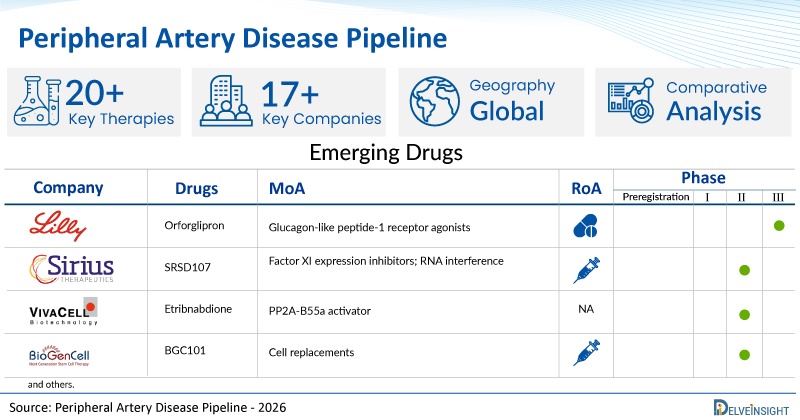
Orforglipron: Eli Lilly and Company
Orforglipron is a once-daily oral, non-peptide glucagon-like peptide-1 (GLP-1) receptor agonist. The drug works by activating the GLP-1 receptor, which helps regulate appetite, body weight, glucose metabolism, and several cardiometabolic risk factors. Currently, the drug is being evaluated in the Phase III stage of its development for the treatment of Peripheral Artery Disease.
SRSD107: Sirius Therapeutics Co., Ltd.
SRSD107 is an investigational small interfering RNA (siRNA) therapeutic being developed by Sirius Therapeutics in collaboration with CRISPR Therapeutics. The drug is designed to target and silence coagulation Factor XI (FXI) messenger RNA, thereby reducing FXI protein production and inhibiting the intrinsic coagulation pathway. SRSD107 is intended to provide anticoagulant and antithrombotic effects while potentially minimizing bleeding risk compared with conventional anticoagulants. SRSD107 is being investigated as a long-acting therapy to reduce thrombotic risk in patients with chronic peripheral arterial disease. Currently, the drug is being evaluated in the Phase II stage of its development for the treatment of Peripheral Artery Disease.
Etribnabdione: VivaCell Biotechnology España
Etribnabdione is an investigational, fully synthetic small-molecule drug for vascular diseases including Peripheral Artery Disease (PAD). Etribnabdione acts as a PP2A-B55a activator and has been shown to promote angiogenesis (formation of new blood vessels) and arteriogenesis (growth of collateral arteries), mechanisms that may improve blood flow in ischemic limbs affected by PAD. Currently, the drug is being evaluated in the Phase II stage of its development for the treatment of Peripheral Artery Disease.
Further product details are provided in the report……..
Peripheral Artery Disease: Therapeutic Assessment
This segment of the report provides insights about the different Peripheral Artery Disease drugs segregated based on following parameters that define the scope of the report, such as:
Major Players in Peripheral Artery Disease
There are approx. 17+ key companies which are developing the therapies Peripheral Artery Disease. The companies which have their Peripheral Artery Disease drug candidates in the most advanced stage, i.e. Phase III include, Eli Lilly and Company, and others.
Phases
DelveInsight’s report covers around 20+ products under different phases of clinical development like
- Late stage products (Phase III)
- Mid-stage products (Phase II)
- Early-stage product (Phase I) along with the details of
- Pre-clinical and Discovery stage candidates
- Discontinued & Inactive candidates
Route of Administration
Peripheral Artery Disease pipeline report provides the therapeutic assessment of the pipeline drugs by the Route of Administration. Products have been categorized under various ROAs such as
- Intra-articular
- Intraocular
- Intrathecal
- Intravenous
- Ophthalmic
- Oral
- Parenteral
- Subcutaneous
- Topical
- Transdermal
Molecule Type
Products have been categorized under various Molecule types such as
- Oligonucleotide
- Peptide
- Small molecule
Product Type
Drugs have been categorized under various product types like Mono, Combination and Mono/Combination.
Peripheral Artery Disease: Pipeline Development Activities
The report provides insights into different therapeutic candidates in phase II, I, preclinical and discovery stage. It also analyses Peripheral Artery Disease therapeutic drugs key players involved in developing key drugs.
Pipeline Development Activities
The report covers the detailed information of collaborations, acquisition and merger, licensing along with a thorough therapeutic assessment of emerging Peripheral Artery Disease drugs.
Peripheral Artery Disease Report Insights
- Peripheral Artery Disease Pipeline Analysis
- Therapeutic Assessment
- Unmet Needs
- Impact of Drugs
Peripheral Artery Disease Report Assessment
- Pipeline Product Profiles
- Therapeutic Assessment
- Pipeline Assessment
- Inactive drugs assessment
- Unmet Needs
Key Questions
Current Treatment Scenario and Emerging Therapies:
- How many companies are developing Peripheral Artery Disease drugs?
- How many Peripheral Artery Disease drugs are developed by each company?
- How many emerging drugs are in mid-stage, and late-stage of development for the treatment of Peripheral Artery Disease?
- What are the key collaborations (Industry–Industry, Industry–Academia), Mergers and acquisitions, licensing activities related to the Peripheral Artery Disease therapeutics?
- What are the recent trends, drug types and novel technologies developed to overcome the limitation of existing therapies?
- What are the clinical studies going on for Peripheral Artery Disease and their status?
- What are the key designations that have been granted to the emerging drugs?


-(acute-kidney-injury)-pipeline.png&w=256&q=75)

