
PET-MRI Systems Market
PET-MRI Systems Market By Phase (Preclinical And Clinical), By Type (Traditional PET-MRI Systems And Helium-Free PET-MRI Systems), By End-User (Hospitals, Diagnostic Centers, Academic & Research Institutes, And Others), and by geography is expected to advance at a respectable CAGR forecast till 2030 owing to the increasing prevalence of various cancer, neurological disorders and the escalating burden of geriatric population prone to various chronic diseases across the globe.
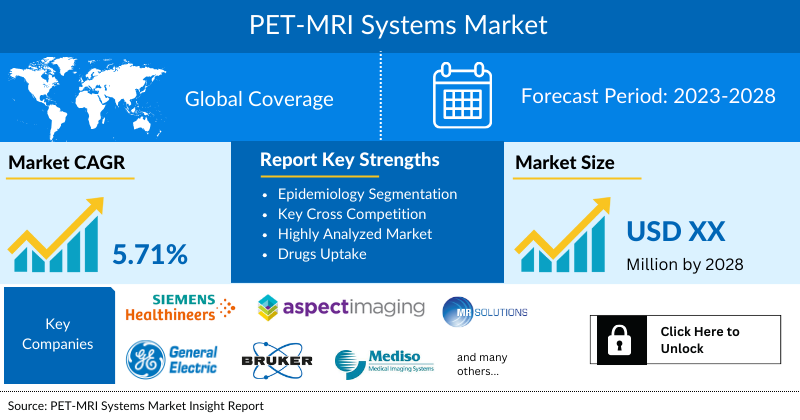
The global PET-MRI systems market is estimated to grow at a CAGR of 5.71% during the forecast period from 2024 to 2030. The PET-MRI systems market is observing substantial market growth owing to the increasing prevalence of neurological disorders such as Alzheimer's and other dementias, strokes, migraine and other headaches, multiple sclerosis, Parkinson's disease, neurological infections, brain tumors and the rising prevalence of various cancers around the globe. Further, the escalating burden of the geriatric population, extensive research and development activities employing PET-MRI systems, increasing approval activities by regulatory authorities for devices, the surging new devices launches, and the presence of key players in the market, among others will create a requisite for PET-MRI systems in the market. Therefore, the PET-MRI systems market is estimated to grow at a substantial CAGR during the forecast period from 2024 to 2030.
PET-MRI Systems Market Dynamics:
One of the key aspects driving the PET-MRI Systems market is the rising burden of various neurological diseases and cancers across the globe.
According to the World Health Organization (WHO) 2022, cancer is a leading cause of death worldwide, accounting for nearly 10 million deaths in 2020. The new cases of breast cancer in 2020 were 2.26 million cases, across the globe. The same source stated that lung cancer accounted for 2.21 million new cases, colon and rectum cancer for 1.93 million new cases, prostate cancer with 1.41 million new cases, skin cancer accounted for 1.20 million new cases, and stomach cancer new cases were 1.09 million, reported globally in 2020.
Moreover, according to the data provided by the WHO, in 2019, approximately 50 million people across the globe were suffering from epilepsy, making it one of the most common neurological diseases globally in the same year. The source further mentioned that as of 2022, about 80% of people with epilepsy live in low- and middle-income countries. Furthermore, it is predicted that up to 70% of people living with epilepsy could live seizure-free if properly diagnosed and treated.
Additionally, as per the data provided by WHO for dementia, in 2020, about 50 million people have dementia, and there are nearly 10 million new cases every year. Alzheimer's disease is the commonest form of dementia and contributes to 60–70% of cases.
In another dataset, according to the Alzheimer Europe 2019 data, the number of people living with dementia in the European Union (EU27) was predicted to be 7,853,705, and in European countries represented by AE members, 9,780,678. It has been estimated that the numbers will almost double by 2050 increasing to 14,298,671 in the EU and 18,846,286 in the wider European region.
PET and MRI are both established imaging modalities for the study of disorders of the central nervous system, with applications in neuro-oncology, epilepsy, dementia syndromes, cerebrovascular disease, neurological disease, and psychiatric disorders. The two modalities offer complimentary information, with conventional MRI providing structural imaging of the brain with high spatial resolution and high tissue contrast and PET providing physiologic information about brain metabolism.
Therefore, the rising prevalence of neurological diseases across the globe is further expected to aid in the increasing demand for devices employed in understanding the anatomical and physiological functioning of the brain, thereby boosting the growth of the global PET-MRI systems market during the forecast period (2024-2030).
However, the extremely high pricing of PET-MRI systems, the presence of alternative techniques, and others may halt the market growth of PET-MRI systems.
The PET-MRI Systems market was significantly impacted during the period of COVID- 19 pandemic. One of the major steps during the pandemic was the reorganization of the healthcare facilities to cater to the patient load associated with COVID-19 infection. This resulted in a significant reduction in patients suffering from strokes, sleep disorders, and other neurological indications visiting such facilities and getting PET-MRI scans. For instance, the Radiological Society of North America COVID-19 task force reported a 40–90% decline in examination volumes in radiology practices during the COVID-19 pandemic. Similarly, several surveys have evaluated the impact of COVID-19 on nuclear medicine services. Across the world, all surveys showed that COVID-19 had resulted in a significant decline in nuclear medicine scanning, with some centers experiencing a decrease in activity of up to 85%. Therefore, the COVID-19 pandemic affected the facilities offering PET-MRI scans ultimately creating impacting the demand for PET-MRI systems during the pandemic phase of the study period for this market. However, the ease of lockdown restrictions, the upturn of resources and supply chain, the administration of a vaccine to the public, and with the increasing number of patients in hospitals or clinics for diagnosis, the demand for PET-MRI systems picked up momentum again and is anticipated to do the same during the forecast period from 2022 – 2030.
PET-MRI Systems Market Segment Analysis:
PET-MRI Systems Market by Phase (Preclinical and Clinical), By Type (Traditional PET-MRI Systems and Helium-Free PET-MRI Systems), End-User (Hospitals, Diagnostic Centers, Academic & Research Institutes, and Others), and Geography (North America, Europe, Asia-Pacific, and Rest of the World).
In the phase type segment of the PET-MRI Systems market, the preclinical segment is expected to have a significant revenue share in the year 2021. This was primarily owing to the increasing number of preclinical research across the globe.
Also, as most of the research and experimental studies are initially conducted on model organisms such as mice, rabbits, and marmosets among others, preclinical systems prove to be of crucial importance in helping in different areas of research for disease biology to drug development.
These systems are important in the research area as being specifically designed to deal with smaller anatomy compared to humans therefore, these systems help reduce the time under anesthesia for the animals being studied, reducing the chance of anesthesia-related side effects and improving animal health and participation to study completion in longitudinal studies.
Additionally, Aspect Imaging; Bruker; Mediso Ltd.; MR Solutions; and Bruker are some of the market players developing pre-clinical PET-MRI systems for research purposes as well.
Therefore, owing to the above-mentioned factors, the demand for gel PET-MRI Systems upsurges, thereby the category is expected to witness considerable growth eventually contributing to the overall growth of the global PET-MRI Systems market during the forecast period.
|
Report Metrics |
Details |
|
Study Period |
2020 to 2030 |
|
Base Year |
2022 |
|
Forecast Period |
2024 to 2030 |
|
CAGR | |
|
Pet Mri Systems Market Size |
USD XX million by 2030 |
|
Key Pet Mri Systems Companies |
Siemens Healthineers AG, General Electric Company, Aspect Imaging Ltd, Bruker, Mediso Ltd, MR Solutions, United Imaging Healthcare Co., Ltd., Koninklijke Philips N.V., Cubresa Inc., Inviscan Imaging Systems, MR Solutions, and Many Others. |
North America Is Expected To Dominate The Overall PET-MRI Systems Market:
Among all the regions, North America is expected to dominate the global PET-MRI Systems in the year 2021 and is expected to do the same during the forecast period from 2024-2030.
This can be ascribed to the increasing prevalence of neurological disorders, cancers, and other chronic diseases. Further, extensive research and development activities employing PET-MRI systems, and the presence of key domicile players in the region are the reasons which act as a supportive factor for the North America PET-MRI systems market growth.
For instance, as per the latest data provided by Parkinson’s Foundation, about one million people were living with Parkinson’s disease (PD) in the United States in 2021. This is expected to rise to 1.2 million by 2030. The source further mentioned that approximately 60,000 Americans are diagnosed with PD each year. Also, about four percent of people with PD are diagnosed before age 50.
Further, according to the Centers for Disease Prevention and Control (CDC) 2020, there was about 61,000 traumatic brain injury (TBI)-related deaths in the United States in 2019.
The source UCB Canada Inc. in 2022, stated that Parkinson’s disease affects 1 in every 500 people in Canada. Over 100,000 Canadians are living with Parkinson’s and approximately 6,600 new cases of PD are diagnosed each year in Canada (based on an annual incidence of 20 new cases per 100,000 people).
Thus, these statistics point toward the rising number of cases associated with neurological indications, in North America. Therefore, the increasing prevalence of neurological disease in the region will in turn increase the demand for PET-MRI systems.
Furthermore, the presence of key players such as Siemens Healthineers and GE Healthcare among others, among others and their initiatives to raise awareness of neurological disorders and their management could increase the adoption of the PET/MRI systems thus bolstering the market. Considering the presence of a large patient pool in the US coupled with new product launches, the market for PET/MRI systems looks promising in the United States. For instance, in May 2019, United Imaging Healthcare (UIH) received product approval from the U.S. Food and Drug Administration (FDA) for their uPMR 790 HD TOF PET/MR.
Therefore, the interplay of the aforementioned factors above would provide a conducive growth environment for the North American region in the PET-MRI systems market.
Key PET-MRI Systems Companies In The Market:
Some of the key PET-MRI systems companies operating in the market include Siemens Healthineers AG, General Electric Company, Aspect Imaging Ltd, Bruker, Mediso Ltd, MR Solutions, United Imaging Healthcare Co., Ltd., Koninklijke Philips N.V., Cubresa Inc., Inviscan Imaging Systems, MR Solutions, and others.
Recent Developmental Activities In The PET-MRI Systems Market:
- In November 2019, MR Solutions has installed the first 7T PET/MR preclinical imaging system in Israel. The dry magnet system is helping to advance medical research at the Wohl Institute for Translational Medicine, part of the Hadassah Hebrew University Medical Center in Jerusalem. The system has a large axial 15 cm field of view which can be used for viewing the whole body of a rat, or other subjects in molecular detail.
- In May 2019, United Imaging Healthcare (UIH) received product approval from the U.S. Food and Drug Administration (FDA) for their uPMR 790 HD TOF PET/MR.
Key Takeaways From The PET-MRI Systems Market Report Study
- Market size analysis for current PET-MRI systems market size (2023), and market forecast for 5 years (2024-2030)
- The effect of the COVID-19 pandemic on this market is significant. To capture and analyze suitable indicators, our experts are closely watching the PET-MRI systems market.
- Top key product/services/technology developments, mergers, acquisitions, partnerships, and joint ventures happened for the last 3 years
- Key companies dominating the global PET-MRI systems market.
- Various opportunities available for the other competitor in the PET-MRI systems market space.
- What are the top-performing segments in 2023? How these segments will perform in 2030.
- Which are the top-performing regions and countries in the current PET-MRI systems market scenario?
- Which are the regions and countries where companies should have concentrated on opportunities for PET-MRI systems market growth in the coming future?
Target Audience Who Can Be Benefited From This PET-MRI Systems Market Report Study
- PET-MRI systems providers
- Research organizations and consulting companies
- PET-MRI systems-related organizations, associations, forums, and other alliances
- Government and corporate offices
- Start-up companies, venture capitalists, and private equity firms
- Distributors and Traders dealing in PET-MRI systems
- Various end users who want to know more about the PET-MRI systems market and the latest developments in the PET-MRI systems market.

