
Phacoemulsifier Devices Market Summary
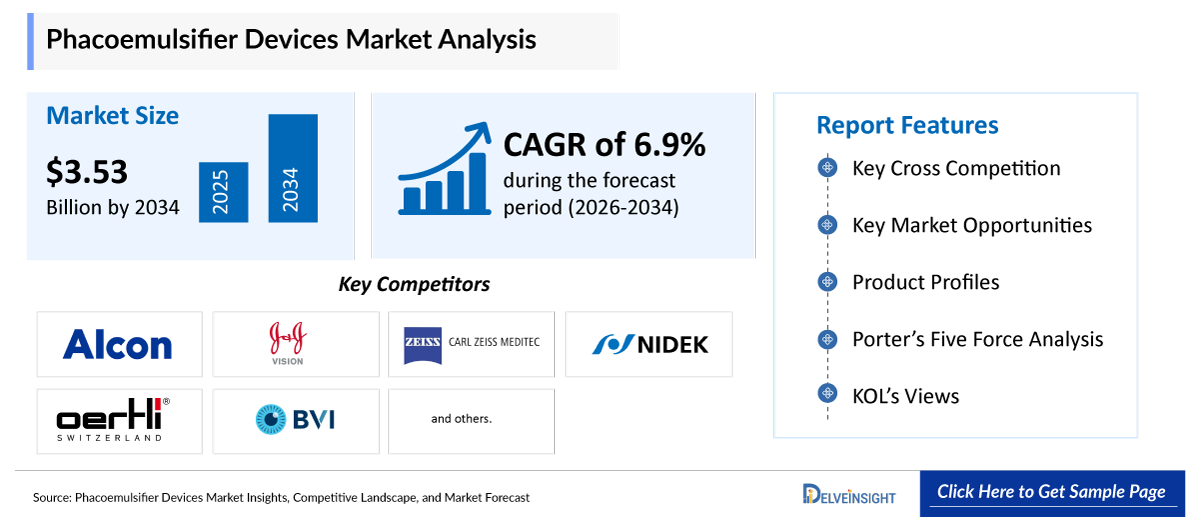
• The global phacoemulsifier devices market was valued at USD 2.10 billion in 2025 and is projected to reach USD 3.85 billion by 2034.
• The market is expected to expand at a CAGR of 6.9% during the forecast period 2026-2034, supported by the expanding global aging population, rising prevalence of cataracts and ocular disorders, rapid transition toward micro-incision cataract surgery (MICS), and continuous innovation in active fluidics and torsional ultrasound handpieces.
• By product type, the phacoemulsification systems segment dominated the market with a 68% share in 2025.
• By technology, the torsional phacoemulsification segment dominated the market with a 52% share in 2025.
• By application, the cataract surgery segment dominated the market with an 82% share in 2025.
• By end-user, the hospitals segment dominated the market with a 48% share in 2025, while ophthalmic clinics and ambulatory surgical centers (ASCs) represent the fastest-growing end-user category.
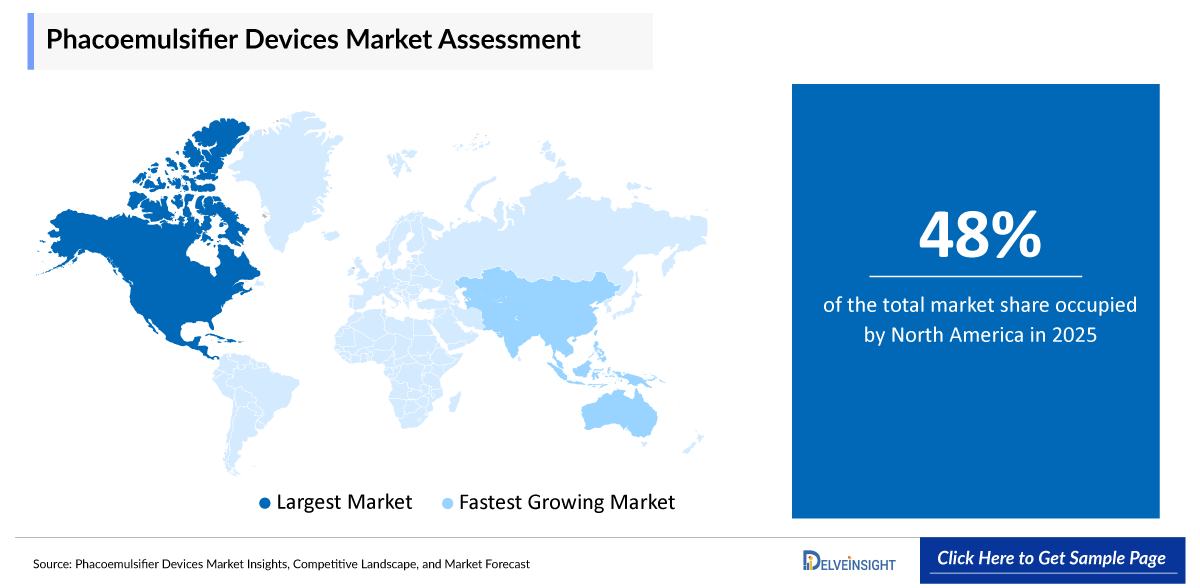
• North America accounted for the largest share of the phacoemulsifier devices market at 42% in 2025, while Asia-Pacific is anticipated to register the fastest growth through 2034.
Phacoemulsifier devices are specialized ophthalmic surgical systems that utilize ultrasonic energy to emulsify and aspirate the clouded natural lens during cataract extraction surgery, allowing for small-incision intraocular lens (IOL) implantation. The scope of this report encompasses phacoemulsification consoles, handpieces, ultrasonic tips, and dedicated surgical packs and accessories used across cataract and combined anterior-posterior vitrectomy procedures. The market is organized by product type, underlying technology, clinical application, end-user setting, and geographic region. By product type, it spans complete phacoemulsification systems and associated consumables and accessories, with complete systems holding the primary capital market share and consumables generating recurring revenue. By technology, it divides between torsional, longitudinal, and hybrid/combination ultrasound systems, with torsional and active fluidics platforms leading the market due to enhanced surge prevention and reduced corneal endothelial heat dissipation. By application, cataract surgery forms the core market segment, alongside combined phaco-vitrectomy procedures. By end-user, the market is distributed across hospitals, specialized ophthalmic clinics, ambulatory surgical centers, and academic research centers. The market is driven by the burgeoning geriatric demographic, high global volumes of age-related cataract surgeries, technological shifts toward micro-incision and femtosecond laser-assisted cataract surgery (FLACS) integration, and expanding ophthalmic infrastructure in emerging economies.
Phacoemulsifier Devices Market Key Growth Drivers
• Rising global aging population and the corresponding surge in age-related eye conditions, particularly nuclear, cortical, and subcapsular cataracts.
• Shift toward micro-incision cataract surgery (MICS) and minimally invasive technique adoption, requiring sophisticated active fluidics to maintain intraocular pressure (IOP) stability.
• Continuous technological advancements in ultrasound energy delivery, including torsional movement, burst mode, and intelligent energy management that minimize corneal endothelial cell loss.
• Growing volume of outpatient and day-care ophthalmic surgeries, driving high adoption in specialized ophthalmic clinics and ambulatory surgical centers (ASCs).
• Integration of phacoemulsification consoles with vitrectomy systems (combination anterior-posterior platforms) for versatile surgical application.
• Expansion of public screening initiatives, government-backed blindness prevention programs, and private eye-care infrastructure in emerging economies across Asia-Pacific and Latin America.
• Favorable reimbursement coverage for cataract extraction procedures and premium intraocular lenses (IOLs) in major developed healthcare systems.
Key Companies in Phacoemulsifier Devices Market
The competitive landscape is led by the following active manufacturers:
• Alcon Inc.
• Bausch + Lomb Corporation
• Johnson & Johnson Vision (Johnson & Johnson MedTech)
• Carl Zeiss Meditec AG
• NIDEK CO., LTD.
• Oertli Instrumente AG
• BVI Medical (PhysIOL)
• HOYA Corporation
• MicroSurgical Technology (MST)
• Geuder AG
Factors Contributing to the Growth of the Phacoemulsifier Devices Market
Market Drivers
Rising Prevalence of Cataracts and Aging Demographics
The foundational driver of the phacoemulsifier devices market is the expanding global population of older adults and the corresponding increase in cataract incidence, as cataracts remain the leading cause of preventable blindness worldwide. According to the World Health Organization (WHO), age-related cataracts account for nearly half of all global blindness cases, affecting tens of millions of individuals globally. As life expectancy increases across both developed and developing regions, the absolute number of surgical procedures performed annually expands steadily. Cataract surgery is an essential, high-volume elective procedure, and phacoemulsification represents the standard of care in modern ophthalmology. Modern patients also demand rapid visual recovery and clear post-operative vision, encouraging earlier surgical intervention before severe lens opacification occurs. This structural demographic expansion creates an escalating, durable demand for phacoemulsification surgical consoles, ergonomic handpieces, and single-use surgical packs across all major geographic markets.
Technological Advancements in Active Fluidics and Energy Delivery
Continuous technological evolution in phacoemulsification mechanics represents a central driver of market value growth, as manufacturers introduce sophisticated fluidic control systems and optimized energy modalities. Traditional gravity-fed fluidic systems were prone to post-occlusion surge and intraocular pressure (IOP) fluctuations that posed risks of capsule rupture or corneal endothelial cell damage. Modern state-of-the-art platforms feature active fluidics technology that monitors and responds instantaneously to intraocular pressure variations, ensuring chamber stability throughout the procedure. Concurrently, the transition from conventional longitudinal ultrasound to torsional oscillatory movement (e.g., Alcon's OZil technology) and intelligent energy management algorithms has significantly reduced ultrasound energy delivery, cutting thermal production and tissue trauma. These engineering breakthroughs shorten surgical duration, improve safety margins, enable micro-incision cataract surgery (MICS) through incisions smaller than 2.0 mm, and encourage healthcare facilities to upgrade their capital equipment portfolios.
Market Restraints
Despite robust market trajectory, the phacoemulsifier devices market faces several notable challenges and constraints. The primary constraint is the high capital cost of premium phacoemulsification consoles and associated laser systems, which can present a substantial barrier to acquisition for small private clinics and healthcare facilities in low- and middle-income countries. Additionally, the risk of post-operative surgical complications, such as corneal endothelial cell loss, posterior capsule rupture (PCR), and thermal wound burns, requires rigorous surgical training and high skill levels, creating a learning curve that can slow device transition in underserved areas. Furthermore, in developing economies, manual small-incision cataract surgery (MSICS) remains a low-cost, highly effective competitor to phacoemulsification due to its independence from continuous electricity, low capital expenditure, and fast surgical throughput in mass surgical camps. Supply chain vulnerabilities affecting electronic components and specialized titanium handpiece manufacturing, alongside stringent regulatory approval pathways for medical devices across different jurisdictions, also impose cost pressures and lengthen commercialization timelines for next-generation consoles.
Phacoemulsifier Devices Market Segment Analysis
The phacoemulsifier devices market is segmented by product type (phacoemulsification systems and consumables & accessories), by technology (torsional phacoemulsification, longitudinal phacoemulsification, and combination/hybrid technology), by application (cataract surgery and combined phaco-vitrectomy), by end-user (hospitals, ophthalmic clinics, ambulatory surgical centers, and academic & research institutes), and by geography (North America, Europe, Asia-Pacific, and the Rest of the World).
By Product Type
Dominant Subsegment: Phacoemulsification Systems.
The phacoemulsification systems segment accounted for a 68% share of the phacoemulsifier devices market in 2025. Phacoemulsification systems dominate the market because the acquisition of advanced surgical consoles represents a high-value capital expenditure essential for performing modern cataract extraction. These consoles integrate sophisticated fluidic pumps, high-frequency ultrasonic generators, dual-pump capabilities, and user-friendly interface platforms that form the operational backbone of ophthalmic operating rooms. Continuous innovation—such as active pressure sensing, wireless foot pedals, and integrated intraoperative diagnostic connectivity—has sustained premium console pricing and driven replacement cycles in developed markets. The consumables and accessories subsegment, comprising ultrasonic handpieces, phaco tips, irrigation/aspiration (I/A) tubings, fluidic cassettes, and single-use custom packs, generates high-margin, recurring revenue that expands directly alongside growing global procedure volumes. While systems represent the majority of capital value, consumables exhibit stable and resilient long-term growth.
By Technology
Dominant Subsegment: Torsional Phacoemulsification.
The torsional phacoemulsification segment accounted for a 52% share of the phacoemulsifier devices market in 2025. Torsional phacoemulsification leads the technology segment due to its significant clinical superiority in minimizing energy delivery and enhancing chamber stability during cataract extraction. Unlike traditional longitudinal ultrasound, which moves the tip back and forth along its longitudinal axis and can cause repulsion of nuclear fragments, torsional motion oscillates the tip side-to-side at high ultrasonic frequencies. This side-to-side movement shearing mechanism maintains continuous contact with lens material, dramatically reduces repulsive forces, decreases occlusion break surge, and lowers thermal energy generation at the incision site. As a result, torsional technology protects corneal endothelial cells and promotes faster visual recovery. Longitudinal phacoemulsification remains widely utilized in standard consoles and entry-level systems, while combination/hybrid platforms that offer pulse, burst, and combined torsional-longitudinal modalities represent an expanding segment for complex cataract cases.
Phacoemulsifier Devices Market Region Analysis
Dominant Region: North America
North America accounted for a 42% share of the global phacoemulsifier devices market in 2025. The region's dominant position is driven by high cataract surgery penetration, rapid commercial adoption of premium surgical technologies (such as active fluidics, torsional handpieces, and FLACS integration), well-established healthcare infrastructure, and favorable reimbursement frameworks. The United States represents the largest individual national market globally, supported by a large aging baby-boomer demographic, a dense network of ambulatory surgical centers, high utilization of premium intraocular lenses, and robust capital expenditure by healthcare providers. Major device manufacturers maintain significant commercial and research presences in the region, ensuring rapid market deployment of novel console technologies and custom surgical accessories. The region is expected to maintain its leading revenue position throughout the forecast period.
Fastest Growing Region: Asia-Pacific
Asia-Pacific is projected to register the fastest compound annual growth rate in the phacoemulsifier devices market through 2034. The region's accelerated growth is propelled by vast population bases, a high backlog of untreated cataract cases, rapid urbanization, rising disposable income, and expanding public and private eye care infrastructure. Countries such as China and India carry immense cataract procedure burdens, where government vision restoration initiatives and expanding health insurance coverage are driving a massive transition from traditional manual surgery (MSICS) to modern phacoemulsification. Furthermore, Japan presents a mature, highly sophisticated market with high adoption of premium phacoemulsification systems. The confluence of expanding surgical access in developing nations and high-tech capital placement in developed regional markets positions Asia-Pacific as the primary growth engine for global manufacturers.
Regional Commentary
North America
North America leads global market revenue, holding a 42% share in 2025. Market dynamics are defined by high surgical volumes, extensive outpatient surgery adoption in ASCs, rapid adoption of active fluidic platforms, and strong integration with intraoperative surgical guidance systems. High healthcare expenditure and supportive Medicare reimbursement for cataract procedures underpin market stability, while surgeon preference for high-end torsional and micro-incision systems sustains premium pricing.
Europe
Europe represents a mature and technologically advanced market, driven by universal healthcare systems, high aging demographics, and strong presence of leading domestic ophthalmic manufacturers in Germany, Switzerland, and the United Kingdom. Countries such as Germany, France, the UK, Italy, and Spain maintain high cataract extraction rates. Growth is characterized by steady console replacement cycles, strong demand for energy-efficient phacoemulsification systems, and strict adherence to European Union Medical Device Regulation (EU MDR) standards.
Asia-Pacific
Asia-Pacific is the fastest-growing market, driven by expanding healthcare coverage, huge patient populations, and large-scale cataract screening programs in China, India, and Southeast Asian nations. Japan and South Korea contribute through high adoption of cutting-edge surgical consoles. The rapid establishment of specialized private eye care hospital chains and expanding medical tourism in countries such as Thailand and India further fuel device demand.
Rest of World
The Rest of the World region comprises the Middle East, Africa, and Latin America. Market expansion in the Middle East is led by substantial healthcare infrastructure investments in Gulf Cooperation Council (GCC) countries. Latin America, particularly Brazil and Mexico, exhibits steady growth supported by expanding urban eye care clinics. In Africa, growth is driven by international humanitarian eye-care initiatives, non-governmental organization (NGO) surgical camps, and gradual infrastructure modernization in urban centers.
Phacoemulsifier Devices Market Competitive Landscape
The global phacoemulsifier devices market is classified as Consolidated. The market is dominated by a select group of leading multinational medical technology companies—principally Alcon, Bausch + Lomb, Johnson & Johnson Vision, Carl Zeiss Meditec, NIDEK, and Oertli Instrumente—that possess extensive global commercial networks, deep intellectual property portfolios, and established relationships with ophthalmic surgical centers. Competition centers upon technological superiority in fluidic control and energy delivery, surgical console integration, ergonomic handpiece design, consumable pricing, and comprehensive customer service and surgical training support.
The competitive landscape is evaluated across the following dimensions:
• Market concentration: Consolidated, with the top four global manufacturers commanding over 75% of total market revenue. High barriers to entry exist due to stringent regulatory compliance, proprietary fluidic and ultrasound patents, and significant capital required for R&D and global field service networks.
• Leading players: Alcon leads global market share through its Centurion Vision System and Constellation platforms; Bausch + Lomb holds a major position with Stellaris Elite; Johnson & Johnson Vision competes strongly with VERITAS and WHITESTAR Signature Pro; Carl Zeiss Meditec features QUATERA 700; and specialized leaders such as NIDEK and Oertli Instrumente offer highly respected regional and global consoles.
• Geographic reach: Tier-1 manufacturers operate comprehensive global sales, distribution, and service networks across North America, Europe, Asia-Pacific, and emerging markets, backed by localized surgeon training centers and rapid technical support.
• Product portfolio strength: Competitive advantage relies on offering complete surgical ecosystems, including integrated active fluidics consoles, torsional ultrasound handpieces, femtosecond lasers, surgical microscopes, intraoperative OCT, and a complete range of single-use surgical packs.
• Pipeline strength: R&D focus is directed toward AI-driven active fluidic adjustments, digital connectivity, intraoperative surgical guidance integration, smaller incision capabilities (<1.6 mm MICS), and ergonomic lightweight handpieces that reduce surgeon fatigue.
• Strategic partnerships: Leading manufacturers frequently collaborate with academic eye institutes, ophthalmic research foundations, and surgical training facilities to refine console software, validate clinical efficacy, and train the next generation of cataract surgeons.
• M&A activity: Strategic acquisitions focus on acquiring innovative fluidic sensing technologies, digital visualization platforms, intraoperative diagnostic tools, and specialized surgical instrument portfolios to strengthen market position.
• Innovation focus: Key technological vectors include real-time intraocular pressure control, reduced ultrasound energy dissipation, fluidic surge elimination, automated tissue sensing, and eco-friendly recyclable surgical packaging.
• Regulatory standing: Clearance and approval from key global regulatory bodies, such as the US FDA (510k/PMA), European CE Mark under MDR, Japanese PMDA, and Chinese NMPA, are vital prerequisites for market entry and sustained commercialization.
Phacoemulsifier Devices Market Recent Developmental Activities
In 2024, Alcon Inc. advanced its market-leading Centurion Vision System with upgraded Active Sentry fluidics software, enhancing intraocular pressure stability during high-vacuum cataract procedures. Strategic significance: reinforced Alcon's dominant market leadership by setting new clinical standards for intraocular pressure control and surge prevention.
In 2024, Johnson & Johnson Vision expanded the global commercial footprint of its VERITAS Vision System, featuring Advanced Fluidics Technology and dual-pump capabilities designed to enhance chamber stability and surgeon comfort. Strategic significance: strengthened J&J's competitive positioning in high-volume outpatient surgical centers and ASCs.
Phacoemulsifier Devices Market Segmentation
Phacoemulsifier Devices Market Assessment by Product Type
• Phacoemulsification Systems
• Consumables & Accessories (Handpieces, Phaco Tips, Tubing Packs, Cassettes)
Phacoemulsifier Devices Market Assessment by Technology
• Torsional Phacoemulsification
• Longitudinal Phacoemulsification
• Combination / Hybrid Technology
Phacoemulsifier Devices Market Assessment by Application
• Cataract Surgery
• Combined Phaco-Vitrectomy
Phacoemulsifier Devices Market Assessment by End-User
• Hospitals
• Ophthalmic Clinics
• Ambulatory Surgical Centers (ASCs)
• Academic & Research Institutes
Phacoemulsifier Devices Market Assessment by Geography
• North America
United States Phacoemulsifier Devices Market Size in USD million (2023-2034)
Canada Phacoemulsifier Devices Market Size in USD million (2023-2034)
Mexico Phacoemulsifier Devices Market Size in USD million (2023-2034)
• Europe
France Phacoemulsifier Devices Market Size in USD million (2023-2034)
Germany Phacoemulsifier Devices Market Size in USD million (2023-2034)
United Kingdom Phacoemulsifier Devices Market Size in USD million (2023-2034)
Italy Phacoemulsifier Devices Market Size in USD million (2023-2034)
Spain Phacoemulsifier Devices Market Size in USD million (2023-2034)
Rest of Europe Phacoemulsifier Devices Market Size in USD million (2023-2034)
• Asia-Pacific
China Phacoemulsifier Devices Market Size in USD million (2023-2034)
Japan Phacoemulsifier Devices Market Size in USD million (2023-2034)
India Phacoemulsifier Devices Market Size in USD million (2023-2034)
Australia Phacoemulsifier Devices Market Size in USD million (2023-2034)
South Korea Phacoemulsifier Devices Market Size in USD million (2023-2034)
Rest of Asia-Pacific Phacoemulsifier Devices Market Size in USD million (2023-2034)
• Rest of the World
Middle East Phacoemulsifier Devices Market Size in USD million (2023-2034)
Africa Phacoemulsifier Devices Market Size in USD million (2023-2034)
South America Phacoemulsifier Devices Market Size in USD million (2023-2034)
Key Takeaways from the Phacoemulsifier Devices Market Report Study
Market size analysis for the current Phacoemulsifier Devices market size (2025), and market forecast for 9 years (2026 to 2034).
Top key product/technology developments, mergers, acquisitions, partnerships, and joint ventures that happened over the last 3 years.
Key companies dominating the global Phacoemulsifier Devices market.
Various opportunities available for competitors in the Phacoemulsifier Devices market space.
What are the top-performing segments in 2025? How will these segments perform in 2034?
Which are the top-performing regions and countries in the current Phacoemulsifier Devices market scenario?
Which are the regions and countries where companies should concentrate their opportunities for Phacoemulsifier Devices market growth in the future?
Target audience that can benefit from this Phacoemulsifier Devices market report study:
Phacoemulsifier Devices product providers
Research organizations and consulting companies
Phacoemulsifier Devices -related organizations, associations, forums, and other alliances
Government and corporate offices
Start-up companies, venture capitalists, and private equity firms
Distributors and traders dealing in Phacoemulsifier Devices
Various end-users who want to know more about the Phacoemulsifier Devices market and the latest technological developments in the Phacoemulsifier Devices market.

