
Pharmaceutical Taste Solutions Market Summary
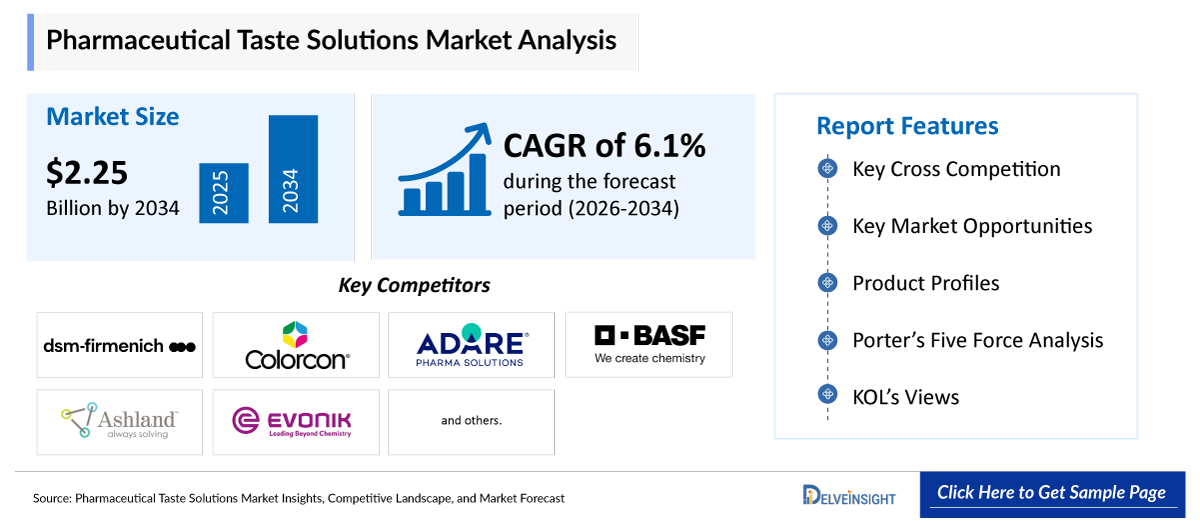
- The global pharmaceutical taste solutions market size was valued at USD 1.32 billion in 2025 and is projected to reach USD 2.25 billion by 2034.
- The market is expected to expand at a CAGR of 6.1% during the forecast period 2026-2034, supported by the central role of palatability in patient compliance, the tightening of pediatric formulation requirements, the aging population and polypharmacy, the growth of orally disintegrating and liquid dosage forms, and continuous advancement in taste-masking technology.
- By product type, the taste-masking coating systems segment dominated the pharmaceutical taste solutions market with a 28% share in 2025.
- By technology, the film and barrier coating segment dominated the pharmaceutical taste solutions market with a 34% share in 2025.
- By formulation, the tablets segment dominated the pharmaceutical taste solutions market with a 40% share in 2025.
- By clinical application, the prescription pharmaceuticals segment dominated the pharmaceutical taste solutions market with a 60% share in 2025.
- By end-user, the pharmaceutical manufacturers segment dominated the pharmaceutical taste solutions market with a 38% share in 2025.
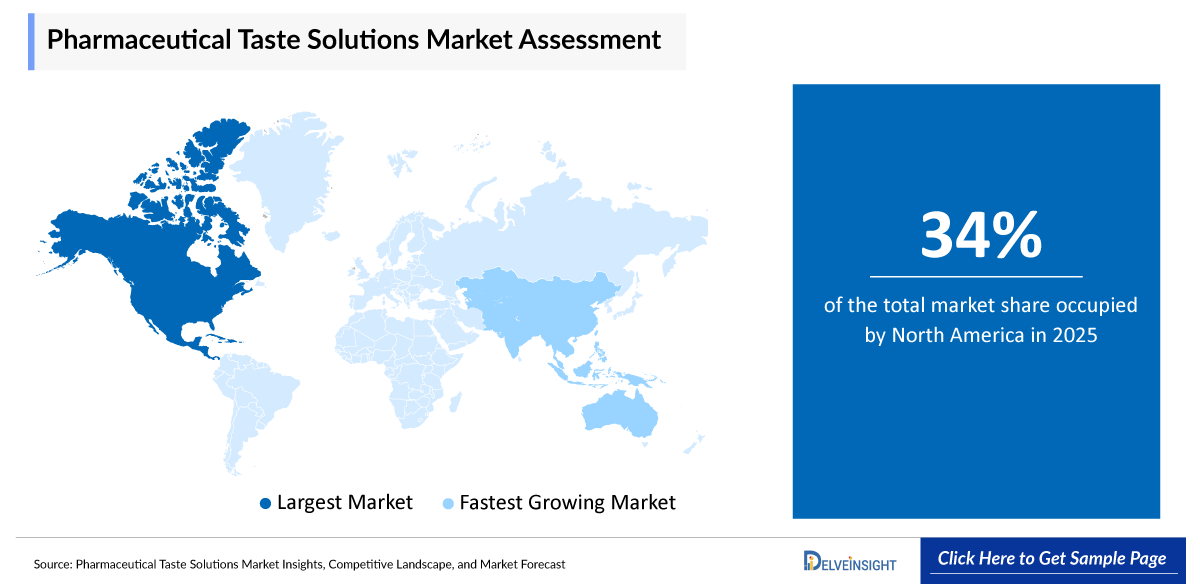
- North America accounted for the largest share of the pharmaceutical taste solutions market at 34% in 2025, while Asia-Pacific is anticipated to register the fastest growth through 2034.
Pharmaceutical taste solutions comprise the flavors, sweeteners, taste-masking agents, functional excipients, coating systems, and modulation technologies used to render oral medicines palatable without compromising their safety, stability, or bioavailability. The unpleasant taste of many active pharmaceutical ingredients is a recognized barrier to patient compliance, since a bitter, acidic, or metallic medicine is one that patients, and particularly children, may refuse to take, so taste solutions occupy the point at which formulation science meets patient acceptance.
The market is organized upon the type of solution supplied, the technology by which taste is controlled, the dosage form to which it is applied, the clinical setting of use, and the manufacturer that adopts it. By product type, it spans flavors, sweeteners, direct taste-masking agents, functional taste-masking excipients, coating systems, and taste-modulation solutions. By technology, it spans organoleptic masking through flavors and sweeteners, film and barrier coating, microencapsulation, complexation through ion-exchange resins and cyclodextrins, particle and multiparticulate masking, and advanced formulation technologies including hot-melt extrusion and spray drying. By formulation, it spans tablets, capsules, oral liquids, oral powders, granules, and others, and by clinical application, it divides between prescription and over-the-counter pharmaceuticals. The contemporary market is defined by the requirement for age-appropriate pediatric formulations, the growth of orally disintegrating dosage forms, and the emergence of taste modulation and bitterness-blocking technology.
Pharmaceutical Taste Solutions Market Key Growth Drivers
- The central role of palatability in patient compliance, since the unpleasant taste of many active pharmaceutical ingredients is a recognized cause of non-adherence, particularly in pediatric and geriatric populations.
- Tightening pediatric formulation requirements, with the United States Food and Drug Administration Pediatric Study Plan and the European Medicines Agency Pediatric Investigation Plan requiring the development of palatable, age-appropriate dosage forms.
- An aging population and rising polypharmacy, since older patients take multiple medications and experience greater difficulty with swallowing and handling, increasing demand for palatable and easy-to-take dosage forms.
- The rapid growth of orally disintegrating tablets, oral liquids, and dispersible powders, which dissolve or disperse in the mouth and therefore require effective taste masking to achieve acceptable palatability.
- The expansion of generic and over-the-counter pharmaceuticals, in which palatability is a source of differentiation and patient preference in a competitive and commoditized market.
- Continuous advancement in taste-masking technology, including microencapsulation, film and barrier coating, complexation, and taste-modulation solutions that address previously difficult active ingredients.
- Regulatory support for novel excipients, with the United States Food and Drug Administration Center for Drug Evaluation and Research Novel Excipient Review Pilot Program offering a pathway to review new excipients before their use in a formulation.
Key Companies in Pharmaceutical Taste Solutions Market
The leading participants in the pharmaceutical taste solutions market include the following:
- dsm-firmenich
- Colorcon Inc.
- Adare Pharma Solutions
- BASF SE
- Ashland Inc.
- Evonik Industries AG
- Roquette Freres
- SPI Pharma Inc.
- Kerry Group plc
- Sensient Technologies Corporation
- Gattefosse SAS, and others
For illustrative purposes, only the top 11 companies are listed in the Table of Contents. The report may include analysis and references to additional companies relevant to the market assessment.
Pharmaceutical Taste Solutions Market Size
The following table summarizes the headline market metrics for the global pharmaceutical taste solutions market across the base year and the forecast horizon.
|
Report Metrics |
Details |
|
2025 Market Size |
USD 1.32 billion |
|
2034 Projected Market Size |
USD 2.25 billion |
|
Growth Rate (2026-2034) |
6.1% CAGR |
|
Largest Market |
North America (34% share in 2025) |
|
Fastest Growing Market |
Asia-Pacific |
|
Market Structure |
Fragmented |
All market values are expressed in USD and represent DelveInsight estimates synthesized from primary and secondary research.
Factors Contributing to the Growth of the Pharmaceutical Taste Solutions Market
Pharmaceutical Taste Solutions Market Drivers
- Palatability as a Determinant of Patient Compliance: The foundational driver of the pharmaceutical taste solutions market is the central role of palatability in patient compliance, since taste is one of the most important considerations influencing whether a patient completes a course of medication as prescribed. An unpleasant taste is one of the most common formulation difficulties associated with oral medicines, because many active pharmaceutical ingredients are intensely bitter, acidic, or metallic, and patients confronted with a medicine they find unpalatable may reduce their dose, skip doses, or refuse the medicine altogether, which undermines the therapeutic objective and, in the case of anti-infectives and chronic disease therapy, carries consequences for both the individual and public health. The problem is most acute in pediatric and geriatric populations, where the caregiver administering the medicine must overcome active resistance in a child or accommodate the swallowing and sensory difficulties of an older patient. Because taste solutions directly address this barrier by rendering the medicine acceptable without altering its therapeutic action, they occupy the point at which formulation science meets real-world adherence, and their value is measured not merely in patient satisfaction but in completed courses of therapy and improved outcomes. As patient-centric drug design becomes a formal objective of both developers and regulators, palatability moves from a desirable attribute to a required one, and the demand for taste solutions rises correspondingly.
- Tightening Pediatric Formulation Requirements: The strengthening of pediatric formulation requirements is a powerful and distinctive driver of the pharmaceutical taste solutions market, because it converts palatability from a commercial preference into a regulatory obligation. In addition to ensuring that medicines are safe and effective for children, the United States Food and Drug Administration and the European Medicines Agency require drug developers to address the creation of palatable, age-appropriate dosage forms as part of the required Pediatric Study Plan and Pediatric Investigation Plan respectively, which means that a developer seeking approval of a medicine likely to be used in children must demonstrate that the formulation is acceptable to the pediatric palate. This requirement applies across a wide range of common and rare disease indications and encompasses both investigational compounds and new dosage forms of approved medicines, and it obliges developers to engage taste-masking technology and, frequently, specialized taste-assessment services early in development. Because children cannot reliably swallow conventional tablets and capsules, the age-appropriate forms these requirements demand, including orally disintegrating tablets, oral liquids, dispersible powders, and soft-textured formats, are precisely the forms that most require taste masking to achieve acceptable palatability. The regulatory mandate therefore drives demand not only for taste solutions in general but for the specific technologies suited to pediatric dosage forms, and it embeds taste solutions into the formal drug development pathway.
- Aging Population and Rising Polypharmacy: Demographic aging and the rising prevalence of polypharmacy are significant drivers of the pharmaceutical taste solutions market, because the older population that is expanding across the developed and increasingly the developing world combines a high medication burden with a diminished ability to manage conventional dosage forms. Older patients are often taking multiple medications and dosages, frequently administered by caregivers, and they experience a greater degree of challenge with swallowing and with the handling of small solid dosage forms, so taste masking is one element among several that must be considered in designing medicines for this group. Dosage forms other than conventional tablets and capsules, which may be difficult for older patients to swallow, need to be developed, and chewable tablets, dispersible powders, and orally disintegrating tablets are the alternate forms that address swallowing difficulty, each of which requires effective taste masking so that it has acceptable palatability with little or no bitterness. The scale of the geriatric medication burden, driven by the chronic diseases that accumulate with age including cardiovascular disease, diabetes, and neurological conditions, means that a large and growing volume of medicine is consumed by exactly the population least tolerant of unpalatable formulations. As health systems and manufacturers respond to this demographic reality with age-appropriate dosage forms, the demand for the taste solutions that make those forms acceptable grows correspondingly.
- Growth of Orally Disintegrating and Liquid Dosage Forms: The rapid growth of orally disintegrating tablets, oral liquids, dispersible powders, and granules is a central driver of the pharmaceutical taste solutions market, because these patient-friendly dosage forms bring the medicine into direct and prolonged contact with the taste receptors of the mouth and therefore depend upon taste masking to be acceptable at all. A conventional tablet or capsule is swallowed quickly and its coating limits contact with the tongue, but an orally disintegrating tablet dissolves in the mouth, a liquid bathes the oral cavity, and a dispersible powder or granule is held there, so any bitterness of the active ingredient is fully exposed unless it is masked. This is why the growth of these forms, driven by the demand for convenience, by the needs of patients who cannot swallow conventional forms, and by the differentiation they offer, translates so directly into demand for taste solutions. The technical challenge is considerable, since the taste-masking approach must prevent the release of the bitter active in the mouth while permitting its full release and absorption in the gastrointestinal tract, a balance achieved through coating, microencapsulation, or complexation that must not compromise the disintegration and bioavailability that define the dosage form. Because these forms are among the fastest-growing in oral drug delivery and because each unit requires taste masking, their growth is a direct and expanding source of demand.
- Expansion of Generic and Over-the-Counter Pharmaceuticals: The continued expansion of generic and over-the-counter pharmaceuticals is an important driver of the pharmaceutical taste solutions market, because in these competitive and often commoditized segments palatability becomes a meaningful source of differentiation and patient preference. When multiple generic versions of a medicine compete on largely identical clinical grounds, the sensory experience of taking the medicine can influence both prescriber and patient choice, and a generic manufacturer able to offer a more palatable formulation gains an advantage that pure price competition cannot provide. In the over-the-counter segment the effect is stronger still, since the patient selects the product directly and repeat purchase depends heavily upon the acceptability of the experience, which is why over-the-counter analgesics, cough and cold preparations, antacids, and vitamins invest so heavily in flavor and taste masking. The growth of both segments, driven by patent expirations that expand the generic pool and by the continuing shift of medicines from prescription to over-the-counter status, enlarges the population of products for which taste is a commercial rather than merely a compliance consideration. Manufacturers serving these segments, including dedicated generic and over-the-counter producers, are consequently significant and growing consumers of flavors, sweeteners, and taste-masking solutions, and their expansion broadens the demand base of the market.
- Technological Advancement in Taste Masking and Modulation: Continuous technological advancement is a central driver of the pharmaceutical taste solutions market, because the range of active ingredients that can be effectively masked, and the quality of the result, depend directly upon the sophistication of the available technology. The field has advanced well beyond the simple addition of flavors and sweeteners to encompass microencapsulation, in which a uniform polymer coating applied by coacervation or particle engineering creates a physical barrier that prevents the bitter active from contacting the taste receptors while permitting its release in the gastrointestinal tract; film and barrier coating, including pH-dependent and pH-independent polymer systems and novel reverse-enteric polymers that are stable in saliva but soluble in gastric juice; complexation, in which ion-exchange resins or cyclodextrins bind the active to prevent its dissolution in the mouth; and particle and multiparticulate masking that combines taste control with modified release. The frontier is taste modulation, in which bitterness-blocking compounds interrupt the perception of bitterness at the receptor rather than physically sequestering the active, offering a route to mask ingredients that resist conventional approaches. Each advance extends effective taste masking to previously intractable active ingredients, improves the palatability achievable, and raises the value delivered per solution, so that technological progress drives the market in value as well as volume.
- Regulatory Support for Novel Excipients: Growing regulatory support for novel excipients is an important and enabling driver of the pharmaceutical taste solutions market, because it lowers a longstanding barrier to the adoption of the new materials upon which advanced taste masking depends. Historically, a drug manufacturer selecting a novel excipient carried a higher risk, since the associated New Drug Application could be delayed by questions about the safety and quality of a new excipient, which discouraged the adoption of innovative taste-masking materials and favored established but sometimes less capable alternatives. The United States Food and Drug Administration Center for Drug Evaluation and Research Novel Excipient Review Pilot Program addresses this directly by offering a pathway for manufacturers to obtain a Food and Drug Administration review of novel excipients before those excipients are used in a formulation, allowing the safety and quality questions to be resolved up front and thereby reducing the risk to the developer timeline and making it easier to select a novel excipient for a dosage form. Because many of the most capable taste-masking technologies, including novel reverse-enteric coating polymers and advanced functional excipients, depend upon materials that would otherwise face this adoption barrier, the pilot program and the broader regulatory recognition of excipient innovation encourage the uptake of advanced taste solutions and support the introduction of new masking chemistries.
Pharmaceutical Taste Solutions Market Restraints
Despite a compliance-driven and regulation-supported demand base, the pharmaceutical taste solutions market faces several material constraints. The most fundamental is the technical difficulty of masking taste without compromising bioavailability, since the same barrier that prevents a bitter active from dissolving in the mouth can impede its dissolution and absorption in the gastrointestinal tract, so every taste-masking approach must strike a balance between palatability and therapeutic performance, and achieving this balance for a potent, highly bitter, or high-dose active is genuinely difficult and sometimes not fully attainable. High-dose active ingredients are particularly challenging, because the sheer quantity of bitter material to be masked strains the capacity of coating and complexation approaches, and orally disintegrating and liquid forms compound the challenge by exposing the active directly to the mouth. A second constraint is the regulatory burden associated with novel excipients, since although the novel excipient review pathway reduces the risk, a genuinely new taste-masking material still faces a demanding safety and quality evaluation, and the cost and time of qualifying a new excipient discourage all but the largest developers. A third constraint is the difficulty and expense of taste assessment itself, since measuring palatability reliably requires either trained human sensory panels, which are costly and difficult to standardize, or electronic tongue instrumentation whose correlation with human perception is imperfect, so demonstrating that a taste-masking approach works is itself a hurdle. Additional constraints include the pricing pressure exerted by the commoditized generic segment, in which the cost of taste solutions must be justified against thin margins; the formulation complexity and added manufacturing steps that taste masking introduces; the limited but real competition from in-house formulation capability at large pharmaceutical manufacturers; and the fragmented and competitive supplier landscape that constrains pricing power. Together these technical, regulatory, and commercial factors ensure that growth, while supported by compliance and regulation, proceeds under genuine constraint.
Pharmaceutical Taste Solutions Market Segment Analysis
The global pharmaceutical taste solutions market is segmented by product type ( flavors solution, sweeteners, taste-masking agents, functional taste-masking excipients, taste-masking coating systems, and taste-modulation solutions); by technology (organoleptic taste masking, film and barrier coating, microencapsulation, complexation, particle and multiparticulate masking, and advanced formulation technologies); by formulation (tablets, capsules, oral liquids, oral powders, granules, and others); by clinical application (prescription and over-the-counter pharmaceuticals); by end-user (pharmaceutical manufacturers, generic drug manufacturers, over-the-counter drug manufacturers, contract development and manufacturing organizations, and others); and by geography (North America, Europe, Asia-Pacific, and the Rest of the World).
By Product Type
Dominant Subsegment: Taste-Masking Coating Systems.
The taste-masking coating systems segment accounted for a 28% share of the pharmaceutical taste solutions market in 2025. Taste-masking coating systems dominate the product-type structure because film and barrier coating is the most widely applied and most reliable approach to masking the taste of solid oral dosage forms and the particles and granules within them. A well-designed film coating, whether pH-dependent or pH-independent, forms a physical barrier that prevents the bitter active from contacting the taste receptors during the brief residence of the dosage form in the mouth while dissolving to release the active in the gastrointestinal tract, and the maturity, versatility, and regulatory familiarity of coating technology make it the default choice across a broad range of products. The category encompasses complete coating systems that combine polymer, plasticizer, and pigment in a single supplied product, and it is served by the established barrier membrane and reverse-enteric coating platforms of the leading coating specialists. Functional taste-masking excipients constitute the second product category, encompassing the ion-exchange resins, cyclodextrins, and lipid excipients used in complexation and particle masking, followed by direct taste-masking agents, and by flavors and sweeteners, which are the highest-volume organoleptic solutions but command lower value per unit. Taste-modulation solutions, the newest category, employ bitterness-blocking compounds that interrupt the perception of bitterness at the receptor. Taste-masking coating systems are expected to retain their leading share throughout the forecast period, supported by continuous advancement in coating polymers and application technology.
By Technology
Dominant Subsegment: Film/Barrier Coating.
The film and barrier coating segment accounted for a 34% share of the pharmaceutical taste solutions market in 2025. Film and barrier coating dominates the technology structure and remains the dominant application method for taste masking, because it offers the most direct, versatile, and well-understood means of interposing a physical barrier between a bitter active and the taste receptors of the mouth. The approach applies a polymer film to a tablet, particle, or granule, and by selecting a pH-dependent polymer that is insoluble in the neutral environment of the mouth but soluble in the acidic environment of the stomach, or a pH-independent membrane whose thickness controls the rate of release, the formulator prevents the release of the bitter active in the oral cavity while permitting its full release and absorption thereafter. The technology is served by mature barrier membrane systems, by ion-exchange resin approaches, and by novel reverse-enteric polymers that are highly stable in saliva and specifically soluble in gastric juice, the last representing an active frontier of coating innovation. Microencapsulation constitutes the second technology, applying a uniform polymer coating to individual particles by coacervation or precision particle engineering, and it is the recognized approach for combining taste masking with modified release. Complexation through ion-exchange resins and cyclodextrins, particle and multiparticulate masking, advanced formulation technologies including hot-melt extrusion and spray drying, and organoleptic masking through flavors and sweeteners complete the structure. Film and barrier coating is expected to retain its leading share throughout the forecast period.
By Formulation
Dominant Subsegment: Tablets.
The tablets segment accounted for a 40% share of the pharmaceutical taste solutions market in 2025. Tablets dominate the formulation structure because the tablet, in its conventional, chewable, and orally disintegrating forms, is the most widely produced and consumed oral dosage form worldwide, and each of these forms requires taste solutions in some measure. Conventional film-coated tablets use coating both to protect the active and to mask its taste during the brief period before swallowing, while chewable and orally disintegrating tablets, which are held or dissolved in the mouth, depend absolutely upon effective taste masking of the active particles they contain, since the protective effect of rapid swallowing is absent. The sheer scale of tablet production across prescription, generic, and over-the-counter pharmaceuticals sustains the leading position of this segment, and the rapid growth of orally disintegrating tablets, driven by the needs of pediatric and geriatric patients and by the demand for convenience, is increasing the intensity of taste-masking technology required per tablet. Oral liquids constitute the second formulation and one of the most demanding, since a liquid bathes the oral cavity and exposes the active fully, requiring flavors, sweeteners, and often complexation or suspension of taste-masked particles. Oral powders and granules, including the dispersible and sachet forms used in pediatric and geriatric care, follow, and capsules and other forms complete the structure. Tablets are expected to retain their leading share throughout the forecast period.
By Clinical Application
Dominant Subsegment: Prescription Pharmaceuticals.
The prescription pharmaceuticals segment accounted for a 60% share of the pharmaceutical taste solutions market in 2025. Prescription pharmaceuticals dominate the clinical-application structure by value because the prescription segment encompasses the large, complex, and high-value therapeutic areas in which taste masking is both technically demanding and clinically consequential. Prescription medicines span the anti-infective, central nervous system, cardiovascular, oncology, and rare-disease therapies whose active ingredients are frequently intensely bitter and whose formulation, particularly for pediatric indications, is subject to the palatability requirements of the Pediatric Study Plan and Pediatric Investigation Plan. The value intensity of prescription taste masking is high, since these are often novel or specialized formulations developed with dedicated taste-masking technology and taste-assessment services, and the regulatory obligation to demonstrate age-appropriate palatability embeds taste solutions into the prescription development pathway. Over-the-counter pharmaceuticals constitute the second clinical application and a substantial one by volume, encompassing the analgesics, cough and cold preparations, antacids, and vitamins in which flavor and palatability are decisive commercial factors driving patient selection and repeat purchase, and this segment is a particularly heavy consumer of flavors and sweeteners. The over-the-counter segment is growing as medicines continue to shift from prescription to non-prescription status. Prescription pharmaceuticals are expected to retain their leading share of value throughout the forecast period, while the over-the-counter segment grows steadily in volume terms.
By End-User
Dominant Subsegment: Pharmaceutical Manufacturers.
The pharmaceutical manufacturers segment accounted for a 38% share of the pharmaceutical taste solutions market in 2025. Pharmaceutical manufacturers dominate the end-user structure because the large branded and integrated pharmaceutical companies develop and produce the greatest value of oral medicines and therefore consume the greatest value of taste solutions, applying them across the prescription and specialty portfolios in which palatability is both a compliance requirement and, for pediatric indications, a regulatory one. These manufacturers possess the development resources to engage advanced taste-masking technology and dedicated taste-assessment services early in formulation, and they adopt the coating systems, functional excipients, and microencapsulation platforms that define the higher-value core of the market. Contract development and manufacturing organizations constitute the second end-user category and a rapidly growing one, since the technology-driven organizations specializing in oral dosage forms deliver taste masking, controlled release, and particle engineering as a service to developers who lack the capability in-house, and the recognized microencapsulation and particle-fabrication platforms reside substantially within this group. Generic drug manufacturers form a third significant category, adopting taste solutions to differentiate otherwise interchangeable products, and over-the-counter drug manufacturers a fourth, consuming flavors and sweeteners heavily in the consumer-selected products where palatability drives purchase. Other end users, including nutraceutical and veterinary producers, complete the structure. Pharmaceutical manufacturers are expected to retain their leading share throughout the forecast period, with contract organizations growing fastest.
Pharmaceutical Taste Solutions Market Region Analysis
Dominant Region: North America
North America accounted for a 34% share of the global pharmaceutical taste solutions market in 2025. The region is expected to account for the largest share of the global market, supported by the scale and sophistication of its pharmaceutical industry, the strength of its patient-centric and pediatric formulation requirements, and the local presence of the leading coating, excipient, and flavor participants. The steady expansion of the pharmaceutical sector, the high demand for functional excipients, and continuous technological advancement underpin regional demand, and the United States pediatric formulation framework, under which the Food and Drug Administration requires developers to address palatable age-appropriate dosage forms through the Pediatric Study Plan, embeds taste solutions into the drug development pathway. The region also leads in regulatory innovation relevant to the market, with the Food and Drug Administration Center for Drug Evaluation and Research Novel Excipient Review Pilot Program offering a pathway to review novel excipients before their use in a formulation, reducing the barrier to advanced taste-masking materials. The high adoption of orally disintegrating tablets and other patient-friendly dosage forms, the large generic and over-the-counter segments in which palatability drives differentiation and purchase, and the presence of major coating and excipient manufacturers together reinforce the position of the region. The region is expected to retain its leading position throughout the forecast period.
Fastest Growing Region: Asia-Pacific
Asia-Pacific is projected to register the fastest compound annual growth rate in the pharmaceutical taste solutions market through 2034. The region is emerging as the principal growth engine of the market, propelled by the rapid expansion of pharmaceutical manufacturing, the large and rising penetration of generic drugs, and the growth of contract development and manufacturing capacity across densely populated nations including China, India, Japan, and South Korea. The region combines very large patient populations with rapidly expanding domestic pharmaceutical industries, and as manufacturing scales and moves toward higher-value and patient-centric products, the adoption of taste solutions rises correspondingly. The generic drug industries of India and China, which supply a substantial share of the world market, are increasingly adopting taste masking to differentiate products and to meet the palatability expectations of both domestic and export markets, and the growth of contract development and manufacturing organizations across the region, which deliver taste masking and particle engineering as a service, further accelerates adoption. Rising healthcare expenditure, expanding pediatric and geriatric care, growing awareness of patient compliance, and the presence of both international suppliers and capable regional excipient and flavor manufacturers offering cost-appropriate solutions all contribute. Japan in particular combines an aged population with sophisticated orally disintegrating tablet technology. Regional growth is expected to exceed the global average across every segment.
Pharmaceutical Taste Solutions Market Regional Commentary
North America
North America leads on value and adoption, holding a 34% share in 2025. The region combines a large and sophisticated pharmaceutical industry with strong patient-centric and pediatric formulation requirements under the Food and Drug Administration Pediatric Study Plan, and it leads in regulatory innovation through the Center for Drug Evaluation and Research Novel Excipient Review Pilot Program. High adoption of orally disintegrating and other patient-friendly dosage forms, large generic and over-the-counter segments, and the local presence of major coating, excipient, and flavor manufacturers reinforce the position of the region. Near-term dynamics are shaped by novel coating polymers, taste-modulation technology, and the growth of contract development and manufacturing capacity.
Europe
Europe is a large and standards-driven market, supported by a substantial pharmaceutical industry, strong pediatric formulation requirements under the European Medicines Agency Pediatric Investigation Plan, and the presence of several of the leading coating, excipient, and flavor manufacturers, with Germany, France, and the United Kingdom the principal markets. The region hosts major excipient and lipid technology suppliers and a strong tradition of pharmaceutical formulation science, and European regulatory expectations for pediatric palatability are among the most developed globally. The European excipient regulatory framework and the emphasis upon quality and documentation favor established suppliers, while public and reimbursement pricing pressure on generics constrains the cost available for taste solutions.
Asia-Pacific
Asia-Pacific is the fastest-growing region, propelled by the rapid expansion of pharmaceutical manufacturing, high generic drug penetration, and the growth of contract development and manufacturing capacity across China, India, Japan, and South Korea. The large generic industries of India and China increasingly adopt taste masking to differentiate products and meet export market expectations, while contract organizations deliver taste masking as a service. Rising healthcare expenditure, expanding pediatric and geriatric care, and the presence of both international and cost-competitive regional suppliers drive adoption, and Japan combines an aged population with sophisticated orally disintegrating tablet technology. Growth exceeds the global average across every segment.
Rest of World
The Rest of the World comprises the Middle East, Africa, and South America. Access and adoption are stratified. The larger Latin American markets, particularly Brazil and Mexico, support substantial pharmaceutical and generic manufacturing that increasingly adopts taste solutions, and the Gulf states are investing in pharmaceutical capability, together representing steady growth. Much of Africa relies upon imported medicines and has limited domestic formulation capacity, so taste-solution adoption is concentrated in imported products and the larger regional manufacturers. Regional growth will be driven by the expansion of pharmaceutical manufacturing, rising generic penetration, growing pediatric and public health programs that require palatable formulations, and the availability of cost-appropriate solutions from regional and international suppliers.
Pharmaceutical Taste Solutions Market Competitive Landscape
The global pharmaceutical taste solutions market is classified as Fragmented. The market is structured upon three overlapping groups: the coating and excipient specialists that supply the film coating systems and functional excipients at the core of taste masking, the flavor and sweetener houses that supply organoleptic solutions, and the technology-driven contract development and manufacturing organizations that deliver microencapsulation and particle engineering as a service. Competition centers upon the breadth and performance of the technology platform, regulatory familiarity and excipient qualification, material compatibility and effect upon bioavailability, formulation and taste-assessment support, and increasingly upon the ability to mask difficult high-dose and intensely bitter actives.
The competitive landscape is evaluated across the following dimensions:
- Market concentration: Fragmented, with a large number of international and regional participants competing across the distinct product and technology segments, and with no single participant dominating the whole scope, since coating, functional excipients, flavors, and contract services are served by different specialists.
- Leading players: Colorcon leads in film coating systems, Adare Pharma Solutions in microencapsulation and particle engineering, BASF, Ashland, and Evonik in coating polymers and functional excipients, Roquette in complexation excipients, SPI Pharma in taste-masking agents and orally disintegrating platforms, and Kerry and Sensient in pharmaceutical flavors.
- Geographic reach: The leading participants maintain global commercial and technical service organizations, which matter because taste-masking selection requires formulation support and excipient qualification, while regional excipient and flavor manufacturers serve domestic and cost-sensitive markets, particularly across Asia-Pacific and Latin America.
- Product portfolio strength: Competitive advantage rests upon the breadth of the technology platform and the depth of formulation support, since developers value a supplier able to offer coating, complexation, and microencapsulation options alongside the taste-assessment and formulation services that de-risk selection, rather than a single masking product in isolation.
- Pipeline strength: Development is concentrated in novel reverse-enteric and stable-in-saliva coating polymers, advanced microencapsulation and precision particle fabrication, taste-modulation and bitterness-blocking compounds, cyclodextrin and ion-exchange complexation, and integrated technologies combining taste masking with modified release.
- Strategic partnerships: Collaboration spans coating and polymer suppliers working together to bring novel excipients into film-coating systems, exemplified by the evaluation of a reverse-enteric polymer for inclusion in an established coating platform, alongside contract organizations partnering with developers and with technology providers to extend manufacturing capability.
- M&A activity: Moderate acquisition activity is observed, focused upon expanding product portfolios and geographic reach, with larger companies acquiring smaller specialized firms that possess unique technologies or formulations, and with the broader consolidation of flavor and ingredient houses reshaping the organoleptic segment.
- Innovation focus: Innovation is shifting toward taste modulation that blocks bitterness perception at the receptor, novel coating polymers stable in saliva, precision particle engineering, technologies capable of masking high-dose and intensely bitter actives, and objective taste-assessment methods including electronic tongue instrumentation and artificial-saliva testing.
- Regulatory standing: Excipient qualification, compendial compliance, and demonstrated safety are decisive competitive credentials, and the Novel Excipient Review Pilot Program together with pediatric formulation requirements favors participants with the regulatory scale to qualify novel materials and to support developers through the palatability requirements of the Pediatric Study Plan and Pediatric Investigation Plan.
Pharmaceutical Taste Solutions Market Recent Developmental Activities
- In 2023 and 2024, the United States Food and Drug Administration advanced its Center for Drug Evaluation and Research Novel Excipient Review Pilot Program, offering drug manufacturers a pathway to obtain a review of novel excipients before those excipients are used in a formulation. Strategic significance: by allowing the safety and quality of a new excipient to be resolved before a New Drug Application depends upon it, the program reduced the risk and timeline barrier that had discouraged adoption of novel taste-masking materials, directly benefiting suppliers of advanced coating polymers and functional excipients.
- In 2023 and 2024, Colorcon and BASF collaborated on the application of the Kollicoat Smartseal reverse-enteric polymer, a material highly stable in saliva and specifically soluble in gastric juice, evaluated for inclusion in a film-coating system to simplify coating operations and provide new options for taste masking of drug particles and granules. Strategic significance: the collaboration illustrated the partnership model through which a novel polymer reaches the market inside an established coating platform, combining polymer chemistry with coating-system formulation to lower the adoption barrier for a novel excipient.
- In April 2023, Colorcon launched the Nutracore range of label-friendly coating excipients, extending its coating portfolio for nutritional and supplement applications alongside its established pharmaceutical film-coating and barrier-membrane systems. Strategic significance: the launch reinforced the position of the leading coating specialist across adjacent palatability applications and reflected the continuing extension of film-coating technology, the dominant taste-masking method, into new product categories.
- In 2023 and 2024, Adare Pharma Solutions continued to advance its Microcaps microencapsulation platform, based upon organic-phase coacervation, and its Optimum and Precision Particle Fabrication technologies that produce uniform microspheres and microcapsules for taste masking and modified release. Strategic significance: the continued development of the industry-leading coacervation platform sustained the position of the recognized microencapsulation specialist and reinforced particle engineering as the approach of choice for combining taste masking with controlled release in a single dosage form.
- In 2024 and 2025, Adare Pharma Solutions collaborated with Laxxon Medical to introduce cGMP three-dimensional printing capability, extending its advanced formulation technology alongside its established microencapsulation and multiparticulate platforms. Strategic significance: the addition of three-dimensional printing extended the advanced formulation technologies category of the market and positioned a leading contract organization at the frontier of dosage-form innovation, where novel manufacturing methods create new taste-masking and dosing possibilities.
- In 2024 and 2025, Adare Pharma Solutions expanded its European capability with a purpose-built packaging hall, an expanded warehouse, and a high-speed blistering line at its Milan facility. Strategic significance: the investment reinforced the growing role of contract development and manufacturing organizations in the taste solutions market, expanding the European capacity through which developers access taste masking and particle engineering as a service.
- In October 2021, Beneo launched GalenIQ 721, an isomalt-based filler binder that improves the flavor and stability of effervescent tablets and powders while offering non-hygroscopic, water-soluble, and readily compressible properties. Strategic significance: the launch illustrated the continuing innovation in sweetening and organoleptic excipients that underpins the flavors and sweeteners categories, addressing palatability and processability together in the effervescent and lozenge formats where taste is decisive.
- In May 2023, dsm-firmenich was formed through the combination of DSM and Firmenich, creating a major nutrition, health, and flavor company with substantial taste, texture, and modulation capability relevant to pharmaceutical palatability. Strategic significance: the combination consolidated flavor, sweetening, and bitterness-modulation capability within a single organization, strengthening the organoleptic and taste-modulation segments and reflecting the broader consolidation of the flavor and ingredient houses that serve pharmaceutical taste.
- In 2023 and 2024, the industry advanced taste-modulation and bitterness-blocking technology, building upon bitter-blocker compounds that interrupt the perception of bitterness at the taste receptor rather than physically sequestering the active. Strategic significance: taste modulation represents the frontier of the market, offering a route to mask intensely bitter and high-dose actives that resist conventional coating and complexation, and its advance defines the newest and fastest-evolving product category.
- In 2023 and 2024, Roquette continued to expand its cyclodextrin and specialty excipient portfolio for complexation-based taste masking and solubility enhancement. Strategic significance: the expansion reinforced the complexation technology segment, in which cyclodextrins bind bitter actives to prevent their dissolution in the mouth, and it strengthened the position of a leading excipient supplier in a technology complementary to coating and microencapsulation.
- In 2024 and 2025, coating and excipient suppliers advanced objective taste-assessment methods, including electronic tongue instrumentation and in-vitro testing using artificial saliva, to support the development and validation of taste-masking systems. Strategic significance: objective taste assessment addresses one of the central difficulties of the market, the reliable measurement of palatability, and its advance reduces the dependence upon costly human sensory panels and supports the demonstration of taste-masking efficacy required for pediatric and novel formulations.
- In 2024 and 2025, the growth of orally disintegrating tablets and dispersible pediatric formulations accelerated across the industry, driven by pediatric and geriatric requirements and by the demand for patient-friendly dosage forms. Strategic significance: because orally disintegrating and dispersible forms expose the active directly to the mouth and therefore depend absolutely upon taste masking, their accelerating growth increased the intensity of taste-masking technology required per unit and reinforced the demand for coating, microencapsulation, and modulation solutions.
Pharmaceutical Taste Solutions Market Segmentation
- Pharmaceutical Taste Solutions Market Assessment by Product Type
- Flavors Solution
- Sweeteners
- Taste-Masking Agents
- Functional Taste-Masking Excipients
- Taste-Masking Coating Systems
- Taste-Modulation Solutions
- Pharmaceutical Taste Solutions Market Assessment by Technology
- Organoleptic Taste Masking
- Film/Barrier Coating
- Microencapsulation
- Complexation
- Particle/Multiparticulate Masking
- Advanced Formulation Technologies
- Pharmaceutical Taste Solutions Market Assessment by Formulation
- Tablets
- Capsules
- Oral Liquids
- Oral Powders
- Granules
- Others
- Pharmaceutical Taste Solutions Market Assessment by Clinical Application
- Prescription Pharmaceuticals
- OTC Pharmaceuticals
- Pharmaceutical Taste Solutions Market Assessment by End User
- Pharmaceutical Manufacturers
- Generic Drug Manufacturers
- OTC Drug Manufacturers
- CDMOs/CMOs
- Other End Users
Pharmaceutical Taste Solutions Market Assessment by Geography
- North America Pharmaceutical Taste Solutions Market Assessment
- United States Pharmaceutical Taste Solutions Market Size in USD million (2023-2034)
- Canada Pharmaceutical Taste Solutions Market Size in USD million (2023-2034)
- Mexico Pharmaceutical Taste Solutions Market Size in USD million (2023-2034)
- Europe Pharmaceutical Taste Solutions Market Assessment
- France Pharmaceutical Taste Solutions Market Size in USD million (2023-2034)
- Germany Pharmaceutical Taste Solutions Market Size in USD million (2023-2034)
- United Kingdom Pharmaceutical Taste Solutions Market Size in USD million (2023-2034)
- Italy Pharmaceutical Taste Solutions Market Size in USD million (2023-2034)
- Spain Pharmaceutical Taste Solutions Market Size in USD million (2023-2034)
- Rest of Europe Pharmaceutical Taste Solutions Market Size in USD million (2023-2034)
- Asia-Pacific Pharmaceutical Taste Solutions Market Assessment
- China Pharmaceutical Taste Solutions Market Size in USD million (2023-2034)
- Japan Pharmaceutical Taste Solutions Market Size in USD million (2023-2034)
- India Pharmaceutical Taste Solutions Market Size in USD million (2023-2034)
- Australia Pharmaceutical Taste Solutions Market Size in USD million (2023-2034)
- South Korea Pharmaceutical Taste Solutions Market Size in USD million (2023-2034)
- Rest of Asia-Pacific Pharmaceutical Taste Solutions Market Size in USD million (2023-2034)
- Rest of the World Pharmaceutical Taste Solutions Market Assessment
- Middle East Pharmaceutical Taste Solutions Market Size in USD million (2023-2034)
- Africa Pharmaceutical Taste Solutions Market Size in USD million (2023-2034)
- South America Pharmaceutical Taste Solutions Market Size in USD million (2023-2034)
Pharmaceutical Taste Solutions Market Recent Industry Trends and Milestones (2023-2026):
|
Category |
Key Developments |
|
Pharmaceutical Taste Solutions Market Product Approval |
Regulatory activity in this market centers upon excipient qualification rather than device or drug approval, and the defining development is the United States Food and Drug Administration Center for Drug Evaluation and Research Novel Excipient Review Pilot Program, which offers a pathway to review novel excipients before their use in a formulation and thereby lowers the barrier to advanced taste-masking materials. The pediatric formulation frameworks of the Food and Drug Administration and the European Medicines Agency, which require palatable age-appropriate dosage forms through the Pediatric Study Plan and Pediatric Investigation Plan, function as a de facto approval requirement for palatability in medicines used in children. Novel coating polymers stable in saliva and specifically soluble in gastric juice, exemplified by reverse-enteric chemistry evaluated for inclusion in established coating systems, advanced through evaluation toward broader adoption. |
|
Pharmaceutical Taste Solutions Market Product Expansion |
Product expansion advanced along three axes. The first is coating chemistry, as novel reverse-enteric and stable-in-saliva polymers extended the film and barrier coating category and as label-friendly coating ranges broadened application. The second is particle engineering, as microencapsulation by coacervation and precision particle fabrication produced uniform microcapsules combining taste masking with modified release, and as advanced formulation technologies including hot-melt extrusion, spray drying, and three-dimensional printing extended the technology frontier. The third is modulation, as bitterness-blocking compounds that interrupt taste perception at the receptor advanced as a route to mask actives that resist physical sequestration. Sweetening and organoleptic excipients continued to advance for effervescent, lozenge, and dispersible formats. |
|
Pharmaceutical Taste Solutions Market Investment |
Investment concentrated upon technology platforms and upon the contract capacity that delivers them as a service. Leading contract development and manufacturing organizations invested in microencapsulation, particle-fabrication, and three-dimensional printing capability and expanded manufacturing and packaging capacity, exemplified by facility investment in European blistering and warehousing. Coating and excipient suppliers invested in novel polymer chemistry and in objective taste-assessment methods including electronic tongue instrumentation and artificial-saliva testing. The consolidation of flavor and ingredient houses, exemplified by the formation of dsm-firmenich, concentrated organoleptic and modulation capability, and moderate acquisition activity saw larger companies acquire smaller specialized firms possessing unique taste-masking technologies or formulations to expand portfolios and geographic reach. |
|
Company Strategy |
The unifying strategic theme is competition on the breadth of the technology platform and the depth of formulation support rather than upon a single masking product. Colorcon is extending its film-coating leadership through novel polymers and coating systems and through collaboration with polymer suppliers. Adare Pharma Solutions is deepening its microencapsulation and particle-engineering leadership and adding advanced formulation technologies as a contract service. BASF, Ashland, and Evonik are advancing coating and functional-excipient chemistry, Roquette is expanding complexation excipients, and SPI Pharma is developing taste-masking agents and orally disintegrating platforms. The flavor and sweetener houses, including Kerry, Sensient, and dsm-firmenich, are strengthening organoleptic and modulation capability. Across the field, participants are investing in objective taste assessment and in the ability to mask difficult high-dose and intensely bitter actives. |
|
Emerging Technologies |
The defining emerging technologies are taste modulation and bitterness blocking, in which compounds interrupt the perception of bitterness at the taste receptor rather than physically sequestering the active, offering a route to mask ingredients that resist conventional approaches; novel coating polymers, including reverse-enteric chemistry that is stable in saliva and specifically soluble in gastric juice; and precision particle engineering, in which coacervation and precision fabrication produce uniform microcapsules combining taste masking with modified release. Complementing these are advanced formulation technologies including hot-melt extrusion, spray drying, and cGMP three-dimensional printing; cyclodextrin and ion-exchange complexation; and objective taste-assessment methods including electronic tongue instrumentation and in-vitro artificial-saliva testing. Across these, the trajectory is toward masking previously intractable actives, combining taste masking with modified release, and measuring palatability objectively rather than only through human sensory panels. |
Pharmaceutical Taste Solutions Market Startup Funding and Investment Trends
Investment in the pharmaceutical taste solutions field concentrates upon the technologies that address the limitations of conventional masking, principally taste modulation that blocks bitterness perception at the receptor, precision particle engineering that combines masking with modified release, and novel coating chemistry stable in the mouth. Because the established coating, excipient, and flavor suppliers hold regulatory qualification and formulation depth that a new entrant cannot readily replicate, innovators typically enter through differentiated technology and through contract-service models rather than by contesting commodity chemistry, and the archetypal outcome is partnership with or acquisition by an established supplier or contract organization. The table below summarizes representative companies and platforms advancing the next generation of taste-solution technology.
|
Company |
Total Funding |
Funding Stage |
Main Product/Offering |
Core Technology |
|
Adare Pharma Solutions |
Privately held |
Commercial stage |
Microcaps and Optimum platforms |
Coacervation microencapsulation |
|
Senopsys LLC |
Privately held |
Commercial stage |
Taste-assessment and masking |
Sensory and formulation science |
|
Request for unlocking the report of the @ Pharmaceutical Taste Solutions Market Insights | ||||
Capital formation in this field is shaped by the fragmented and technology-driven structure of the market and by the depth of regulatory qualification and formulation expertise the established suppliers hold, which together mean that a new entrant competes most effectively through differentiated technology rather than through commodity chemistry. Taste modulation is the most distinctive thesis, since bitterness-blocking compounds that act at the receptor offer a route to mask actives that resist coating and complexation, and interest in this approach has grown as the difficulty of masking high-dose and intensely bitter actives has become more prominent. Precision particle engineering and microencapsulation constitute a second thesis, combining taste masking with modified release in a single technology, and the recognized platforms reside substantially within the specialized contract organizations. Novel coating chemistry, advanced formulation technologies including three-dimensional printing, and objective taste-assessment instrumentation complete the principal categories. The archetypal outcome for an innovator is partnership with an established coating or excipient supplier, integration into a contract development and manufacturing organization, or acquisition by a larger company seeking a unique technology, as reflected in the moderate acquisition activity through which larger firms absorb specialized capability. The principal risks are the cost and time of excipient qualification, the technical difficulty of demonstrating taste masking without compromising bioavailability, the pricing pressure of the generic segment, and the formulation depth of the incumbents. Source: company disclosures.

