
Physical Therapy Market Summary
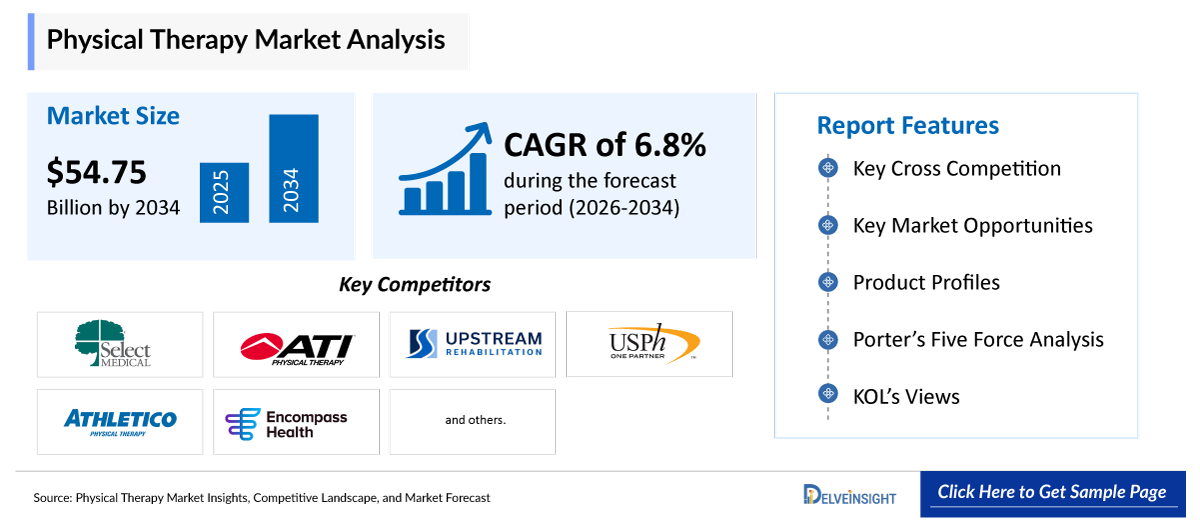
● The Physical Therapy market is estimated at USD 30.20 billion in 2025 and is projected to reach USD 54.75 billion by 2034. Growth is anchored in the rising global burden of musculoskeletal disorders, an aging population requiring long-term rehabilitation, and the rapid, private-equity-fueled consolidation of outpatient clinic networks.
● The global Physical Therapy market is growing at a CAGR of 6.8% during the forecast period from 2026 to 2034.
● By therapy type, the orthopedic physical therapy segment dominated the Physical Therapy market with a 44% share in 2025.
● By treatment modality, the therapeutic exercise segment dominated the Physical Therapy market with a 39% share in 2025.
● By service delivery, the in-person physical therapy segment dominated the Physical Therapy market with a 72% share in 2025.
● By payer, the private health insurance segment dominated the Physical Therapy market with a 46% share in 2025.
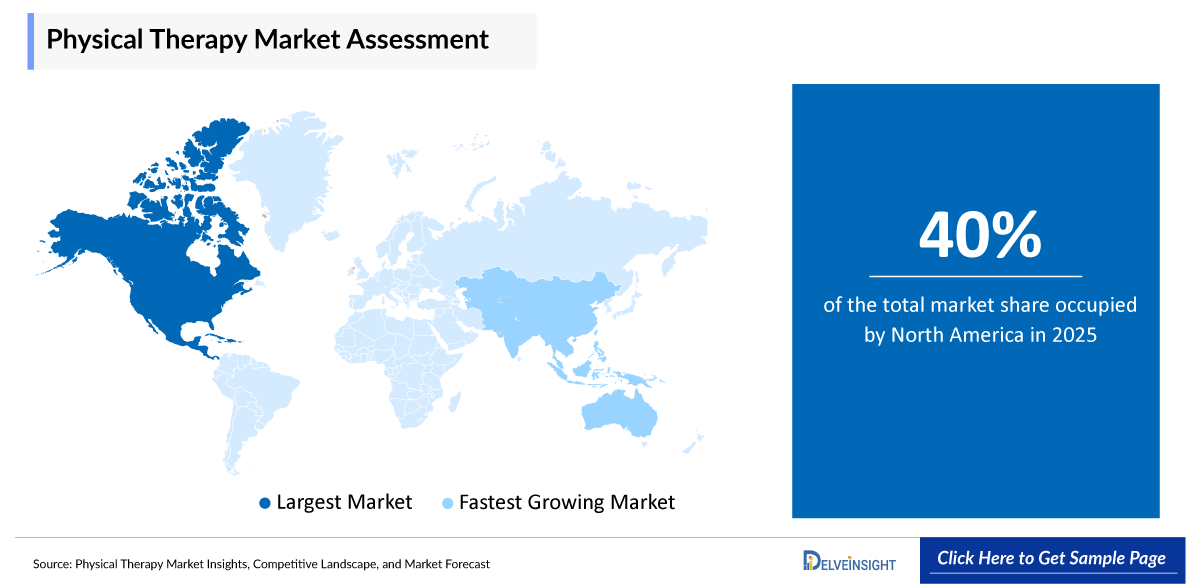
● North America dominated the global Physical Therapy market revenue with a 40% share in 2025, representing the highest regional market share globally.
Physical therapy (physiotherapy) is a licensed healthcare discipline that restores, maintains, and improves movement and physical function through therapeutic exercise, manual therapy, electrotherapy, hydrotherapy, thermal therapy, and patient education, delivered by physical therapists and physical therapist assistants across hospitals, outpatient clinics, home health settings, and increasingly telehealth and hybrid care platforms. Because musculoskeletal, neurological, and cardiopulmonary conditions often require sustained, hands-on, and progressively adjusted care, physical therapy has become a first-line, non-pharmacological intervention for pain management, post-surgical recovery, sports injury rehabilitation, fall prevention, and chronic disease management. The market is organized by therapy type across orthopedic, neurological, cardiopulmonary, sports, and pelvic floor physical therapy; by treatment modality, including therapeutic exercise, manual therapy, electrotherapy, hydrotherapy, and thermal therapy; by service delivery across in-person, telehealth/virtual, and hybrid models; and by payer, led by private health insurance alongside Medicare and Medicaid/government programs. Driven by rising musculoskeletal disease prevalence, an aging global population, expanding sports participation, and large-scale private-equity-backed clinic consolidation, physical therapy has become essential infrastructure within the broader value-based, non-pharmacological care continuum.
Physical Therapy Market Key Growth Drivers
• The rising global burden of musculoskeletal disorders and growing orthopedic surgical volumes are driving sustained demand for post-operative and conservative rehabilitation care.
• An aging global population is expanding demand for fall-prevention, balance, and geriatric rehabilitation programs, with the elderly segment expected to post the fastest growth in patient volumes.
• Rising participation in youth, collegiate, and professional sports is increasing demand for sports physical therapy and injury-prevention programs.
• Growing awareness of non-pharmacological, conservative pain management as an alternative to opioids and surgery is expanding first-line referrals to physical therapy.
• Large-scale private-equity-backed consolidation is accelerating clinic network expansion, de novo openings, and multi-site acquisitions across the United States and other developed markets.
• Expansion of telehealth and hybrid care delivery models is broadening access, although recent U.S. Medicare telehealth reimbursement restrictions for therapy services are reshaping delivery-model economics.
• The convergence of musculoskeletal disease burden, an aging population, sports participation, and clinic consolidation is expected to sustain steady mid-to-high single-digit growth in the market through 2034.
Key Companies in Physical Therapy Market
The competitive landscape is led by the following active players:
• Select Medical
• ATI Physical Therapy
• Upstream Rehabilitation
• U.S. Physical Therapy
• Athletico Physical Therapy
• Encompass Health
• FYZICAL Therapy & Balance Centers
• PT Solutions Physical Therapy
• Ivy Rehab Network
• CORA Physical Therapy
Factors Contributing to the Growth of the Physical Therapy Market
Market Drivers
Rising Burden of Musculoskeletal Disorders and Orthopedic Procedures
The most significant driver of the Physical Therapy market is the growing global burden of musculoskeletal disorders, including osteoarthritis, back and neck pain, and joint injuries, combined with rising volumes of orthopedic surgeries such as total knee and hip replacements. These conditions and procedures routinely require structured, multi-week rehabilitation programs to restore range of motion, strength, and function, and physical therapy is the standard of care for both conservative management and post-surgical recovery. As orthopedic surgical volumes climb alongside an aging and increasingly overweight population, and as evidence continues to support early mobilization protocols, referral volumes into outpatient and hospital-based physical therapy programs expand directly, anchoring market growth through 2034.
Aging Population and Rising Demand for Geriatric Rehabilitation
The rapid growth of the global geriatric population is expanding demand for fall-prevention, balance, and functional-mobility rehabilitation. Older adults are disproportionately affected by osteoarthritis, stroke, and fall-related injuries, and many require ongoing physical therapy to maintain independence and avoid institutional care. Providers such as FYZICAL Therapy & Balance Centers have built dedicated vestibular and balance/fall-prevention program lines specifically to address this demographic shift. As life expectancy rises and healthcare systems prioritize keeping older adults active and out of higher-cost care settings, demand for geriatric-focused physical therapy services is expected to grow faster than the overall market through the forecast period.
Market Restraints
Despite strong underlying demand, the Physical Therapy market faces material constraints. Reimbursement pressure is intensifying: the U.S. Centers for Medicare & Medicaid Services finalized a permanent 'efficiency adjustment' reducing work relative value units for many non-time-based codes in the CY2026 Medicare Physician Fee Schedule, resulting in an estimated net negative impact for physical therapists even as the conversion factor rose, while standalone telehealth reimbursement for therapy services lapsed after October 1, 2025. A persistent shortage of licensed physical therapists and physical therapist assistants constrains clinic capacity and wage costs, particularly in rural and underserved areas. High out-of-pocket costs, visit caps, and prior-authorization requirements under many commercial and government plans limit treatment adherence and completion of prescribed care plans. Licensure portability across states, though improving through the Physical Therapy Licensure Compact, remains incomplete, complicating multi-state clinic staffing. Geographic access disparities leave rural and low-income populations underserved relative to urban centers. Together, these reimbursement, workforce, cost, and access barriers temper the pace of growth, even as the underlying drivers of musculoskeletal disease burden, an aging population, and clinic consolidation remain firmly intact.
Physical Therapy Market Segment Analysis
The physical therapy market therapy type (orthopedic physical therapy, neurological physical therapy, cardiopulmonary physical therapy, sports physical therapy, pelvic floor physical therapy, and others), treatment modality (therapeutic exercise, manual therapy, electrotherapy, hydrotherapy, thermal therapy, and others), service delivery (in-person physical therapy, telehealth / virtual physical therapy, and hybrid physical therapy), payers (private health insurance, medicare, medicaid / government programs, and others), and geography (North America, Europe, Asia-Pacific, and Rest of World).
Therapy Type
Dominant Subsegment: Orthopedic Physical Therapy.
The orthopedic physical therapy segment accounted for 44% of the Physical Therapy market in 2025. Orthopedic physical therapy is the leading therapy type because musculoskeletal conditions, including osteoarthritis, back and neck pain, joint replacements, and fracture recovery, represent the largest and most consistent source of physical therapy referrals across hospitals and outpatient clinics. The rising volume of total knee and hip replacement surgeries, combined with an aging population and increasing incidence of degenerative joint disease, sustains high, recurring demand for structured post-surgical and conservative orthopedic rehabilitation. Leading clinic networks such as CORA Physical Therapy and U.S. Physical Therapy maintain orthopedic care as their core service line. While neurological physical therapy is the fastest-growing therapy type, propelled by rising stroke survival rates and growing awareness of neurodegenerative disease management, the sheer volume and recurrence of orthopedic caseloads secure the segment's leadership across the forecast period.
By Treatment Modality
Dominant Subsegment: Therapeutic Exercise.
The therapeutic exercise segment accounted for 39% of the Physical Therapy market in 2025. Therapeutic exercise is the leading treatment modality because it forms the foundation of nearly every physical therapy plan of care, spanning strengthening, stretching, balance, and functional-movement protocols applicable across orthopedic, neurological, cardiopulmonary, and sports rehabilitation. Its low equipment intensity, strong evidence base, and adaptability to in-person, telehealth, and home-exercise-program formats make it the most widely prescribed and billed modality across care settings. Manual therapy remains a significant complementary modality for pain modulation and joint mobilization, while electrotherapy is the fastest-growing modality, aided by expanding adoption of portable neuromuscular electrical stimulation and wearable devices that extend treatment between clinic visits. Nonetheless, the universality and evidence base of therapeutic exercise secure its leadership across the forecast period.
Physical Therapy Market Region Analysis
Dominant Region: North America
North America accounted for 40% of the global Physical Therapy market revenue in 2025, representing the highest regional market share globally. The region's dominance reflects a mature outpatient rehabilitation infrastructure, broad private and public insurance coverage, a high volume of orthopedic surgical procedures, and the presence of the largest multi-state clinic networks in the world, including Select Medical, ATI Physical Therapy, Upstream Rehabilitation, and U.S. Physical Therapy. The United States in particular benefits from an aging population, high sports participation rates, and continued private-equity-backed consolidation that is expanding clinic density and payer contracting scale. Despite emerging Medicare reimbursement pressure, strong commercial insurance penetration, deep clinical evidence supporting physical therapy as first-line care, and the scale of leading outpatient platforms anchor the region's continued leadership across the forecast period.
Fastest Growing Region: Asia-Pacific
Asia-Pacific is the fastest-growing region in the Physical Therapy market. The region's elevated CAGR is driven by a rapidly aging population in Japan and China, rising incidence of lifestyle-related musculoskeletal disorders, expanding health insurance coverage, and growing government investment in rehabilitation infrastructure across China, Japan, India, South Korea, and Australia. China is expanding hospital-based and private outpatient rehabilitation capacity, Japan's super-aged demographic profile is driving sustained demand for geriatric and post-stroke rehabilitation, India is scaling private outpatient clinic chains alongside growing middle-class healthcare spending, and Australia benefits from a well-established allied health insurance and Medicare Benefits Schedule framework. Government healthcare investment, expanding orthopedic surgical volumes, and rising awareness of physical therapy as a conservative treatment option are accelerating adoption across the region, positioning Asia-Pacific as the principal source of incremental growth over the forecast period.
Regional Commentary
North America
North America accounted for 40% of the global Physical Therapy market revenue in 2025. The United States dominates on the strength of its outpatient clinic infrastructure, broad insurance coverage, and the scale of leading multi-state providers, while continued private-equity-backed consolidation among companies such as CORA Physical Therapy, Ivy Rehab Network, and PT Solutions Physical Therapy, alongside an aging population and high orthopedic surgical volumes, reinforce the region's leadership.
Europe
Europe is a large and mature regional market, supported by universal or near-universal health coverage, well-established physiotherapy professional standards, and aging populations across Germany, France, the United Kingdom, Italy, and Spain. National health systems and statutory insurance funds provide broad, though often visit-limited, access to physiotherapy, while growing private physiotherapy clinic networks are expanding capacity and supplementing public-system waiting times across the region's largest economies.
Asia-Pacific
Asia-Pacific is the fastest-growing region, propelled by rapid population aging in Japan and China, expanding orthopedic surgical volumes, and growing government and private investment in rehabilitation infrastructure across China, Japan, India, South Korea, and Australia. China's expanding hospital and private outpatient rehabilitation capacity, Japan's super-aged demographic profile, India's growing private clinic chains, and Australia's allied health insurance framework are accelerating regional physical therapy adoption and clinical-service expansion.
Rest of World
The Rest of World region, spanning Latin America, the Middle East, and Africa, is an emerging growth frontier. Expanding private healthcare infrastructure, rising incidence of musculoskeletal and lifestyle-related conditions, and growing insurance penetration are gradually broadening access to physical therapy services, while international clinic-brand partnerships and rising medical tourism support the build-out of regional rehabilitation capacity.
Physical Therapy Market Competitive Landscape
The Physical Therapy market is classified as Fragmented, with Accelerating Consolidation. Thousands of independent and small regional clinics continue to operate alongside a growing tier of large, private-equity-backed multi-state platforms, including Select Medical, ATI Physical Therapy, Upstream Rehabilitation, U.S. Physical Therapy, Athletico Physical Therapy, Encompass Health, FYZICAL Therapy & Balance Centers, PT Solutions Physical Therapy, Ivy Rehab Network, and CORA Physical Therapy, which compete through acquisition-led scale, de novo clinic openings, payer contracting leverage, and specialized service lines such as sports medicine, pelvic floor therapy, and balance/fall-prevention programs.
The competitive landscape can be evaluated across the following dimensions:
• Market concentration: Fragmented overall, with a fast-consolidating tier of private-equity-backed multi-state platforms gaining share from independent clinics.
• Leading players: Select Medical, ATI Physical Therapy, Upstream Rehabilitation, and U.S. Physical Therapy anchor the top tier through clinic count, geographic reach, and payer relationships.
• Geographic reach: Leaders operate multi-state clinic networks; Upstream Rehabilitation's portfolio exceeds 1,000 owned and managed clinics across 28 states following its acquisition of Results Physiotherapy.
• Service portfolio strength: Top players offer orthopedic, sports medicine, neurological, pelvic floor, and occupational health services alongside hybrid and telehealth-enabled care.
• Clinic network scale: Ownership or management of large, branded multi-clinic footprints, including CORA Physical Therapy's 250-plus locations across 10 states, is a decisive competitive advantage.
• Strategic partnerships: Tie-ups with independent practices and regional brands, such as Ivy Rehab Network's partnership with Cawley Physical Therapy and Rehabilitation, extend geographic reach.
• M&A activity: Active consolidation, including Upstream Rehabilitation's acquisition of Results Physiotherapy, CORA Physical Therapy's acquisition of One to One Physical Therapy and Aquatics, and ATI Physical Therapy's transition to private ownership.
• Payer contracting capabilities: Scale platforms negotiate more favorable in-network commercial contracts and manage Medicare and Medicaid billing complexity more efficiently than independent clinics.
• Innovation focus: EMR and practice-management technology, remote therapeutic monitoring, AI-assisted documentation, and hybrid care models are key areas of competitive differentiation.
Physical Therapy Market Recent Developmental Activities
In August 2025, ATI Physical Therapy transitioned from public to private ownership through a merger with a consortium of existing stockholders led by Knighthead Capital Management and Marathon Asset Management, acquiring remaining shares for USD 2.85 per share in cash.
In February 2025, Upstream Rehabilitation completed its acquisition of Results Physiotherapy, becoming the largest pure-play outpatient physical therapy provider in the United States with a portfolio exceeding 1,000 owned and managed clinics across 28 states and roughly 3,500 providers performing more than five million patient visits annually.
Physical Therapy Market Segmentation
Physical Therapy Market by Therapy Type
• Orthopedic Physical Therapy
• Neurological Physical Therapy
• Cardiopulmonary Physical Therapy
• Sports Physical Therapy
• Pelvic Floor Physical Therapy
• Others
Physical Therapy Market by Treatment Modality
• Therapeutic Exercise
• Manual Therapy
• Electrotherapy
• Hydrotherapy
• Thermal Therapy
• Others
Physical Therapy Market by Service Delivery
• In-Person Physical Therapy
• Telehealth / Virtual Physical Therapy
• Hybrid Physical Therapy
Physical Therapy Market by Payers
• Private Health Insurance
• Medicare
• Medicaid / Government Programs
• Others
Physical Therapy Market by Geography
• North America Physical Therapy Market
▪ United States Physical Therapy Market Size in USD million (2023-2034)
▪ Canada Physical Therapy Market Size in USD million (2023-2034)
▪ Mexico Physical Therapy Market Size in USD million (2023-2034)
• Europe Physical Therapy Market
▪ Germany Physical Therapy Market Size in USD million (2023-2034)
▪ United Kingdom Physical Therapy Market Size in USD million (2023-2034)
▪ France Physical Therapy Market Size in USD million (2023-2034)
▪ Italy Physical Therapy Market Size in USD million (2023-2034)
▪ Spain Physical Therapy Market Size in USD million (2023-2034)
▪ Rest of Europe Physical Therapy Market Size in USD million (2023-2034)
• Asia-Pacific Physical Therapy Market
▪ China Physical Therapy Market Size in USD million (2023-2034)
▪ Japan Physical Therapy Market Size in USD million (2023-2034)
▪ India Physical Therapy Market Size in USD million (2023-2034)
▪ Australia Physical Therapy Market Size in USD million (2023-2034)
▪ South Korea Physical Therapy Market Size in USD million (2023-2034)
▪ Rest of Asia-Pacific Physical Therapy Market Size in USD million (2023-2034)
• Rest of the World (RoW) Physical Therapy Market
▪ Middle East Physical Therapy Market Size in USD million (2023-2034)
▪ Africa Physical Therapy Market Size in USD million (2023-2034)
▪ South America Physical Therapy Market Size in USD million (2023-2034)
Key Takeaways from the Physical Therapy Market Report Study
• Market size analysis for the current Physical Therapy market size (2025), and market forecast for 9 years (2026 to 2034).
• Top key product/technology developments, mergers, acquisitions, partnerships, and joint ventures that happened over the last 3 years.
• Key companies dominating the global Physical Therapy market.
• Various opportunities available for competitors in the Physical Therapy market space.
• What are the top-performing segments in 2025? How will these segments perform in 2034?
• Which are the top-performing regions and countries in the current Physical Therapy market scenario?
• Which are the regions and countries where companies should concentrate their opportunities for Physical Therapy market growth in the future?
Target audience who can benefit from this Physical Therapy market report study
• Physical Therapy product providers
• Research organizations and consulting companies
• Physical Therapy -related organizations, associations, forums, and other alliances
• Government and corporate offices
• Start-up companies, venture capitalists, and private equity firms
• Distributors and traders dealing in Physical Therapy
• Various end-users who want to know more about the Physical Therapy market and the latest technological developments in the Physical Therapy market.

