
plague market
Key Highlights
- Plague is a zoonotic bacterial disease caused by Yersinia pestis, which is maintained primarily in wild rodents and transmitted by infected fleas.
- Untreated bubonic plague has a case-fatality ratio of approximately 30%–60%, while untreated plague overall can have a case-fatality ratio of 30%–100%, depending on the clinical form.
- Key companies involved in the plague market include SIGA Technologies, Entasis Therapeutics, Paratek Pharmaceuticals, Cumberland Pharmaceuticals, Nabriva Therapeutics, Pfizer, Johnson & Johnson, Merck & Co., and Sanofi.
- Key therapies for plague include streptomycin, gentamicin, doxycycline, tetracycline, ciprofloxacin, levofloxacin, moxifloxacin, chloramphenicol, and trimethoprim-sulfamethoxazole.
DelveInsight's "Plague Market Insights, Epidemiology, and Market Forecast-2036" report delivers an in-depth understanding of the Plague, historical and forecasted epidemiology as well as the Plague market trends in the United States, EU5 (Germany, Spain, Italy, France, and United Kingdom) and Japan.
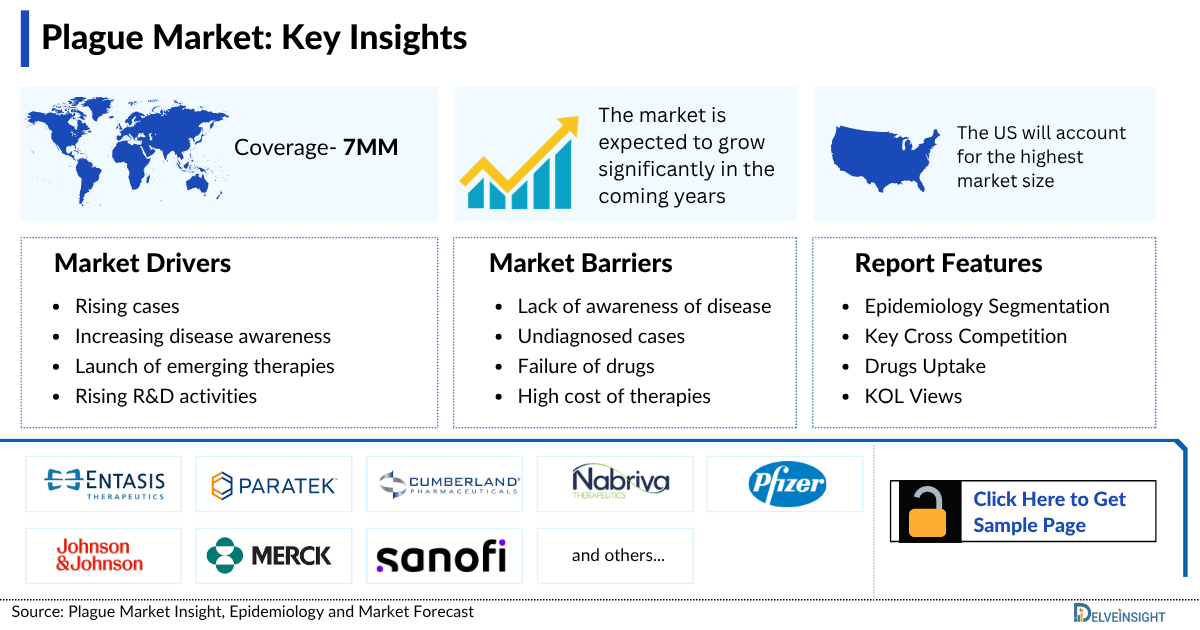
The Plague market report provides current treatment practices, emerging drugs, Plague market share of the individual therapies, current and forecasted Plague market Size from 2022 to 2036 segmented by seven major markets. The Report also covers current Plague treatment practice/algorithm, market drivers, market barriers and unmet medical needs to curate the best of the opportunities and assesses the underlying potential of the Plague market.
Geography Covered
- The United States
- EU5 (Germany, France, Italy, Spain, and the United Kingdom)
- Japan
Study Period: 2022-2036
Key Factors Driving the Growth of the Plague Market
- Rising Risk of Plague Outbreaks: Sporadic plague outbreaks continue to occur in endemic regions, particularly in parts of Africa, Asia, and the Americas. The persistent presence of Yersinia pestis in natural rodent and flea reservoirs sustains the need for preparedness, diagnosis, and treatment options.
- Increasing Focus on Outbreak Preparedness: Governments and public-health organizations are strengthening preparedness for infectious-disease outbreaks, including plague. Stockpiling antibiotics, improving surveillance systems, and maintaining emergency response capabilities can support demand for plague-related therapeutics.
- Growing Demand for Rapid Diagnosis: Early identification of plague is critical because untreated disease can progress rapidly and result in severe complications. Greater adoption of molecular, antigen-based, and other rapid diagnostic technologies is driving investment in faster and more reliable detection.
- Development of Novel Antibacterial Therapies: Research into new antibiotics and alternative antibacterial approaches is expanding to address treatment limitations and concerns regarding antimicrobial resistance. Development of therapies specifically targeting Y. pestis can create new opportunities within the plague treatment market.
Plague Disease Understanding and Treatment Algorithm
Plague is an acute infectious disease caused by the bacterium Yersinia pestis, which primarily circulates among wild rodents and can be transmitted to humans through the bite of infected fleas. Human infection can also occur through direct contact with infected animals or, in the case of pneumonic plague, through respiratory droplets from an infected person. The major clinical forms are bubonic plague, characterized by painful swollen lymph nodes (buboes); septicemic plague, in which the infection spreads into the bloodstream; and pneumonic plague, which affects the lungs and can progress rapidly. Without timely treatment, plague can lead to severe systemic infection, tissue damage, respiratory failure, and death.
Plague Diagnosis
Diagnosis of plague involves combining clinical assessment with laboratory testing, particularly when a patient presents with compatible symptoms and a history of exposure to rodents, fleas, or areas where plague occurs. In suspected bubonic or septicemic plague, specimens such as bubo aspirates, blood, or other relevant tissue samples may be examined for Y. pestis using culture, polymerase chain reaction (PCR), or other laboratory methods. For suspected pneumonic plague, respiratory specimens may be tested in addition to blood samples. Because the disease can progress rapidly, treatment is generally initiated based on clinical suspicion while confirmatory laboratory testing is underway rather than waiting for definitive results.
Plague Treatment
Plague requires prompt antibiotic treatment, as early therapy substantially improves the likelihood of recovery. Commonly used antibiotics include gentamicin, streptomycin, doxycycline, ciprofloxacin, and levofloxacin, with the choice depending on the clinical form of plague, patient characteristics, and local treatment guidance. Severe cases may require hospitalization and supportive care for complications such as sepsis, respiratory failure, or organ dysfunction. Patients with pneumonic plague require appropriate infection-control precautions because the disease can spread through respiratory droplets. Close contacts of patients with pneumonic plague may also require medical evaluation and, when indicated, post-exposure antibiotic prophylaxis.
Plague Epidemiology
The Plague epidemiology section provides insights about the historical and current Plague patient pool and forecasted trends for individual seven major countries. It helps to recognize the causes of current and forecasted trends by exploring numerous studies and views of key opinion leaders. This part of the Plague market report also provides the diagnosed patient pool and their trends along with assumptions undertaken.
Key Findings
The disease epidemiology covered in the report provides historical as well as forecasted Plague epidemiology scenario in the 7MM covering the United States, EU5 countries (Germany, Spain, Italy, France, and the United Kingdom), and Japan from 2022 to 2036.
Plague Drug Chapters
The drug chapter segment of the Plague report encloses the detailed analysis of Plague marketed drugs and late-stage (Phase-III and Phase-II) Plague pipeline drugs. It also helps to understand the Plague clinical trial details, expressive pharmacological action, agreements and collaborations, approval and patent details, advantages and disadvantages of each included drug and the latest news and press releases.
Plague Emerging Drugs
Fetroja (cefiderocol): Shionogi
Fetroja (cefiderocol) is currently the clearest emerging antimicrobial program being actively advanced in the U.S. specifically toward plague preparedness. Shionogi Inc., the company's U.S. subsidiary, received a BARDA Project BioShield contract in April 2026, initially funded at $119 million and potentially worth up to $482 million, covering procurement, U.S. manufacturing, and development of cefiderocol against high-priority biothreat pathogens, including Yersinia pestis and Burkholderia pseudomallei. In August 2026, BARDA exercised a $36.9 million procurement option for Fetroja. Cefiderocol is already FDA-approved for certain serious Gram-negative infections, so the plague effort represents an expansion into a biodefense indication rather than development of an entirely new molecule. Its siderophore-mediated mechanism enables the antibiotic to exploit bacterial iron-uptake pathways to enter Gram-negative bacteria, providing a mechanistically differentiated option for difficult-to-treat infections.
Eravacycline: Tetraphase / La Jolla
Eravacycline is a synthetic fluorocycline antibiotic that has attracted interest as a potential alternative treatment for plague because of its activity against Gram-negative organisms and its relationship to other tetracycline-class agents. CDC's plague treatment guidance identifies eravacycline among tetracycline alternatives that may be considered based primarily on extrapolation rather than direct human plague evidence. However, unlike cefiderocol, there is no strong evidence of an active 2026 U.S. clinical-development program specifically pursuing an FDA plague indication for eravacycline. Consequently, it should be regarded as an emerging/repurposing candidate rather than a confirmed active commercial plague pipeline asset.
Plague Market Outlook
The Plague market outlook of the report helps to build a detailed comprehension of the historic, current, and forecasted Plague market trends by analyzing the impact of current Plague therapies on the market, unmet needs, drivers and barriers, and demand for better technology.
This segment gives a thorough detail of Plague market trend of each marketed drug and late-stage pipeline therapy by evaluating their impact based on the annual cost of therapy, inclusion and exclusion criteria's, mechanism of action, compliance rate, growing need of the market, increasing patient pool, covered patient segment, expected launch year, competition with other therapies, brand value, their impact on the market and view of the key opinion leaders. The calculated Plague market data are presented with relevant tables and graphs to give a clear view of the market at first sight.
According to DelveInsight, the Plague market in 7MM is expected to witness a major change in the study period 2022-2036.
Plague Drugs Uptake
This section focuses on the rate of uptake of the potential Plague drugs recently launched in the Plague market or expected to get launched in the market during the study period 2022-2036. The analysis covers Plague market uptake by drugs; patient uptake by therapies; and sales of each drug.
Plague Drugs Uptake helps in understanding the drugs with the most rapid uptake, reasons behind the maximal use of new drugs, and allow the comparison of the drugs on the basis of Plague market share and size which again will be useful in investigating factors important in market uptake and in making financial and regulatory decisions.
Plague Pipeline Development Activities
The Plague report provides insights into different therapeutic candidates in Phase II, and Phase III stage. It also analyses Plague key players involved in developing targeted therapeutics.
Pipeline Development Activities
The Plague report covers the detailed information of collaborations, acquisition, and merger, licensing, patent details, and other information for Plague emerging therapies.
Reimbursement Scenario in Plague
Approaching reimbursement proactively can have a positive impact both during the late stages of product development and well after product launch. In a report, we take reimbursement into consideration to identify economically attractive indications and market opportunities. When working with finite resources, the ability to select the markets with the fewest reimbursement barriers can be a critical business and price strategy.
KOL- Views
To keep up with current Plague market trends, we take KOLs and SMEs ' opinion working in the Plague domain through primary research to fill the data gaps and validate our secondary research. Their opinion helps to understand and validate current and emerging therapies treatment patterns or Plague market trends. This will support the clients in potential upcoming novel treatment by identifying the overall scenario of the market and the unmet needs.
Competitive Intelligence Analysis
We perform Competitive and Market Intelligence analysis of the Plague Market by using various Competitive Intelligence tools that include - SWOT analysis, PESTLE analysis, Porter's five forces, BCG Matrix, Market entry strategies etc. The inclusion of the analysis entirely depends upon the data availability.
Scope of the Plague Market Report
- The Plague Therapeutics Market Report covers a segment of key events, an executive summary, a descriptive overview, explaining their causes, signs and symptoms, pathogenesis, and currently available treatments.
- Comprehensive insight has been provided into the epidemiology segments and forecasts, the future growth potential of the diagnosis rate, and disease progression along Plague Treatment guidelines.
- Additionally, an all-inclusive account of both the current and emerging treatments, along with the elaborative profiles of late-stage and prominent therapies, will have an impact on the current Plague Treatment landscape.
- A detailed review of the Plague Therapeutics Market, historical and forecasted Plague Treatment Market Size, Plague Drugs Market Share by therapies, detailed assumptions, and rationale behind our approach is included in the report, covering the 7MM drug outreach.
- The Plague Therapeutics Market Report provides an edge while developing business strategies by understanding trends through SWOT analysis and expert insights/KOL views, patient journey, and treatment preferences that help in shaping and driving the 7MM Plague Drugs Market.
Plague Market Report Insights
- Plague Patient Population Forecast
- Plague Therapeutics Market Size
- Plague Pipeline Drugs Analysis
- Plague Market Size and Trends
- Plague Therapeutics Market Opportunity (Current and Forecasted)
Plague Market Report Key Strengths
- Epidemiology-based (Epi-based) Bottom-up Forecasting
- Artificial Intelligence (AI) - enabled Market Research Report
- 11-year forecast
- Plague Market Outlook (North America, Europe, Asia-Pacific)
- Patient Burden Trends (by geography)
- Plague Treatment Addressable Market (TAM)
- Plague Competitive Landscape
- Plague Major Companies Insights
- Plague Price Trends and Analogue Assessment
- Plague Therapies Drug Adoption/Uptake
- Plague Therapies Peak Patient Share Analysis
Plague Market Report Assessment
- Plague Current Treatment Practices
- Plague Unmet Needs
- Plague Clinical Development Analysis
- Plague Emerging Drugs Product Profiles
- Plague Market Attractiveness
- Plague Qualitative Analysis (SWOT and Attribute analysis)
Key Questions Answered in the Plague Treatment Market Report
Plague Therapeutics Market Insights
- What was the Plague Treatment Market Size, the Plague Market Size by therapies, Plague Drugs Market Share (%) distribution in 2025, and what would it look like by 2036? What are the contributing factors for this growth?
- What are the anticipated pricing variations among different geographies for the emerging therapies in the future?
- What can be the future treatment paradigm of Plague?
- What are the disease risks, burdens, and unmet needs of Plague?
- What will be the growth opportunities across the 7MM concerning the patient population with Plague?
- Who is the major future competitor in the market, and how will the competitors affect their market share?
- What are the current options for the treatment of Plague? What are the current guidelines for treating Plague in the US, Europe, and Japan?
Reasons to Buy the Plague Therapeutics Market Report
- The Plague Therapeutics Market Report will help in developing business strategies by understanding the latest trends and changing treatment dynamics driving the Plague Drugs Market.
- Bottom up forecasting builds from the affected population to product forecasts, delivering a robust, data driven approach ideal for new therapies and novel classes.
- Insights on patient burden/disease Plague Prevalence, evolution in diagnosis, and factors contributing to the change in the epidemiology of the disease during the forecast years.
- Understand the existing Plague Drugs Market opportunities in varying geographies and the growth potential over the coming years.
- Identifying strong upcoming players in the Plague Drugs Market will help devise strategies to help get ahead of competitors.
- Detailed analysis, ranking of class-wise potential current, and emerging therapies under the attribute analysis section to provide visibility around leading classes.
- To understand KOLs’ perspectives on the accessibility, acceptability, and compliance-related challenges of existing treatment to overcome barriers in the future.
- Detailed insights on the unmet needs of the existing Plague Drugs Market so that the upcoming players can strengthen their development and launch strategy.
- This Artificial Intelligence (AI) enabled report summarize and simplify complex datasets with in the report into clear, actionable insights for stakeholders, investors, and healthcare providers, enabling faster, data driven decisions.