Plant Extracts Market Summary
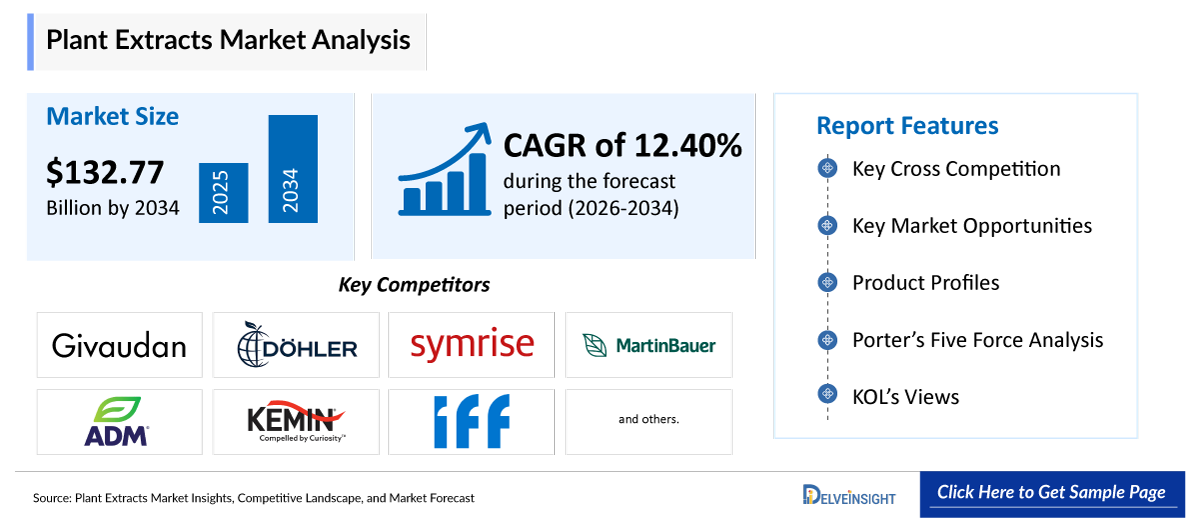
- The Plant Extracts market is estimated at USD 46.37 billion in 2025 and is projected to reach USD 132.77 billion by 2034. Growth is anchored in rising consumer demand for natural, clean-label ingredients across food, nutraceuticals, and personal care, advances in green extraction technology, and expanding pharmaceutical use of standardized botanical actives.
- The global Plant Extracts market is growing at a CAGR of 12.40% during the forecast period from 2026 to 2034.
- By type, the herbal extracts segment dominated the Plant Extracts market with a 34% share in 2025.
- By formulation, the liquid segment dominated the Plant Extracts market with a 58% share in 2025.
- By active compound, the polyphenols segment dominated the Plant Extracts market with a 31% share in 2025.
- By extraction method, the solvent extraction segment dominated the Plant Extracts market with a 42% share in 2025.
- By application, the food & beverages segment dominated the Plant Extracts market with a 37% share in 2025.
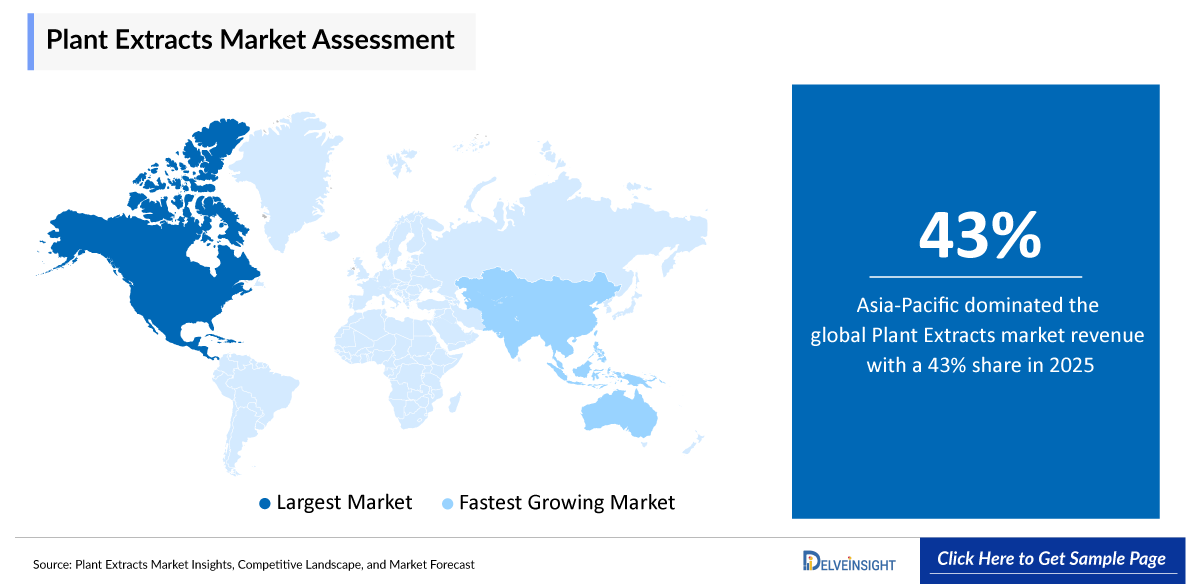
- Asia-Pacific dominated the global Plant Extracts market revenue with a 43% share in 2025, representing the highest regional market share globally.
A plant extract is a concentrated preparation obtained from the leaves, roots, seeds, bark, flowers, fruits, or vegetables of a plant using solvent-based, thermal, mechanical, or pressure-driven extraction techniques, capturing bioactive and functional compounds such as polyphenols, flavonoids, alkaloids, terpenoids, and carotenoids. Because consumers and regulators increasingly favor natural, traceable, and clean-label ingredients over synthetic alternatives, food and beverage manufacturers, nutraceutical formulators, pharmaceutical companies, and cosmetics brands rely on specialized plant extract suppliers for standardized, quality-assured botanical ingredients. These suppliers provide end-to-end capabilities spanning raw material sourcing and agronomy, extraction and purification, standardization and analytical testing, formulation support, and regulatory documentation. The market is organized by type across herbal, fruit and vegetable, spice, flower, and leaf extracts; by formulation across powder and liquid; by active compound, including polyphenols, flavonoids, alkaloids, terpenoids, and carotenoids; by extraction method, including solvent extraction, steam distillation, cold press extraction, supercritical fluid extraction, and maceration; and by application, led by food and beverages. Driven by the clean-label movement, rising nutraceutical and dietary supplement consumption, expanding cosmetics use of botanical actives, and continuous advances in sustainable and solvent-free extraction technology, plant extract producers have become essential suppliers underpinning the global natural ingredients value chain.
Plant Extracts Market Key Growth Drivers
- The accelerating global shift toward clean-label and natural products is driving demand, with roughly 80% of new food and beverage launches now using natural color or natural ingredient claims and manufacturers reformulating away from synthetic additives.
- Rising global demand for preventive healthcare and dietary supplementation is expanding the nutraceuticals and dietary supplements application, with consumers increasingly seeking standardized herbal and botanical actives supported by scientific research.
- Food and beverage manufacturers are increasingly outsourcing natural flavor, color, and functional ingredient development to specialized plant extract suppliers to cut reformulation costs and accelerate clean-label product launches.
- Regulatory momentum against synthetic additives, including U.S. FDA action to phase out several petroleum-based synthetic dyes by the end of 2026, is directly increasing commercial demand for natural, plant-derived alternatives.
- Heavy capital investment in extraction capacity and decentralized, regionally distributed manufacturing, including new facilities across North America, Europe, and Asia-Pacific, is expanding available plant extract supply.
- Advances in green and solvent-free extraction technologies, including supercritical fluid extraction and fermentation-based processing, are improving yield, purity, and sustainability, broadening the addressable application base.
- The convergence of clean-label demand, preventive health trends, natural-color regulatory shifts, and extraction technology advances is expected to sustain strong double-digit growth in the market through 2034.
Key Companies in Plant Extracts Market
The competitive landscape is led by the following active manufacturers:
- Givaudan
- Döhler
- Symrise
- Martin Bauer
- ADM
- Kemin Industries, Inc.
- International Flavors & Fragrances Inc.
- Chr. Hansen Holding A/S
- Indena S.p.A.
- Sensient Technologies Corporation
- Nutra Green Biotechnology Co., Ltd.
For illustrative purposes, only the top 10 companies are listed in the Table of Contents. The report may include analysis and references to additional companies relevant to the market assessment.
Plant Extracts Market Size
The following snapshot summarizes the principal report metrics for the Plant Extracts market.
|
Report Metrics |
Details |
|
2025 Market Size |
USD 46.37 billion |
|
2034 Projected Market Size |
USD 132.77 billion |
|
Growth Rate (2026-2034) |
12.40% CAGR |
|
Largest Market |
Asia-Pacific |
|
Fastest Growing Market |
North America |
|
Market Structure |
Fragmented |
All market values are expressed in USD and represent DelveInsight estimates synthesized from primary and secondary research.
Factors Contributing to the Growth of the Plant Extracts Market
Market Drivers
Accelerating Shift Toward Clean-Label and Natural Ingredients
The most powerful driver of the Plant Extracts market is the accelerating consumer and regulatory shift away from synthetic additives toward natural, plant-derived ingredients. Approximately 80% of new food and beverage launches globally now use natural color, and manufacturers across food, beverage, and personal care categories are reformulating products to meet clean-label expectations. In the United States, more than 100 state-level legislative actions targeting synthetic dyes were introduced in 2025 alone, and the FDA has moved to phase out several petroleum-based synthetic colorants by the end of 2026. Because natural color and flavor conversion typically requires substantially higher usage rates than synthetic equivalents to achieve the same visual or sensory effect, this shift is directly expanding demand for plant-derived colorants, flavors, and functional extracts. As more categories convert from synthetic to natural formulations, demand for plant extract capacity expands directly, anchoring market growth through 2034.
Rising Demand for Nutraceuticals and Preventive Healthcare
The growing global emphasis on preventive healthcare and dietary supplementation is expanding demand for standardized botanical actives and the manufacturing services that support them. Consumers are increasingly turning to herbal remedies, functional beverages, and fortified foods for antioxidant, immune-support, and anti-inflammatory benefits, while healthy-aging and longevity trends are driving adoption of ingredients such as polyphenol-rich botanical phytosomes and standardized herbal extracts. Plant extracts are central to this shift, supporting both dietary supplement formulation and functional food and beverage development. As scientific research increasingly validates the efficacy of standardized botanical compounds and consumer skepticism toward synthetic pharmaceuticals grows, the volume and sophistication of plant extract production rise in step, translating into sustained requirements for extraction, standardization, and quality-control services across the forecast period.
Increasing Outsourcing of Natural Ingredient Development
A structural shift toward outsourcing is a central growth engine for the market. Developing natural colorants, flavors, and functional ingredients requires specialized agronomy, extraction technology, standardization know-how, and regulatory documentation that many food, beverage, and personal care companies lack in-house. As a result, brand owners increasingly partner with specialized plant extract suppliers to access proprietary extraction platforms, botanical sourcing networks, and application expertise, reducing reformulation cost and accelerating time to market. Suppliers provide end-to-end capabilities spanning raw material sourcing, extraction, purification, standardization, and formulation support, allowing customers to focus on product development and marketing. As reformulation pipelines expand across categories, outsourcing intensity rises, directly enlarging the addressable market for plant extract suppliers through the forecast period.
Regulatory Momentum Against Synthetic Additives
A growing wave of regulatory action against synthetic additives is increasing commercial demand for natural alternatives. In the United States, the FDA has targeted synthetic dyes including Red No. 40, Yellow No. 5, and several others for phase-out by the end of 2026, while individual states have moved to ban synthetic colorants in school meals and, in some cases, statewide retail sale. Similar clean-label and ingredient-transparency regulatory trends are emerging across Europe and Asia-Pacific. Because natural color and flavor conversion requires meaningfully higher usage volumes than synthetic equivalents, each regulatory action creates durable, recurring demand for plant-derived colorants, antioxidants, and functional ingredients. This regulatory momentum flows directly to suppliers with proven natural ingredient portfolios and scalable extraction capacity, reinforcing market growth across the forecast period.
Investment in Extraction Capacity and Sustainable Technology
Heavy capital investment in extraction capacity and sustainable processing technology is expanding supply networks and improving product quality across the industry. Leading suppliers have expanded hydroethanolic and botanical extraction capabilities, opened new production facilities across North America, Europe, and Asia-Pacific, and invested in supercritical fluid and solvent-free extraction platforms to meet rising demand while addressing sustainability expectations. This investment expands available extraction capacity, improves supply reliability and traceability, and supports the scale-up of premium, differentiated botanical ingredients through the forecast period.
Strong Innovation and M&A Activity Across the Value Chain
Active consolidation and innovation investment are reshaping the competitive landscape and expanding capability. Strategic transactions and capacity expansions, including acquisitions of regional botanical extract specialists, natural-ingredient hub investments in established production clusters, and joint innovation platforms between global ingredient houses and local extraction specialists, underscore the strategic value of proprietary natural ingredient portfolios. Large ingredient companies are vertically integrating by securing botanical sourcing networks and extraction capacity. This influx of capital and consolidation expands industry infrastructure, validates the sector's long-term growth, and channels sustained demand toward suppliers with scale, technology, and reliable botanical sourcing across the forecast period.
Market Restraints
Despite strong momentum, the Plant Extracts market faces material constraints. Agricultural volatility and climate-related raw material price fluctuations create supply-chain fragility, since the quality, yield, and bioactive concentration of plant-derived raw materials vary with growing conditions, harvest timing, and geography. Maintaining standardized potency and consistent bioactive profiles across different harvests and sourcing regions is technically demanding, requiring rigorous testing and quality-control infrastructure that smaller players often lack. Diverse and evolving global regulatory frameworks for health claims, novel-food approvals, and ingredient labeling complicate market entry and lengthen product development timelines across regions. The market remains moderately fragmented, with numerous small and regional extraction specialists competing alongside large diversified ingredient houses, which intensifies price competition in commoditized extract categories and pressures margins. High capital and technical requirements for advanced extraction technologies, including supercritical fluid extraction, create barriers for smaller entrants seeking to move into premium, differentiated ingredient segments. Additionally, reimbursement and regulatory acceptance of certain phytopharmaceutical and nutraceutical health claims remain uneven across geographies, tempering the pace of premium-segment growth. Together, these agricultural, quality-control, regulatory, and competitive-intensity barriers moderate the pace of growth, even as the underlying drivers of clean-label demand, preventive health trends, and extraction technology advancement remain firmly intact.
Plant Extracts Market Segment Analysis
The plant extracts market by type (herbal extracts, fruit & vegetable extracts, spice extracts, flower extracts, leaf extracts, and others), formulation (powder and liquid), active compounds (polyphenols, flavonoids, alkaloids, terpenoids, carotenoids, and others), extraction method (solvent extraction, steam distillation, cold press extraction, supercritical fluid extraction, maceration, and others), application (pharmaceuticals, nutraceuticals & dietary supplements, food & beverages, cosmetics & personal care, and others), and geography (North America, Europe, Asia-Pacific, and Rest of World).
By Type
Dominant Subsegment: Herbal Extracts.
The herbal extracts segment accounted for 34% of the Plant Extracts market in 2025. Herbal extracts are the leading type because of their long-established traditional use, broad application across pharmaceuticals, nutraceuticals, and functional foods, and strong scientific research support validating their therapeutic and antioxidant properties. Standardized herbal extracts such as ginkgo, turmeric, ashwagandha, and echinacea are widely adopted in dietary supplements and phytopharmaceutical formulations, and rising consumer skepticism toward synthetic pharmaceuticals continues to drive adoption of standardized herbal remedies for chronic-condition management and general wellness. Fruit and vegetable extracts are growing quickly on the back of clean-label coloring and functional beverage demand, while spice extracts benefit from culinary and preservative applications, and flower and leaf extracts serve specialized cosmetic and nutraceutical niches. Nonetheless, the depth of clinical and traditional-use evidence and the breadth of end-market applications secure herbal extracts' leadership across the forecast period.
By Formulation
Dominant Subsegment: Liquid.
The liquid segment accounted for 58% of the Plant Extracts market in 2025. Liquid extracts, including essential oils, oleoresins, and standardized liquid concentrates, are the leading formulation because they offer superior solubility, ease of blending, and precise dosing control across beverage, flavor, fragrance, and liquid supplement applications. Liquid formulations retain volatile aromatic and bioactive compounds more effectively during processing, making them the preferred format for flavor houses and fragrance manufacturers, while their compatibility with high-speed liquid-filling and beverage production lines supports large-scale commercial adoption. Powder formulations are growing steadily, favored for their extended shelf stability, ease of transport, and compatibility with tablet, capsule, and dry-mix supplement manufacturing. While powder formats are gaining share in nutraceutical and functional-food applications where shelf life and standardized dosing are prioritized, the versatility and processing advantages of liquid extracts secure the segment's leadership across the forecast period.
By Active Compounds
Dominant Subsegment: Polyphenols.
The polyphenols segment accounted for 31% of the Plant Extracts market in 2025. Polyphenols are the leading active compound category because of their well-documented antioxidant, anti-inflammatory, and cardiovascular health benefits, which have driven widespread adoption across nutraceuticals, functional foods and beverages, and cosmetic formulations. Compounds such as catechins, resveratrol, and proanthocyanidins are extensively researched and incorporated into dietary supplements, skincare actives, and fortified food products, supported by growing consumer awareness of oxidative-stress-related health concerns. Flavonoids, a closely related subclass, are also expanding rapidly on the back of clean-label coloring and immune-support applications, while alkaloids remain important in pharmaceutical-grade extracts and terpenoids and carotenoids serve specialized flavor, fragrance, and color applications. Nonetheless, the breadth of scientific validation and cross-industry application of polyphenols secures the segment's leadership across the forecast period.
By Extraction Method
Dominant Subsegment: Solvent Extraction.
The solvent extraction segment accounted for 42% of the Plant Extracts market in 2025. Solvent extraction is the leading method because it is a versatile, cost-effective, and highly scalable technique capable of extracting a broad range of bioactive compounds, including polyphenols, alkaloids, and flavonoids, from diverse plant matrices at commercial volumes. Its compatibility with existing large-scale industrial infrastructure and its ability to achieve high extraction yields across herbal, fruit, and spice sources make it the default choice for high-volume ingredient production. Steam distillation remains essential for essential-oil and aromatic extraction, cold-press extraction is preferred for citrus and delicate oils, and supercritical fluid extraction is the fastest-growing method as manufacturers seek solvent-free, high-purity extracts for premium nutraceutical and cosmetic applications. Maceration continues to serve smaller-batch, artisanal, and traditional-medicine production. While supercritical fluid extraction is gaining momentum on sustainability and purity grounds, the cost efficiency and scalability of solvent extraction secure its leadership across the forecast period.
By Application
Dominant Subsegment: Food & Beverages.
The food & beverages segment accounted for 37% of the Plant Extracts market in 2025. Food and beverages is the leading application because plant extracts are extensively used as natural colorants, flavors, preservatives, and functional additives across an enormous volume of packaged food, beverage, and confectionery products worldwide. The accelerating clean-label movement and regulatory pressure against synthetic dyes and preservatives are driving large-scale reformulation across the food and beverage industry, sustaining high-volume, recurring demand for natural colorants such as beet, turmeric, and butterfly pea flower extracts and for natural flavor and preservative systems. Nutraceuticals and dietary supplements represent the fastest-growing application, propelled by preventive-health trends and standardized botanical actives, while cosmetics and personal care and pharmaceuticals continue to expand steadily on the back of natural-actives demand. Nonetheless, the sheer volume, frequency, and breadth of food and beverage reformulation secure the segment's leadership across the forecast period.
Plant Extracts Market Region Analysis
Dominant Region: Asia-Pacific
Asia-Pacific accounted for 43% of the global Plant Extracts market revenue in 2025, representing the highest regional market share globally. The region's dominance reflects its vast raw material base and biodiversity, a deep heritage in traditional medicine systems including traditional Chinese medicine and Ayurveda, low-cost manufacturing capabilities, and rapidly expanding nutraceutical and personal care industries across China, India, Japan, South Korea, and Australia. Asia-Pacific hosts the largest concentration of botanical cultivation, extraction, and processing capacity globally, and manufacturers benefit from proximity to abundant, diverse plant raw materials and an extensive network of extraction facilities. Rising disposable incomes, growing health consciousness, and government support for traditional medicine modernization sustain substantial domestic and export-oriented production. Heavy investment is expanding capacity, including new extraction facilities and quality-certification upgrades, while regional manufacturers increasingly align with international GMP and quality standards to serve global export markets. Strong raw-material availability, cost advantages, and traditional-medicine heritage anchor the region's continued leadership across the forecast period.
Fastest Growing Region: North America
North America is the fastest-growing region in the Plant Extracts market. The region's elevated CAGR is driven by aggressive regulatory action against synthetic additives, rapid clean-label reformulation across the food and beverage industry, and rising consumer demand for natural, traceable ingredients across the United States and Canada. U.S. state legislatures introduced more than 100 color-related bills in 2025 alone, and federal regulatory momentum is pushing a nationwide phase-out of several synthetic dyes, directly accelerating conversion to plant-derived natural colorants and flavors. Leading ingredient suppliers are expanding North American production capacity, including new botanical extraction and juice-processing facilities, to meet surging reformulation demand. Growing adoption of functional beverages, adaptogenic herbal products, and clean-label dietary supplements further supports regional growth. The combination of regulatory pressure, reformulation urgency, and capacity investment positions North America as the principal source of incremental growth over the forecast period.
Regional Commentary
North America
North America is the fastest-growing region in the Plant Extracts market. The United States leads on the strength of aggressive regulatory action against synthetic dyes, rapid clean-label reformulation, and strong nutraceutical and functional-beverage demand, while heavy investment in botanical extraction and juice-processing capacity, and ingredient suppliers' moves to expand North American manufacturing footprints, reinforce regional growth.
Europe
Europe is a large and technologically advanced regional market, supported by a strong natural-ingredients heritage, established EFSA regulatory frameworks for novel foods and health claims, and deep expertise in premium botanical extraction, particularly for fragrance, flavor, and pharmaceutical-grade actives. Capacity investments and premium-naturals hubs, including natural fragrance ingredient clusters in France's Grasse region and specialized pharmaceutical-grade botanical production in Italy, reinforce the region's role in supplying premium plant extracts across Germany, France, the United Kingdom, Italy, and Spain.
Asia-Pacific
Asia-Pacific is the largest region, propelled by an extensive raw material base, deep traditional-medicine heritage, low-cost manufacturing, and rapidly expanding nutraceutical and personal care industries across China, Japan, India, South Korea, and Australia. China's extensive botanical cultivation and processing infrastructure, Japan's advanced functional-ingredient research, India's traditional Ayurvedic extraction expertise, and Australia's premium natural ingredient exports are sustaining the region's scale and export competitiveness.
Rest of World
The Rest of World region, spanning Latin America, the Middle East, and Africa, is an emerging growth frontier. Expanding agricultural processing infrastructure, rich indigenous plant biodiversity, rising demand for natural food and personal care ingredients, and efforts to align regulatory frameworks with global GMP standards are gradually broadening access, while international partnerships and export-oriented investment support the build-out of regional extraction capacity.
Plant Extracts Market Competitive Landscape
The Plant Extracts market is classified as Fragmented. A group of large, diversified ingredient houses with global sourcing networks and integrated extraction platforms, including Givaudan, Symrise, ADM, and International Flavors & Fragrances Inc., anchors the top tier, while specialized botanical and regional extraction specialists such as Döhler, Martin Bauer, Kemin Industries, Chr. Hansen Holding A/S, Indena S.p.A., Sensient Technologies Corporation, and Nutra Green Biotechnology Co., Ltd. compete through deep botanical sourcing networks, proprietary extraction technology, and application-specific expertise, sustaining intense competition across a highly fragmented supplier base.
The competitive landscape can be evaluated across the following dimensions:
- Market concentration: Fragmented, with diversified global ingredient houses leading and a large field of specialized regional and botanical extraction specialists.
- Leading players: Givaudan, Symrise, ADM, and International Flavors & Fragrances Inc. anchor the top tier through integrated sourcing networks and global manufacturing reach.
- Geographic reach: Leaders operate global, regionally distributed sourcing and extraction networks; IFF's LMR Naturals platform alone processes roughly 85,000 tons of biomass annually across more than 130 botanical families.
- Portfolio strength: Top players offer end-to-end botanical sourcing, extraction, standardization, formulation support, and regulatory documentation across food, nutraceutical, cosmetic, and pharmaceutical applications.
- Extraction technology access: Ownership of advanced extraction platforms, including supercritical fluid CO2 extraction and hydroethanolic extraction capacity, is a decisive competitive advantage.
- Strategic partnerships: Tie-ups between global ingredient houses and regional botanical specialists, such as Symrise's planned combination of Floral Concept with its Maison Lautier 1795 naturals house in Grasse, extend sourcing reach.
- M&A and portfolio activity: Active reshaping of natural-ingredient portfolios, including Givaudan's acquisition of Indena, Chr. Hansen's 2024 merger with Novozymes to form Novonesis, Döhler's acquisition of Premier Juices, and IFF's 2026 divestiture of its botanical extracts and natural colors portfolio to SuanNutra.
- Manufacturing capabilities: Regionally distributed extraction facilities, standardized quality-control infrastructure, and vertically integrated botanical supply chains are key competitive moats.
- Innovation focus: Supercritical fluid and solvent-free extraction scale-up, botanical phytosome and bioavailability technologies, natural color conversion capacity, and AI-supported formulation and sourcing optimization.
Plant Extracts Market Recent Developmental Activities
In July 2026, International Flavors & Fragrances Inc. announced an agreement to sell its portfolio of botanical extracts, vitamins and minerals, and food enhancement activities, including its natural colors and antioxidants business, to SuanNutra, a Carbyne Equity Partners portfolio company. Strategic significance: Reflects ongoing portfolio optimization across the industry and creates a dedicated, independently owned botanical extracts platform.
In July 2026, Symrise signed a put option agreement to acquire 100% of Floral Concept, a French supplier of premium natural fragrance extracts, to be combined with its Maison Lautier 1795 naturals house in the Grasse region. Strategic significance: Strengthens Symrise's premium natural extraction and sourcing capabilities for high-value botanical raw materials.
In June 2026, Döhler opened a new natural ingredients production plant in the State of Mexico, backed by an investment of more than USD 64 million, alongside the launch of Döhler Canada, expanding its North American natural ingredients and plant-based extraction footprint. Strategic significance: Expands regional manufacturing capacity and strengthens Döhler's natural ingredients platform across North and Latin America.
In June 2026, Döhler significantly expanded flavour production and botanical extraction capabilities at its Cartersville, Georgia facility, including a major upgrade to hydroethanolic extraction capacity for botanicals. Strategic significance: Scales premium natural extract production to meet growing demand for clean-label functional ingredient systems.
In July 2026, Kemin Industries, Inc., held a foundation-laying ceremony for its Kuriosity Centre, a new flagship facility at its Asia-Pacific regional headquarters in Singapore, representing an investment of approximately USD 35 million. Strategic significance: Strengthens Kemin's Asia-Pacific innovation and ingredient-solutions capacity, including its botanical antioxidant portfolio.
In May 2026, Indena S.p.A. showcased new botanical solutions, including its Centextra Centella Indena Phytosome ingredient, at Vitafoods Europe 2026, expanding its portfolio of plant-derived actives for healthy aging and skin health. Strategic significance: Reinforces Indena's leadership in pharmaceutical-grade and premium nutraceutical botanical actives.
In 2025 and 2026, Sensient Technologies Corporation accelerated capital investment in natural color production capacity, with 2025 capital expenditures exceeding USD 100 million and 2026 guidance of USD 150-170 million, in response to U.S. regulatory action against synthetic dyes. Strategic significance: Positions Sensient to capture what the company has called the single largest revenue opportunity in its history from synthetic-to-natural color conversion.
In September 2025, International Flavors & Fragrances Inc. inaugurated an expanded LMR Naturals site in Grasse, France, following a EUR 10 million investment that increased the facility's footprint by 75% and added a dedicated pilot hall for natural ingredient innovation. Strategic significance: Expands premium natural extraction capacity and accelerates new botanical ingredient development.
In July 2025, Martin Bauer invested in a new spray-drying tower at its Kleinostheim, Germany site, increasing botanical powder production capacity while supporting the company's climate goals. Strategic significance: Expands sustainable powder-extract manufacturing capacity to meet growing demand for standardized botanical powders.
In April 2025, Döhler acquired Premier Juices, strengthening its natural fruit-based extract and ingredient portfolio and adding strategic operations in Delaware to enhance North American supply chain reach. Strategic significance: Broadens Döhler's fruit and vegetable extract portfolio and North American distribution capability.
In January 2024, Chr. Hansen Holding A/S completed its merger with Novozymes A/S to form Novonesis, a global biosolutions group with combined annual revenue of approximately EUR 3.7 billion, integrating plant health, fermentation-based plant ingredient, and natural-color capabilities. Strategic significance: Creates a broader biosolutions platform spanning plant-derived and fermentation-based natural ingredient technologies.
Plant Extracts Market Segmentation
Plant Extracts Market by Type
- Herbal Extracts
- Fruit & Vegetable Extracts
- Spice Extracts
- Flower Extracts
- Leaf Extracts
- Others
Plant Extracts Market by Formulation
- Powder
- Liquid
Plant Extracts Market by Active Compounds
- Polyphenols
- Flavonoids
- Alkaloids
- Terpenoids
- Carotenoids
- Others
Plant Extracts Market by Extraction Method
- Solvent Extraction
- Steam Distillation
- Cold Press Extraction
- Supercritical Fluid Extraction
- Maceration
- Others
Plant Extracts Market by Application
- Pharmaceuticals
- Nutraceuticals & Dietary Supplements
- Food & Beverages
- Cosmetics & Personal Care
- Others
Plant Extracts Market by Geography
- North America Plant Extracts Market
- United States Plant Extracts Market Size in USD million (2023-2034)
- Canada Plant Extracts Market Size in USD million (2023-2034)
- Mexico Plant Extracts Market Size in USD million (2023-2034)
- Europe Plant Extracts Market
- Germany Plant Extracts Market Size in USD million (2023-2034)
- United Kingdom Plant Extracts Market Size in USD million (2023-2034)
- France Plant Extracts Market Size in USD million (2023-2034)
- Italy Plant Extracts Market Size in USD million (2023-2034)
- Spain Plant Extracts Market Size in USD million (2023-2034)
- Rest of Europe Plant Extracts Market Size in USD million (2023-2034)
- Asia-Pacific Plant Extracts Market
- China Plant Extracts Market Size in USD million (2023-2034)
- Japan Plant Extracts Market Size in USD million (2023-2034)
- India Plant Extracts Market Size in USD million (2023-2034)
- Australia Plant Extracts Market Size in USD million (2023-2034)
- South Korea Plant Extracts Market Size in USD million (2023-2034)
- Rest of Asia-Pacific Plant Extracts Market Size in USD million (2023-2034)
- Rest of the World (RoW) Plant Extracts Market
- Middle East Plant Extracts Market Size in USD million (2023-2034)
- Africa Plant Extracts Market Size in USD million (2023-2034)
- South America Plant Extracts Market Size in USD million (2023-2034)
Plant Extracts Market Recent Industry Trends and Milestones (2023-2026)
|
Category |
Key Developments |
|
Plant Extracts Market Product Approval |
Regulatory momentum against synthetic additives is expanding commercial demand for natural ingredients. The FDA has moved to phase out several petroleum-based synthetic dyes, including Red No. 40 and Yellow No. 5, by the end of 2026, while U.S. state legislatures introduced more than 100 color-related bills in 2025. Natural color conversion, which requires substantially higher usage rates than synthetic equivalents, creates durable demand for plant-derived colorants, the large majority of which is supplied by specialized plant extract manufacturers. |
|
Plant Extracts Market Expansion |
Suppliers broadened capacity and capability across the value chain. Döhler opened a new natural ingredients plant in Mexico and expanded flavour and botanical extraction capabilities in Cartersville, Georgia; Kemin Industries broke ground on its Kuriosity Centre in Singapore; Martin Bauer invested in new spray-drying capacity in Germany; and IFF expanded its LMR Naturals site in Grasse, France. Sustainability-focused, solvent-free extraction technologies and regionally distributed manufacturing expanded to address raw-material and logistics constraints. |
|
Plant Extracts Market Investment |
Capital and portfolio realignment accelerated. Chr. Hansen completed its merger with Novozymes to form Novonesis (January 2024), Symrise signed an agreement to acquire Floral Concept (July 2026), Döhler acquired Premier Juices (April 2025), and IFF agreed to divest its botanical extracts, vitamins, and natural colors portfolio to SuanNutra (July 2026). Sensient Technologies raised capital expenditure guidance to USD 150-170 million for 2026, concentrated on natural color production capacity. |
|
Company Strategy |
Givaudan: Integrated natural extracts leadership anchored by its Naturex and Indena platforms. Symrise: Premium naturals expansion through the Floral Concept and Maison Lautier 1795 combination. ADM: Botanical and fruit extract portfolio built around functional nutrition ingredients. International Flavors & Fragrances Inc.: Premium natural ingredient innovation via LMR Naturals, alongside portfolio optimization through the SuanNutra divestiture. Döhler, Martin Bauer, Kemin Industries, Chr. Hansen Holding A/S (Novonesis), Indena S.p.A., Sensient Technologies Corporation, and Nutra Green Biotechnology Co., Ltd.: Specialized botanical extraction capacity, natural color conversion capability, and regional sourcing strength. |
|
Emerging Technologies |
Supercritical fluid extraction and other solvent-free technologies are the leading edge of innovation, offering high-purity, sustainable extracts for premium nutraceutical and cosmetic applications. Botanical phytosome and bioavailability-enhancement technologies are expanding the therapeutic and cosmetic utility of standardized extracts. Fermentation-based and AI-supported formulation and sourcing optimization are emerging, alongside sustainability initiatives such as low-waste extraction, regenerative botanical sourcing, and environmentally friendly packaging. |
Plant Extracts Market Startup Funding and Investment Trends
|
Company |
Total Funding |
Funding Stage |
Main Offering |
Core Technology |
|
Floral Concept |
Undisclosed acquisition value |
Acquired by Symrise (2026) |
Premium natural fragrance extracts |
Botanical sourcing and extraction |
|
Request to unlock the report on the @ Plant Extracts Market | ||||
Investment in the Plant Extracts ecosystem has concentrated on premium natural fragrance and flavor extraction, natural color conversion capacity, and sustainable, solvent-free extraction technology. The following companies illustrate recent funding and investment activity and technology focus.
Capital is flowing toward suppliers that secure differentiated botanical sourcing and scale natural ingredient manufacturing. Symrise's planned acquisition of Floral Concept underscores the strategic value of premium natural fragrance extraction capability, while IFF's divestiture of its botanical extracts and natural colors portfolio to SuanNutra, a Carbyne Equity Partners portfolio company, reflects continued portfolio realignment across the industry. Regional botanical specialists across China, India, and Latin America are scaling extraction and standardization capacity, while established suppliers including Sensient Technologies and Döhler are investing heavily in natural color and botanical extraction infrastructure. Collectively, these investments signal conviction that botanical sourcing strength, extraction technology, and natural color conversion capacity will define the next phase of competitive advantage in the global Plant Extracts market.
Key Takeaways from the Plant Extracts Market Report Study
- Market size analysis for the current Plant Extracts market size (2025), and market forecast for 9 years (2026 to 2034).
- Top key product/technology developments, mergers, acquisitions, partnerships, and joint ventures that happened over the last 3 years.
- Key companies dominating the global Plant Extracts market.
- Various opportunities available for competitors in the Plant Extracts market space.
- What are the top-performing segments in 2025? How will these segments perform in 2034?
- Which are the top-performing regions and countries in the current Plant Extracts market scenario?
- Which are the regions and countries where companies should concentrate their opportunities for Plant Extracts market growth in the future?
Target audience that can benefit from this Plant Extracts market report study
- Plant Extracts product providers
- Research organizations and consulting companies
- Plant Extracts -related organizations, associations, forums, and other alliances
- Government and corporate offices
- Start-up companies, venture capitalists, and private equity firms
- Distributors and traders dealing in Plant Extracts
- Various end-users who want to know more about the Plant Extracts market and the latest technological developments in the Plant Extracts market.