
Plasma Protease C1-inhibitor Market Summary
- The Plasma Protease C1-inhibitor market is estimated at USD 2.8 billion in 2025 and is projected to reach USD 5.1 billion by 2034. Growth is anchored in the rising diagnosis of hereditary angioedema, the expansion of long-term prophylaxis, and continued innovation in C1-inhibitor replacement therapy and the broader hereditary angioedema treatment landscape.
- The global Plasma Protease C1-inhibitor market is growing at a CAGR of 6.8% during the forecast period from 2026 to 2034.
- By product type, the plasma-derived C1-inhibitor segment dominated the Plasma Protease C1-inhibitor market with a 78% share in 2025.
- By treatment type, the routine prophylaxis segment dominated the Plasma Protease C1-inhibitor market with a share of 56% in 2025.
- By route of administration, the intravenous segment dominated the Plasma Protease C1-inhibitor market with a share of 55% in 2025.
- By distribution channel, the specialty pharmacies segment dominated the Plasma Protease C1-inhibitor market with a share of 48% in 2025.
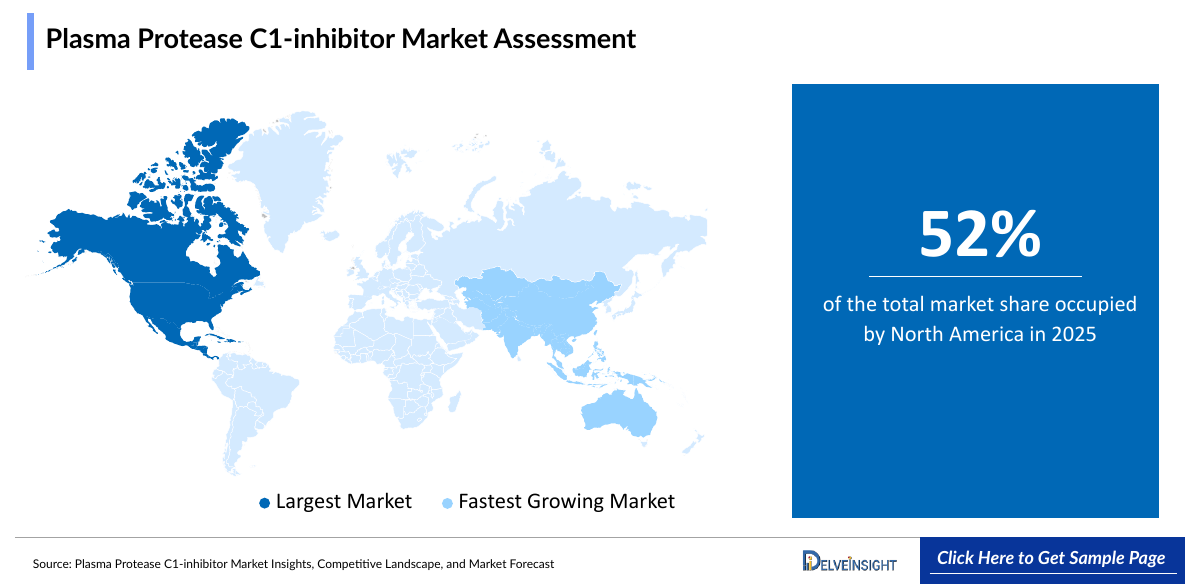
- North America dominated the global Plasma Protease C1-inhibitor market revenue with a share of 52% in 2025, representing the highest regional market share globally.
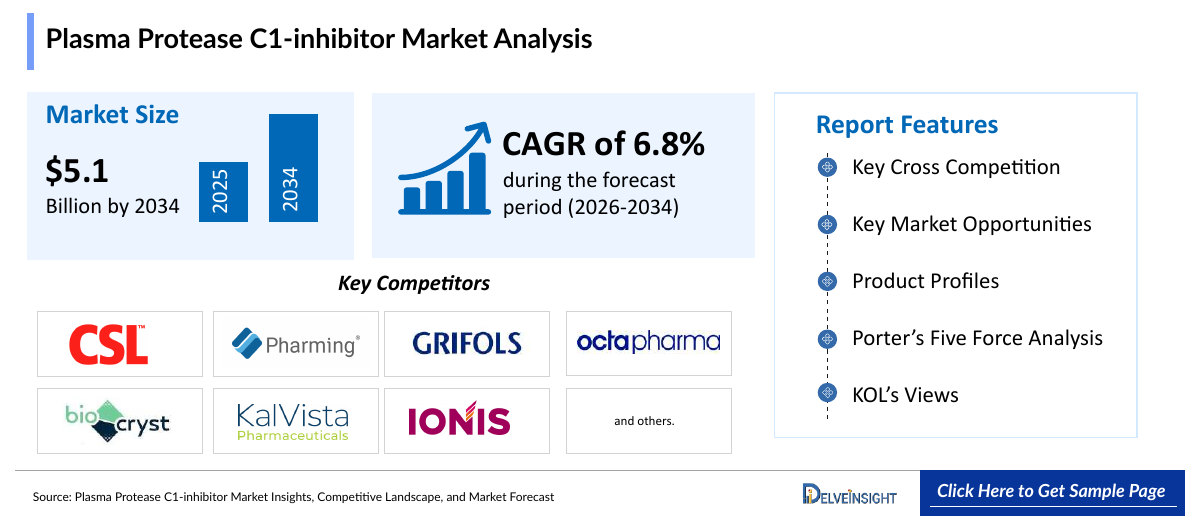
Plasma protease C1-inhibitor, or C1-esterase inhibitor, is a serine protease inhibitor that regulates the complement, contact, and coagulation systems, and its deficiency or dysfunction causes hereditary angioedema, a rare genetic disorder characterized by recurrent, potentially life-threatening episodes of swelling. The C1-inhibitor market comprises C1-inhibitor replacement therapies and the broader set of treatments used to manage hereditary angioedema. C1-inhibitor products include plasma-derived therapies such as Berinert and Haegarda from CSL Behring and Cinryze from Takeda, and the recombinant C1-inhibitor Ruconest from Pharming Group, used for acute attack treatment and routine prophylaxis. The broader hereditary angioedema landscape includes kallikrein inhibitors such as lanadelumab and ecallantide and the bradykinin receptor antagonist icatibant from Takeda, the oral kallikrein inhibitors berotralstat from BioCryst and sebetralstat from KalVista, and newer prophylactic agents including garadacimab from CSL and donidalorsen from Ionis. These therapies are delivered intravenously and subcutaneously, for acute and prophylactic use, and distributed largely through specialty pharmacies. Over the past decade, treatment has shifted from on-demand management toward effective long-term prophylaxis, from intravenous toward subcutaneous and oral administration, and toward home and self-administration. Driven by rising diagnosis, expanding prophylaxis, and continued innovation, the C1-inhibitor and hereditary angioedema market is a specialized and steadily growing segment of the rare-disease therapeutics market.
Plasma Protease C1-inhibitor Market Key Growth Drivers
- The rising diagnosis and recognition of hereditary angioedema is expanding the treated patient population and demand for C1-inhibitor and related therapies.
- The expansion of long-term prophylaxis, which reduces attack frequency and improves quality of life, is driving sustained, recurring treatment demand.
- The shift toward subcutaneous and home self-administration is improving convenience and expanding adoption of prophylactic therapy.
- Continuous innovation in C1-inhibitor replacement and the broader hereditary angioedema landscape, including oral and long-acting therapies, is expanding and sustaining the market.
- The high unmet need and severity of hereditary angioedema, together with orphan drug incentives, support premium pricing and continued investment.
- Expanding diagnosis, access, and reimbursement in international markets are broadening the global demand for hereditary angioedema therapies.
- The convergence of rising diagnosis, expanding prophylaxis, and therapeutic innovation is expected to sustain steady growth in the global Plasma Protease C1-inhibitor market through 2034.
Key Companies in Plasma Protease C1-inhibitor Market
The competitive landscape is led by the following active developers and manufacturers of C1-inhibitor and hereditary angioedema therapies:
- CSL Limited
- Takeda Pharmaceutical Company Limited
- Pharming Group N.V.
- Grifols, S.A.
- Octapharma AG
- BioCryst Pharmaceuticals, Inc.
- KalVista Pharmaceuticals, Inc.
- Ionis Pharmaceuticals, Inc.
- Intellia Therapeutics, Inc.
- Kedrion Biopharma
For illustrative purposes, only the top 10 companies are listed in the Table of Contents. The report may include analysis and references to additional companies relevant to the market assessment.
Plasma Protease C1-inhibitor Market Size
The following snapshot summarizes the principal report metrics for the Plasma Protease C1-inhibitor market.
|
Report Metrics |
Details |
|
2025 Market Size |
USD 2.8 billion |
|
2034 Projected Market Size |
USD 5.1 billion |
|
Growth Rate (2026-2034) |
6.8% CAGR |
|
Largest Market |
North America |
|
Fastest Growing Market |
Asia-Pacific |
|
Market Structure |
Consolidated |
All market values are expressed in USD and represent DelveInsight estimates synthesized from primary and secondary research.
Factors Contributing to the Growth of the Plasma Protease C1-inhibitor Market
Market Drivers
Rising Diagnosis and Recognition of Hereditary Angioedema
The rising diagnosis and recognition of hereditary angioedema is the foundational driver of the C1-inhibitor market. Hereditary angioedema is a rare genetic disorder, most commonly caused by C1-inhibitor deficiency or dysfunction, that has historically been underdiagnosed and misdiagnosed owing to its rarity and the nonspecific nature of its symptoms. Growing awareness among physicians and patients, improved diagnostic testing, including C1-inhibitor level and function and complement testing, and the activity of patient organizations have increased diagnosis rates. Each diagnosed patient requires access to acute attack treatment and, increasingly, long-term prophylaxis, generating sustained demand for C1-inhibitor and related therapies. As awareness grows and diagnosis improves, the treated patient population expands. As the diagnosis and recognition of hereditary angioedema continue to rise, the expanding treated population is expected to be an important driver of C1-inhibitor market growth across the forecast period.
Expansion of Long-Term Prophylaxis
The expansion of long-term prophylaxis is a defining driver of the C1-inhibitor and hereditary angioedema market. Clinical practice has shifted substantially toward routine prophylaxis to prevent attacks, reduce disease burden, and improve quality of life, rather than relying solely on on-demand treatment of attacks. Prophylactic C1-inhibitor therapies such as subcutaneous Haegarda and intravenous Cinryze, together with non-C1-inhibitor prophylactic agents, are widely used, and guidelines increasingly support prophylaxis for many patients. Prophylaxis generates sustained, recurring, long-term treatment demand that is substantially larger per patient than on-demand use, driving market growth. The continued development and adoption of effective, convenient prophylactic therapies reinforce this shift. As long-term prophylaxis continues to expand across the hereditary angioedema population, it is expected to be a leading driver of market growth across the forecast period.
Shift Toward Subcutaneous and Home Self-Administration
The shift toward subcutaneous and home self-administration is a substantial driver of the C1-inhibitor market. Historically, C1-inhibitor therapies were administered intravenously, often requiring healthcare provider involvement, but the development of subcutaneous C1-inhibitor prophylaxis, exemplified by Haegarda, and subcutaneous and oral non-C1-inhibitor therapies has enabled convenient home self-administration. This improves adherence, quality of life, and the feasibility of long-term prophylaxis, expanding adoption. The convenience of subcutaneous and oral administration supports the broader shift toward prophylaxis and patient self-management. Manufacturers continue to develop more convenient formulations and administration routes. As treatment continues to shift toward subcutaneous and home self-administration, this trend is expected to be an important driver of C1-inhibitor and hereditary angioedema market growth across the forecast period.
Continuous Therapeutic Innovation
Continuous therapeutic innovation across C1-inhibitor replacement and the broader hereditary angioedema landscape is a defining driver of the market. Beyond plasma-derived and recombinant C1-inhibitor therapies, innovation has produced kallikrein inhibitors, bradykinin receptor antagonists, oral prophylactic and on-demand therapies such as berotralstat and sebetralstat, and novel prophylactic agents including the factor XIIa inhibitor garadacimab and the antisense therapy donidalorsen, with gene-editing approaches in development. This continuous innovation expands and improves treatment options, sustains the market, and, while introducing competition to C1-inhibitor products, grows the overall hereditary angioedema market and improves outcomes. C1-inhibitor therapies remain foundational, particularly plasma-derived products for acute treatment and prophylaxis. As innovation continues across the hereditary angioedema landscape, therapeutic advancement is expected to be a significant driver of market growth across the forecast period.
High Unmet Need and Orphan Drug Incentives
The high unmet need and severity of hereditary angioedema, together with orphan drug incentives, are substantial drivers of the market. Hereditary angioedema attacks can be painful, debilitating, and, when affecting the airway, life-threatening, creating a strong need for effective acute and prophylactic treatment. The seriousness and rarity of the disease support premium pricing, orphan drug designations, and regulatory incentives that encourage investment in C1-inhibitor and hereditary angioedema therapies. The high value per patient, driven by the chronic need for treatment and premium pricing, sustains a substantial market despite the small patient population. Continued unmet needs, including for more convenient, effective, and durable therapies, drive ongoing investment. As unmet needs persist and orphan incentives continue to support development, these factors are expected to be an important driver of C1-inhibitor market growth across the forecast period.
Expanding Diagnosis and Access in International Markets
Expanding diagnosis, access, and reimbursement in international markets is opening growth opportunities for the C1-inhibitor market. Hereditary angioedema treatment has historically been concentrated in North America and Europe, where diagnosis and access are most advanced, but rising awareness, improving diagnosis, and expanding access and reimbursement in other regions, including parts of Asia-Pacific, Latin America, and the Middle East, are broadening the treated population. Growing healthcare investment, the activity of patient organizations, and the entry of therapies into new markets expand access. Both established and emerging manufacturers are expanding their international presence. As diagnosis, access, and reimbursement continue to expand internationally, this expansion is expected to be an important driver of C1-inhibitor and hereditary angioedema market growth across the forecast period, particularly in underpenetrated regions.
Market Restraints
Despite steady momentum, the Plasma Protease C1-inhibitor market faces material constraints. The rarity of hereditary angioedema results in a small patient population, which inherently limits the absolute size of the market despite high per-patient value. The very high cost of C1-inhibitor and hereditary angioedema therapies, often among the most expensive medicines, strains payers and can limit access; reimbursement and access vary significantly across regions, with many markets underpenetrated. Growing competition from non-C1-inhibitor therapies, including oral kallikrein inhibitors such as berotralstat and sebetralstat, the monoclonal antibody lanadelumab, and novel prophylactic agents, is capturing share, particularly in prophylaxis, and emerging gene-editing approaches could, if successful, offer durable or one-time treatment that reshapes the market. Plasma-derived C1-inhibitor products depend on plasma supply and complex manufacturing, exposing them to supply and capacity constraints. The need for diagnosis by specialists and the historical underdiagnosis of the disease limit the treated population. Rigorous regulatory requirements for biologics and rare-disease therapies add cost and complexity. Finally, the shift toward oral and novel prophylactic therapies may constrain growth of injectable C1-inhibitor products across parts of the forecast period, even as the overall hereditary angioedema market grows.
Plasma Protease C1-inhibitor Market Segment Analysis
The Plasma Protease C1-inhibitor Market is segmented by product type (plasma-derived C1-inhibitor, recombinant C1-inhibitor), treatment type (routine prophylaxis, acute on-demand treatment), route of administration (intravenous, subcutaneous), distribution channel (specialty pharmacies, hospital pharmacies, retail pharmacies, others), and geography (North America, Europe, Asia-Pacific, Rest of World).
By Product Type
Dominant Subsegment: Plasma-Derived C1-Inhibitor.
The plasma-derived C1-inhibitor segment accounted for 78% of the Plasma Protease C1-inhibitor market in 2025. Plasma-derived C1-inhibitor dominates because it comprises the most widely used and established C1-inhibitor replacement therapies, including Berinert and the subcutaneous prophylactic Haegarda from CSL Behring and Cinryze from Takeda, used across acute attack treatment and routine prophylaxis. Plasma-derived C1-inhibitor directly replaces the deficient protein, has a long track record of efficacy and safety, and anchors both on-demand and prophylactic treatment, driving the largest share of the C1-inhibitor market. Haegarda in particular, as a subcutaneous prophylactic therapy, represents a large and important product. The recombinant C1-inhibitor segment, comprising Ruconest from Pharming Group, provides a non-plasma-derived alternative produced in transgenic rabbits and is used primarily for acute attack treatment, representing a smaller but established segment that offers an option free of human plasma sourcing. Nonetheless, the breadth, established use, and role in both acute and prophylactic treatment of plasma-derived C1-inhibitor secure the leadership of this segment across the forecast period.
By Treatment Type
Dominant Subsegment: Routine Prophylaxis.
The routine prophylaxis segment accounted for 56% of the Plasma Protease C1-inhibitor market in 2025. Routine prophylaxis dominates because treatment of hereditary angioedema has shifted substantially toward long-term prevention of attacks, which reduces disease burden and improves quality of life, and prophylaxis generates sustained, recurring, high-value treatment demand that is substantially larger per patient than on-demand use. Prophylactic C1-inhibitor therapies, including subcutaneous Haegarda and intravenous Cinryze, together with non-C1-inhibitor prophylactic agents, are widely used, and guidelines increasingly support prophylaxis for many patients. The acute on-demand treatment segment, comprising therapies used to treat attacks as they occur, including Berinert, Ruconest, and non-C1-inhibitor on-demand therapies, remains essential, as all patients require access to acute treatment, and it is a large and important segment. Nonetheless, the shift toward long-term prevention, the high recurring value of prophylaxis, and expanding guideline support secure the leadership of the routine prophylaxis segment across the forecast period, with acute treatment remaining a critical component of care.
By Route of Administration
Dominant Subsegment: Intravenous.
The intravenous segment accounted for 55% of the Plasma Protease C1-inhibitor market in 2025. Intravenous administration dominates because several of the most established and widely used C1-inhibitor therapies, including Berinert, Cinryze, and the recombinant C1-inhibitor Ruconest, are administered intravenously for acute treatment and prophylaxis. Intravenous C1-inhibitor has a long track record and remains central to both acute attack treatment, where rapid replacement is needed, and intravenous prophylaxis. The subcutaneous segment is large and rapidly growing, driven by the subcutaneous prophylactic C1-inhibitor Haegarda and by subcutaneous non-C1-inhibitor therapies, which enable convenient home self-administration and support the shift toward prophylaxis and patient self-management. The continued development of subcutaneous and, in the broader landscape, oral therapies is shifting administration away from intravenous over time. Nonetheless, the established role and broad use of intravenous C1-inhibitor therapies in both acute and prophylactic treatment secure the leadership of the intravenous segment across the forecast period, with subcutaneous administration growing rapidly.
By Distribution Channel
Dominant Subsegment: Specialty Pharmacies.
The specialty pharmacies segment accounted for 48% of the Plasma Protease C1-inhibitor market in 2025. Specialty pharmacies dominate because C1-inhibitor and hereditary angioedema therapies are high-cost specialty biologics and rare-disease products that require specialized handling, cold-chain logistics, patient support, and coordination of reimbursement, and they are predominantly dispensed through specialty pharmacy channels. The shift toward home self-administration of prophylactic and on-demand therapies, together with the chronic nature of treatment, reinforces specialty pharmacy distribution, which supports patient onboarding, education, and adherence. Hospital pharmacies represent an important channel, particularly for acute attack treatment administered in emergency and hospital settings and for intravenous therapies, and retail pharmacies and other channels add limited demand. The specialty nature, high cost, and home-administration trend of these therapies concentrate distribution in specialty pharmacies. Nonetheless, the specialized handling, patient support, and home-administration requirements of C1-inhibitor therapies secure the leadership of the specialty pharmacies segment across the forecast period, with hospital pharmacies important for acute care.
Plasma Protease C1-inhibitor Market Region Analysis
North America accounted for 52% of the global Plasma Protease C1-inhibitor market revenue in 2025, representing the highest regional market share globally. The region's dominance reflects advanced diagnosis and awareness of hereditary angioedema, broad access to and reimbursement for high-cost therapies, rapid adoption of prophylaxis and novel treatments, and the largest and highest-priced pharmaceutical market. The United States leads on the strength of high diagnosis rates, comprehensive specialty pharmacy infrastructure, strong reimbursement for rare-disease therapies, rapid adoption of prophylactic and novel therapies, and the presence of major developers and marketers including CSL Behring, Takeda, Pharming, BioCryst, and KalVista. The high awareness and activity of patient organizations further support diagnosis and treatment. The regulatory environment is highly supportive, with the Food and Drug Administration providing orphan drug pathways and a track record of approving hereditary angioedema therapies. This combination of diagnosis, access, and innovation reinforces North America's leadership in the global market.
Fastest Growing Region: Asia-Pacific
Asia-Pacific is the fastest-growing region in the Plasma Protease C1-inhibitor market. The region's elevated CAGR is driven by rising awareness and diagnosis of hereditary angioedema, expanding healthcare access, and growing availability and reimbursement of therapies across China, Japan, South Korea, and other markets. Hereditary angioedema has historically been underdiagnosed in the region, and improving awareness, diagnostic capability, and specialist recognition are expanding the treated population from a low base. Rising healthcare investment, expanding access to high-cost rare-disease therapies, and the entry of C1-inhibitor and hereditary angioedema therapies into new markets drive growth. Both multinational and regional companies are expanding their presence and access programs. Patient advocacy and improving reimbursement further support growth. The combination of rising diagnoses, expanding access, and the entry of therapies into underpenetrated markets positions Asia-Pacific as the highest-growth region over the forecast period.
Regional Commentary
North America
North America accounted for 52% of the global Plasma Protease C1-inhibitor market revenue in 2025. The United States dominates the region on the strength of high diagnosis rates, strong reimbursement, rapid adoption of prophylaxis and novel therapies, and the presence of leading developers, while Canada contributes through its healthcare system and access programs.
Europe
Europe represents the second-largest regional market, led by Germany, France, the United Kingdom, and Italy. Growth is supported by established diagnosis and treatment, access to C1-inhibitor and hereditary angioedema therapies, and the presence of major manufacturers such as CSL Behring, Takeda, Pharming, Grifols, and Octapharma, while the European Medicines Agency provides orphan drug pathways.
Asia-Pacific
Asia-Pacific is the fastest-growing region, propelled by rising awareness and diagnosis of hereditary angioedema, expanding healthcare access, and growing availability and reimbursement of therapies across China, Japan, South Korea, and other markets. Improving diagnosis from a low base and the entry of therapies into new markets broaden access.
Rest of World
The Rest of World region, spanning the Middle East, Africa, and South America, is an emerging growth frontier. Rising awareness and diagnosis of hereditary angioedema, improving access to rare-disease therapies, and expanding healthcare investment are broadening adoption from a developing base, while patient advocacy supports diagnosis and treatment.
Plasma Protease C1-inhibitor Market Competitive Landscape
The Plasma Protease C1-inhibitor market is classified as Consolidated. A small group of companies holds the majority of revenue, led by CSL Behring with Berinert and Haegarda and Takeda with Cinryze and a broad hereditary angioedema portfolio, with Pharming holding the recombinant C1-inhibitor Ruconest, while Grifols, Octapharma, and Kedrion supply plasma-derived products and BioCryst, KalVista, Ionis, and Intellia compete and innovate across the broader hereditary angioedema landscape.
The competitive landscape can be evaluated across the following dimensions:
- Market concentration: Consolidated, with C1-inhibitor revenue concentrated among a few companies alongside a growing field of non-C1-inhibitor hereditary angioedema developers.
- Leading players: CSL Behright and Takeda anchor the C1-inhibitor market with Berinert, Haegarda, and Cinryze; Pharming holds recombinant C1-inhibitor Ruconest; and BioCryst, KalVista, Ionis, and Intellia innovate across the broader landscape.
- Geographic reach: Leaders operate global commercial and manufacturing networks, with strong positions across North America and Europe and expanding presence in other regions.
- Product portfolio strength: Top players hold C1-inhibitor therapies across acute and prophylactic use and, for some, broad hereditary angioedema portfolios spanning multiple mechanisms.
- Pipeline strength: Deep pipelines in oral, long-acting, and novel prophylactic therapies and emerging gene-editing approaches for hereditary angioedema.
- Strategic partnerships: Collaborations, licensing, and acquisitions shape the competitive landscape across the hereditary angioedema field.
- M&A activity: Consolidation and acquisitions continue, reflecting the strategic value of the hereditary angioedema market.
- Manufacturing capabilities: Plasma collection and fractionation and biologics manufacturing are key competitive strengths for plasma-derived C1-inhibitor products.
- Innovation focus: Subcutaneous and oral administration, long-acting prophylaxis, novel mechanisms, and gene editing for durable treatment.
Plasma Protease C1-inhibitor Market Recent Developmental Activities
In 2025, the Food and Drug Administration approved sebetralstat (Ekterly) from KalVista, the first oral on-demand treatment for hereditary angioedema attacks. Strategic significance: Introduces oral on-demand therapy and intensifies competition with injectable C1-inhibitor acute treatment.
In 2025, garadacimab (Andembry) from CSL, a factor XIIa inhibitor for prophylaxis, was approved. Strategic significance: Adds a novel long-acting prophylactic mechanism to CSL's hereditary angioedema portfolio alongside its C1-inhibitor products.
In 2025, donidalorsen (Dawnzera) from Ionis, an antisense prophylactic therapy, was approved. Strategic significance: Expands prophylactic options and competition in the hereditary angioedema market.
In 2023 and 2024, CSL Behring continued to market Berinert for acute treatment and Haegarda for subcutaneous prophylaxis, reinforcing its leadership in plasma-derived C1-inhibitor. Strategic significance: Sustains the core of the C1-inhibitor market across acute and prophylactic use.
In 2023 and 2024, Takeda continued to market Cinryze for prophylaxis and its broader hereditary angioedema portfolio, including lanadelumab, icatibant, and ecallantide. Strategic significance: Maintains Takeda's broad position across C1-inhibitor and non-C1-inhibitor therapies.
In 2023 and 2024, Pharming continued to market the recombinant C1-inhibitor Ruconest for acute treatment. Strategic significance: Sustains the non-plasma-derived C1-inhibitor option in acute treatment.
In 2023 and 2024, BioCryst expanded the oral kallikrein inhibitor berotralstat (Orladeyo) for prophylaxis. Strategic significance: Grows oral prophylaxis and competes with injectable prophylactic C1-inhibitor therapy.
In 2023 and 2024, Intellia advanced its in vivo gene-editing therapy for hereditary angioedema into late-stage development. Strategic significance: Raises the prospect of durable or one-time treatment that could reshape the market.
In 2023 and 2024, the shift toward long-term prophylaxis and subcutaneous and oral administration continued across the hereditary angioedema market. Strategic significance: Reshapes treatment patterns and influences the C1-inhibitor product mix.
In 2023 and 2024, plasma-derived therapy manufacturers invested in plasma collection and fractionation capacity. Strategic significance: Supports supply of plasma-derived C1-inhibitor products amid growing demand.
In 2023 and 2024, awareness and diagnosis of hereditary angioedema expanded through physician education and patient advocacy. Strategic significance: Grows the treated patient population and underlying demand.
In 2023 and 2024, access and reimbursement for hereditary angioedema therapies expanded in additional international markets. Strategic significance: Broadens the global treated population and market.
Plasma Protease C1-inhibitor Market Segmentation
Plasma Protease C1-inhibitor Market by Product Type
- Plasma-Derived C1-Inhibitor
- Recombinant C1-Inhibitor
Plasma Protease C1-inhibitor Market by Treatment Type
- Routine Prophylaxis
- Acute On-Demand Treatment
Plasma Protease C1-inhibitor Market by Route of Administration
- Intravenous
- Subcutaneous
Plasma Protease C1-inhibitor Market by Distribution Channel
- Specialty Pharmacies
- Hospital Pharmacies
- Retail Pharmacies
- Others
Plasma Protease C1-inhibitor Market by Geography
- North America Plasma Protease C1-inhibitor Market
- United States Plasma Protease C1-inhibitor Market Size in USD million (2023-2034)
- Canada Plasma Protease C1-inhibitor Market Size in USD million (2023-2034)
- Mexico Plasma Protease C1-inhibitor Market Size in USD million (2023-2034)
- Europe Plasma Protease C1-inhibitor Market
- Germany Plasma Protease C1-inhibitor Market Size in USD million (2023-2034)
- United Kingdom Plasma Protease C1-inhibitor Market Size in USD million (2023-2034)
- France Plasma Protease C1-inhibitor Market Size in USD million (2023-2034)
- Italy Plasma Protease C1-inhibitor Market Size in USD million (2023-2034)
- Spain Plasma Protease C1-inhibitor Market Size in USD million (2023-2034)
- Rest of Europe Plasma Protease C1-inhibitor Market Size in USD million (2023-2034)
- Asia-Pacific Plasma Protease C1-inhibitor Market
- China Plasma Protease C1-inhibitor Market Size in USD million (2023-2034)
- Japan Plasma Protease C1-inhibitor Market Size in USD million (2023-2034)
- India Plasma Protease C1-inhibitor Market Size in USD million (2023-2034)
- Australia Plasma Protease C1-inhibitor Market Size in USD million (2023-2034)
- South Korea Plasma Protease C1-inhibitor Market Size in USD million (2023-2034)
- Rest of Asia-Pacific Plasma Protease C1-inhibitor Market Size in USD million (2023-2034)
- Rest of the World (RoW) Plasma Protease C1-inhibitor Market
- Middle East Plasma Protease C1-inhibitor Market Size in USD million (2023-2034)
- Africa Plasma Protease C1-inhibitor Market Size in USD million (2023-2034)
- South America Plasma Protease C1-inhibitor Market Size in USD million (2023-2034)
Plasma Protease C1-inhibitor Market Recent Industry Trends and Milestones (2023-2026)
|
Category |
Key Developments |
|
Plasma Protease C1-inhibitor Market Product Approval |
The FDA approved sebetralstat (Ekterly, KalVista), the first oral on-demand HAE treatment (2025); garadacimab (Andembry, CSL) and donidalorsen (Dawnzera, Ionis) were approved for prophylaxis (2025); C1-inhibitor products Berinert, Haegarda, Cinryze, and Ruconest remained central; the FDA and EMA provided orphan drug pathways. |
|
Plasma Protease C1-inhibitor Market Product Expansion |
CSL Behring sustained Berinert and Haegarda; Takeda sustained Cinryze and its broader portfolio; Pharming sustained Ruconest; BioCryst expanded oral berotralstat (Orladeyo); prophylaxis and subcutaneous and oral administration expanded across the market. |
|
Plasma Protease C1-inhibitor Market Product Investment |
Companies invested in oral, long-acting, and novel prophylactic therapies and gene editing; plasma manufacturers invested in collection and fractionation capacity; Intellia advanced gene-editing therapy; access and reimbursement expanded internationally. |
|
Plasma Protease C1-inhibitor Market Company Strategy |
CSL Limited: Plasma-derived C1-inhibitor (Berinert, Haegarda) and garadacimab. Takeda Pharmaceutical Company Limited: Cinryze and broad HAE portfolio. Pharming Group N.V.: Recombinant C1-inhibitor Ruconest. BioCryst, KalVista, Ionis, and Intellia: Oral, prophylactic, and gene-editing innovation. Grifols, Octapharma, and Kedrion: Plasma-derived products. |
|
Plasma Protease C1-inhibitor Market Emerging Technologies |
Subcutaneous prophylactic C1-inhibitor; oral on-demand and prophylactic kallikrein inhibitors; long-acting prophylactic antibodies and antisense therapies; factor XIIa inhibition; and in vivo gene editing offering the prospect of durable or one-time treatment for hereditary angioedema. |
Plasma Protease C1-inhibitor Market Startup Funding and Investment Trends
Investment in the hereditary angioedema ecosystem has concentrated on long-acting and oral therapies and durable, potentially one-time treatments. The following companies illustrate recent activity and technology focus.
|
Company |
Total Funding |
Funding Stage |
Main Product |
Core Technology |
|
Astria Therapeutics, Inc. |
Public and venture funding |
Public / growth-stage |
Navenibart long-acting prophylaxis |
Long-acting plasma kallikrein monoclonal antibody for infrequent dosing |
|
Pharvaris N.V. |
Public and venture funding |
Public / growth-stage |
Deucrictibant oral therapy |
Oral bradykinin B2 receptor antagonist for on-demand and prophylactic use |
|
Request for unlocking the report of the @ Plasma Protease C1-inhibitor Market | ||||
Astria Therapeutics is developing navenibart, a long-acting plasma kallikrein inhibitor antibody designed for infrequent dosing in hereditary angioedema prophylaxis, while Pharvaris develops deucrictibant, an oral bradykinin B2 receptor antagonist for on-demand and prophylactic use. Additional capital continues to flow toward long-acting, oral, and durable therapies, including gene editing, reflecting conviction that more convenient and durable treatment is the next source of competitive advantage. Collectively, these efforts signal sustained investment in improving the convenience, efficacy, and durability of hereditary angioedema treatment and in addressing the remaining unmet needs of patients.
Key Takeaways from the Plasma Protease C1-inhibitor Market Report Study
- Market size analysis for the current plasma protease C1-inhibitor market size (2025), and market forecast for 9 years (2026 to 2034).
- Top key product/technology developments, mergers, acquisitions, partnerships, and joint ventures that happened over the last 3 years.
- Key companies dominating the global plasma protease C1-inhibitor market.
- Various opportunities available for competitors in the plasma protease C1-inhibitor market space.
- What are the top-performing segments in 2025? How will these segments perform in 2034?
- Which are the top-performing regions and countries in the current plasma protease C1-inhibitor market scenario?
- Which are the regions and countries where companies should concentrate their opportunities for plasma protease C1-inhibitor market growth in the future?
Target audience who can benefit from this plasma protease C1-inhibitor market report study
- Plasma Protease C1-inhibitor product providers
- Research organizations and consulting companies
- Plasma Protease C1-inhibitor-related organizations, associations, forums, and other alliances
- Government and corporate offices
- Start-up companies, venture capitalists, and private equity firms
- Distributors and traders dealing in plasma protease C1-inhibitor and hereditary angioedema therapies
- Various end-users who want to know more about the plasma protease C1-inhibitor market and the latest therapeutic developments in the plasma protease C1-inhibitor market.