
Plocabulin Market Summary
Key Factors Driving Plocabulin Growth
1. Significant Unmet Need in Refractory Solid Tumors
Plocabulin is being developed for patients with advanced metastatic colorectal cancer and soft tissue sarcoma who have progressed after standard therapies. These patients have limited treatment options and poor prognosis. In metastatic STS, median overall survival is typically 12–19 months, and currently available second- and later-line therapies generally provide only modest disease control. This unmet need creates an opportunity for novel agents with differentiated mechanisms of action.
2. Novel Mechanism of Action with Dual Antitumor Activity
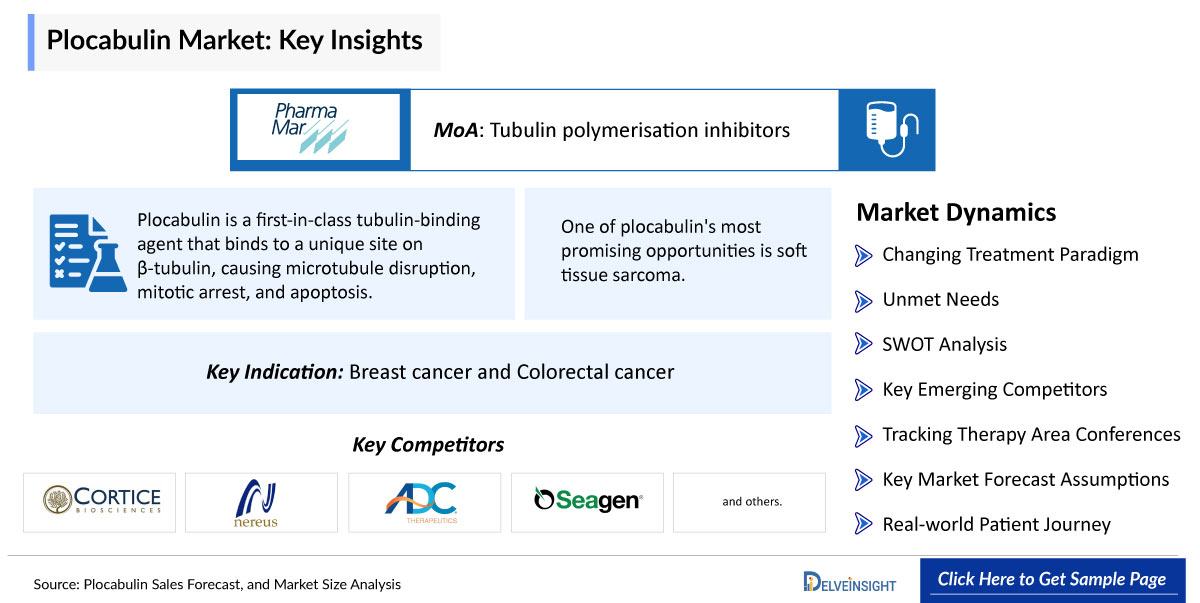
Plocabulin is a first-in-class tubulin-binding agent that binds to a unique site on β-tubulin, causing microtubule disruption, mitotic arrest, and apoptosis. In addition to direct cytotoxicity, it exhibits vascular-disrupting and anti-angiogenic activity, reducing tumor blood supply. This dual mechanism differentiates it from conventional microtubule inhibitors such as taxanes and vinca alkaloids and may provide activity in tumors resistant to existing chemotherapies. Preclinical studies demonstrated potent antitumor activity across colorectal cancer, gastrointestinal stromal tumors (GIST), ovarian cancer, and multiple soft tissue sarcoma models.
3. Encouraging Early Clinical Activity Supports Further Development
In the first-in-human Phase I trial involving 44 patients with advanced solid tumors, plocabulin demonstrated a clinical benefit rate of approximately 33%, including partial responses in heavily pretreated patients with non-small cell lung cancer and cervical cancer. In the completed Phase II study in heavily pretreated metastatic colorectal cancer (NCT03427268), the 3-month progression-free survival (PFS) rate was 20.7%, providing proof-of-concept activity in a refractory patient population. These findings support continued exploration of optimized dosing schedules and combination regimens.
4. Strong Preclinical Evidence in Soft Tissue Sarcoma
One of plocabulin's most promising opportunities is soft tissue sarcoma. Patient-derived xenograft (PDX) studies published in the International Journal of Molecular Sciences demonstrated tumor regression or durable tumor stabilization across multiple sarcoma subtypes, including leiomyosarcoma, dedifferentiated liposarcoma, undifferentiated sarcoma, intimal sarcoma, and CIC-rearranged sarcoma. Importantly, plocabulin produced significant tumor shrinkage in several models where doxorubicin showed minimal activity, supporting its potential as a differentiated therapy in rare sarcoma indications.
5. Potential for Combination Therapy Expands Commercial Opportunity
Plocabulin is also being evaluated in combination with gemcitabine and other cytotoxic agents to enhance efficacy while optimizing tolerability. Its complementary mechanism may allow integration into combination regimens for multiple solid tumors, broadening its commercial potential beyond monotherapy. Continued investigation of rational combinations could improve clinical outcomes and expand future indications if ongoing studies demonstrate favorable efficacy and safety.
Plocabulin Recent Developments
A 2024 Phase I safety and efficacy trial of plocabulin plus gemcitabine in advanced solid tumors reported a 13% overall response rate (1 CR, 5 PR) and durable stable disease (≥4 months) in multiple tumor types, with progression‑free survival exceeding prior time‑to‑progression in patients deriving clinical benefit.
“Plocabulin Sales Forecast, and Market Size Analysis – 2034” report provides comprehensive insights of Plocabulin for potential indication like Breast cancer and Colorectal cancer in the 7MM. A detailed picture of Plocabulin’s existing usage in anticipated entry and performance in potential indications in the 7MM, i.e., the United States, EU4 (Germany, France, Italy, and Spain) and the United Kingdom, and Japan for the study period 2020 –2034 is provided in this report along with a detailed description of the Plocabulin for potential indications. The Plocabulin market report provides insights about Plocabulin’s sales forecast, mechanism of action (MoA), dosage and administration, as well as research and development including regulatory milestones, along with other developmental activities. Further, it also consists of historical and current Plocabulin performance, future market assessments inclusive of the Plocabulin market forecast analysis for potential indications in the 7MM, SWOT, analysts’ views, comprehensive overview of market competitors, and brief about other emerging therapies in respective indications. It also provides analysis of Plocabulin sales forecasts, along with factors driving its market.
Plocabulin Drug Summary
Plocabulin is an investigational, intravenously administered microtubule-binding antineoplastic agent originally isolated from the marine sponge Lithoplocamia lithistoides and developed by PharmaMar for the treatment of advanced solid tumors. The compound binds with high affinity to the plus end of β-tubulin, inhibiting microtubule polymerization and dynamics, which disrupts mitotic spindle formation, induces G2/M cell-cycle arrest, and triggers apoptotic cell death in rapidly proliferating cancer cells. In addition to its direct cytotoxic activity, plocabulin exhibits potent vascular-disrupting effects, leading to collapse of tumor blood vessels and enhanced antitumor efficacy in preclinical models. Early-phase clinical studies have demonstrated manageable safety, dose-dependent pharmacokinetics, and preliminary antitumor activity across several refractory malignancies, including gastrointestinal and other advanced solid tumors. Plocabulin is not approved for any indication and remains under clinical investigation as a potential anticancer therapy, either as monotherapy or in combination with other anticancer agents, with ongoing research focused on optimizing its therapeutic window and identifying tumor types most likely to benefit from its unique mechanism of action. The report provides Plocabulin’s sales, growth barriers and drivers, post usage and approvals in multiple indications.
Scope of the Plocabulin Market Report
The report provides insights into:
- A comprehensive product overview including the Plocabulin MoA, description, dosage and administration, research and development activities in potential indication like Breast cancer and Colorectal cancer.
- Elaborated details on Plocabulin regulatory milestones and other development activities have been provided in Plocabulin market report.
- The report also highlights Plocabulin‘s cost estimates and regional variations, reported and estimated sales performance, research and development activities in potential indications across the United States, Europe, and Japan.
- The Plocabulin market report also covers the patents information, generic entry and impact on cost cut.
- The Plocabulin market report contains current and forecasted Plocabulin sales for potential indications till 2034.
- Comprehensive coverage of the late-stage emerging therapies for respective indications.
- The Plocabulin market report also features the SWOT analysis with analyst views for Plocabulin in potential indications.
Methodology
The Plocabulin market report is built using data and information sourced primarily from internal databases, primary and secondary research and in-house analysis by DelveInsight’s team of industry experts. Information and data from the secondary sources have been obtained from various printable and nonprintable sources like search engines, news websites, global regulatory authorities websites, trade journals, white papers, magazines, books, trade associations, industry associations, industry portals and access to available databases.
Plocabulin Analytical Perspective by DelveInsight
- In-depth Plocabulin Market Assessment
This Plocabulin sales market forecast report provides a detailed market assessment of Plocabulin for potential indication like Breast cancer and Colorectal cancer in the seven major markets, i.e., the United States, EU4 (Germany, France, Italy, and Spain) and the United Kingdom, and Japan. This segment of the report provides current and forecasted Plocabulin sales data uptil 2034.
- Plocabulin Clinical Assessment
The Plocabulin market report provides the clinical trials information of Plocabulin for potential indications covering trial interventions, trial conditions, trial status, start and completion dates.
Plocabulin Competitive Landscape
The report provides Insights on competitors and marketed products within the domain, along with a summary of emerging products and their respective launch dates, posing significant competition in the market.
Plocabulin Market Potential & Revenue Forecast
- Projected market size for the Plocabulin and its key indications
- Estimated Plocabulin sales potential (Plocabulin peak sales forecasts)
- Plocabulin Pricing strategies and reimbursement landscape
Plocabulin Competitive Intelligence
- Number of competing drugs in development (pipeline analysis)
- Plocabulin Market positioning compared to existing treatments
- Plocabulin Strengths & weaknesses relative to competitors
Plocabulin Regulatory & Commercial Milestones
- Plocabulin Key regulatory approvals & expected launch timelines
- Commercial partnerships, licensing deals, and M&A activity
Plocabulin Clinical Differentiation
- Plocabulin Efficacy & safety advantages over existing drugs
- Plocabulin Unique selling points
Plocabulin Market Report Highlights
- In the coming years, the Plocabulin market scenario is set to change due to strong adoption, increased prescriptions and broader uptake in multiple immunological indications; which would expand the size of the market.
- The Plocabulin companies are developing therapies that focus on novel approaches to treat/improve the disease condition, assess challenges, and seek opportunities that could influence Plocabulin’s dominance.
- Other emerging products for Breast cancer and Colorectal cancer are expected to give tough market competition to Plocabulin and launch of late-stage emerging therapies in the near future will significantly impact the market.
- A detailed description of regulatory milestones, and developmental activities, provide the current development scenario of Plocabulin in potential indications.
- Analyse Plocabulin cost, pricing trends and market positioning to support strategic decision-making in the immunology landscape.
- Our in-depth analysis of the forecasted Plocabulin sales data uptil 2034 will support the clients in decision-making process regarding their therapeutic portfolio by identifying the overall scenario of Plocabulin in potential indications.
Key Questions
- What is the class of therapy, route of administration and mechanism of action of Plocabulin? How strong is Plocabulin’s clinical and commercial performance?
- What is Plocabulin’s clinical trial status in each individual indications such as Breast cancer and Colorectal cancer and study completion date?
- What are the key collaborations, mergers and acquisitions, licensing and other activities related to the Plocabulin Manufacturers?
- What are the key designations that have been granted to Plocabulin for potential indications? How are they going to impact Plocabulin’s penetration in various geographies?
- What is the current and forecasted Plocabulin market scenario for potential indications? What are the key assumptions behind the forecast?
- What are the current and forecasted sales of Plocabulin in the seven major countries, including the United States, Europe (Germany, France, Italy, Spain) and the United Kingdom, and Japan?
- What are the other emerging products available and how are these giving competition to Plocabulin for potential indications?
- Which are the late-stage emerging therapies under development for the treatment of potential indications?
- How cost-effective is Plocabulin? What is the duration of therapy and what are the geographical variations in cost per patient?

