Pompe Disease Market Summary
- The Pompe Disease Therapeutics Market is expanding steadily, driven by increasing disease awareness, advancements in early newborn screening, and the development of novel enzyme replacement therapies (ERTs) and gene-targeted treatments.
- The leading Pompe Disease Companies include Genzyme, Sanofi, Amicus Therapeutics, Actus Therapeutics, Valerion Therapeutics, Astellas Therapeutics, Roche, Lacerta Therapeutics, and others.
Pompe Disease Market & Epidemiology Insights
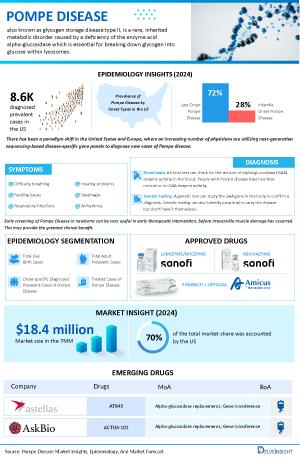
- Pompe disease, also known as glycogen storage disease type II, is a rare, inherited metabolic disorder caused by a deficiency of the enzyme acid alpha-glucosidase which is essential for breaking down glycogen into glucose within lysosomes. Without adequate enzyme activity, glycogen accumulates in various tissues, particularly in muscle cells, leading to progressive damage.
- In 2023, around 8.600 prevalent cases Pompe disease were diagnosed Pompe disease were reported in the United States out of which 98% cases were recorded in adult patients.
- Significant number of Pompe disease cases are infantile-onset, leading to high mortality within the first few months due to severe muscle weakness, poor muscle tone, and respiratory difficulties. This rapid progression can cause significant psychological distress for parents.
- In 2023, the incidence of the CRIM-positive phenotype in infantile-onset Pompe disease was notably higher in the United States, reaching approximately 80%. The CRIM-positive phenotype is characterized by the presence of residual enzyme activity, which can influence the disease's progression and response to treatment.
- The US FDA has approved several enzyme replacement therapies for different forms of Pompe disease, including MYOZYME (alglucosidase alfa) and LUMIZYME (alglucosidase alfa) by Genzyme/Sanofi, as well as POMBILITI (cipaglucosidase alfa-atga) by Amicus Therapeutics, among others.
- The Pompe disease Pipeline remains relatively limited, with only a few companies advancing their candidates through different stages of Pompe disease clinical trials. Notable candidates include AAV2/8-LSPhGAA (ACTUS-101) by Asklepios Biopharmaceutical, currently in Phase I/II, and Avalglucosidase alfa by Sanofi, now in Phase III. The rarity of Pompe disease presents challenges in patient recruitment for pompe disease clinical trials, which in turn slows the progress of developing new treatment options.
Request to unlock the sample page of the "Pompe Disease Treatment Market"
Key Factors Driving the Growth of the Pompe Disease Market
-
Rising Disease Awareness and Diagnosis
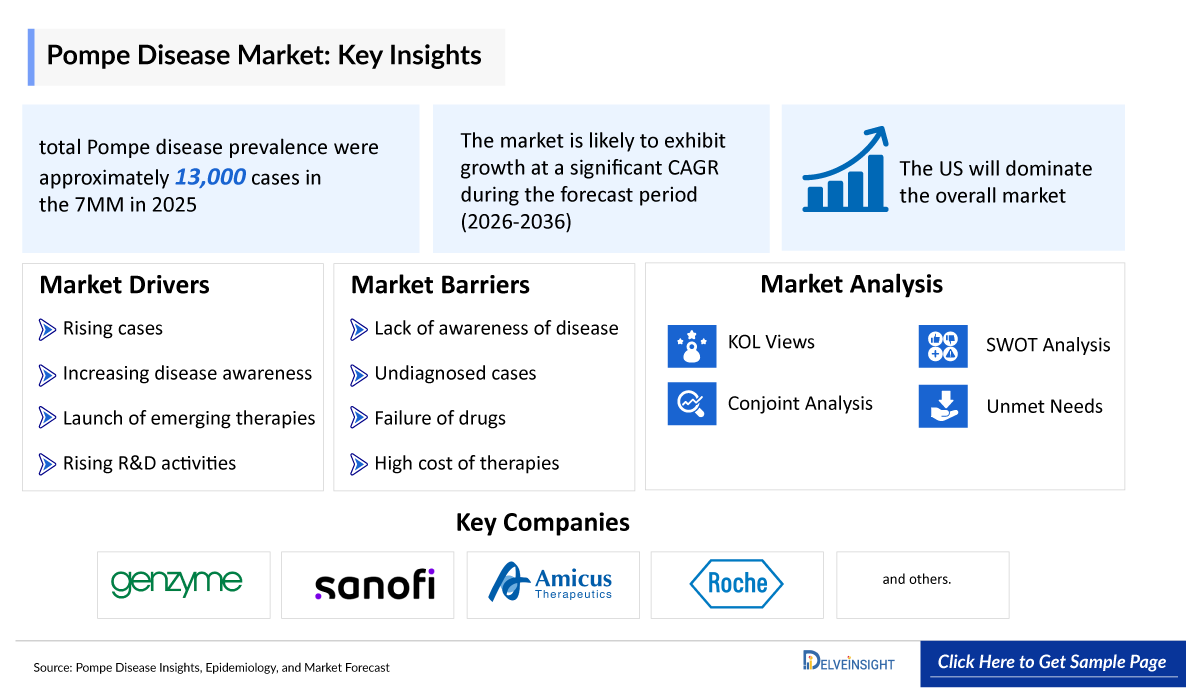
Growing awareness of Pompe disease among healthcare professionals and patients is improving disease recognition and diagnosis, supporting earlier treatment initiation.
-
Advancements in Enzyme Replacement Therapy
Continued development and adoption of enzyme replacement therapies (ERTs) are driving market growth by providing established treatment options for patients with Pompe disease.
-
Emergence of Next-Generation Therapies
Increasing research into improved ERTs, gene therapies, substrate reduction therapies, and other novel approaches is expanding the Pompe disease treatment landscape.
-
Growing Investment in Rare Disease Research
Pharmaceutical and biotechnology companies are increasing investments in rare disease drug development, clinical research, and innovative therapeutic platforms targeting Pompe disease.
-
Improved Newborn Screening and Diagnostic Technologies
Expansion of newborn screening programs and advancements in genetic and biomarker-based testing are facilitating earlier identification of affected individuals and potentially expanding the diagnosed patient pool.
DelveInsight's “Pompe disease Market Insights, Epidemiology and Market Forecast – 2036” report delivers an in-depth understanding of the indication Pompe disease, historical and forecasted epidemiology as well as the Pompe disease market trends in the United States, EU4 (Germany, Spain, Italy, and France) and the United Kingdom, and Japan.
The Pompe disease treatment market report provides real-world prescription pattern analysis, approved pompe disease drugs, pompe disease market share of individual therapies, and historical and forecasted 7MM Pompe disease market size from 2022 to 2036. The pompe disease treatment market report also covers current Pompe disease treatment practices/algorithms and unmet medical needs to curate the best opportunities and assess the market’s underlying potential.
Scope of the Pompe Disease Market Report | |
| Study Period | 2022-2036 |
| Forecast Period | 2026-2036 |
| Geographies Covered |
|
| Pompe Disease Epidemiology |
Segmented by:
|
| Pompe Disease Companies |
|
| Pompe Disease Therapies |
|
| Pompe Disease Market |
Segmented By:
|
| Pompe Disease Market Analysis |
|
Pompe disease Understanding
Pompe disease Overview
Pompe disease is a rare, inherited metabolic disorder caused by mutations in the GAA gene, leading to a deficiency in the enzyme acid alpha-glucosidase. This enzyme is responsible for breaking down glycogen into glucose within the lysosomes.
The buildup of glycogen in cells, particularly in muscles, results in progressive muscle weakness, respiratory difficulties, and other severe complications. Pompe disease manifests in two primary forms: infantile-onset, which presents within the first few months of life and often leads to early mortality if untreated, and late-onset, which can develop anytime from childhood to adulthood with a slower progression.
Pompe Disease Diagnosis
Pompe Disease Diagnosis typically involves enzyme assays to measure acid alpha-glucosidase activity in blood or muscle tissue, genetic testing to confirm GAA mutations, and muscle biopsies. Early diagnosis is crucial to managing the disease effectively, especially for the infantile-onset form.
Further details related to country-based variations in diagnosis are provided in the report
Pompe disease Treatment
Treatment for Pompe disease primarily involves enzyme replacement therapy (ERT), which helps replenish the deficient enzyme. MYOZYME and LUMIZYME (both alglucosidase alfa) by Sanofi/Genzyme have been the standard treatments for years. More recently, Amicus Therapeutics' POMBILITI (cipaglucosidase alfa-atga) was approved as an alternative ERT. Researchers are also exploring gene therapy approaches, such as AAV2/8-LSPhGAA by Asklepios Biopharmaceutical, as potential future treatments.
Supportive care is also vital and typically includes respiratory management, physical therapy, and nutritional support to address muscle weakness and respiratory difficulties, common symptoms of Pompe disease. These interventions help maintain mobility, improve breathing, and manage complications.
Pompe disease Epidemiology Insights in the 7MM
The Pompe disease epidemiology chapter in the report provides historical as well as forecasted Pompe Disease Prevalence in the 7MM covering the United States, EU4 countries (Germany, France, Italy, and Spain), the United Kingdom, and Japan from 2026 to 2036. The Pompe disease epidemiology is segmented with detailed insights into:
Key findings from the Pompe Disease Epidemiology Analysis
- As per DelveInsight's estimates, in the year 2023, the total Pompe disease Prevalence was ~13,000 cases in the 7MM, which might rise by 2036 at a CAGR of XX%.
- EU4 and the UK, accounted for approximately 25% of the total prevalent cases of Pompe disease in the year 2023.
- In 2023, around 8.600 prevalent cases Pompe disease were diagnosed Pompe disease were reported in the United States out of which 98% cases were recorded in adult patients.
- Significant number of Pompe disease cases are infantile-onset, leading to high mortality within the first few months due to severe muscle weakness, poor muscle tone, and respiratory difficulties. This rapid progression can cause significant psychological distress for parents.
- In 2023, the incidence of the CRIM-positive phenotype in infantile-onset Pompe disease was notably higher in the United States, reaching approximately 80%. The CRIM-positive phenotype is characterized by the presence of residual enzyme activity, which can influence the disease's progression and response to treatment.
Key Findings from the Pompe Disease Epidemiological Analysis
- Total Live Birth Cases of Pompe Disease
- Total Adult Prevalent Cases of Pompe Disease
- Total Prevalent Cases of Pompe Disease
- Prevalence of Pompe Disease by Onset Types
- Incidence of IOPD based on Clinical Phenotype
Pompe Disease Market Recent Breakthroughs and Developments
- BioMarin presented positive 5-year Phase 3 data for Pombiliti (cipaglucosidase alfa-atga) combined with Opfolda (miglustat) in late-onset Pompe disease (LOPD), showing durable motor function and stabilization of pulmonary outcomes.
- In February 2025, Aro Biotherapeutics announced that it has received FDA clearance for the Investigational New Drug Application (IND) for ABX1100. This novel therapy is currently being investigated in a Phase 1 study for late-onset Pompe disease (LOPD) patients.
Pompe Disease Drug Analysis
The drug chapter segment of the Pompe disease Therapeutics Market Report includes a detailed analysis of Pompe disease emerging and approved candidates. It also deep dives into the pivotal Pompe disease clinical trial details, recent and expected market approvals, patent details, the latest news, and recent deals and collaborations.
Approved Pompe Disease Drugs
-
MYOZYME (alglucosidase alfa): Genzyme/ Sanofi
Alglucosidase alfa is a recombinant form of human acid α-glucosidase and is produced in Chinese hamster ovary cells (CHO) by recombinant DNA technology. MYOZYME will restore lysosomal GAA activity resulting in stabilisation or restoration of cardiac and skeletal muscle function (including respiratory muscles). Due to the blood-brain barrier effect and the enzyme’s size, uptake of alglucosidase alfa in the central nervous system is unlikely.
The US Food and Drug Administration (FDA) approved MYOZYME (alglucosidase alfa) in 2006, for the treatment of infantile-onset Pompe disease (IOPD). The European Medicines Agency also approved the drug at the same time.
-
LUMIZYME (alglucosidase alfa): Genzyme/ Sanofi
Alglucosidase alfa provides an exogenous source of GAA. Binding to mannose-6-phosphate receptors on the cell surface has been shown to occur via carbohydrate groups on the GAA molecule, after which it is internalized and transported into lysosomes, where it undergoes proteolytic cleavage that results in increased enzymatic activity. It then exerts enzymatic activity in cleaving glycogen.
The Food and Drug Administration (FDA) approved Lumizyme (alglucosidase alfa) in 2010, for use in people over eight years old with late-onset Pompe disease (LOPD).
Emerging Pompe Disease Drugs
-
AAV2/8-LSPhGAA (ACTUS-101): Asklepios Biopharmaceutical
ACTUS-101 is an AAV Gene Therapy that aims to address the deficiency of acid-alpha-glucosidase (GAA) in patients with Pompe disease. GAA deficiency leads to deleterious progressive accumulation of glycogen in organs and tissues, especially skeletal and cardiac muscle, leading to high morbidity and premature death. The current standard of care for patients with Pompe is enzyme replacement therapy (ERT).
-
Avalglucosidase alfa: Sanofi
Avalglucosidase alfa, also known as Nexviazyme, is an enzyme replacement therapy (ERT) developed by Sanofi Genzyme to treat patients with late-onset Pompe disease (LOPD) or GAA deficiency. It's a recombinant form of acid alpha-glucosidase (GAA), a human enzyme that helps the body digest and absorb glycogen. Pompe disease is a genetic condition that occurs when GAA is deficient, causing a buildup of glycogen in the body's cells.
Further details about emerging pompe disease drugs will be provided in the report.
Pompe Disease Market Outlook
In 2023, the total Pompe disease therapeutics market across the 7MM reached USD 18.4 million, with the US capturing about 70% of the Pompe disease treatment market. The US market significantly outpaced the EU4 (Germany, Spain, Italy, France), the UK, and Japan.
Key findings from the Pompe Disease Market Forecast Report
- The United States represents the largest share of the Pompe disease treatment market, accounting for a significant proportion compared to the EU4 (Germany, Spain, Italy, France), the United Kingdom, and Japan.
- Among EU4 and the UK, Germany had the largest Pompe Disease treatment market size, accounting for ~USD 94 million, followed by France, with XX having the smallest market size in 2023.
- Asklepios Biopharmaceutical is developing AAV2/8-LSPhGAA, a gene therapy candidate aimed at treating Pompe disease by delivering the GAA gene to restore enzyme function. Alongside Avalglucosidase alfa by Sanofi, which represents the next generation of enzyme replacement therapy, these candidates hold potential to address unmet needs in Pompe disease treatment. While early-stage results for AAV2/8-LSPhGAA show promise, pivotal trials will be essential to confirm its safety and efficacy in humans.
Pompe Disease Drug Uptake
This section focuses on the uptake rate of potential Pompe disease drugs expected to be launched in the market during 2026–2036, which depends on the competitive landscape, safety, and efficacy data along with order of entry. It is important to understand that the key players evaluating their novel pompe disease therapies in the pivotal and confirmatory trials should remain vigilant when selecting appropriate comparators to stand the greatest chance of a positive opinion from regulatory bodies, leading to approval, smooth launch, and rapid uptake.
Pompe Disease Clinical Trials Activities
This section provides insights into different therapeutic candidates. It also analyzes key players involved in developing targeted therapeutics.
Pompe Disease Pipeline Development Activities
This section covers information on collaborations, acquisitions and mergers, licensing, and patent details for emerging pompe disease therapies.
Latest KOL Views on Pompe Disease
To keep up with the real-world scenario in current market trends, we take opinions from Key Industry leaders working in the domain through primary research to fill the data gaps and validate our secondary research. Industry Experts were contacted for insights on the evolving treatment landscape, patient reliance on conventional pompe disease therapies, patient therapy switching acceptability, and drug uptake along with challenges related to accessibility.
DelveInsight’s analysts connected with 10+ KOLs to gather insights; however, interviews were conducted with 5+ KOLs in the 7MM. Their opinion helps understand and validate current treatment patterns of Pompe disease. This will support the clients in potential upcoming novel treatments by identifying the overall scenario of the market and the unmet needs.
Pompe Disease Report Qualitative Analysis
We perform Qualitative and Pompe Disease Therapeutics Market Intelligence analysis using various approaches, such as SWOT analysis and Conjoint Analysis. In the SWOT analysis, strengths, weaknesses, opportunities, and threats in terms of gaps in disease diagnosis, patient awareness, physician acceptability, competitive landscape, cost-effectiveness, and geographical accessibility of pompe disease therapies are provided.
Conjoint Analysis analyzes multiple approved Pompe disease therapies based on relevant attributes such as safety, efficacy, frequency of administration, route of administration, and order of entry. Scoring is given based on these parameters to analyze the effectiveness of therapy.
In efficacy, the trial’s primary and secondary outcome measures are evaluated; for instance, in event-free survival, one of the most important primary outcome measures is event-free survival and overall survival.
Further, the therapies’ safety is evaluated wherein the acceptability, tolerability, and adverse events are majorly observed, and it sets a clear understanding of the side effects posed by the drug in the trials. In addition, the scoring is also based on the probability of success, and the addressable patient pool for each therapy.
Pompe Disease Market Access and Reimbursement
The section provides detailed insights on the country-wise accessibility and reimbursement scenarios, cost-effectiveness scenario of currently used pompe disease therapies, programs making accessibility easier and out-of-pocket costs more affordable, insights on patients insured under federal or state government prescription drug programs, etc.
Scope of the Pompe Disease Report
- The Pompe Disease Therapeutics Market Report covers a segment of key events, an executive summary, descriptive overview, explaining its causes, signs and symptoms, pathogenesis, and currently available therapies.
- Comprehensive insight has been provided into the epidemiology segments and forecasts, the future growth potential of diagnosis rate, and disease progression along with country specific treatment guidelines.
- Additionally, an all-inclusive account of the current Pompe disease Therapies, along with the elaborative profiles of late-stage and prominent pompe disease drugs, will have an impact on the current Pompe Disease Treatment landscape.
- A detailed review of the Pompe Disease Treatment Market, historical and forecasted Pompe Disease Market Size, Pompe Disease Drugs Market Share by therapies, detailed assumptions, and rationale behind our approach is included in the report, covering the 7MM drug outreach.
- The Pompe Disease Therapeutics Market Report provides an edge while developing business strategies, by understanding trends, through SWOT analysis and expert insights/KOL views, patient journey, and treatment preferences that help in shaping and driving the 7MM Pompe disease.
Pompe disease Market Report Insights
- Pompe Disease Patient Population
- Therapeutic Approaches
- Pompe disease Pipeline Analysis
- Pompe disease Market Size and Trends
- Existing and future Market Opportunity
Pompe disease Market Report Key Strengths
- 11 Years Pompe Disease Market Forecast
- 7MM Coverage
- Pompe disease Epidemiology Segmentation
- Inclusion of Country specific treatment guidelines
- KOL’s feedback on approved therapies
- Key Cross Competition
- Conjoint analysis
- Drugs Uptake and Key Pompe Disease Market Forecast Assumptions
Pompe disease Market Report Assessment
- Current Pompe Disease Treatment Practices
- Pompe Disease Unmet Needs
- Pompe Disease Pipeline Drugs Profiles
- Pompe Disease Therapeutics Market Attractiveness
- Qualitative Analysis (SWOT and Conjoint Analysis)
Key Questions Answered in the Pompe Disease Treatment Market Report
- What is the growth rate of the 7MM Pompe disease treatment market?
- What was the Pompe disease total market size, the market size by therapies, market share (%) distribution in 2022, and what would it look like in 2036? What are the contributing factors/key catalysts for this growth?
- Is there any unexplored patient setting that can open the window for growth in the future?
- What are the pricing variations among different geographies for approved and off-label therapies?
- How would the market drivers, barriers, and future opportunities affect the market dynamics and subsequent analysis of the associated trends?
- What are the current options for the treatment of Pompe disease?
- What are the recent novel therapies, targets, Pompe disease mechanisms of action, and technologies developed to overcome the limitations of existing therapies?
- Patient acceptability in terms of preferred treatment options as per real-world scenarios?
- What are the country-specific accessibility issues of expensive, recently approved therapies?
Reasons to Buy the Pompe Disease Therapeutics Market Report
- The Pompe Disease Therapeutics Market Report will help in developing business strategies by understanding the latest trends and changing treatment dynamics driving the Pompe disease Drugs Market.
- Insights on patient burden/disease, Pompe Disease Prevalence, evolution in diagnosis, and factors contributing to the change in the epidemiology of the disease during the forecast years
- Understand the existing Pompe Disease Drugs Market opportunities in varying geographies and the growth potential over the coming years.
- Distribution of historical and current patient share based on real-world prescription data along with reported sales of approved products in the US, EU4 (Germany, France, Italy, and Spain), the United Kingdom, and Japan.
- Detailed analysis and ranking of class-wise potential current therapies under the conjoint analysis section to provide visibility around leading classes.
- Highlights of access and reimbursement policies of approved therapies, barriers to accessibility of expensive off-label therapies, and patient assistance programs.
- To understand Key Opinion Leaders’ perspectives around the accessibility, acceptability, and compliance-related challenges of existing treatment to overcome barriers in the future.
- Detailed insights on the unmet needs of the existing Pompe Disease Drugs Market so that the upcoming players can strengthen their development and launch strategy.
Stay updated with us for Recent Articles
- 5 Promising Pompe Disease Drugs in Early-stage Development
- Transforming Pompe Disease Care: Latest Innovations and Strategic Advances in Treatment
- The Transforming Pompe Disease Treatment Landscape in Emerging Markets
- Pompe Disease Treatment Landscape
- Pompe Disease: Causes, Symptoms, Diagnosis, Pathology, Currently Marketed and Emerging Drugs in the Pipeline
- Navigating Challenges in Pompe Disease Treatment and Research in Eastern Europe
- Advances in Pompe Disease Treatment: From ERT to New Therapies
- Pompe Disease Market Infographics
- Pompe Disease Newsletter
- New DelveInsight Blogs