
Postoperative Pain Management Pipeline Summary
- The Postoperative Pain Management Pipeline is advancing rapidly, with several biopharmaceutical companies developing innovative therapies aimed at improving disease control, reducing symptom burden, and addressing unmet patient needs.
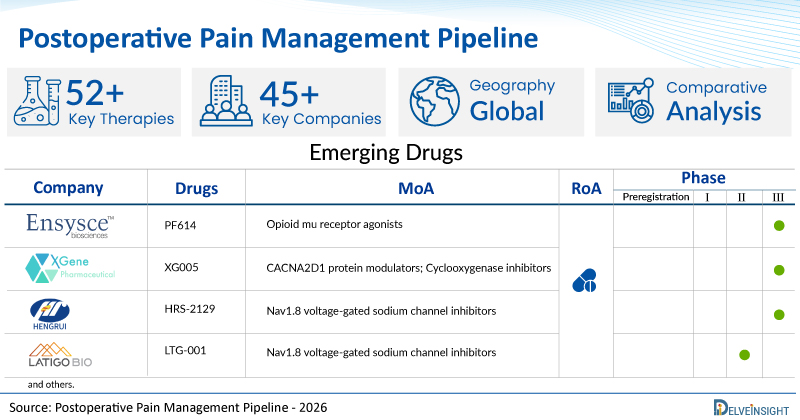
- The leading Postoperative Pain Management Companies include Viatris, Ensysce Biosciences, TLC Biopharmaceuticals, Inc., Xgene Pharmaceutical Group, Shandong Suncadia Medicine Co., Ltd., Allay Therapeutics, Inc., Bausch & Lomb Incorporated, Shanghai Yidian Pharmaceutical Technology Development Co., Ltd., Rebel Medicine Inc., Beijing Tide Pharmaceutical, Latigo Biotherapeutics, Cullgen Inc., and others.
Request for Unlocking the Sample Page of the "Postoperative Pain Management Pipeline"
Key Factors Driving the Growth of the Postoperative Pain Management Pipeline
-
Rising Number of Surgical Procedures
The increasing volume of surgical procedures worldwide is a major factor driving demand for postoperative pain management. Growth in orthopedic, cardiovascular, abdominal, gynecological, and minimally invasive surgeries is expanding the patient population requiring effective pain control.
-
Growing Prevalence of Chronic Diseases
The rising burden of cancer, cardiovascular disorders, musculoskeletal conditions, and other chronic diseases is contributing to increased surgical interventions. As more patients undergo surgery, the need for effective postoperative pain management is also increasing.
-
Increasing Adoption of Minimally Invasive Surgeries
The growing preference for minimally invasive and outpatient procedures is encouraging the use of targeted pain management approaches that can support faster recovery, earlier mobilization, and shorter hospital stays.
-
Growing Awareness of Multimodal Pain Management
Healthcare providers are increasingly adopting multimodal pain management strategies that combine different analgesic mechanisms to improve pain control while reducing reliance on individual medications, particularly opioids.
-
Increasing Concerns about Opioid-Related Risks
Concerns surrounding opioid dependence, misuse, tolerance, and adverse effects are encouraging the development and adoption of non-opioid and opioid-sparing alternatives. This is creating opportunities for innovative postoperative analgesics and drug-delivery technologies.
-
Development of Novel Non-Opioid Therapies
Pharmaceutical companies are investing in novel non-opioid analgesics, local anesthetics, extended-release formulations, and other therapies designed to provide effective and sustained postoperative pain relief with fewer opioid-related complications.
-
Advancements in Regional Anesthesia
Innovations in nerve blocks, local anesthetic formulations, and regional anesthesia techniques are improving postoperative pain control. These approaches can provide targeted analgesia while potentially reducing systemic medication use.
-
Increasing Demand for Extended-Release Pain Therapies
Long-acting and extended-release formulations are gaining attention because they can provide sustained pain relief following surgery and reduce the need for frequent dosing. Improved dosing convenience may also support patient adherence and recovery.
-
Growing Focus on Enhanced Recovery After Surgery
Enhanced Recovery After Surgery (ERAS) protocols emphasize effective pain control, early mobilization, reduced opioid use, and shorter hospital stays. Increasing adoption of these protocols is supporting demand for modern postoperative pain management solutions.
"DelveInsight’s “Postoperative Pain Management Pipeline Insight, 2026” report provides comprehensive insights about 45+ companies and 52+ pipeline drugs in the Postoperative Pain Management pipeline landscape. It covers the Postoperative Pain Management Pipeline drug profiles, including clinical and nonclinical stage products. It also covers the therapeutics assessment by product type, stage, route of administration, and molecule type. It further highlights the inactive pipeline products in this space.
Geography Covered
- Global coverage
Postoperative Pain Management Understanding
Postoperative Pain Management Overview
Postoperative pain management refers to the prevention, assessment, and treatment of pain following a surgical procedure. Effective pain control is essential because uncontrolled postoperative pain can delay recovery, impair mobility, increase hospital stays, reduce patient satisfaction, and increase the risk of developing chronic pain. Modern postoperative pain management aims not only to relieve pain but also to facilitate early recovery and improve overall surgical outcomes.
Postoperative pain occurs as a result of tissue injury caused by surgery, which activates nociceptors and inflammatory pathways. Surgical trauma leads to the release of inflammatory mediators such as prostaglandins, cytokines, and other chemical signals that sensitize peripheral nerves and amplify pain perception. Depending on the type and extent of surgery, pain may be nociceptive, inflammatory, or neuropathic. If inadequately treated, acute postoperative pain can contribute to central sensitization and the development of persistent postsurgical pain syndromes.
Accurate pain assessment is a critical component of postoperative care. Healthcare providers commonly use validated pain scales such as the Visual Analog Scale (VAS), Numeric Rating Scale (NRS), and Wong-Baker FACES Scale to evaluate pain intensity. The primary goals of postoperative pain management are to minimize patient discomfort, promote early mobilization, facilitate participation in rehabilitation activities, reduce complications, and improve overall quality of recovery.
Individual patient factors, including age, comorbidities, psychological status, and type of surgery, are considered when developing a pain management plan.
Current postoperative pain management relies on a multimodal analgesia approach, which combines different medications and techniques to target multiple pain pathways while minimizing opioid use. Common Postoperative Pain Management Treatments include opioids, nonsteroidal anti-inflammatory drugs (NSAIDs), acetaminophen, local anesthetics, regional nerve blocks, epidural analgesia, gabapentinoids, ketamine, and non-pharmacological interventions such as physical therapy and cognitive strategies. Multimodal pain control has been shown to improve analgesia, reduce opioid requirements, and decrease treatment-related adverse effects.
Despite advances in analgesic techniques, postoperative pain remains undertreated in many patients. Inadequate pain control can result in impaired sleep, delayed wound healing, reduced physical activity, increased risk of postoperative complications, and progression to chronic pain.
At the same time, excessive reliance on opioids may lead to adverse effects such as respiratory depression, nausea, constipation, sedation, and potential opioid dependence. Therefore, individualized and multidisciplinary pain management strategies are recommended to optimize pain relief while minimizing treatment-related risks.
"Postoperative Pain Management Pipeline Insight, 2026 " report by DelveInsight outlays comprehensive insights of present scenario and growth prospects across the indication. A detailed picture of the Postoperative Pain Management pipeline landscape is provided which includes the disease overview and Postoperative Pain Management treatment guidelines. The assessment part of the report embraces, in depth Postoperative Pain Management commercial assessment and clinical assessment of the pipeline products under development.
In the Postoperative Pain Management Pipeline Report, detailed description of the drug is given which includes mechanism of action of the drug, clinical studies, NDA approvals (if any), and product development activities comprising the technology, Postoperative Pain Management collaborations, licensing, mergers and acquisition, funding, designations and other product related details.
Explore More Insights to the Market Report @ Postoperative Pain Management Treatment Market Size
Postoperative Pain Management Pipeline Report Highlights
- The Postoperative Pain Management Companies and academics are working to assess challenges and seek opportunities that could influence Postoperative Pain Management R&D. The Postoperative Pain Management Therapies under development are focused on novel approaches to treat/improve Postoperative Pain Management.
Postoperative Pain Management Emerging Drugs Chapters
This segment of the Postoperative Pain Management Pipeline Report encloses its detailed analysis of various drugs in different stages of clinical development, including phase II, I, preclinical and Discovery. It also helps to understand clinical trial details, expressive pharmacological action, agreements and collaborations, and the latest Postoperative Pain Management news and press releases.
Postoperative Pain Management Emerging Drugs
-
TLC590: TLC Biopharmaceuticals, Inc.
TLC590 is an investigational non-opioid, sustained-release liposomal formulation of ropivacaine for the management of post-operative pain. The drug utilizes the company’s proprietary BioSeizer® technology to prolong the retention of ropivacaine at the surgical site, creating a local drug depot that provides rapid onset and extended analgesia while reducing systemic exposure.
Its mechanism of action is based on the local anesthetic activity of ropivacaine, which blocks voltage-gated sodium channels in peripheral nerves, thereby preventing pain signal transmission. The liposomal formulation is designed to extend pain relief for several days following surgery and potentially reduce opioid use. Currently, the drug is being evaluated in the Phase III stage of its development for the treatment of Postoperative Pain Management.
-
TRD205: Beijing Tide Pharmaceutical Co., Ltd.
TRD205 is a first-in-class, orally administered small-molecule analgesic being developed for postoperative pain and chronic post-surgical neuropathic pain. The drug is a highly selective angiotensin II type 2 receptor (AT2R) antagonist. Its mechanism of action involves blocking AT2R-mediated pain sensitization pathways that become activated after peripheral nerve injury, thereby reducing pain signaling without acting on opioid receptors and potentially avoiding opioid-associated adverse effects and dependence risks.
Currently, the drug is being evaluated in the Phase II stage of its development for the treatment of Postoperative Pain Management.
-
CG001419: Gyre Therapeutics
CG001419 is a first-in-class oral pan-TRK (tropomyosin receptor kinase) protein degrader being developed as a non-opioid, non-NSAID analgesic for acute and chronic pain, including acute post-operative pain. The drug is a small-molecule targeted protein degrader designed to selectively degrade both wild-type and mutant TRK proteins.
By eliminating TRK proteins, which are involved in pain-signal transmission and sensitization pathways, CG001419 acts as a novel pain-signal inhibitor and may reduce reliance on opioid analgesics while potentially avoiding opioid-associated addiction risks. Currently, the drug is being evaluated in the Phase I stage of its development for the treatment of Postoperative Pain Management.
Further product details are provided in the report……..
Postoperative Pain Management Pipeline Therapeutic Assessment
This segment of the Postoperative Pain Management Pipeline Report provides insights about the different Postoperative Pain Management drugs segregated based on following parameters that define the scope of the report, such as:
-
Major Postoperative Pain Management Companies
There are approx. 45+ key companies which are developing the therapies Postoperative Pain Management. The Postoperative Pain Management Companies which have their Postoperative Pain Management drug candidates in the most advanced stage, i.e. Phase III include, TLC Biopharmaceuticals, Inc., and others.
-
Postoperative Pain Management Phases
DelveInsight’s Postoperative Pain Management Pipeline Report covers around 52+ products under different phases of clinical development like
- Late-stage products (Phase III)
- Mid-stage products (Phase II)
- Early-stage products (Phase I) along with the details of
- Pre-clinical and Discovery stage candidates
- Discontinued & Inactive candidates
- Route of Administration
Postoperative Pain Management Pipeline Report provides the therapeutic assessment of the pipeline drugs by the Route of Administration. Products have been categorized under various ROAs such as
- Intra-articular
- Intraocular
- Intrathecal
- Intravenous
- Ophthalmic
- Oral
- Parenteral
- Subcutaneous
- Topical
- Transdermal
- Molecule Type
Postoperative Pain Management Products have been categorized under various Molecule types such as
- Oligonucleotide
- Peptide
- Small molecule
- Product Type
Postoperative Pain Management Drugs have been categorized under various product types like Mono, Combination and Mono/Combination.
Postoperative Pain Management Clinical Trials Activities
The Postoperative Pain Management Pipeline Report provides insights into different therapeutic candidates in phase II, I, preclinical and discovery stage. It also analyses Postoperative Pain Management therapeutic drugs key players involved in developing key drugs.
Postoperative Pain Management Pipeline Development Activities
The Postoperative Pain Management Pipeline Report covers the detailed information of collaborations, acquisition and merger, licensing along with a thorough therapeutic assessment of emerging Postoperative Pain Management drugs.
Postoperative Pain Management Pipeline Report Insights
- Postoperative Pain Management Pipeline Analysis
- Postoperative Pain Management Therapeutic Assessment
- Postoperative Pain Management Unmet Needs
- Impact of Postoperative Pain Management Drugs
Postoperative Pain Management Pipeline Report Assessment
- Postoperative Pain Management Pipeline Product Profiles
- Postoperative Pain Management Therapeutic Assessment
- Postoperative Pain Management Pipeline Assessment
- Inactive Postoperative Pain Management Drugs Assessment
- Postoperative Pain Management Unmet Needs
Key Questions Answered in the Postoperative Pain Management Pipeline Report
Current Postoperative Pain Management Treatment Scenario and Emerging Therapies
- How many companies are developing Postoperative Pain Management Drugs?
- How many Postoperative Pain Management drugs are developed by each company?
- How many emerging drugs are in mid-stage and late-stage of development for the treatment of Postoperative Pain Management?
- What are the key collaborations (Industry–Industry, Industry–Academia), Mergers and acquisitions, and licensing activities related to the Postoperative Pain Management therapeutics?
- What are the recent trends, drug types and novel technologies developed to overcome the limitations of existing therapies?
- What are the clinical studies going on for Postoperative Pain Management and their status?
- What are the key designations that have been granted to the emerging drugs?
Postoperative Pain Management Companies
- Viatris
- Ensysce Biosciences
- TLC Biopharmaceuticals, Inc.
- Xgene Pharmaceutical Group
- Shandong Suncadia Medicine Co., Ltd.
- Allay Therapeutics, Inc.
- Bausch & Lomb Incorporated
- Shanghai Yidian Pharmaceutical Technology Development Co., Ltd.
- Rebel Medicine Inc
- Beijing Tide Pharmaceutical
- Latigo Biotherapeutics
- Cullgen Inc.
Key Postoperative Pain Management Products
- MELOXICAM (MR-107A-02)
- PF614
- TLC590
- XG005
- HRS-2129
- ATX101
- BL1332
- HL-1186
- ALX006
- TRD205
- LTG-001
- CG001419
Click here to Read More about the Related Articles @ New DelveInsight Blogs