
Pralsetinib Market Summary
Key Factors Driving Pralsetinib Growth
1. Precision oncology approach in RET-altered cancers supports sustained adoption
Pralsetinib is a highly selective RET tyrosine kinase inhibitor approved for RET fusion-positive metastatic non-small cell lung cancer (NSCLC) and RET fusion-positive advanced or metastatic thyroid cancer requiring systemic therapy. RET alterations represent approximately 1–2% of NSCLC and 10–20% of papillary thyroid cancers, making pralsetinib an important targeted therapy for biomarker-selected patients. Precision medicine continues to drive routine molecular testing, expanding identification of eligible patients and supporting long-term utilization. The FDA converted the NSCLC indication from accelerated to regular approval in 2023 based on mature ARROW trial data.
2. Durable efficacy and CNS activity strengthen physician confidence
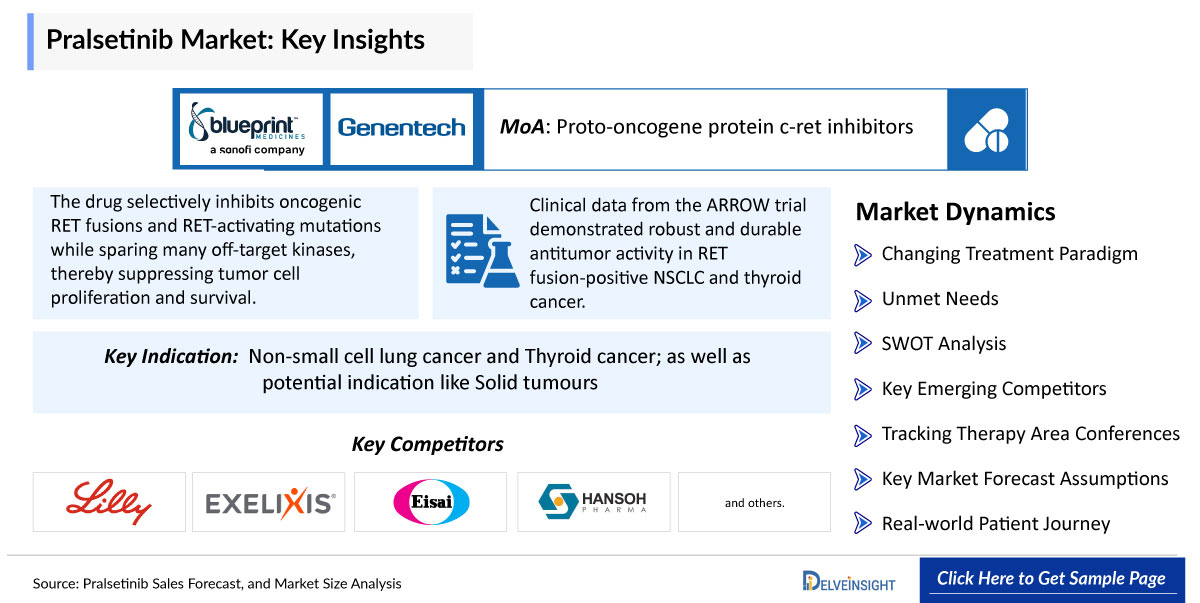
Clinical data from the ARROW trial demonstrated robust and durable antitumor activity in RET fusion-positive NSCLC and thyroid cancer, including clinically meaningful intracranial responses in patients with brain metastases. Long-term follow-up has shown durable progression-free survival and overall response rates, supporting continued use in both treatment-naïve and previously treated patients. These data have established pralsetinib as one of the two leading selective RET inhibitors available for RET-driven malignancies.
3. Expansion into pediatric and thyroid cancer populations increases the addressable market
In addition to adult NSCLC, GAVRETO is approved for adult and pediatric patients (12 years and older) with advanced or metastatic RET fusion-positive thyroid cancer that is radioactive iodine-refractory (where appropriate). This expanded label broadens the eligible patient population and supports incremental growth, particularly as comprehensive genomic profiling becomes more widely implemented in thyroid cancer management. The updated U.S. prescribing information continues to reflect these indications.
4. Increasing genomic testing drives earlier identification of eligible patients
International oncology guidelines increasingly recommend next-generation sequencing (NGS) or comprehensive molecular profiling for advanced NSCLC and selected thyroid cancers. As adoption of biomarker testing expands globally, more patients with RET fusions are identified earlier in their treatment journey, increasing opportunities for targeted therapy with pralsetinib. This trend remains one of the principal long-term commercial drivers for all RET-directed therapies.
5. Global commercialization through Roche/Chugai and U.S. commercialization by Rigel support market penetration
Since June 2024, Rigel Pharmaceuticals has been responsible for U.S. commercialization of GAVRETO, while Roche/Genentech and Chugai continue commercial activities in international markets. This regional commercialization strategy allows focused promotion within rare molecular oncology while leveraging Roche's established global oncology infrastructure outside the U.S. Rigel has identified GAVRETO as one of only two approved RET inhibitors currently available and continues to work with regulators on confirmatory requirements for the thyroid cancer indication.
Pralsetinib Recent Developments
In February 2023, Blueprint Medicines Corporation announced it would regain global commercialization and development rights to GAVRETO (Pralsetinib), excluding Greater China, following a decision by Roche to discontinue the collaboration agreement between the companies for GAVRETO for strategic reasons.
“Pralsetinib Sales Forecast, and Market Size Analysis – 2034” report provides comprehensive insights of Pralsetinib for approved indication like Non-small cell lung cancer and Thyroid cancer; as well as potential indication like Solid tumours in the 7MM. A detailed picture of Pralsetinib’s existing usage in approved and anticipated entry and performance in potential indications in the 7MM, i.e., the United States, EU4 (Germany, France, Italy, and Spain) and the United Kingdom, and Japan for the study period 2020 –2034 is provided in this report along with a detailed description of the Pralsetinib for approved and potential indications. The Pralsetinib market report provides insights about Pralsetinib’s sales forecast, mechanism of action (MoA), dosage and administration, as well as research and development including regulatory milestones, along with other developmental activities. Further, it also consists of historical and current Pralsetinib performance, future market assessments inclusive of the Pralsetinib market forecast analysis for approved and potential indications in the 7MM, SWOT, analysts’ views, comprehensive overview of market competitors, and brief about other emerging therapies in respective indications. It also provides analysis of Pralsetinib sales forecasts, along with factors driving its market.
Pralsetinib Drug Summary
Pralsetinib is a potent, selective, oral rearranged during transfection (RET) tyrosine kinase inhibitor developed by Blueprint Medicines and subsequently licensed to Genentech (a member of the Roche Group) for the treatment of RET-driven cancers. The drug selectively inhibits oncogenic RET fusions and RET-activating mutations while sparing many off-target kinases, thereby suppressing tumor cell proliferation and survival. Pralsetinib is approved in multiple regions for patients with RET fusion-positive non-small cell lung cancer (NSCLC), RET fusion-positive thyroid cancer, and RET-mutant medullary thyroid cancer (MTC). Administered orally once daily, it has demonstrated high objective response rates, durable responses, and clinically meaningful intracranial activity in patients with advanced RET-altered malignancies, as shown in the pivotal ARROW clinical trial. Its targeted mechanism, favorable efficacy across multiple RET-driven tumor types, and generally manageable safety profile have established pralsetinib as an important precision oncology therapy for patients harboring actionable RET alterations. The report provides Pralsetinib’s sales, growth barriers and drivers, post usage and approvals in multiple indications.
Scope of the Pralsetinib Market Report
The report provides insights into:
- A comprehensive product overview including the Pralsetinib MoA, description, dosage and administration, research and development activities in approved indications like Non-small cell lung cancer and Thyroid cancer; as well as potential indication like Solid tumours.
- Elaborated details on Pralsetinib regulatory milestones and other development activities have been provided in Pralsetinib market report.
- The report also highlights Pralsetinib‘s cost estimates and regional variations, reported and estimated sales performance, research and development activities in approved and potential indications across the United States, Europe, and Japan.
- The Pralsetinib market report also covers the patents information, generic entry and impact on cost cut.
- The Pralsetinib market report contains current and forecasted Pralsetinib sales for approved and potential indications till 2034.
- Comprehensive coverage of the late-stage emerging therapies for respective indications.
- The Pralsetinib market report also features the SWOT analysis with analyst views for Pralsetinib in approved and potential indications.
Methodology
The Pralsetinib market report is built using data and information sourced primarily from internal databases, primary and secondary research and in-house analysis by DelveInsight’s team of industry experts. Information and data from the secondary sources have been obtained from various printable and nonprintable sources like search engines, news websites, global regulatory authorities websites, trade journals, white papers, magazines, books, trade associations, industry associations, industry portals and access to available databases.
Pralsetinib Analytical Perspective by DelveInsight
- In-depth Pralsetinib Market Assessment
This Pralsetinib sales market forecast report provides a detailed market assessment of Pralsetinib for approved indication like Non-small cell lung cancer and Thyroid cancer; as well as potential indication like Solid tumours in the seven major markets, i.e., the United States, EU4 (Germany, France, Italy, and Spain) and the United Kingdom, and Japan. This segment of the report provides current and forecasted Pralsetinib sales data uptil 2034.
- Pralsetinib Clinical Assessment
The Pralsetinib market report provides the clinical trials information of Pralsetinib for approved and potential indications covering trial interventions, trial conditions, trial status, start and completion dates.
Pralsetinib Competitive Landscape
The report provides Insights on competitors and marketed products within the domain, along with a summary of emerging products and their respective launch dates, posing significant competition in the market.
Pralsetinib Market Potential & Revenue Forecast
- Projected market size for the Pralsetinib and its key indications
- Estimated Pralsetinib sales potential (Pralsetinib peak sales forecasts)
- Pralsetinib Pricing strategies and reimbursement landscape
Pralsetinib Competitive Intelligence
- Number of competing drugs in development (pipeline analysis)
- Pralsetinib Market positioning compared to existing treatments
- Pralsetinib Strengths & weaknesses relative to competitors
Pralsetinib Regulatory & Commercial Milestones
- Pralsetinib Key regulatory approvals & expected launch timelines
- Commercial partnerships, licensing deals, and M&A activity
Pralsetinib Clinical Differentiation
- Pralsetinib Efficacy & safety advantages over existing drugs
- Pralsetinib Unique selling points
Pralsetinib Market Report Highlights
- In the coming years, the Pralsetinib market scenario is set to change due to strong adoption, increased prescriptions and broader uptake in multiple immunological indications; which would expand the size of the market.
- The Pralsetinib companies are developing therapies that focus on novel approaches to treat/improve the disease condition, assess challenges, and seek opportunities that could influence Pralsetinib’s dominance.
- Other emerging products for Non-small cell lung cancer and Thyroid cancer; as well as potential indication like Solid tumours are expected to give tough market competition to Pralsetinib and launch of late-stage emerging therapies in the near future will significantly impact the market.
- A detailed description of regulatory milestones, and developmental activities, provide the current development scenario of Pralsetinib in approved and potential indications.
- Analyse Pralsetinib cost, pricing trends and market positioning to support strategic decision-making in the immunology landscape.
- Our in-depth analysis of the forecasted Pralsetinib sales data uptil 2034 will support the clients in decision-making process regarding their therapeutic portfolio by identifying the overall scenario of Pralsetinib in approved and potential indications.
Key Questions
- What is the class of therapy, route of administration and mechanism of action of Pralsetinib? How strong is Pralsetinib’s clinical and commercial performance?
- What is Pralsetinib’s clinical trial status in each individual indications such as Non-small cell lung cancer and Thyroid cancer; as well as potential indication like Solid tumours and study completion date?
- What are the key collaborations, mergers and acquisitions, licensing and other activities related to the Pralsetinib Manufacturers?
- What are the key designations that have been granted to Pralsetinib for approved and potential indications? How are they going to impact Pralsetinib’s penetration in various geographies?
- What is the current and forecasted Pralsetinib market scenario for approved and potential indications? What are the key assumptions behind the forecast?
- What are the current and forecasted sales of Pralsetinib in the seven major countries, including the United States, Europe (Germany, France, Italy, Spain) and the United Kingdom, and Japan?
- What are the other emerging products available and how are these giving competition to Pralsetinib for approved and potential indications?
- Which are the late-stage emerging therapies under development for the treatment of approved and potential indications?
- How cost-effective is Pralsetinib? What is the duration of therapy and what are the geographical variations in cost per patient?

